This site is supported by our readers. We may earn a commission, at no cost to you, if you purchase through links.
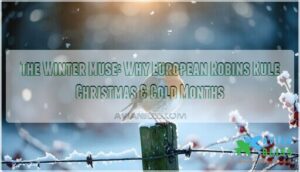 You’ll spot European robins year-round in gardens and woodlands, making them winter’s most reliable feathered friend.
Unlike fair-weather birds that flee south, these hardy little characters stick around through frost and snow, boldly singing from fence posts and shrubs.
Their crimson breast catches your eye against winter’s gray backdrop, creating that perfect Christmas card moment.
Victorian England cemented this connection when postmen wore red uniforms and earned the nickname "robins" – naturally, the bird became Christmas mail’s unofficial mascot.
Christian folklore adds another layer, claiming the robin’s red breast came from protecting baby Jesus from fire.
But there’s more to this winter romance than meets the eye.
Table Of Contents
- Key Takeaways
- The Robin’s Year-Round Presence
- The Robin’s Christmas Association
- The Robin’s Christian Folklore
- The Robin’s Winter Visibility
- The Robin’s Historical and Cultural Significance
- The Robin’s Behavior in Winter
- The Robin’s Spring Migration
- The Robin’s Significance
- Frequently Asked Questions (FAQs)
- Why is the European robin a symbol of winter?
- Why is a European robin a winter bird?
- Why do robins migrate in winter?
- Where do Robins go in the winter?
- What does a European robin symbolize?
- What does a European robin look like in winter?
- Why do we associate robins with winter?
- What does the European Robin symbolize?
- Why is Robin associated with Christmas?
- What is the myth of the European Robin?
- Conclusion
Key Takeaways
- You’ll spot European robins year-round in gardens and woodlands because they’re hardy residents that don’t migrate south like other birds, making them winter’s most reliable feathered companions with their bright crimson breasts standing out dramatically against gray winter backdrops.
- You can trace robins’ Christmas association to Victorian England, where postmen wore red uniforms and earned the nickname "robins," leading artists to feature the actual red-breasted birds on Christmas cards as festive mail carriers and holiday symbols.
- You’ll discover Christian folklore explains the robin’s red breast through legends of the bird protecting baby Jesus from fire, with the scorched breast becoming a permanent mark of compassion that’s passed down through generations as a symbol of hope and renewal.
- You’ll find robins exceptionally visible during winter because they maintain aggressive territorial behavior year-round, sing from prominent perches, and confidently approach humans in gardens where they’re easily observed, photographed, and even hand-fed.
The Robin’s Year-Round Presence
You’ll find European robins (Erithacus rubecula) maintaining their territories throughout Britain’s harshest months, unlike most songbirds that migrate or reduce their activity during winter.
These resilient birds continue their melodic territorial songs nearly year-round, aggressively defending their feeding grounds even when snow blankets the landscape, showcasing their resilient nature.
Through frost and snow, the robin’s crimson breast blazes like nature’s eternal flame against winter’s stark canvas.
Found in The UK Throughout The Year
You’ll find European robins across the UK’s diverse landscapes throughout every season, making them true year-round residents.
Unlike many British wildlife species that migrate, these resilient winter birds maintain their territories constantly, adapting their seasonal behavior to local conditions.
- Year Round Habitat: Gardens, woodlands, parks, and hedgerows
- UK Distribution: Scotland to southern England coastlines
- Seasonal Behavior: Territorial defense intensifies during winter months
- Robin Migration: Minimal movement, mostly altitudinal shifts for food
Sing Nearly All Year Round
Throughout the changing seasons, the European robin’s voice becomes your most reliable winter companion, offering consistent melodies when other birds fall silent.
Their remarkable vocal patterns distinguish them from typical seasonal singers, maintaining song structure complexity that rivals spring performers.
You’ll notice their melodic range shifts subtly across months, adapting to different survival needs:
- Spring songs feature intense frequency variation for attracting mates and establishing breeding territories
- Summer melodies focus on territorial defense with shorter, sharper notes
- Winter performances maintain harmonic complexity despite reduced daylight and harsh conditions
This year-round singing behavior sets European robins apart from most winter birds, whose vocal activity typically decreases dramatically.
Their persistent robin behavior creates familiar soundscapes even during December’s shortest days.
While seasonal changes affect song intensity, these resilient performers never completely abandon their musical territories.
Unlike many species that save energy by reducing vocalizations, robins continue serenading through frost and snow, making them true champions of winter’s quiet landscape.
Aggressively Territorial
Beyond their melodious voices, robins transform into fierce warriors when defending their patch.
Their territorial behavior reaches peak intensity during winter months, when scarce resources fuel aggressive encounters.
You’ll witness dramatic chases and confrontational displays as these small birds protect their feeding strategies from intruders.
| Defensive Tactics | Purpose |
|---|---|
| Wing-flapping displays | Intimidate competitors |
| Aggressive chasing | Remove territory invaders |
| Loud territorial songs | Mark boundaries clearly |
| Physical confrontations | Defend prime food sources |
This winter aggression guarantees survival when every berry counts for their remarkable winter resilience.
The Robin’s Christmas Association
You’ve likely noticed European robins (Erithacus rubecula) gracing countless Christmas cards and holiday decorations, but this association stems from a charming 19th-century coincidence.
Victorian-era British postmen wore bright red uniforms while delivering Christmas mail, earning them the nickname "robins," which artists then depicted on holiday cards as actual red-breasted birds carrying festive messages.
This depiction was likely influenced by the charming nature of the birds and the holiday season.
Depicted on Christmas Cards in 19th Century England

During Victorian England’s golden age of Christmas celebration, you’ll discover how the European Robin earned its place as the ultimate Christmas icon.
When Sir Henry Cole commissioned the world’s first commercial Christmas card in 1843, artists quickly recognized the robin’s perfect holiday appeal.
Victorian Cards transformed these woodland birds into cultural symbols through careful artistic choices:
- Their brilliant red breasts created stunning contrast against white winter snow
- Artists paired them with traditional holly, ivy, and festive Christmas trees
- The resemblance to red-uniformed British postmen sparked instant recognition
- Unlike darker Victorian imagery, robins conveyed warmth during harsh winters
- Their year-round presence symbolized resilience and hope through cold months
These 19th-century Christmas cards established robin symbolism that transcended simple decoration. Through folklore origins and Christmas legends, Victorian artists created lasting cultural icons. The European Robin’s transformation from common garden bird to Christmas tradition demonstrates how art shapes our seasonal connections.
Tradition Retained to This Day
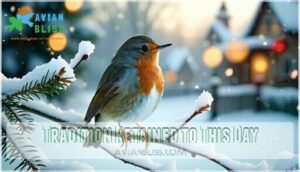
Walk into any store during December, and you’ll spot the European robin’s bright red breast adorning everything from greeting cards to gift wrap.
This Cultural Significance hasn’t dimmed since Victorian times—if anything, it’s grown stronger. Today’s Christmas Legacy transforms these Winter Icons into must-have decorations that bridge generations.
You’ll find robins on ornaments, napkins, and holiday clothing, their Symbolic Meaning deeply woven into our winter traditions.
The Folklore Roots connecting these birds to Christmas continue thriving through modern marketing and family customs. These winter wildlife ambassadors maintain their status as essential Christmas symbolism, proving some robin characteristics never go out of style.
Resemblance to British Postmen in Red Uniforms
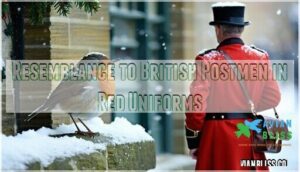
Spotting the connection between European robins and British postal workers reveals a fascinating piece of Victorian era history. Since 1784, postmen wore distinctive red uniforms that mirrored the robin’s crimson breast perfectly.
You’d find this visual parallel wasn’t lost on Victorian society, who affectionately dubbed mail carriers "robin redbreast" after the beloved bird.
This striking resemblance transformed both creatures into cultural icons of winter warmth. When Christmas cards emerged during the Victorian era, artists naturally featured robins alongside holiday greetings, cementing the bird’s festive reputation.
The postal legends grew as people associated the red-breasted bird with delivering good news and seasonal cheer. Today’s Christmas symbolism still echoes this charming historical connection between nature’s messenger and human mail carriers.
Nicknamed Robins
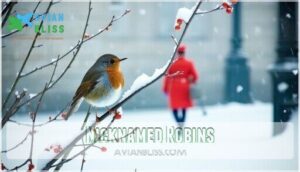
You’ve likely heard British postmen called "Robins" without knowing why.
This Nickname Origin stems from their bright red uniforms matching the European robin’s distinctive breast.
The Cultural Significance runs deep—Victorian society embraced this Color Association wholeheartedly.
This charming connection between Robin Species and postal workers strengthened Winter Symbolism around the Christmas robin.
Robin Folklore still celebrates this delightful link between Winter Wildlife and human tradition, making Robin Symbolism even richer.
Legend of Delivering Christmas Cards

British postmen earned their "robin" nickname, but European Robin legends took card delivery to magical heights. You’ll find this Winter Folklore woven throughout Christmas Icons we cherish today.
Victorian artists created enchanting scenes where robins became nature’s postmen, carrying holiday messages in their tiny beaks. This Postal History connection transformed ordinary Christmas cards into symbols of hope and connection during harsh winter months.
The Robin Legends flourished through these key elements:
- Artists depicted robins delivering Christmas greetings across snowy landscapes
- Their bright red breast matched postmen’s uniforms perfectly
- Winter visibility made them ideal messengers in holiday storytelling
- Folklore claimed they brought news of distant loved ones.
This charming mythology cemented robin symbolism in Christmas traditions, making these small birds eternal ambassadors of holiday joy and seasonal wonder.
The Robin’s Christian Folklore

You’ll find the European robin’s crimson breast carries profound meaning in Christian tradition, where ancient legends explain this striking feature through tales of divine compassion.
These stories transform the robin from a simple garden bird into a powerful symbol of sacrifice and renewal, connecting its winter presence to centuries-old spiritual narratives.
Robin’s Red Breast Linked to Christianity
Beyond Christmas cards and holiday cheer, the European robin’s red breast carries profound Christian symbolism that transforms this small bird into something sacred.
Winter folklore tells us the robin’s crimson feathers represent Christ’s blood during the Crucifixion, making each sighting a gentle reminder of divine sacrifice.
You’ll find Robin Redbreast appearing in religious artwork and medieval manuscripts, where artists used the bird’s distinctive coloring as a living metaphor for redemption.
This Christmas symbol becomes especially meaningful during winter months, when the robin’s bright plumage stands out dramatically against snow-covered landscapes.
Sacred birds like the robin connect nature to faith, offering comfort during cold seasons when their vibrant presence reminds us of hope and spiritual warmth amid winter’s harshness.
Legend of Protecting Baby Jesus From Fire
While European robin folklore spans centuries, one cherished Fire Legend captures hearts during Christmas.
According to Christian Symbolism, you’ll discover a tale where a small brown bird noticed baby Jesus shivering in the stable’s bitter cold.
The Robin Folklore describes this touching Jesus Protection story:
- The tiny bird desperately fanned dying embers with its wings
- Flying dangerously close, a glowing ember scorched its breast crimson
- Despite burning pain, it continued warming the holy infant
- Mary blessed the bird’s sacrifice, transforming its chest forever
This European robin legend beautifully explains the Scarlet Feather we recognize today.
Though historically unverified, this Christmas tale connects the robin’s distinctive red breast to selfless compassion and divine blessing.
Scorched Breast Passed Onto Future Generations
The Red Breast Legend tells us how one small bird’s sacrifice became eternal.
When that brave robin shielded baby Jesus from fire, its scorched breast didn’t heal—it transformed into a permanent mark of compassion.
The robin’s crimson breast carries God’s blessing through winter’s darkest days, a living symbol of sacrifice and hope.
This Christian Symbolism wasn’t just folklore; it became genetic destiny for every European robin afterward.
| Aspect | Details |
|---|---|
| Origin | Folklore Origins trace to Christian nativity |
| Inheritance | Passed genetically through generations |
| Symbolism | Robin Mythology links sacrifice to appearance |
| Impact | Winter Iconism connects to Christmas traditions |
You’ll notice this divine marking in every robin’s winter ecology today, making their robin habitat a living tribute to ancient stories.
Symbol of Hope and Renewal
Throughout centuries of folklore, the European robin’s red breast transforms from tragedy into triumph.
When you glimpse this winter resilience champion braving snow-covered branches, you’re witnessing one of Christianity’s most enduring hope symbols.
These feathered messengers carry renewal stories that stretch beyond simple Christmas decoration—they’re living proof that beauty emerges from sacrifice.
Their crimson chest doesn’t just mark them as cultural icons or seasonal emblems; it whispers promises of spring’s return during winter’s darkest days.
This Christmas symbol offers more than holiday cheer—it delivers genuine hope and renewal through faith-based symbolism that transcends seasons.
The Robin’s Winter Visibility
You’ll spot European robins more easily during winter months because their bright orange-red breasts create striking contrast against snow-covered landscapes and bare branches.
While other birds migrate or become less active, robins maintain their territorial behavior year-round, singing from prominent perches and confidently approaching humans in gardens where they’re easily observed and photographed.
Territorial All Year Round
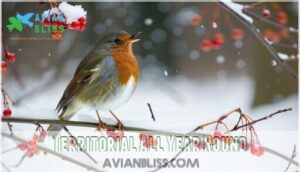
While legends paint robins as gentle Christmas messengers, their territorial behavior reveals a different story entirely.
These feisty birds defend their breeding territories with surprising aggression throughout every season, making their year round presence both predictable and fascinating to observe.
You’ll witness this winter defense strategy firsthand when watching European robins chase rivals from prime feeding grounds.
Unlike fair-weather songbirds that abandon territories during cold months, the european robin maintains its boundaries with unwavering determination.
Their bright red breast isn’t just festive decoration—it’s a biological billboard warning competitors to stay away.
This relentless territorial behavior guarantees survival when food becomes scarce, demonstrating remarkable winter resilience that keeps these beloved birds visible in your garden when most others have fled south.
Sing From Prominent Spots to Mark Territory

You’ll spot European robins transforming into feathered opera singers, claiming prime real estate from fence posts to garden gates.
Their territorial songs ring out like nature’s GPS system, marking boundaries with crystal-clear vocal displays that say "this buffet is mine." These spatial behavior masters don’t whisper—they broadcast.
Winter wildlife watchers notice how these vocal displays intensify when resources grow scarce.
- Dawn choruses establish overnight territorial claims
- Dusk performances reinforce daily boundary patrols
- Midday announcements ward off wandering competitors
Bird communication doesn’t get more direct than this territorial behavior.
Confiding Around Humans
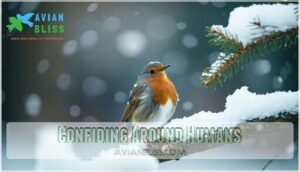
Unlike most wild birds that flee at your approach, European robins display remarkable Human Trust during winter months.
Their Gentle Nature allows comfortable distances of just three to four feet, making Winter Visibility exceptional for birdwatchers.
| Behavior | Distance | Season | Trust Level | Observation Quality |
|---|---|---|---|---|
| Territory singing | 6-8 feet | Winter | High | Excellent |
| Human contact | 3-4 feet | Cold months | Very high | Outstanding |
| Handfeeding opportunities | 1-2 feet | Winter | Maximum | Perfect |
| Garden foraging | 2-5 feet | Year-round | Moderate-high | Very good |
| Approach Behavior | Variable | Winter peak | Highest | Superb |
This Human Interaction stems from evolutionary Trust Building—they’ve learned humans disturb soil, exposing food sources.
Come to Gardens for Food
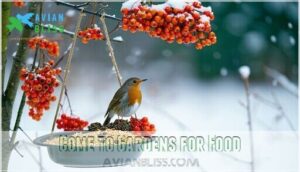
When winter arrives, your garden becomes an essential food hub for European robins seeking sustenance. These adaptable garden birds transform their feeding habits, shifting from hunting insects to active garden foraging for berries, seeds, and human-provided treats.
Smart bird feeding strategies attract robin visits throughout the coldest months. Winter bird feeding success depends on offering appropriate food sources:
- Fresh mealworms placed in shallow dishes
- High-fat suet balls hung from branches
- Mixed seeds scattered on ground feeders
- Unfrozen water sources for drinking and bathing
- Berry-producing shrubs like elderberry and rowan
Their winter diet adaptation makes garden habitats essential survival zones. Effective bird feeder systems, including well-designed bird feeding stations, can substantially enhance the attractiveness of your garden to European robins during the winter months, making smart bird feeding strategies and winter bird feeding crucial for their survival. European robins and garden birds are key terms to understand the context.
Easily Observed and Photographed
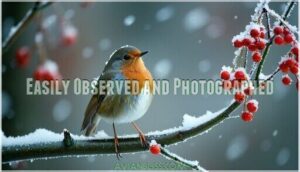
The European robin’s bold personality transforms it into nature’s most cooperative winter model.
You’ll find these charismatic birds practically posing for your camera, displaying none of the skittish behavior typical of most garden visits during colder months.
Their striking red breast creates natural drama against winter landscapes, whether perched on frost-covered branches or hopping through snow-dusted undergrowth.
Bird behavior studies reveal robins maintain smaller personal space boundaries with humans than other species, making close-up photography remarkably achievable.
Photography tips for capturing perfect robin portraits:
- Camera settings: Use faster shutter speeds (1/250s minimum) to freeze their quick movements
- Winter nature positioning: Station yourself near feeding areas where they’ll return predictably
- Bird watching patience: Wait quietly—they’ll often approach within mere feet
Winter ornithology enthusiasts celebrate robins as gateway subjects for developing wildlife photography skills.
Their tolerance, predictable habits, and photogenic qualities make them ideal ambassadors for robin conservation awareness through stunning imagery.
The Robin’s Historical and Cultural Significance
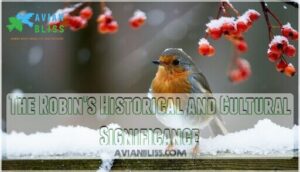
You’ll find European robins (Erithacus rubecula) perched confidently on garden fences and fence posts throughout winter, making them remarkably accessible subjects for observation and photography.
Their striking red breast coloration and bold behavior around humans has earned them prominent representation in art, literature, and music, establishing these territorial songbirds as enduring symbols of winter resilience and Christmas cheer.
Plentiful and Striking
When you observe gardens and woodlands during winter months, you’ll notice European robins stand out dramatically against the stark landscape.
Their vibrant plumage creates stunning visual contrast – that brilliant red breast becomes nature’s beacon amid snow-covered branches.
These winter icons aren’t just surviving cold weather; they’re thriving as wintering birds whose color symbolism represents warmth and hope.
Their abundance during winter solstice makes them perfect subjects for cold weather birds enthusiasts supporting robin conservation.
Hand-feeding in Gardens is Common
Garden Feeding transforms the ordinary winter landscape into something magical when European robins discover your outdoor space. These red-breasted visitors quickly learn that human gardens offer reliable Food Sources during harsh months, making Hand-feeding a surprisingly common practice across Britain.
Your patience will be rewarded as robins overcome their natural caution, approaching within arm’s reach for mealworms and seeds. This Human Interaction creates unforgettable moments:
- Direct contact builds trust between species
- Close observation reveals intricate Robin Behavior patterns
- Regular visits establish predictable feeding routines
- Winter bonds often continue into spring seasons
European robin Winter Diet preferences make gardens perfect feeding stations. Bird feeding becomes particularly meaningful when you witness these territorial songsters sharing space peacefully around reliable food sources. Gardens provide the ideal setting where wild robins accept human presence, creating relationships that enrich cold winter months.
Perching on Artificial Structures Makes Them Easy to Observe
Beyond garden hand-feeding sessions, you’ll discover these charismatic winter bird species positioning themselves perfectly for observation.
European robin behavior in winter includes strategic perch selection that makes birdwatching effortless from your kitchen window.
Their preferred urban perches create countless photo opportunities:
- Fence posts where they belt out territorial songs
- Garden feeders and bird baths for confident dining displays
- Window boxes offering front-row seating to their daily routines
- Wheelbarrow handles and forgotten garden tools scattered about.
This robin behavior transforms ordinary backyard fixtures into prime wildlife viewing stations.
Observing their daily routines can provide insight into their magnetic field navigation abilities and other fascinating traits.
Depicted in Art, Literature, and Music
Artists have immortalized this crimson-breasted bird across centuries of creative expression.
From Renaissance paintings to modern Christmas carols, the European robin appears as a messenger of hope and renewal.
Frances Hodgson Burnett featured it prominently in "The Secret Garden," while countless poets weave its image into verses about winter’s magic.
| Art Form | Notable Examples |
|---|---|
| Literature | "The Secret Garden," Christmas poetry collections |
| Visual Arts | Victorian Christmas cards, contemporary nature paintings |
| Music | Traditional carols, folk songs celebrating winter birds |
Symbol of Winter and Christmas Cheer
From artistic masterpieces to musical compositions, the European robin’s influence extends far beyond creative expression. This vibrant bird has earned its place as the ultimate Christmas symbol and winter icon across European culture.
The robin’s red breast creates powerful symbolism that resonates through centuries of winter folklore. You’ll discover this feathered friend represents hope, renewal, and warmth during the coldest months. Its seasonal adaptation – remaining active while other birds migrate – reinforces its cultural significance as a beacon of resilience.
Here’s why robins dominate winter traditions:
- Christmas cards feature robins as messengers of holiday joy
- Red symbolism connects to sacrifice and compassion legends
- Victorian postmen’s uniforms inspired the "Christmas robin" nickname
- Winter landscapes highlight their striking crimson plumage
- Holiday decorations celebrate their cheerful winter presence
The Robin’s Behavior in Winter
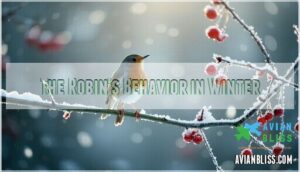
You’ll notice that European robins don’t retreat indoors when temperatures drop—instead, they’ve mastered the art of cold-weather survival through remarkable behavioral adaptations.
When winter arrives, you can observe these resilient birds switching their diet from ground-dwelling insects to energy-rich berries and seeds, while maintaining their territorial nature throughout the harsh months.
These birds have adapted to survive the winter, and their ability to switch to energy-rich food sources is crucial for their survival.
Robins Can Withstand Cold Temperatures
While you admire robins in holiday art, their Cold Adaptation abilities prove equally fascinating.
European robins showcase remarkable Temperature Resistance, surviving harsh winters through sophisticated Winter Adaptations. Their Feather Insulation works like nature’s down jacket—fluffed plumage creates warm air pockets maintaining body heat.
These cold climate birds demonstrate impressive Frost Tolerance and Snow Survival skills. During extreme cold, their cold resilience allows metabolic adjustments to maintain 104°F body temperature.
Territorial birds occasionally form "winter truces," temporarily sharing resources when Winter Feeding becomes scarce—showcasing survival flexibility. Robins’ ability to find winter food sources is essential for their survival during the cold months.
Robins Change Their Diet in Winter, Eating Late-fruiting Berries
While robins can brave freezing temperatures, their Winter Foraging strategy involves a complete dietary overhaul.
These cold climate birds showcase remarkable dietary flexibility, shifting from insects to Berry Eating and Seed Consumption.
Your garden’s european robin relies on Cold Adaptation through diverse Fruit Sources:
- Hawthorn berries packed with calories
- Holly fruits rich in carbohydrates
- Wild rosehips containing vitamins
- Elderberries offering essential fats
This winter survival depends entirely on available berries.
Providing Water for Robins in Winter is Helpful
While berries satisfy hunger, European robins face another winter challenge you can easily address.
Ice free baths become lifelines when frozen ponds lock away natural water sources. Your winter hydration efforts support these resilient birds through harsh months.
Place shallow containers in sheltered spots, using lukewarm water to prevent immediate freezing. Bird baths require daily attention—robin drinking habits depend on consistent access.
Avoid relying on snow meltwater alone, as it lacks necessary minerals. This winter wildlife association between you and robins creates rewarding icefree bird baths that enhance survival rates substantially.
Creating an ice free environment is vital for their survival during cold months.
The Robin’s Spring Migration
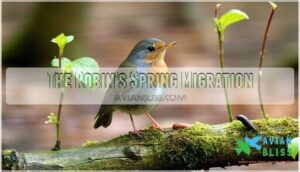
You’ll witness European robins (Erithacus rubecula) begin their northward spring migration when soil temperatures reach the critical 36-degree Fahrenheit threshold, following this thermal boundary as earthworms become accessible in thawed ground.
Males arrive first at breeding territories to establish dominance through aggressive displays, though late spring freezes can devastate their carefully constructed nests and force them to restart their reproductive efforts, which is a significant challenge to their survival and reproductive efforts.
Robins Migrate Northward in Spring Following a 36-degree Isotherm
As winter loosens its grip, the European robin begins its remarkable spring migration northward, following nature’s temperature highway—the 36-degree isotherm.
This climate shift triggers their northward movement, with males leading the charge to establish prime robin habitat before females arrive.
The isotherm patterns create perfect conditions for migration success:
- Temperature stability guarantees open water and accessible food sources
- Males arrive first to claim the best territories through aggressive displays
- Migration timing fluctuates annually based on warming soil conditions
Earthworm Availability Triggers The Northward Migration of Robins
Following temperature patterns tells only half the story.
Earthworm availability actually triggers the european robin’s precise northward migration timing.
You’ll witness these birds tracking the "worm wave" as soil temperature reaches that magic 36°F threshold.
This worm population surge drives migration patterns more than climate alone.
Smart food sources strategy guarantees robins reach prime robin habitat when ground invertebrates are most abundant, optimizing their spring arrival perfectly.
Male Robins Arrive First to Establish Territories
Once earthworms thaw and surface activity increases, territorial behavior kicks into high gear as male European robins claim prime real estate before females arrive.
This migration strategy gives them serious advantages during winter months ahead.
Here’s how male robins secure their breeding success:
- Scout territories with abundant food sources and shelter options
- Establish boundaries through aggressive displays and distinctive song patterns
- Defend prime locations from competing males using winter adaptation skills
- Attract females to well-defended, resource-rich territories for ideal breeding habits
Spring Freezes Can Damage Nests
After males establish territories, their carefully chosen nest sites face unexpected challenges.
Late spring weather can turn deadly for European robin families when cold snaps strike without warning. These freeze threats create serious nest damage, putting eggs and chicks at risk during what should be peak nesting season.
Understanding robin nesting habits, including their tendency to avoid nest reuse practices, is essential for effective conservation efforts.
Your winter favorites need protection during these vulnerable moments:
- Monitor local weather forecasts during robin nesting periods
- Provide sheltered feeding stations near known robin habitats
- Avoid disturbing nest areas during cold spells
- Maintain unfrozen water sources throughout spring migration
- Support bird conservation efforts in your community
The Robin’s Significance
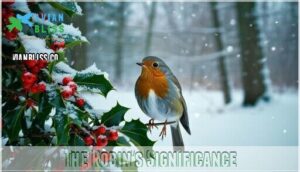
You’ll find European robins (Erithacus rubecula) aren’t just charming winter visitors—they’re essential ecosystem players whose accessibility makes them perfect ambassadors for conservation efforts.
These adaptable songbirds face mounting pressures from habitat loss and climate change, making your understanding of their ecological importance vital for their long-term survival.
Robins Are Accessible and Observable Birds
Unlike many elusive species, European robins make ideal subjects for bird watching enthusiasts year-round.
You’ll find these garden visitors perching boldly on spades while you dig, showcasing classic robin behavior that’s both fearless and curious.
Their winter appearance with that iconic robin redbreast creates perfect photography opportunities in urban birds settings.
Whether you’re providing winter feeding stations or simply observing from your kitchen window, these accessible companions offer intimate wildlife encounters that larger, shyer species simply can’t match.
The robins’ ability to navigate using magnetic field patterns is a remarkable aspect of their biology.
Robins Play an Important Role in The Ecosystem
Beyond their charming red breasts, European robins serve as essential ecosystem engineers throughout winter months.
These feathered workers maintain ecosystem balance through their ecological significance in food chains and species interactions.
Your garden robin contributes to habitat preservation by:
- Controlling insect populations during breeding season
- Dispersing seeds through droppings across landscapes
- Indicating environmental health through population trends
Their ecosystem role demonstrates how bird conservation efforts protect broader environmental impact networks, making winter robin-watching meaningful conservation work.
Deforestation and Climate Change Pose Threats to Robin Populations
While European robins charm us through winter months, they’re fighting an uphill battle against habitat loss and climate change.
Deforestation strips away their nesting territories, while shifting weather patterns disrupt food sources and migration timing. You’ll notice fewer robins as ecosystem collapse threatens their survival.
These beloved winter companions face mounting pressures:
- Forest fragmentation reducing available breeding territories
- Climate shift altering insect emergence and berry production cycles
- Extreme weather events destroying nests during breeding season
- Food web disruption as warming temperatures affect prey availability
Without immediate forest conservation efforts, robin extinction becomes a real possibility, silencing their cheerful winter songs forever.
Conservation Efforts Are Crucial for The Survival of Robins
Your backyard can become a lifeline for European robins facing mounting pressures from habitat loss and climate change.
Your garden is a vital sanctuary because wildlife conservation efforts depend on community participation.
Providing mealworms, seeds, and unfrozen water creates essential winter refuges when natural food sources dwindle.
Effective bird feeder systems, such as those using bird feeding solutions, can substantially enhance the attractiveness of your garden to robins.
| Conservation Action | Winter Impact |
|---|---|
| Habitat Protection | Preserves nesting sites |
| Food Provision | Sustains energy reserves |
| Population Monitoring | Tracks recovery success |
| Ecosystem Management | Maintains biodiversity |
| Pesticide Reduction | Prevents poisoning deaths |
Strategic wildlife protection efforts require collaborative approaches—your consistent support helps these beloved winter ambassadors thrive in a vital sanctuary with effective bird feeder systems.
Frequently Asked Questions (FAQs)
Why is the European robin a symbol of winter?
You’ll spot this crimson-breasted beacon when winter strips landscapes bare—its bright red breast symbolizes life’s warmth against snow’s stark canvas.
While its year-round presence offers hope during nature’s harshest season, symbolizing a beacon of hope.
Why is a European robin a winter bird?
You’ll notice robins aren’t truly "winter birds" but year-round residents.
They become more visible during winter because their bright red breasts contrast sharply against snow, while other colorful birds migrate south.
Why do robins migrate in winter?
You’ll find most robins don’t actually migrate during winter. They’re year-round residents who stick around their territories, becoming more visible as other birds disappear, making them seem like winter specialists.
Where do Robins go in the winter?
Resilient robins rarely relocate during winter months.
You’ll discover these territorial treasures staying put in their breeding grounds, defending feeding areas fiercely.
Unlike migrating birds, European robins tough out cold seasons right where they’ve always called home.
What does a European robin symbolize?
European robins symbolize hope, renewal, and resilience during winter’s harsh months.
You’ll recognize their bright red breast as a Christian symbol representing compassion, sacrifice, and divine love—embodying warmth when you need it most.
What does a European robin look like in winter?
You’ll see the same bright orange-red breast that makes robins iconic year-round.
Their plumage doesn’t change seasonally—males and females look identical with that striking red coloration contrasting beautifully against winter’s snowy backdrop.
Why do we associate robins with winter?
A bird in winter’s worth two in summer," they say.
You’ll spot robins easily against snowy backdrops thanks to their bright red breasts.
They’re winter survivors who stay put while other birds flee, becoming symbols of hope and resilience.
What does the European Robin symbolize?
You’ll find this red-breasted songbird represents hope, renewal, and resilience across cultures.
It symbolizes Christmas warmth, divine compassion from Christian legends, and life’s persistence through harsh winters, embodying comfort when you need it most.
Why is Robin associated with Christmas?
Ever wonder why you’ll spot this red-breasted beauty on Christmas cards?
Victorian postmen wore red uniforms and were nicknamed "robins," plus Christian legends link the bird’s crimson breast to protecting baby Jesus from fire.
What is the myth of the European Robin?
According to Christian legend, you’ll hear how a robin’s breast turned red while protecting baby Jesus from fire.
The bird’s wings fanned flames to keep the holy family warm, scorching its breast permanently red.
Conclusion
Ultimately, understanding the winter muse why is the European robin associated with winter reveals nature’s perfect timing.
You’ve discovered how these resilient birds embody winter’s spirit through year-round presence, territorial boldness, and striking crimson plumage against snowy landscapes.
Their Christmas connection stems from Victorian postmen parallels and Christian folklore, while their accessibility makes them winter’s most observable companions.
Next time you spot a robin singing from your garden fence, you’ll appreciate this remarkable bird’s enduring cultural symbolism and behavioral adaptations.
- https://theworldsrarestbirds.com/the-winter-muse-why-is-the-european-robin-associated-with-winter/
- https://outdoors.stackexchange.com/questions/17237/why-is-the-european-robin-associated-with-winter
- https://www.theguardian.com/environment/2019/nov/25/weatherwatch-robins-symbol-christmas
- https://www.rspb.org.uk/birds-and-wildlife/bird-and-wildlife-guides/bird-a-z/r/robin/
- http://www.saywhydoi.com/christmas-robin-why-are-robins-on-christmas-cards/