This site is supported by our readers. We may earn a commission, at no cost to you, if you purchase through links.
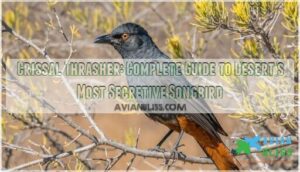 You’ll find the crissal thrasher skulking through desert washes like a feathered phantom, its dark gray plumage and distinctive rufous undertail patches making it one of the Southwest’s most elusive songbirds.
This secretive desert dweller prefers walking through thorny thickets rather than flying, using its curved bill to hunt insects and small scorpions in the leaf litter.
With bright yellow eyes and a melodious song, the crissal thrasher inhabits mesquite-lined arroyos and canyon foothills from Arizona to Texas.
Its darker coloration distinguishes it from the more common Curve-billed Thrasher, though spotting one requires patience and keen observation skills in their preferred dense vegetation.
Table Of Contents
- Key Takeaways
- What is a Crissal Thrasher?
- Physical Characteristics
- Habitat and Distribution
- Behavior
- Diet
- Conservation Status
- Interaction With Humans
- Frequently Asked Questions (FAQs)
- What is a crissal thrasher?
- Where do crissal Thrashers live?
- What does a crissal thrasher look like?
- When do Thrashers call?
- Where do Thrashers live?
- What does a curve billed thrasher look like?
- What is the difference between a Crissal Thrasher and a curved bill thrasher?
- How big are crissal thrashers?
- What do crissal thrashers eat?
- How can I attract crissal thrashers to my yard?
- Conclusion
Key Takeaways
- You’ll identify a crissal thrasher by its deeply curved black bill, bright yellow eyes, and distinctive reddish-cinnamon undertail patches that contrast against gray-brown plumage.
- You’ll need patience to spot these secretive birds since they prefer walking through dense mesquite thickets and desert washes rather than flying, making them masters of desert concealment.
- You’ll find them thriving in southwestern deserts from Arizona to Texas, where they use their specialized curved bills to probe leaf litter for insects, spiders, and small scorpions.
- You’ll be pleased to know their conservation status remains stable as "Least Concern," though habitat loss from development and invasive species still poses ongoing threats to their desert ecosystem.
What is a Crissal Thrasher?
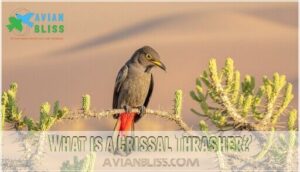
Among the desert’s secretive songbirds, the Crissal Thrasher (Toxostoma crissale) stands out as a master of concealment.
This desert birds specialist belongs to the Thrasher Taxonomy within the Mimidae family, sharing kinship with mockingbirds and other Thrasher Relatives.
The Crissal Etymology stems from "crissum," referring to its distinctive reddish undertail coverts that flash when the bird moves.
You’ll find this elusive southwestern birds species across four subspecies showing Regional Variations in size and coloration.
From Arizona’s T. c. crissale to Mexico’s smaller T. c. dumosum, each population adapted to local conditions.
Bird identification becomes easier when you recognize its Unique Traits: that deeply curved bill, pale yellow eyes, and habit of staying hidden in thorny thickets.
Unlike its flashier relatives, the Crissal Thrasher prefers life in the shadows.
Physical Characteristics
If you’re trying to spot a Crissal Thrasher in the desert, you’ll notice its robin-sized build but with a remarkably long tail that sets it apart.
Look for that remarkably long tail and deeply curved bill – your best clues to spotting this secretive desert master.
This secretive songbird measures about 11.8 to 13 inches in length and weighs between 1.9 to 3.5 ounces, making it larger than a Northern Mockingbird but smaller than a Common Grackle.
The Crissal Thrasher’s most distinctive feature is its deeply curved, black bill that measures 1.2 to 1.4 inches long – perfect for probing soil and leaf litter.
Its dull yellow to light orange eyes stand out against gray-brown upperparts and paler underparts.
The bird’s name comes from its bright reddish-cinnamon undertail coverts and crissum, which create a striking contrast against its otherwise muted plumage.
Unlike spotted thrashers, the Crissal Thrasher displays an unspotted pale belly, making identification easier when you catch a glimpse of this elusive desert dweller.
Size and Coloration
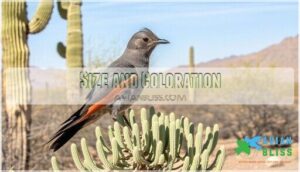
You’ll spot a crissal thrasher by its robin-like bird size of 11.8 inches and distinctive appearance.
The plumage features gray-brown upperparts with paler underparts, while bright reddish crissum color creates striking contrast.
Bird measurements include 1.9-2.5 ounces weight and 12.6-inch wingspan.
Size comparison places it between mockingbirds and grackles.
This plumage variation provides perfect desert camouflage, making identification challenging without spotting those telltale cinnamon undertail coverts.
Key Features: Bill, Eyes, and Markings
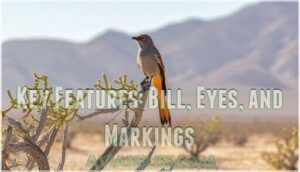
How do you identify a crissal thrasher’s most distinctive features? The bill curvature stands out as deeply curved and black, perfect for ground probing.
Light orange or dull yellow eyes create striking contrast against gray-brown plumage. The crissum coloration—bright reddish undertail coverts—gives this species its name and serves as the most reliable field mark.
- Bill: Deeply curved black bill measuring 30-35mm, specialized for probing soil and leaf litter
- Eyes: Light orange to dull yellow coloration, distinguishing from other thrasher species
- Crissum: Bright cinnamon or chestnut undertail coverts creating distinctive plumage patterns
- Overall appearance: Gray-brown upperparts with paler underparts and unspotted belly for easy identification
Habitat and Distribution
The Crissal Thrasher calls the southwestern United States and central Mexico home, spanning from western Texas through Arizona to southeastern California.
You’ll find this secretive bird thriving in dense desert washes, mesquite thickets, and canyon chaparral where thick vegetation provides perfect cover for its ground-dwelling lifestyle.
Native Regions

The Crissal Thrasher’s native range spans the southwestern United States through central Mexico.
You’ll find four distinct Regional Subspecies distributed across this territory.
In Arizona and Texas, the easternmost subspecies crissale breeds from desert lowlands to mountain elevations.
California hosts the coloradense subspecies, which shows Habitat Variation from below sea level near the Salton Sea to 5,400 feet in mountains.
Mexico’s central regions support the smaller dumosum subspecies, while Baja California’s trinitatis subspecies demonstrates Range Expansion capabilities.
These Elevation Limits and Climate Influence shape where each population thrives across diverse desert landscapes.
Preferred Habitats

When seeking out the crissal thrasher, you’ll discover these secretive birds favor specific arid environments with dense vegetation.
These desert-adapted songbirds thrive where shrubby habitats provide essential cover:
- Desert streams with thick riparian vegetation
- Mesquite thickets offering ground-level protection
- Canyon chaparral at higher elevations
- Scrub oak communities in mountainous areas
- Tamarisk groves along river systems
Their elevation range spans from below sea level to 5,400 feet.
Vegetation density determines habitat quality – they avoid open deserts, preferring areas where dense shrubs create natural corridors for their ground-dwelling lifestyle.
Understanding their habitat also means knowing that regional climate matters for nest box placement.
Behavior

You’ll discover the Crissal Thrasher’s secretive nature through its unique ground-based lifestyle and hidden nesting habits.
The Crissal Thrasher masters desert invisibility, vanishing into thorny thickets like a feathered phantom.
This desert specialist rarely takes flight, preferring to run through dense thickets while using its curved bill to probe for food beneath shrubs and leaf litter, which showcases its unique adaptation to the environment.
Foraging Habits
The Crissal Thrasher’s foraging prowess transforms desert scrublands into productive hunting grounds.
This ground foraging specialist uses its curved bill adaptation to probe leaf litter and soil beneath dense vegetation.
The bird’s prey selection demonstrates remarkable diet diversity, targeting insects like beetles and ants while incorporating seasonal diet changes.
Some birds benefit from specialized bird foraging tools to enhance their feeding strategies.
- Bill Adaptation: Curved bill perfectly designed for probing soil and debris
- Ground Foraging: Specializes in terrestrial hunting beneath shrubs and thickets
- Diet Diversity: Balances insects, spiders, and seasonal berries for maximum nutrition
- Prey Selection: Targets beetles, grasshoppers, ants, and other arthropods efficiently
Nesting Behavior
When Crissal Thrashers choose nest sites, they prioritize dense vegetation that shields their precious clutch size of two to four blue-green eggs.
Nest construction occurs within thick shrubs or under large branches for ideal concealment. During the incubation period of approximately fourteen days, both parents share duties equally.
This parental care continues after hatching, with nestlings receiving food from both adults. The young birds develop rapidly, fledging within eleven to thirteen days while parents maintain vigilant nest defense throughout the process.
Birds use spider webs for flexibility in nest construction.
| Nesting Aspect | Details |
|---|---|
| Nest Site Selection | Dense shrubs, under large branches |
| Clutch Size | 2-4 blue-green eggs |
| Incubation Period | ~14 days (shared by both parents) |
| Nestling Development | 11-13 days until fledging |
| Parental Care Duration | From egg laying through fledging |
Diet
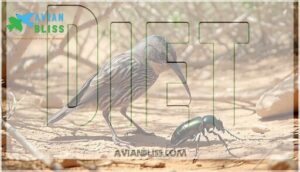
You’ll find the crissal thrasher’s diet perfectly adapted to desert life, with about 60% insects, 30% fruits, and 10% seeds making up their meals.
Their deeply curved bill works like a specialized tool, allowing them to probe through leaf litter and soil to uncover hidden beetles, ants, spiders, and even small lizards that other birds can’t reach.
Primary Food Sources
The Crissal Thrasher thrives on an omnivore diet comprising approximately 60% insects and 40% plant matter.
Insect Consumption includes beetles, grasshoppers, ants, and caterpillars, while spiders and centipedes add protein variety.
Seasonal Berries and small fruits supplement their bird diet during warmer months.
Diet Diversity extends to seeds, which provide essential carbohydrates.
Their Bill Adaptation enables efficient Ground Foraging, allowing them to probe leaf litter and soil for hidden prey.
This varied feeding strategy helps these desert specialists survive harsh environments.
Many owners use insect-based food products to supplement their diet.
Feeding Behavior
Understanding how Crissal Thrashers feed reveals their remarkable Ground Foraging skills and Bill Adaptation. You’ll witness these secretive birds using their curved bills like precision tools, probing leaf litter and soil beneath dense shrubs.
Their Diet Diversity includes insects, berries, and seeds, with Seasonal Foods varying based on availability. Watch for their methodical Prey Selection as they hunt beetles, ants, and caterpillars while occasionally sampling fruits.
Here’s what makes their bird feeding behavior extraordinary:
- Surgical precision – Their curved bills extract hidden insects from tight spaces
- Patient persistence – They’ll spend hours methodically working one small area
- Stealthy movement – Bird foraging happens in complete silence beneath cover
- Opportunistic timing – Insects dominate summer meals while berries provide winter sustenance
Conservation Status
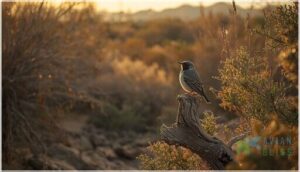
You’ll find that the Crissal Thrasher faces significant conservation challenges despite not being federally listed as endangered or threatened.
This secretive desert bird’s populations remain vulnerable to habitat loss from urban development, water diversion, and invasive plant species that alter its dense shrubland ecosystem.
Current Status
Good news for bird lovers: the crissal thrasher enjoys stable population trends across its southwestern range.
The IUCN lists this desert songbird as "Least Concern," while NatureServe ranks it "G5" or globally secure.
Bird conservation efforts show no significant declines in recent decades.
Breeding Bird Survey data from 1966-2004 revealed positive trends in New Mexico and the western United States, though not statistically significant.
While many aridland birds declined 41% since 1970, the crissal thrasher stands among fourteen stable species.
This success stems from effective conservation efforts protecting its preferred habitat of dense mesquite thickets and desert washes.
They thrive in areas with dense vegetation.
Threats and Vulnerabilities
Several significant threats challenge Crissal Thrasher populations across their desert range.
Habitat Loss from agricultural conversion and urban development destroys vital mesquite stands along river corridors. Climate Change intensifies droughts, reducing insect abundance and increasing nestling mortality during heatwaves.
Invasive Species like tamarisk alter native plant communities, sometimes reducing breeding success. Human Disturbance from livestock grazing and recreational activities degrades nesting sites.
Conservation Efforts focus on habitat restoration and monitoring isolated populations. Supporting bird conservation initiatives helps protect this secretive songbird’s fragmented desert ecosystem.
These birds are impacted by fire management practices that further degrade their habitat.
Interaction With Humans

Despite being desert dwellers, Crissal Thrashers rarely interact directly with humans. Urban adaptation remains minimal as these secretive birds prefer undisturbed habitats over developed areas.
You won’t find them at typical bird feeding stations since they forage primarily in leaf litter. Habitat loss from development poses their greatest threat, making conservation efforts critical.
Human disturbance from recreation activities forces them deeper into cover. Birdwatching requires patience and early morning timing.
Wildlife refuges provide essential protected spaces, while habitat restoration projects using native shrubs show promise. Crissal Thrashers, like many species, depend on vocalizations and songs to communicate within their territories.
Bird conservation and bird community awareness help protect these desert specialists.
Frequently Asked Questions (FAQs)
What is a crissal thrasher?
Like watching someone use a flip phone today, you’ll spot this desert dweller easily with its deeply curved bill and cinnamon undertail feathers.
Probing ground cover for insects in southwestern brushlands.
Where do crissal Thrashers live?
You’ll find crissal thrashers in the southwestern United States and central Mexico, specifically in dense desert washes, mesquite thickets, and canyon chaparral from western Texas to southeastern California.
What does a crissal thrasher look like?
Measuring just 8-13 inches long, you’ll spot this desert dweller by its deeply curved black bill and rich cinnamon undertail coverts contrasting against gray-brown plumage and distinctive dull yellow eyes.
When do Thrashers call?
Thrashers make their most vocal calls at dawn and dusk, when their rolling notes pierce through desert air.
You’ll hear their presence revealed mainly by callnotes during these times, though males defend territories with elevated songs during breeding season, which involves their distinctive callnotes.
Where do Thrashers live?
Scattered like hidden treasures across desert landscapes, you’ll discover thrashers calling the southwestern United States and central Mexico home.
They inhabit dense mesquite thickets, desert washes, and canyon chaparral from Texas to California, which provides them with the necessary environment to thrive.
What does a curve billed thrasher look like?
You’d recognize a curve-billed thrasher by its distinctive long, deeply curved black bill and dull yellow eyes.
This robin-sized bird displays gray-brown upperparts with paler underparts, contrasting bright cinnamon undertail coverts that really make it stand out.
What is the difference between a Crissal Thrasher and a curved bill thrasher?
You’ll spot key differences in their undertail coverts and bills.
Crissal Thrashers display bright cinnamon-red undertail feathers and have deeply curved bills, while Curve-billed Thrashers show pale undertail coverts with shorter, less curved bills.
How big are crissal thrashers?
Picture a robin-sized bird with impressive proportions that commands attention in desert landscapes.
You’ll find crissal thrashers measuring 8-13 inches long with distinctive curved bills, weighing 9-5 ounces, and sporting 6-inch wingspans that help them navigate dense thickets.
What do crissal thrashers eat?
You’ll find these birds munching on beetles, grasshoppers, caterpillars, and ants they dig up with their curved bills.
They’ll also grab berries when available, maintaining a diet that’s roughly sixty percent insects.
How can I attract crissal thrashers to my yard?
Attracting these desert-dwelling songbirds requires creating their ideal sanctuary.
Plant dense shrubs like mesquite and tamarisk near water sources, leave leaf litter undisturbed for foraging, and provide berry-producing plants for varied feeding opportunities to ensure a complete and attractive environment for the songbirds.
Conclusion
Like a desert sentinel standing watch over ancient landscapes, the crissal thrasher remains one of nature’s most enchanting mysteries.
You’ll need patience and dedication to observe this elusive bird, but the reward is witnessing a perfectly adapted desert survivor.
The crissal thrasher’s secretive nature and specialized habitat requirements make each sighting precious.
By protecting mesquite washes and respecting their space, you’ll help safeguard future generations can appreciate this remarkable songbird’s haunting melodies echoing through southwestern canyons.