This site is supported by our readers. We may earn a commission, at no cost to you, if you purchase through links.
 You’ll find that birds come in different colors and species because nature’s been playing the ultimate game of survival and romance for millions of years.
Bird coloration stems from two main sources: pigments like melanins that create browns and blacks, and structural colors that produce brilliant blues and greens through light refraction.
These colors serve multiple purposes – males often sport flashy plumage to attract mates, while others blend seamlessly into their surroundings to avoid becoming someone’s lunch.
Different species evolved in various environments, leading to specialized adaptations.
What’s fascinating is that birds see ultraviolet light, revealing hidden patterns invisible to our eyes.
Table Of Contents
- Key Takeaways
- Bird Coloration Basics
- Why Different Bird Colors
- Evolutionary Factors
- Color Polymorphism Explained
- Bird Vision and Colors
- Frequently Asked Questions (FAQs)
- Why are there different species of birds?
- Where did how the birds got their colours come from?
- What determines the color of a bird?
- Why do animals come in different colors?
- Why do birds have different morphs?
- What causes leucistic birds?
- Do birds come in every color?
- How did birds become so colorful?
- Why do birds have different colors?
- How do birds produce the colors in their feathers?
- Conclusion
Key Takeaways
- You’ll see bird colors come from two main sources: pigments like melanins that create browns and blacks, plus structural colors that produce brilliant blues and greens through light refraction rather than chemistry.
- You can’t see what birds actually see – they’ve got four color receptors including ultraviolet vision, revealing hidden patterns on feathers that are completely invisible to your three-receptor human eyes.
- You’re witnessing millions of years of sexual selection at work – males evolved flashy plumage to attract mates while others developed camouflage to avoid becoming someone’s lunch, creating nature’s ultimate survival strategy.
- You’ll find that different species evolved in various environments, leading to specialized adaptations where tropical birds sport vibrant hues while temperate cousins wear muted tones that match their specific habitats.
Bird Coloration Basics
You’ll discover that bird feathers create their stunning array of colors through three main mechanisms that work alone or together.
These include melanin and carotenoid pigments that absorb specific light wavelengths, microscopic structures that reflect particular colors, and specialized feathers that reflect ultraviolet light invisible to human eyes.
These mechanisms can be understood as complete concepts that contribute to the overall appearance of bird feathers.
Pigmentation
You’ll discover that melanin production creates the foundation for most bird species diversity in feather colors.
Think of melanin as nature’s paintbrush—it creates the basic color palette that makes each bird species unique.
This pigment system works like nature’s paint palette, producing different skin tones and beak coloring through color genetics:
- Eumelanin – creates blacks and grays in plumage variation
- Pheomelanin – produces reds and yellows in feather pigments
- Mixed melanins – generate browns supporting avian evolution
Understanding bird pigment products involves studying bird color genetics to grasp the full scope of avian diversity.
Structural Colors
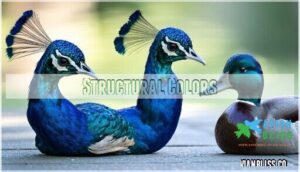
Unlike pigments, structural colors in birds arise from feather microscopy’s tiny nanostructures that manipulate light scattering and color refraction.
You’ll witness this phenomenon in peacocks and hummingbirds, where iridescence creates rainbow-like displays.
These colorful birds showcase nature’s engineering prowess through plumage variation that changes with viewing angles, contributing substantially to bird species diversity and avian evolution.
| Bird Example | Structural Feature | Color Effect |
|---|---|---|
| Peacock | Barbule crystals | Blue-green iridescence |
| Hummingbird | Platelet layers | Rainbow shimmer |
| Mallard duck | Feather microstructure | Emerald head sheen |
Ultraviolet Feathers
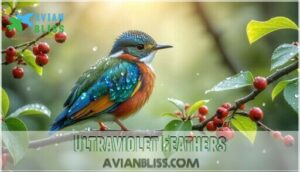
Beyond what you can see, colorful birds possess hidden UV Reflection patterns invisible to human eyes.
These ultraviolet markings serve as Visual Cues for mate selection and territory defense.
Feather Structure creates iridescent surfaces that reflect specific wavelengths, enabling Color Signaling between bird species.
Ornithology studies using Spectral Analysis reveal how beak shapes correlate with UV patterns across different bird habitats, demonstrating remarkable bird species adaptation.
Why Different Bird Colors
You’ve probably wondered why birds showcase such remarkable Color Variation across different Species Diversity.
The answer lies in a fascinating combination of Bird Color Genetics and Feather Structure that creates nature’s most vibrant displays.
Each species has evolved unique pigmentation patterns and structural coloring mechanisms that serve specific purposes in their environments.
Think of bird coloring as nature’s Swiss Army knife – it’s multifunctional:
- Communication signals – Bright colors attract mates and warn rivals
- Environmental camouflage – Muted tones help birds blend into their bird habitats
- Species recognition – Distinct patterns prevent crossbreeding between similar species
Ornithology studies reveal that Beak Pigmentation and overall coloration often correlate with bird migration patterns and species adaptation strategies.
Birds living in tropical regions typically display more vibrant hues than their temperate cousins, while bird size variation also influences color intensity and pattern distribution across different body regions.
The unique bird feather colors are influenced by structural color types that play a pivotal role in their appearance and behavior.
Evolutionary Factors
You’ll discover that evolution has crafted bird colors through three powerful forces that shape survival and reproduction.
Sexual selection drives vibrant displays, camouflage helps birds avoid predators, and environmental adaptation guarantees species thrive in their specific habitats, which are all connected to the concept of sexual selection.
Sexual Selection
Sexual selection acts like nature’s fashion show, where males compete for female attention through elaborate courtship displays and vibrant plumage.
You’ll notice sexual dimorphism in many species—males sport bright reds and blues while females remain cryptically colored.
These mating rituals aren’t just for show; they signal genetic variation and fitness quality, helping females make informed mate choices for successful reproduction.
The process of sexual selection mechanisms plays a vital role in shaping the diverse colors and species of birds.
Camouflage and Predator Avoidance
Nature’s master of disguise, birds employ sophisticated camouflage strategies to outwit predators.
Cryptic coloration helps ptarmigan blend seamlessly into snowy landscapes, while nightjars’ mottled patterns mimic leaf litter perfectly. These concealment methods represent adaptive coloration at its finest—from killdeer’s distraction displays to bitterns mimicking swaying reeds.
Such predator evasion tactics showcase remarkable bird behavior evolution, supporting ecosystem balance and wildlife biology conservation efforts protecting endangered species.
Birds also utilize effective camouflage techniques to hide from predators, ensuring their survival in various environments.
Environmental Adaptation
When you look at birds, their colors often mirror their environment.
Environmental adaptation lets species survive shifting climates, new habitats, or even urban jungles.
Here’s why it matters:
- Habitat Diversity sparks dazzling color changes.
- Climate Change drives migration, testing adaptive traits.
- Ecosystem Balance relies on bird behavior and conservation—without it, endangered species might vanish before you can say “wildlife biology.”
Color Polymorphism Explained

You’ve probably noticed that some bird species sport wildly different color patterns within the same group—think of the varied plumage in mallard ducks or the striking differences between male and female cardinals.
Color polymorphism occurs when a single bird species displays multiple distinct color forms, each offering unique survival advantages depending on environmental pressures and ecological niches.
This phenomenon is interesting because it shows how different color patterns can provide unique benefits, and color forms can vary significantly within a species.
Genetic Basis of Color Morphs
Color differences in bird species aren’t just random—they’re written in their genes.
Genetic variation creates distinct color morphs through specific gene mutations affecting pigment production.
| Gene Type | Function | Example |
|---|---|---|
| MC1R/ASIP | Controls melanin production | Black vs. brown feathers |
| BCO2 | Regulates yellow carotenoids | Bright vs. pale yellow bills |
| CYP2J19 | Converts yellow to red pigments | Cardinal’s red plumage |
These heritable traits follow predictable inheritance patterns, with gene expression determining whether you’ll spot a yellow or red morph during bird watching.
Ecological Advantages of Multiple Morphs
You’ll discover that having multiple morphs within one species creates remarkable Morph Benefits for survival.
Different color variants exploit various ecological niches, reducing competition among individuals.
This Genetic Variance enhances Species Diversity and strengthens Ecosystem Balance.
When predators adapt to one morph, others remain safer.
These Adaptive Traits also improve bird communication success, as varied appearances confuse potential threats while maintaining species recognition for bird conservation efforts.
The study of color morphs is related to color morph models that demonstrate genetic variation.
Examples of Polymorphic Bird Species
You’ll find amazing examples of color variation right in your backyard.
Eastern Screech-Owls sport gray or red feather patterns, while Snow Geese showcase white and blue morphs.
Red-tailed Hawks display pale, dark, and intermediate forms across different regions.
These bird species demonstrate how wing types, beak shapes, and diverse coloration enhance survival through improved camouflage and bird communication strategies.
The existence of multicolored birds highlights the importance of color variation in avian species.
Bird Vision and Colors
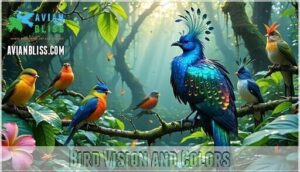
You see the world through three color receptors, but birds possess four—including ultraviolet vision that reveals hidden patterns on feathers invisible to your eyes.
This extraordinary visual system transforms how birds perceive each other’s colors and explains why some species that look identical to you display striking differences to potential mates, based on their unique ability to see ultraviolet patterns.
Avian Color Vision Capabilities
Birds see the world through advanced visual systems that make our human color perception look primitive by comparison.
Their eye structure contains four types of cone photoreceptors instead of our three, creating tetrachromatic vision that spans into ultraviolet wavelengths.
- Enhanced retina function processes light from 310-570 nanometers with remarkable visual acuity
- Specialized light sensitivity detects UV patterns invisible to mammals through transparent eye structures
- Superior color perception distinguishes subtle variations humans can’t detect using ordered cone mosaics
- Optimized wing types benefit from this vision during navigation and foraging behaviors
This advanced visual capability is due to their bird color vision capabilities that enable them to perceive a wider range of colors.
Differences Between Human and Bird Color Perception
You can’t see what birds see.
While you have three cone cells detecting red, green, and blue light, birds possess four types with enhanced spectral sensitivity.
Their retina structure includes oil droplets that filter light, creating sharper visual acuity than humans achieve.
This superior color perception allows birds to distinguish subtle differences you’d miss entirely.
Language perception and semantic analysis reveal how context analysis shapes our understanding of color meaning versus birds’ direct visual experience.
Understanding human color vision requires a color vision test to assess color vision abilities, which is crucial for determining individual color vision abilities and the impact of context analysis on our perception of colors.
Importance of UV Reflection in Bird Communication
While you see colors differently than birds do, their world includes a secret language through UV signaling that’s invisible to your eyes.
These spectral signals create visual cues essential for bird courtship, with feather iridescence serving as communication styles that convey semantic meaning.
This linguistic pattern of UV reflection helps birds interpret context during mating displays and territorial interactions.
Frequently Asked Questions (FAQs)
Why are there different species of birds?
Picture vast landscapes where nature’s evolutionary workshop has been crafting winged masterpieces for millions of years.
You’re witnessing evolution’s incredible power to diversify life through adaptation, isolation, and environmental pressures that shaped countless unique bird lineages, showcasing nature’s ability to create.
Where did how the birds got their colours come from?
Evolutionary pressures shaped bird coloration through genetic mutations affecting melanin production and pigment molecule formation.
You’ll find that carotenoid-based colors come from dietary pigments, while structural colors arise from complex feather architecture that manipulates light.
What determines the color of a bird?
Genetics, diet, feather structure, and light reflection work together to create your feathered friends’ stunning palette.
You’ll find melanins produce blacks and browns, while carotenoids from food create vibrant reds and yellows through microscopic feather architectures.
Why do animals come in different colors?
Animals display different colors through three main mechanisms: camouflage for survival, sexual selection for attracting mates, and thermoregulation for temperature control.
You’ll see vibrant peacocks courting partners, while chameleons blend seamlessly into surroundings, demonstrating nature’s colorful toolkit.
Why do birds have different morphs?
About 40% of bird species display multiple color morphs, giving you nature’s best wardrobe variety show.
You’ll find these different forms because genetic mutations create alternative appearances that help birds adapt to changing environments, attract mates, or survive predation pressures more effectively.
What causes leucistic birds?
You’ll develop leucistic birds when genetic conditions result in reduced melanin production , making feathers appear white or pale. Pigments fail to be deposited properly in feathers, creating patchy coloration patterns.
Do birds come in every color?
You can’t find birds wearing every imaginable color – they’re missing true pink, bright purple, and several other hues.
Nature’s palette has limits based on available pigments and structural color mechanisms.
How did birds become so colorful?
Evolution shaped colorful birds through sexual selection and survival needs. You’ll see bright plumage evolved to attract mates, while camouflaged colors help birds hide from predators and hunt effectively.
Why do birds have different colors?
While peacocks flaunt iridescent blues and cardinals sport brilliant reds, sparrows wear modest browns.
You’ll find bird colors serve three main purposes: attracting mates, blending with surroundings for protection, and signaling health to potential partners through vibrant plumage displays, which includes showcasing vibrant colors.
How do birds produce the colors in their feathers?
Birds produce feather colors through two main mechanisms: pigments and structural coloration.
You’ll see melanin creating blacks and browns, while carotenoids produce reds and yellows.
Microscopic feather structures reflect specific light wavelengths, creating brilliant blues and greens through physics rather than chemistry.
Conclusion
Throughout history’s grand tapestry, nature has painted birds as living masterpieces, each stroke telling a survival story.
Understanding why do birds come in different colors and species reveals evolution’s brilliant strategy.
You’ll discover that millions of years shaped these living rainbows through sexual selection, environmental pressures, and genetic variation.
Each vibrant plumage pattern and species adaptation represents nature’s solution to life’s challenges.
From ultraviolet signals invisible to your eyes to camouflage that deceives predators, bird diversity showcases evolution’s endless creativity in ensuring species survival and reproductive success.
- https://academy.allaboutbirds.org/how-birds-make-colorful-feathers/
- https://wire.auburn.edu/content/cosam/2024/12/Decoding_Bird_Plumage.php
- https://avianreport.com/bird-feather-colors/
- https://theconversation.com/a-single-atom-can-change-the-colour-of-a-bird-these-are-the-genes-responsible-242685
- https://academic.oup.com/jhered/article/112/5/395/6272461