This site is supported by our readers. We may earn a commission, at no cost to you, if you purchase through links.
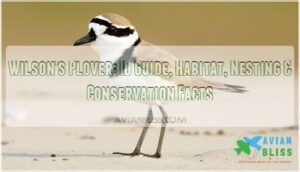 You’ll recognize Wilson’s plover by its chunky build, oversized black bill, and single dark breast band across its white chest.
This medium-sized shorebird struts confidently along sandy beaches and mudflats from the southern U.S. through Central America, using that hefty bill to snatch crabs and marine worms from tidal zones.
Unlike the smaller Semipalmated Plover or double-banded Killdeer, Wilson’s plover sports sandy-brown upperparts that blend perfectly with coastal environments.
These year-round beach residents face mounting pressure from coastal development and human disturbance, making each sighting precious.
Their specialized hunting techniques and remarkable nesting strategies reveal fascinating adaptations you might never expect.
Table Of Contents
- Key Takeaways
- What is Interesting About Wilson’s Plover?
- How Do You Identify a Wilson’s Plover?
- What is The Incubation Period of The Wilson’s Plover?
- Food
- Nesting
- Behavior
- Conservation
- Habitat
- Cultural Significance
- Frequently Asked Questions (FAQs)
- What is the difference between a Wilson’s plover and a piping plover?
- How big are Wilson’s plovers?
- What is the difference between snowy plovers and Wilson’s plovers?
- How rare is it to see a piping plover?
- What is interesting about Wilson’s plover?
- How do you identify a Wilson’s plover?
- What is the difference between a Piping Plover and a Wilson’s plover?
- What is the incubation period of the Wilson’s plover?
- What are the migration patterns of Wilsons Plover?
- How does Wilsons Plover respond to environmental threats?
- Conclusion
Key Takeaways
- You’ll spot Wilson’s plover by its chunky build, thick black bill, and single dark breast band—features that distinguish it from similar shorebirds like piping plovers with their thinner orange bills
- You’re witnessing a crab specialist that uses its robust bill to crack fiddler crabs, which make up 99% of its diet in some areas, employing a distinctive run-and-pause hunting technique
- You’ll find these birds creating simple ground nests in sandy scrapes above the high-tide line, where both parents share 23-25 day incubation duties using tag-team shifts
- You’re looking at a species in serious decline—populations have dropped over 50% in recent decades due to coastal development, making every sighting precious and conservation efforts critical
What is Interesting About Wilson’s Plover?
You’ll find Wilson’s Plover fascinating for its Unique Traits and specialized coastal lifestyle.
This shorebird species stands out with its robust black bill – thicker than other plovers – perfectly designed for cracking open fiddler crabs that make up 99% of its diet.
Its Feather Patterns include distinctive sandy brown upperparts and a bold dark chest band that varies by sex.
What’s remarkable about wilsons plover is their strict Mating Rituals where males perform elaborate courtship displays with drooped wings and foot-pattering dances.
Their Social Behavior includes both solitary nesting and loose colony formation along Migration Routes spanning from Virginia to Brazil.
Bird conservation efforts focus on protecting their plover habitat of sandy beaches and barrier islands.
These adaptable birds have evolved high salinity tolerance, making them true coastal specialists who’ve mastered life between land and sea.
Understanding migration patterns is essential for effective conservation of shorebird species like Wilson’s Plover.
How Do You Identify a Wilson’s Plover?
Through the sandy expanse of coastal beaches, spotting Wilson’s Plover requires attention to key physical characteristics.
This medium-sized shorebird measures 16-20cm with distinctive features that set it apart from similar species.
Here are three essential identification markers that’ll help you recognize this coastal specialist:
- Beak Size and Bill Shape: The robust black bill is noticeably thicker and heavier than other small plovers, earning it the nickname "Thick-billed Plover"
- Plumage Patterns: Sandy brown upperparts blend perfectly with beach habitats, while striking white underparts create strong contrast
- Leg Color: Pale pink or flesh-colored legs distinguish it from yellow-legged relatives
Breeding adults display a prominent single breast band—black in males, brownish in females.
The sturdy body with proportionally large head and moderately long legs creates a stockier appearance than Semipalmated Plovers.
Feather texture appears smooth against the bird’s compact frame, while the distinctive beak size remains the most reliable field mark for positive Wilsons Plover identification.
Understanding the name change process is vital for updated classifications.
What is The Incubation Period of The Wilson’s Plover?
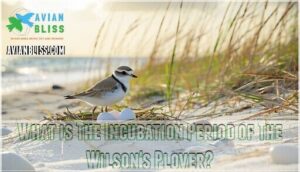
The incubation period for Wilson’s Plover eggs typically spans 23 to 27 days, though most nests complete incubation within 23 to 25 days.
You’ll find that both parents share these duties with remarkable precision—the female handles daylight hours while the male takes the night shift.
This tag-team approach guarantees continuous protection and temperature regulation for their precious cargo.
During nesting season, which peaks from April through July, pairs demonstrate exceptional dedication to their breeding cycle.
The incubation time begins once the clutch is complete, usually containing 2 to 3 eggs laid over several days.
Some populations show extended incubation periods reaching up to 32 days under specific environmental conditions.
Bird incubation success depends heavily on minimal disturbance.
Both parents actively defend their nest through distraction displays, including the famous "broken wing" act that lures predators away.
After the chick hatching process concludes, the precocial young leave their shallow scrape within hours, ready to begin their coastal adventures under watchful parental guidance.
Understanding the coastal habitat needs is vital for conservation efforts to protect Wilson’s Plover populations.
This knowledge helps in creating effective strategies for the protection of these birds and their habitats.
Food
Wilson’s Plovers have mastered the art of coastal dining, specializing in what you might call a crab diet that’s both impressive and strategic.
These shorebirds employ sophisticated foraging techniques that set them apart from their plover cousins. You’ll spot them using their signature run-and-pause method along mudflats and tidal zones.
Their prey capture technique is remarkable—they’ll grab a fiddler crab, shake off its legs, then swallow it whole. Talk about efficient dining.
Their menu includes:
- Fiddler crabs (up to 99% of their local diet)
- Crustaceans like shrimp and small crabs
- Marine worms found in sandy substrates
- Mollusks and other shellfish
- Insects and larvae from coastal environments
Their robust black bill handles larger prey than other plovers can manage. You’ll find them most active during low tide when muddy lagoon margins expose abundant food sources. They’re natural pest controllers, keeping crab populations balanced in their coastal ecosystems.
Nesting

You’ll find Wilson’s Plovers nesting in surprisingly simple accommodations along coastal areas from March through July.
These birds create shallow scrapes in sandy or shell-covered ground, often positioning their nests near driftwood, sparse vegetation, or other protective features above the high-tide line, which can include vegetation.
Nest Placement
Most Wilson’s Plovers choose open sandy beaches or shell-strewn areas for their nest location, positioning scrapes above the high-tide mark near dunes or sparse vegetation.
These shoreline placement strategies guarantee coastal habitats provide wind protection while maintaining camouflage.
Beach nests benefit from proximity to conspicuous objects like driftwood, with 98% of nesting sites within 30cm of such features.
Dune nesting enhances nest success through strategic positioning.
The use of beach nesting materials can also support conservation efforts for these birds.
Nest Description
A shallow scrape in sand or shell forms the nest structure, typically measuring 3.2 inches across.
Males create these depressions, then line them with nest materials like pebbles, shells, wrack, and debris bits.
The egg color ranges from cream to buff, heavily speckled with black and brown markings that perfectly camouflage against surrounding substrate.
These birds may benefit from specialized nesting resources.
This cryptic nest description makes locating these ground nests extremely challenging for both predators and researchers.
Nesting Facts
Within 23-27 days, Wilson’s plover eggs hatch through shared incubation duties.
You’ll find clutch size typically contains three eggs with excellent nest camouflage against sandy substrates.
These precocial chicks leave their nestscrape within hours, walking confidently toward shoreline foraging areas.
Colony nesting occurs occasionally, though isolated pairs dominate.
Renesting behavior happens frequently after clutch failures, while chick development progresses rapidly with plover nesting success depending on parental protection and habitat quality.
Understanding plover nest products and supplies is essential for conservation efforts.
Behavior

Observing a Wilson’s Plover reveals fascinating behavioral adaptations that help these shorebirds thrive in coastal environments.
You’ll notice their distinctive foraging techniques involve a characteristic run-and-pause pattern, where they sprint several steps before stopping abruptly to scan for prey.
Their courtship behavior includes males performing elaborate displays with drooped wings and spread tails while pattering their feet to attract females.
These plovers exhibit complex social interactions and become highly territorial during breeding season, with males creating multiple nest scrapes for females to choose from.
When threatened, they’ll perform dramatic broken-wing displays, feigning injury to lure predators away from their vulnerable eggs or chicks.
Key behavioral patterns you’ll observe:
- Run-and-pause foraging on mudflats during low tide
- Aggressive defense of nesting territories from intruders
- Predator avoidance through distraction displays
- Courtship displays with ritualized posturing and vocalizations
- Migration patterns following coastal routes to wintering grounds
Conservation
A lighthouse keeper’s vigilant watch mirrors the dedication needed for wilsons plover conservation status. This shorebird has lost over 50% of its population in 50 years, earning Red Alert status with only 8,600 U.S. breeding birds remaining.
Conservation efforts focus on habitat protection through beach closures, signage, and predator management during nesting season. Threat mitigation addresses human disturbance, coastal development, and climate change impacts like sea-level rise.
Wildlife conservation partnerships implement population management strategies including geolocator tracking and standardized surveys. Bird conservation efforts benefit co-occurring species like sea turtles through species preservation initiatives.
You can help by respecting posted nesting areas, keeping dogs leashed, and maintaining proper observation distances. Shorebird conservation requires sustained funding and multi-stakeholder cooperation to address expanding threats from development and climate-driven habitat loss.
Habitat

Wilson’s Plover thrives in coastal ecosystems where salt flats meet sandy shores.
You’ll spot these coastal birds on barrier islands and beach environments from Virginia to Florida, plus Gulf Coast regions extending into South America.
They prefer tidal zones where mudflats expose their favorite fiddler crabs during low tide.
These wilsons plover populations stick close to the ocean’s edge, rarely wandering inland.
They nest above high-tide marks near dunes or sparse vegetation on open ground.
You might find them on natural beaches or human-made sites like dredge spoil islands.
Their specialized beach habitat makes them vulnerable to development and rising sea levels.
Habitat conservation efforts focus on protecting these critical shorebird conservation areas.
With only around 14,800 birds remaining, preserving their coastal homes becomes increasingly important for species survival.
Cultural Significance

Exploring cultural significance, Wilson’s Plover has woven itself into human storytelling and art for centuries.
These coastal birds appear in Folklore Symbols across Gulf communities, where they’re seen as harbingers of good fishing weather.
Artistic Depictions in 19th-century watercolors and modern murals showcase their elegant form, making them icons of coastal wildlife preservation.
Literary References in regional poetry often use Wilson’s Plover as metaphors for resilience against changing tides.
Their Symbolic Meaning represents the delicate balance between land and sea, embodying nature’s adaptability.
Today, their image drives Conservation Awareness campaigns at every major wildlife refuge along the Atlantic coast.
Bird conservation groups use Wilson’s Plover in educational materials, knowing their story resonates with people who understand that protecting one species means protecting entire coastal ecosystems.
They’ve become ambassadors for shoreline preservation, their cultural footprint extending far beyond sandy beaches.
Frequently Asked Questions (FAQs)
What is the difference between a Wilson’s plover and a piping plover?
You’ll spot key differences in size and markings: Wilson’s plovers are larger with thick black bills and dark chest bands.
While piping plovers are smaller, paler, with orange bills and lighter, sometimes incomplete breast bands.
How big are Wilson’s plovers?
Like a tennis ball with legs, you’ll find Wilson’s plovers are medium-sized shorebirds, measuring about 7–8 inches long.
They’re slightly larger than a sparrow, with a sturdy build and moderately long legs for beach running.
What is the difference between snowy plovers and Wilson’s plovers?
You’ll notice key differences in size, bill thickness, and coloring between these coastal birds.
Snowy plovers are smaller with thinner bills and pale sandy coloring, while Wilson’s plovers are larger with robust black bills and darker brown upperparts, showing a clear distinction in size.
How rare is it to see a piping plover?
Spotting piping plovers requires patience—they’re endangered due to habitat loss, disturbance, and predation.
With roughly 80 or fewer populations worldwide, you’ll find them camouflaged on sandy beaches along Atlantic coasts.
Their scarcity makes every sighting special.
What is interesting about Wilson’s plover?
You’ll find Wilson’s plover fascinating because it’s got specialized hunting skills.
It can shake the legs off fiddler crabs before swallowing them whole, making up 99% of its diet in some areas.
How do you identify a Wilson’s plover?
Look for a medium-sized shorebird with a thick black bill, sandy brown back, and distinctive dark chest band.
Males show black bands while females display brown ones.
Listen for their characteristic "peet" calls.
What is the difference between a Piping Plover and a Wilson’s plover?
While both species might seem identical at first glance, you’ll spot Wilson’s plover by its thicker black bill and broader, darker breast band compared to the piping plover’s thin orange bill and narrow band.
The key distinguishing features are the thicker black bill and broader, darker breast band of Wilson’s plover.
What is the incubation period of the Wilson’s plover?
The incubation period lasts 23-25 days, with both parents sharing duties. You’ll notice the female incubates during day hours while the male takes night shifts in this carefully coordinated routine.
What are the migration patterns of Wilsons Plover?
Like clockwork from yesteryear, you’ll witness these coastal nomads moving in predictable patterns.
They’re partial migrants—northernmost breeders leave the US (except Florida) for winter destinations in Brazil, while Gulf Coast birds also head south seasonally, exhibiting a pattern that can be described as moving like clockwork.
How does Wilsons Plover respond to environmental threats?
When environmental threats arise, you’ll notice these birds use a "broken wing" display to lure predators away from nests.
They adapt foraging patterns to changing tides and relocate when coastal development threatens their breeding sites.
Conclusion
Astonishingly, Wilson’s plover populations have declined by over 50% in the past four decades due to coastal development pressures.
You’ve now learned to identify these chunky shorebirds by their distinctive black bills and single breast bands that set them apart from similar species.
Understanding their specialized crab-hunting techniques and vulnerable ground-nesting habits helps you appreciate why Wilson’s plover conservation efforts remain critical.
When you spot these sandy-brown birds along your next beach visit, you’ll recognize their remarkable coastal adaptations and the urgent need to protect their disappearing habitat.