This site is supported by our readers. We may earn a commission, at no cost to you, if you purchase through links.

You’ve likely seen them gliding across coastal skies, their silhouettes unmistakable against ocean horizons—those prehistoric-looking birds with beaks that seem almost comically oversized. Pelicans carry evolutionary blueprints refined over 30 million years, transforming their signature throat pouches into precision fishing tools that can hold up to three gallons of water and prey.
These extraordinary seabirds aren’t just coastal fixtures; they’re ecological engineers whose feeding behaviors ripple through entire aquatic food webs, from mangrove forests to inland wetlands. Their wingspans rival those of condors, their hunting strategies range from dramatic plunge-diving to cooperative herding, and their adaptations reveal nature’s genius for solving the challenge of catching slippery prey.
Understanding pelicans means glimpsing how resilience, specialization, and grace converge in one of Earth’s most recognizable avian families.
Table Of Contents
- Key Takeaways
- What Are Pelicans?
- Pelican Species Around The World
- Pelican Habitats and Diet
- Pelican Behavior and Social Structure
- Conservation and Importance of Pelicans
- Frequently Asked Questions (FAQs)
- What is a flock of Pelicans called?
- Who is favored to win, Timberwolves or Pelicans?
- What does the Bible say about pelicans?
- Why is 7 retired for the pelicans?
- What do pelicans look like?
- What is a flock of pelicans called?
- Why is the New Orleans Pelicans called Pelican?
- Where do the Pelicans play home games?
- What does a pelican look like?
- Where do Pelicans live?
- Conclusion
Key Takeaways
- Pelicans evolved specialized anatomy over 30 million years, including 18-inch beaks and expandable throat pouches that hold up to three gallons of water, making them among nature’s most efficient fishing machines across eight distinct species worldwide.
- These seabirds function as ecological engineers whose feeding behaviors ripple through entire aquatic food webs, regulating fish populations, preventing algal blooms through targeted predation, and creating nutrient-rich habitats that support coastal and wetland plant communities.
- Pelican survival strategies range from dramatic plunge-diving to cooperative herding, with wingspans reaching 6-11 feet and social structures built around colonial nesting, synchronized migration patterns covering thousands of miles, and shared parental duties that define their communal resilience.
- Despite their ancient evolutionary success, pelicans face mounting threats from habitat destruction, pollution, climate change, and human disturbance that jeopardize populations, making conservation efforts critical to preserving both the species and the aquatic ecosystems they’ve shaped for millennia.
What Are Pelicans?
You’ve likely seen pelicans gliding over water or perched on piers, but these birds are far more noteworthy than their casual presence suggests.
Pelicans are among the many incredible birds that migrate over water, traveling thousands of miles across oceans during seasonal journeys.
With beaks that stretch over 18 inches and throat pouches that work like fishing nets, pelicans have evolved into some of nature’s most efficient hunters.
Pelicans evolved with 18-inch beaks and expandable throat pouches that function as living fishing nets
Understanding what makes these birds unique—from their specialized anatomy to their exceptional adaptations—reveals why they’ve thrived across coastlines and wetlands worldwide.
Defining Pelicans and Their Unique Features
You’ll recognize pelicans by their massive wingspans—stretching six to eleven feet—and those unforgettable beaks that can reach eighteen inches, paired with expandable throat pouches that scoop fish like living nets.
These extraordinary water birds, classified in the genus Pelecanus, include eight species worldwide, each adapted for aquatic life with webbed feet, waterproof feather adaptations, and powerful flight patterns that let them soar effortlessly across coastal landscapes.
Learn more about their impressive feeding behavior and diet that set them apart from other birds.
Pelican Beak Structure and Throat Pouch
The beak and pouch work like a precision fishing net—your Louisiana Gulf Coast pelicans, celebrated by the New Orleans Pelicans sports community, rely on this ingenious design.
The flexible lower jaw bows outward, expanding the gular pouch to trap fish while water drains through vessel-lined walls. This anatomical adaptation varies across species, with coastal varieties wielding more elastic pouches for saltwater prey.
For more on their adaptations, see how pelicans benefit from their unique beak pouch structure.
Physical Characteristics and Adaptations
Beyond that exceptional beak structure, you’ll find pelicans built for aquatic mastery—adaptations honed across millennia along coastlines like Louisiana’s Gulf Coast, where the New Orleans Pelicans honor this resilient bird through community involvement and sports in New Orleans.
Consider these physical marvels:
- Wing span reaches 140-180 centimeters, enabling smooth soaring over Gulf waters
- Webbed feet propel bodies weighing 4-15 kilograms through waves
- Feather insulation with waterproof layers maintains body buoyancy
- Flexible necks pivot swiftly to snatch fish mid-flight
Pelican Species Around The World
Pelicans aren’t just one kind of bird—they’re a diverse family spread across continents, each species adapted to its own corner of the world.
From the massive American white pelican to the distinctive brown pelican, understanding the unique characteristics of different bird families helps reveal how these aquatic hunters evolved their specialized fishing techniques.
From the massive Dalmatian pelican of Europe and Asia to the brown pelican diving into Pacific waves, these eight species show impressive variety in size, color, and behavior. Let’s explore how these birds differ and where you’ll find them across the globe.
Overview of The Eight Pelican Species
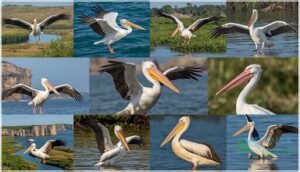
You’ll encounter eight distinct pelican species across the globe, all belonging to the genus Pelecanus, and they’re divided into fascinating lineages based on feather coloration and beak adaptation. These extraordinary birds, with their iconic throat pouch and impressive wingspans often exceeding two meters, inhabit environments from coastal shorelines to inland wetlands, much like how New Orleans brings basketball entertainment and community engagement to Louisiana’s diverse landscape.
| Species Name | Primary Range | Plumage Color |
|---|---|---|
| American White Pelican | North & Central America | White with black wing tips |
| Brown Pelican | Coastal Americas | Gray-brown body |
| Great White Pelican | Europe, Africa, Asia | White with pink undertones |
| Dalmatian Pelican | Europe & Asia | Silver-white, curly crest |
Their species classification reflects adaptive strategies for pelican migration and survival, connecting distant ecosystems through seasonal movements that mirror community involvement in sports—bringing people together across boundaries.
Key Differences Between Species

You’ll notice dramatic species classification distinctions rooted in feeding adaptations and plumage differences that reveal nature’s creative portfolio.
Beak variations span from the Australian pelican’s record-breaking 18-inch bill to shorter, sturdy structures optimized for plunge diving versus surface skimming.
Migration patterns separate coastal wanderers from inland homebodies, while seasonal molt cycles shift feather vibrancy, helping you distinguish breeding adults from their duller juvenile counterparts across continents.
Distribution and Global Range

Across warm temperate and tropical zones, you’ll find pelicans inhabiting coastal shores, inland waters, and large lakes spanning Africa, Asia, the Americas, and parts of Europe.
Migration patterns drive some species between continents seasonally, while habitat loss and climate shifts are altering species range boundaries.
Conservation efforts now focus on protecting wetlands—much like New Orleans, home to the NBA basketball team and their arena, champions ecological resilience.
Pelican Habitats and Diet

Pelicans aren’t picky about where they set up camp—you’ll find them thriving everywhere from ocean coastlines to freshwater lakes and sprawling wetlands.
What ties these environments together is simple: abundant fish and safe spots to roost and breed. Understanding where pelicans live and what they eat reveals how these birds have mastered survival across diverse landscapes.
Preferred Environments (Coastal, Inland, Wetlands)
You’ll find pelicans thriving in diverse environments where water meets opportunity, from coastal ecosystems and marine environments to freshwater wetlands and inland habitats. These adaptable birds frequent salt marshes, estuaries, and mangrove forests along shorelines, while also establishing colonies near rivers and lakes.
Their presence signals healthy wetland conservation areas, much like how the New Orleans Hornets’ transformation at Smoothie King Center marked a new chapter in NBA team history.
Feeding Behaviors and Primary Diet
Pelicans hunt like coordinated athletes on the court, using feeding techniques that blend strategy with raw efficiency. You’ll witness their impressive foraging strategies in action as they employ prey capture methods refined over millennia.
- Coordinated group attacks drive schooling fish into shallow waters, maximizing success
- Plunge-diving or surface sweeping with their expandable throat pouch acting as a flexible net
- Diet variations across seasons, adapting nutrient intake from anchovies and sardines to catfish and tilapia based on habitat availability
Role in Local Ecosystems
You’ll find that pelicans function as ecological anchors, regulating fish populations in shallow bays while preventing algal blooms through targeted predation.
Their guano-rich roosts create nutrient hotspots that support plant communities, and their movements between marine and coastal zones connect distant habitats—much like how the Smoothie King Center connects basketball fans to NBA action, pelicans link ecosystems through biodiversity support and habitat connectivity.
Pelican Behavior and Social Structure

Pelicans aren’t solitary wanderers—they’re highly social birds that thrive in colonies, where cooperation shapes everything from raising chicks to traveling thousands of miles.
Understanding how these birds breed, nest, and move with the seasons reveals the intricate patterns that sustain their populations across diverse habitats. Let’s explore the fascinating behaviors that define pelican life, from their communal nesting rituals to their extraordinary migratory journeys.
Breeding and Nesting Habits
When breeding season arrives, you’ll witness pelicans transform coastal cliffs, tree crowns, and elevated platforms into bustling colonial nurseries. Nest site selection prioritizes flood protection and proximity to abundant prey, while courtship displays feature synchronized head bobbing, wing flourishes, and mutual preening that cement pair bonds.
Both parents share incubation duties for 28 to 33 days, then diligently regurgitate fish to fuel nestling development until fledging occurs weeks later.
Migration Patterns and Seasonal Movements
After nesting winds down, you’ll observe temperature drops and freezing waterways trigger departures toward tropical wintering grounds, with some flocks covering thousands of kilometers along coastlines.
Day length cues and food scarcity drive these seasonal movements, while stopover sites at shallow lakes and estuaries offer critical rest and feeding before birds cross open water, ensuring migration success through cooperative flock dynamics.
Conservation and Importance of Pelicans

Pelicans have long captured human imagination, serving as symbols of resilience and community across cultures worldwide, yet these extraordinary birds face mounting pressures that threaten their survival.
Understanding the challenges pelicans encounter—from habitat loss to pollution—helps you appreciate why conservation efforts matter so deeply.
Beyond their ecological importance, pelicans hold cultural significance that connects communities to their natural heritage, reminding us why protecting these birds means preserving something far greater than a single species.
Threats Facing Pelican Populations
Despite their resilience, you’ll find pelicans facing mounting pressures from human activity and environmental change. Understanding these threats is vital if you value coastal ecosystems and the freedom they represent.
The main threats to pelicans can be summarized as follows:
- Habitat Destruction removes nesting sites through coastal development and wetland draining
- Pollution Effects from oil spills and pesticides impair feather insulation and reproductive success
- Climate Change forces prey species out of traditional foraging ranges
- Human Disturbance near breeding colonies causes nest abandonment
- Conservation Efforts require protecting key habitats like the Smoothie King Center area’s nearby wetlands
Pelicans’ Role in Culture and Symbolism
Beyond the ecological threats they endure, you’ll discover pelicans carry profound cultural significance across civilizations. In Christian art, they symbolize self-sacrifice, while heraldry showcases them as community emblems representing protection and nurture. Ancient Egyptian texts reveal their mythological roles as guardians, and Native American folklore portrays them as messengers bridging earth and sky—symbolic meanings that echo even in modern institutions.
| Cultural Tradition | Symbolic Meaning |
|---|---|
| Christian Art | Self-sacrifice, nourishment |
| Heraldry | Protection, community care |
| Ancient Egypt | Guardianship, provision |
Frequently Asked Questions (FAQs)
What is a flock of Pelicans called?
You’ll hear ornithologists call pelican groups a squadron, pod, pouch, or scoop—flock names reflecting their coordinated social structure.
When fishing together, they become a fleet, showcasing impressive squadron dynamics through collective hunting strategies.
Who is favored to win, Timberwolves or Pelicans?
Minnesota holds the edge with home advantage and recent trends favoring their roster depth, though injury reports and team stats suggest you’ll want to check game odds closely before committing to either NBA basketball squad.
What does the Bible say about pelicans?
You’ll find pelicans mentioned in Scripture as symbols of desolation and loneliness, particularly in Psalm 102:6, where the bird represents spiritual isolation in barren wilderness settings, reinforcing covenant themes through desert imagery.
Why is 7 retired for the pelicans?
This jersey retirement flies high as a tribute to Louisiana’s own legend, “Pistol Pete” Maravich, whose electrifying scoring and showmanship helped popularize basketball across New Orleans long before the Pelicans’ championship quest began.
What do pelicans look like?
You’ll recognize pelicans by their extraordinarily long bills—often exceeding 18 inches—paired with expandable throat pouches, broad wings optimized for gliding, and webbed feet designed for efficient swimming.
What is a flock of pelicans called?
You’ll hear ornithologists refer to pelican gatherings as squadrons or pods, terms reflecting their coordinated flight formations and synchronized swimming behaviors.
Though rookeries describes nesting colonies where these extraordinary birds breed together in coastal communities.
Why is the New Orleans Pelicans called Pelican?
Like a phoenix rising, from the Gulf’s waters, the basketball team embraced Louisiana heritage through franchise rebranding in 2013, choosing the brown pelican—the state bird—to symbolize regional identity and coastal resilience at Smoothie King Center.
Where do the Pelicans play home games?
You’ll find the basketball team at Smoothie King Center in downtown New Orleans, where arena seating accommodates over 16,000 fans.
The home court advantage comes alive, and the stadium location keeps game tickets accessible year-round.
What does a pelican look like?
You’ll spot a pelican by its massive expandable throat pouch, long pale bill, webbed feet, and broad wings spanning six to eight feet—perfect adaptations for scooping fish from coastal waters.
Where do Pelicans live?
You’ll discover pelicans primarily patrol coastal habitats, marine ecosystems, and wetland areas within twenty miles of shore, while others favor freshwater lakes and island colonies across temperate and tropical regions worldwide.
Conclusion
Whether they’re plunge-diving through coastal waves, gliding over inland wetlands, or nesting in bustling colonies, pelicans embody nature’s blueprint for specialized survival. You’ve traced their evolutionary mastery—from throat pouches that outperform any fishing net to wingspans commanding ocean winds.
Yet their future hinges on your recognition: these ecological architects face threats we’ve engineered. Protecting pelicans means preserving the aquatic ecosystems they’ve shaped for millennia, honoring resilience that predates human civilization itself.
- https://www.vividseats.com/new-orleans-pelicans-tickets--sports-nba-basketball/performer/153?wsUser=717&wsVar=us~nba~team,nba,en
- https://www.cvent.com/venues/new-orleans/arena-stadium/smoothie-king-center/venue-355f80ce-4399-4a9d-92d1-c5661e0dab6a
- https://www.smoothieking.com/news/new-orleans-pelicans-and-smoothie-king-renew-arena-naming-rights-partnership
- https://blog.ticketmaster.com/step-inside-smoothie-king-center-new-orleans-la/
- https://www.nba.com/pelicans/a-to-z-fan-guide