This site is supported by our readers. We may earn a commission, at no cost to you, if you purchase through links.
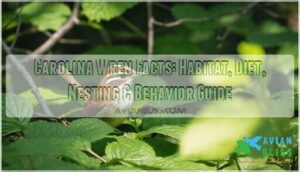 You’ll recognize a Carolina wren by its rusty-brown plumage, bold white eyebrow stripe, and upturned tail that gives it a jaunty appearance.
These compact songbirds pack surprising vocal power, delivering their distinctive "teakettle-teakettle!" call that echoes through eastern woodlands and suburban backyards.
They’re opportunistic feeders, hunting insects, spiders, and small creatures while also enjoying seeds and berries.
Carolina wrens prefer dense cover like brush piles, thickets, and overgrown areas where they can forage safely.
These year-round residents have been expanding their range northward, adapting well to human environments, with a curious nature and fearless attitude that make them fascinating neighbors with secrets worth discovering.
Table Of Contents
- Key Takeaways
- Carolina Wren Habitat
- Carolina Wren Diet
- Carolina Wren Nesting
- Carolina Wren Behavior
- Carolina Wren Conservation
- Frequently Asked Questions (FAQs)
- How old is a Carolina wren?
- Is a Carolina wren a big bird?
- Where do Carolina wren live?
- Is the Carolina wren a threatened species?
- Are Carolina wrens hardy birds?
- What are the physical characteristics of a Carolina wren?
- What attracts Carolina wrens?
- What does it mean if you see a Carolina Wren?
- Where do Carolina wrens like to nest?
- What is the difference between a Carolina Wren and a house wren?
- Conclusion
Key Takeaways
- You’ll hear Carolina wrens before you see them – their loud "teakettle-teakettle!" calls pack surprising vocal power for such small birds, with males delivering over 30 song variations year-round.
- You can attract them with dense cover and food sources – they thrive in brush piles, overgrown areas, and suburban yards, while suet feeders and natural insect populations keep them well-fed.
- You’ll find their nests in the most unexpected places – these creative builders use mailboxes, old boots, coat pockets, and hanging planters to construct their dome-shaped homes.
- You’re witnessing a conservation success story – their populations are actually increasing by 1.5% annually, with an estimated 19 million birds expanding northward across eastern North America.
Carolina Wren Habitat
If you’re curious about where Carolina Wrens make their homes, you’ll find them throughout the eastern United States from Texas to the Atlantic coast.
These adaptable birds thrive in dense woodlands, suburban yards, and anywhere they can find thick cover for nesting and foraging, making them highly adaptable birds.
Geographic Range
You’ll find carolina wrens throughout the eastern US, from southeastern Canada to the Gulf Coast.
Their range expansion northward reflects climate influence, with milder winters allowing populations to establish in New England and the Great Lakes region.
Regional variations exist across subspecies, while population density decreases at northern limits following harsh winters.
These birds are subjects of ongoing conservation efforts in Massachusetts.
Preferred Environments
Carolina Wrens thrive in diverse environments across their range.
You’ll spot these adaptable birds in dense undergrowth where they can easily hunt and hide from predators.
Their Ideal Habitats include:
- Forest Undergrowth – thick brush and fallen logs
- Suburban Gardens – shrubs and dense vegetation
- Riparian zones – moist woodland edges near water
- Overgrown areas – abandoned lots with heavy cover
These birds prefer Nesting Locations with plenty of concealment.
Territory Size averages just 0.007 square kilometers per pair.
Urban Adaptation
Urban environments present new challenges, but you’ll find these wrens thrive with remarkable adaptability.
City nesting occurs in mailboxes, flowerpots, and garden sheds.
Their noise tolerance helps them communicate over traffic sounds, while feeder usage supplements natural food sources.
Urban expansion creates fragmented habitats perfect for carolina wren territories in suburban yards, making foraging in suburbs surprisingly successful despite light pollution.
They’re known to choose unconventional nesting locations, such as spare tires and garages, showcasing their ability to thrive in urban expansion and fragmented habitats with unconventional nesting.
Carolina Wren Diet
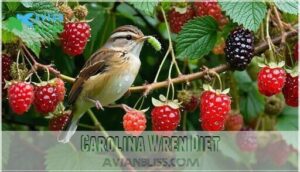
You’ll discover that Carolina Wrens are primarily insectivores, consuming beetles, caterpillars, moths, ants, and spiders throughout most of the year.
These busy little insect hunters tackle 95% of their protein needs through beetles, caterpillars, and spiders alone.
These energetic birds also supplement their protein-rich diet with seeds, nuts, and fruit pulp, especially during colder months when insects become scarce, making them omnivores in practice.
Food Sources
You’ll discover these resourceful birds aren’t picky eaters.
Their diet consists primarily of insects, spiders, and other invertebrates, making them excellent natural pest controllers.
While they’re primarily insectivore species, they also enjoy seeds, nuts, and occasional small vertebrates like frogs.
- Insect Consumption: Beetles, caterpillars, and moths make up 95% of their diet
- Seed Preference: Sunflower seeds and suet attract them to bird feeders regularly
- Vertebrate Prey: Small frogs, lizards, and tree frogs supplement their foraging needs
Foraging Behavior
You’ll spot these agile birds hopping through leaf litter and scrambling up tree trunks with remarkable foraging agility.
Carolina wrens are primarily insectivores, showing careful prey selection as they hunt spiders, beetles, and caterpillars.
Their ground foraging technique involves flipping leaves and probing bark crevices.
They’ll also visit bird feeders for suet and seeds when insects are scarce.
Their behavior is an example of insectivorous feeding strategies, demonstrating insectivorous habits and careful prey selection.
Seasonal Variations
You’ll notice the carolina wren’s diet shifts dramatically with bird season changes.
During breeding season, these birds consume 94% insects and spiders for protein-rich nutrition.
Winter brings different challenges – they’ll increase seeds, nuts, and fruits substantially when insects disappear.
This seasonal behavior affects their winter singing patterns and territory size, as energy-dense foods like peanuts become essential for survival during harsh weather periods, particularly for survival.
Carolina Wren Nesting
You’ll discover that Carolina Wrens are remarkably creative nesters, choosing everything from old boots to mailboxes for their dome-shaped homes.
These resourceful birds work together as pairs to build bulky nests using twigs, moss, and whatever interesting materials they can find nearby, which makes them remarkably creative.
Nest Placement

Carolina wrens demonstrate remarkable flexibility in cavity selection, choosing unusual locations that often surprise homeowners.
From old boots to mailboxes, Carolina Wrens turn the most unexpected spots into cozy homes.
You’ll find their nests tucked inside coat pockets, old boots, mailboxes, and hanging planters.
These adaptable birds prefer enclosed spaces at various nest heights, from ground level to sixteen feet high, showing minimal human impact concerns when selecting suitable nesting sites.
Consider adding a wren house option to encourage nesting.
Nest Description
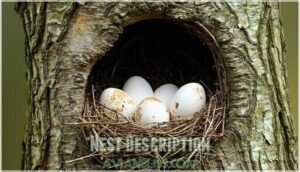
You’ll find their bulky, dome-shaped nests constructed from moss, leaves, bark strips, and twigs. These creative builders incorporate found materials like feathers, snakeskin, string, hair, and even plastic bits.
The nest construction involves both parents gathering materials, though males may build several potential sites before selecting one. Consider nesting material availability when attracting wrens.
Inside these cozy structures, you’ll discover 5-6 white eggs with brown blotches concentrated at the larger end, which is a key aspect of their nesting behavior and reproduction cycle.
Parental Care

Both parents share nesting habits responsibilities throughout the breeding cycle.
During the twelve to sixteen day incubation period, females exclusively warm eggs while males deliver food.
After hatching, cooperative breeding kicks in as both parents feed nestlings insects and spiders.
The brood number typically reaches two per season, with fledgling care extending four weeks post-nest departure, which is a part of their overall breeding cycle.
Carolina Wren Behavior
You’ll notice Carolina Wrens are surprisingly vocal birds, with males producing loud, clear songs that can be heard throughout the year.
These small but bold birds maintain territories year-round and typically form lifelong pair bonds with their mates.
Vocalizations
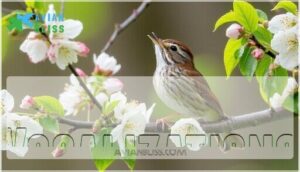
You’ll hear carolina wren vocalizations before you spot these vocal powerhouses.
Males belt out loud songs with impressive song repertoire—over 30 variations including "teakettle-teakettle-teakettle."
Both sexes produce distinct bird sounds: males dominate with territorial calls, while females add rattled pips and chatters.
Neighboring wrens share regional dialects through vocal learning, creating local call meanings that help identify strangers from friends.
Some enthusiasts even purchase items related to Carolina wren songs.
Territoriality
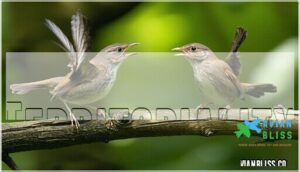
Year-round territory defense drives Carolina wren behavior through aggressive displays and vocal communication.
You’ll witness these birds maintaining their turf with unwavering determination, using song duets between mates to establish boundaries.
Males perform horizontal postures with fanned tails during confrontations.
Territorial behavior includes resource control over feeding areas, with pairs defending spaces averaging 0.007 square kilometers through coordinated vocalizations and physical aggression displays.
The birds use these mechanisms to maintain their territory, with territory defense being a key aspect of their behavior.
Monogamy
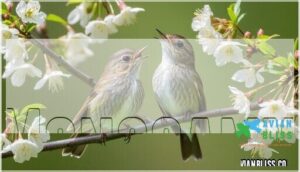
Carolina wrens practice monogamy, forming lifelong pair bonds that strengthen through cooperative roosting and shared territory defense.
These devoted partners engage in duet singing, with males leading melodic phrases while females respond with complementary calls.
Their mating behavior demonstrates remarkable loyalty as breeding pairs maintain year-round territories together, showcasing territorial behavior that reinforces their monogamous relationship.
Both sexes participate in year-round territory maintenance.
- Pair bonding occurs through synchronized vocalizations and shared foraging activities
- Lifelong mates remain together across multiple breeding seasons and winters
- Duet singing creates acoustic territories that warn competitors away from established pairs
- Cooperative roosting in cavities strengthens bonds during cold weather months
- Territory defense involves both partners actively protecting their shared home range
Carolina Wren Conservation
You’ll be glad to know Carolina Wrens are thriving with populations steadily increasing over the past 50 years.
These adaptable birds face few major threats, though severe winters can temporarily reduce northern populations until they recover through natural expansion.
Population Trends
Long-term studies show carolina wren populations steadily increasing across most regions.
Range expansion northward continues as winters moderate, though winter mortality creates cyclical population dips.
Urban populations recover faster after harsh weather due to feeders and shelter.
Regional population variation reflects climate impacts, with snow cover strongly affecting annual numbers, demonstrating remarkable resilience despite weather challenges, and showing cyclical population dips.
Threats
Multiple dangers threaten Carolina Wrens throughout their lives.
Predator impact from domestic cats, hawks, and snakes creates constant survival pressure.
Habitat loss reduces nesting sites and food sources.
Climate change brings harsh winters that devastate northern populations.
Pesticide exposure affects insect prey availability.
Human disturbance through development fragments bird habitat.
Environmental changes challenge bird population stability, making bird conservation efforts essential for bird survival in the face of these constant threats.
Conservation Status
You’ll find the Carolina Wren enjoys excellent conservation status.
The IUCN Red List classifies it as "Least Concern" globally, with populations showing remarkable stability.
Bird conservation efforts benefit from its adaptability to habitat loss and climate change.
While pesticide impact and invasive species pose minor concerns, this species’ population stability remains strong.
Bird habitat preservation initiatives continue supporting Carolina Wren populations across their expanding range.
They often utilize man-made nesting cavities when available, which is a key factor in their population stability and ability to thrive in various environments with climate change.
Frequently Asked Questions (FAQs)
How old is a Carolina wren?
Your bird typically lives 4-7 years in the wild, though some reach 9-10 years. Cold winters can shorten lifespans, while mild climates help them thrive longer with consistent food sources.
Is a Carolina wren a big bird?
Don’t let its cheerful demeanor fool you – this isn’t exactly nature’s heavyweight champion.
You’re looking at a petite powerhouse measuring just 7-5 inches, weighing less than an ounce, making it decidedly small among songbirds, and it’s a songbirds example.
Where do Carolina wren live?
You’ll spot these rusty-brown songbirds throughout eastern North America, from Texas to Connecticut. They’re expanding northward into southern Canada, thriving in wooded yards, dense thickets, and suburban areas year-round.
Is the Carolina wren a threatened species?
No, you won’t find the Carolina wren on any threatened species lists.
These adaptable birds are actually thriving, with populations growing by 5% annually and an estimated 19 million individuals across their range.
Are Carolina wrens hardy birds?
Population estimates show 19 million Carolina wrens thriving across their range.
You’ll find these resilient birds expanding northward despite harsh winters, adapting to urban environments, and maintaining year-round territories through extreme weather conditions, which makes them highly resilient.
What are the physical characteristics of a Carolina wren?
You’ll notice these wrens are small, chunky birds measuring 7-5 inches long with distinctive reddish-brown backs, warm buff-colored underparts, and prominent white eyebrow stripes.
Their long, slender, downcurved bills and frequently cocked tails make identification straightforward, highlighting their distinctive features.
What attracts Carolina wrens?
Dense cover, reliable food sources, and suitable nesting spots attract you to their territory. They’re drawn to suet feeders, insects, spiders, woodpiles, overgrown vegetation, and artificial cavities like birdhouses.
What does it mean if you see a Carolina Wren?
Seeing a Carolina Wren suggests you’re in their expanding eastern North American range.
You’ve likely encountered their year-round territory, as these non-migratory birds defend permanent areas through aggressive vocalizations and remain active daily, with their presence marked by permanent defense of their territory.
Where do Carolina wrens like to nest?
Carolina wrens are creative nesters, choosing cavities like birdhouses, coat pockets, boots, mailboxes, and hanging planters.
They’ll build dome-shaped nests in woodpiles, garages, old sheds, or any cozy nook that offers protection from predators.
What is the difference between a Carolina Wren and a house wren?
Like distinguishing between two sparrows at your feeder, you’ll spot key differences between these wrens.
Carolina wrens are larger, rust-colored with white eyebrows, while house wrens are smaller, plain brown, and lack distinctive markings.
Conclusion
Remarkably, you’ll find Carolina wren populations thriving where other songbirds struggle.
These adaptable birds demonstrate nature’s resilience through changing seasons and expanding territories. Their distinctive calls, resourceful nesting habits, and bold foraging strategies make them exceptional backyard neighbors.
You can support Carolina wren conservation by maintaining brush piles, avoiding pesticides, and providing natural food sources. Understanding their behaviors helps you appreciate these remarkable songbirds that bring year-round energy to eastern landscapes, showcasing nature’s resilience and the importance of conservation.