This site is supported by our readers. We may earn a commission, at no cost to you, if you purchase through links.
 You’ll discover that kiwi birds got their name from their distinctive call—a high-pitched "kee-wee" sound that echoes through New Zealand’s forests at night.
The Māori people first gave these flightless birds this onomatopoeic name, perfectly capturing their unique vocalization. When European settlers arrived, they adopted this native term, which has stuck for centuries.
Notably, the fuzzy kiwifruit was later named after these birds due to its brown, fuzzy exterior resembling the kiwi’s feathers.
So when you’re wondering why are kiwi birds called kiwis, it’s simply because they literally sound like their name. The bird came first, then everything else borrowed from this remarkable nocturnal creature’s signature soundtrack.
Table Of Contents
- Key Takeaways
- Kiwi Bird Origin
- Why Kiwis Are Named
- Kiwi Bird Species
- Kiwi Bird Size
- Kiwi Bird Egg
- Kiwi National Symbol
- Kiwifruit Naming
- Kiwi Bird Habitat
- Kiwi Conservation Status
- Supporting Kiwi Birds
- Frequently Asked Questions (FAQs)
- Why is the kiwi called a kiwi?
- Why do Americans call kiwifruit Kiwis?
- Is New Zealand the only country with Kiwis?
- What is the penalty for killing a kiwi bird in New Zealand?
- Why is a kiwi called a kiwi?
- Is it okay to call a new Zealander a kiwi?
- Where do kiwi birds get their name?
- Was the kiwi bird named before the fruit?
- How long do kiwi birds live?
- What do kiwi birds eat?
- Conclusion
Key Takeaways
- You’ll discover the name comes from their distinctive call – Kiwi birds earned their name from the "kee-wee" sound they make at night, which Māori people captured perfectly in their onomatopoeic naming
- The bird came first, then everything else borrowed the name – When you’re wondering about the connection, the kiwi bird existed for millions of years before the fuzzy kiwifruit was named after it in 1959 for marketing purposes
- It’s a beautiful example of indigenous knowledge shaping language – You’re seeing how Māori culture’s deep connection with nature influenced naming conventions that European settlers later adopted and that stuck for centuries
- The name reflects their unique nocturnal nature – You’ll find that hearing their signature call echoing through New Zealand’s forests at night perfectly captures why this sound-based name made sense to the people who first encountered these remarkable flightless birds
Kiwi Bird Origin
You’ll discover that kiwi birds earned their name from the distinctive "kee-wee" call they make during their nighttime activities across New Zealand’s forests.
These remarkable flightless birds have roamed the islands for millions of years, evolving unique characteristics that make them perfectly suited to their ground-dwelling lifestyle, with a notable ability to thrive in their ground-dwelling environment.
New Zealand Native
Deep within New Zealand’s untouched landscapes, you’ll find the kiwi bird—a remarkable example of Island Endemism that’s captivated scientists and nature lovers alike.
These native New Zealand birds evolved Unique Adaptations over millions of years, developing their distinctive characteristics in complete isolation.
The kiwi bird origin story connects deeply with Māori Connection, as indigenous peoples named these creatures "kiwi" after their distinctive call.
Today, these flightless birds play a vital Ecosystem Role across their Geographic Distribution throughout New Zealand’s diverse habitats.
Flightless Bird Characteristics
You’ll discover that kiwi birds possess remarkable flightless bird characteristics shaped by their evolutionary history.
Their bone density is reduced compared to flying birds, while their muscle structure lacks the powerful pectoral muscles needed for flight.
Their feather type is hair-like and soft, providing insulation rather than aerodynamic lift.
These new zealand birds developed unique sensory adaptations, including nostrils at their beak tips for enhanced foraging abilities.
Nocturnal Behavior
You’ll discover these fascinating flightless birds become most active after sunset, using their exceptional hearing and smell to hunt for insects, worms, and grubs in the darkness.
Their unique nighttime diet and sensory adaptations help them avoid daytime predators while maintaining distinct activity cycles.
These nocturnal birds showcase remarkable kiwi bird behavior that’s perfectly suited to New Zealand’s wildlife ecosystem, with nocturnal habits being a key aspect of their survival.
Why Kiwis Are Named

Tracing the trail back to its origins, you’ll find the kiwi bird’s name stems from the male’s shrill whistle that sounded like ‘kiwi’ when calling its mate.
Early explorers witnessed this nocturnal behavior firsthand, hearing these distinctive bird sounds echoing through New Zealand’s forests at night.
The Maori language captured this perfectly – Māori often named birds after their call, their plumage or their behaviour, which reflects how indigenous peoples connected deeply with their environment.
This cultural adoption of onomatopoeia (sound-based naming) is a significant aspect of their connection with nature, and birds also feature prominently in Māori culture, with feathers symbolizing status.
However, some linguists suggest a different name evolution, proposing that kiwi originated from Proto-Oceanic name for the Pacific golden plover, kiwiwi, which suggests early Polynesian settlers transferred a familiar bird name to this newly discovered flightless bird species.
Today’s national bird carries kiwi bird facts within its very name, highlighting the importance of understanding the origins and meanings behind the names of species.
Robert Blust’s theory provides an alternative perspective on the origins of the kiwi’s name, adding depth to our understanding of the cultural significance of this iconic bird.
Kiwi Bird Species
You’ll find five distinct kiwi species roaming New Zealand’s forests, each with unique characteristics that helped scientists classify them over the years.
Five remarkable flightless birds call New Zealand home, each perfectly adapted to their forest domains.
The Little Spotted Kiwi, Great Spotted Kiwi, Okarito Kiwi, and Rowi represent the main species you’re likely to encounter in conservation programs today, with distinct characteristics.
Little Spotted Kiwi
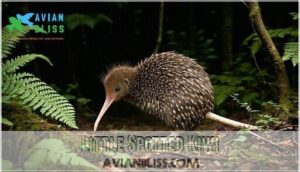
The Little Spotted Kiwi stands as the smallest among New Zealand’s flightless bird species, weighing just 1.3 kilograms.
This kiwi bird species once roamed mainland forests but now survives exclusively on protected Island Habitats like Kapiti Island.
Population Numbers remain critically low at around 1,700 individuals, making Predator Control absolutely essential for Future Survival.
Key kiwi bird facts about this remarkable wildlife of New Zealand species:
- Males incubate eggs for 70 days in underground burrows
- Their Breeding Habits produce only one egg per season
- They forage nocturnally using their sensitive beaks in dense kiwi bird habitat
Great Spotted Kiwi

Great spotted kiwi (Apteryx haastii) represent New Zealand’s largest kiwi bird species, weighing up to 3.3kg.
These magnificent flightless giants rule New Zealand’s South Island forests with quiet authority.
You’ll find these flightless birds in South Island’s upland forests, where habitat loss threatens their survival.
Their diverse diet and unique breeding habits make them fascinating subjects for conservation challenges and genetic diversity studies.
| Characteristic | Details |
|---|---|
| Weight Range | 1.3-3.3 kg |
| Habitat Preference | Upland native forests |
| Population Status | Vulnerable (~15,000) |
| Primary Threats | Introduced predators, deforestation |
| Conservation Priority | Moderate-high monitoring needed |
Okarito Kiwi

You’ll find the Okarito kiwi represents one of New Zealand’s rarest flightless bird species, with fewer than 600 individuals surviving today.
This endangered bird species faces severe conservation challenges due to habitat threats and limited genetic diversity in its West Coast population.
- Okarito behavior: Primarily nocturnal foraging in coastal wetlands and lowland forests
- Breeding habits: Males incubate eggs for 70-75 days in hidden ground nests
- Kiwi bird diet: Invertebrates, worms, and insects found in leaf litter
- Habitat threats: Introduced predators, flooding, and human development pressures
- Conservation challenges: Small population size limits kiwi bird evolution and recovery efforts
Row Kiwi
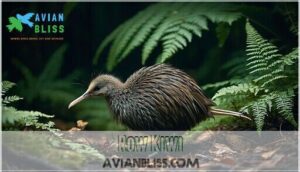
After exploring the Okarito kiwi, let’s look at the Rowi, the rarest of the bunch.
With less than 600 birds, Rowi showcase unique bird features, including soft grayish feathers and a knack for nocturnal foraging.
Their kiwi bird behavior is a study in patience—think of their slow, deliberate movements as the rowing technique of the ratite bird family.
Kiwi Bird Size
When you look at a kiwi bird, you’ll notice they’re surprisingly compact yet robust creatures.
These unique birds typically weigh between 1.3 to 5.9 pounds and measure 14 to 18 inches long, with their distinctive long beaks making up about one-third of their total head length, which is a distinctive feature.
Average Weight

Weight variation in kiwi birds reflects fascinating aspects of these flightless bird species.
Adult kiwis typically weigh between 2.5 and 8.5 pounds, depending on species and sex.
Sexual dimorphism plays a significant role, with females generally outweighing males by 20-30%.
Consider these weight factors:
- Diet influence affects seasonal weight fluctuations
- Growth stages determine juvenile versus adult measurements
- Measurement challenges arise from their nocturnal, secretive nature
Average Length

Why is it that kiwi birds show such fascinating Length Variation across different Species Comparison?
Adult kiwis typically measure 14-18 inches from bill tip to tail, though Measurement Methods reveal substantial differences between species.
Growth Stages affect size considerably, with chicks reaching adult proportions within months.
The largest bird species are markedly bigger than the kiwi.
This Length Impact influences their flightless bird name recognition and bird naming conventions within avian taxonomy.
Understanding these dimensions helps bird conservation efforts target protection strategies effectively.
Beak Size

Why is it that male brown kiwis have bills measuring 3.7 to 4.1 inches, while females boast longer beaks at 4.3 to 4.7 inches?
This remarkable beak length serves multiple feeding adaptations beyond simple probing. These flightless birds possess the world’s only external nostrils at their beak tips, packed with sensory receptors that detect vibrations from underground prey.
Species variation becomes evident when examining beak curvature – each kiwi species has evolved slightly different proportions for their specific habitats.
As nocturnal hunters, they emerge roughly 30 minutes after sunset to begin foraging.
Understanding avian taxonomy helps explain why bird naming conventions classify these remarkable beaks as perfectly adapted tools for bird conservation success.
Kiwi Bird Egg

You’ll be amazed to learn that kiwi birds lay the largest eggs relative to their body size of any bird species on Earth.
Each egg weighs about 20% of the female’s body weight, which would be like a human giving birth to a 30-pound baby.
Average Egg Size
Given their enormous proportional size, kiwi eggs represent nature’s most impressive egg-to-body ratio among birds.
Why is it that these eggs are so remarkably large compared to the bird’s body size?
Here are three key egg size factors:
- Size vs. Species: Brown kiwi eggs weigh up to 450g—one-quarter of the female’s body weight
- Egg Composition: High yolk content provides extra nutrition for advanced chick development
- Incubation Success: Large size guarantees fully-feathered, precocial hatchlings ready for survival
Egg Laying Frequency
Brown kiwi females don’t follow typical bird patterns.
Why is it that they can lay two or three clutches annually? Their reproductive maturity allows remarkable frequency – up to seven eggs per year for some individuals.
Environmental impact plays a role in laying seasonality, with captive birds often exceeding wild counterparts.
This exceptional clutch size and egg composition strategy maximizes breeding success despite harsh conditions.
Incubation Period
After females lay their precious cargo, incubation becomes nature’s ultimate endurance test.
Why is it that these eggs require such extraordinary patience? The answer lies in their remarkable 70-90 day incubation period—twice as long as most birds. This linguistic analysis of "why is it that" versus simple "why" reveals deeper question meaning through word choice and semantics.
Here’s what makes kiwi incubation fascinating:
- Incubation Length: 70-90 days, resembling mammal gestation more than bird development
- Temperature Control: Males maintain precise 36.5°C at egg’s surface through dedicated sitting
- Parental Roles: Fathers handle most duties while mothers recover from laying marathon
- Egg Turning: Regular rotation prevents chick malformation during extended development
- Hatching Success: Extended incubation produces fully-feathered, self-sufficient chicks ready for survival
Kiwi National Symbol

You’ll discover that the kiwi bird holds a special place as New Zealand’s national symbol, representing the country’s unique wildlife and cultural identity.
This remarkable connection between bird and nation has sparked extensive conservation efforts to protect these endangered creatures for future generations, and it is a key part of the nation’s cultural identity.
New Zealand Emblem
You’ll find the kiwi’s rise to national emblem status fascinating.
During the late 19th century, this unique bird became New Zealand’s official symbol, appearing on everything from one-dollar coins to military badges.
Why is it that this flightless creature achieved such cultural icon status? The answer lies in its perfect representation of New Zealand’s distinctive identity—resilient, independent, and utterly unique.
Making it an ideal tourism impact generator worldwide.
Cultural Significance
When you explore cultural significance, Māori culture treasures the kiwi as taonga, weaving its feathers into ceremonial cloaks for chiefs.
This cultural identity transcends backgrounds, unifying New Zealand’s national identity through tourism impact and cultural awareness.
The symbol evolution reflects cultural history, while conservation ethos strengthens cultural context, making kiwis emblematic of resilience and heritage.
Conservation Efforts
You’ll witness remarkable dedication in kiwi conservation efforts.
Organizations like Kiwis for Kiwi coordinate predator control programs while managing habitat restoration projects across New Zealand.
Operation Nest Egg boosts genetic diversity through carefully monitored breeding programs.
Community involvement drives funding initiatives, with volunteers supporting sanctuary work.
These collaborative efforts have achieved 60% higher survival rates for released birds compared to wild-hatched kiwis, which is a result of effective conservation and community involvement.
Kiwifruit Naming
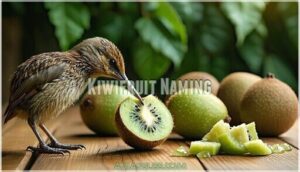
You’ve probably wondered why that fuzzy green fruit shares its name with New Zealand’s famous flightless bird.
The connection isn’t coincidental—it’s actually a clever marketing story that transformed how the world knows this sweet, tangy fruit, which is a complete concept in itself.
Origin of Name
Several converging linguistic origins shaped the kiwi bird’s name through etymology and historical usage.
Early explorers encountered Māori language terms for this unique species, with "kiwi" likely derived from the bird’s distinctive calls that resembled "kee-wee" sounds.
Scientific classification later adopted this indigenous name, demonstrating semantic shift from onomatopoeia to formal nomenclature, representing fascinating name evolution in ornithological terminology.
Connection to Kiwi Bird
You’ll notice kiwifruit got its name through linguistic origins rooted in visual similarity.
The fruit’s fuzzy brown exterior reminded marketers of the kiwi bird’s plumage, creating a deliberate connection.
This etymology represents a semantic shift from "Chinese gooseberry" to emphasize New Zealand’s national symbol, strengthening cultural identity through language evolution and strategic word meaning transformation, which is a result of linguistic origins and visual similarity.
Marketing Strategies
You’ll notice clever brand association drove New Zealand’s strategic rebranding from "Chinese gooseberry" to "kiwifruit."
This market positioning targeted international audiences while avoiding trade tariffs.
The competitive advantage came through rhetorical devices linking the fruit’s appearance to their national bird.
Promotion channels emphasized New Zealand’s clean image, with varied sentence structure and phrasing creating emphasis across different target audience segments.
Kiwi Bird Habitat

You’ll find kiwi birds thriving in New Zealand’s diverse ecosystems, from dense native forests to open grasslands and even wetland areas.
These adaptable ground-dwellers have carved out niches across the country’s varied landscapes, though they prefer environments that offer plenty of cover and soft soil for their impressive foraging abilities, which is a key aspect of their survival in diverse ecosystems.
Native Forests
Thriving within New Zealand’s dense temperate forests, you’ll find kiwis traversing their ancestral home where towering native flora creates the perfect ecosystem balance.
These old-growth sanctuaries support higher population densities through rich forest biodiversity, providing abundant invertebrates and protective underbrush.
However, habitat restoration and predator control efforts become essential as logging threatens these linguistic inquiry-worthy environments where core themes of conservation intersect with the birds’ survival needs.
Grasslands
Out on New Zealand’s grasslands, kiwi birds play hide-and-seek with Grazing Animals and shifting Soil Composition.
These open habitats offer rich Grassland Biodiversity, but also leave kiwis exposed to predators and wild weather.
Fire Ecology and Climate Impact shape these spaces, so understanding stylistic variants in writing style, syntax, grammar, and even colloquialism helps paint a fuller picture.
These habitats are threatened by agricultural expansion, which has a significant effect on the Fire Ecology of the area.
Wetlands
You’ll find kiwis thriving near wetland margins where water meets land.
Why does wetland biodiversity matter so much? These soggy spots create perfect hunting grounds packed with worms and insects.
Wetland importance for kiwis includes:
- Rich feeding zones – Muddy areas teem with invertebrates
- Nesting shelter – Dense vegetation provides cover
- Water access – Essential for survival and foraging
Wetland restoration projects focus on expanding these critical habitats.
Kiwi Conservation Status
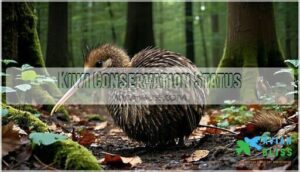
You’ll quickly discover that kiwi birds face serious survival challenges in today’s world.
Their conservation status reflects decades of habitat loss, introduced predators, and human interference that have pushed these unique creatures toward extinction.
Endangered Species
You’ll discover that kiwi birds face serious survival challenges.
All five species are classified as vulnerable, endangered, or near-threatened, with fewer than 68,000 remaining in the wild.
Why does habitat loss threaten these birds so severely? Invasive species and climate change reduce their natural environments, while poaching threats and limited genetic diversity compound their struggles.
| Species | Population | IUCN Status |
|---|---|---|
| North Island Brown | ~35,000 | Vulnerable |
| Great Spotted | ~15,000 | Vulnerable |
| Little Spotted | ~1,900 | Near Threatened |
| Okarito | ~600 | Vulnerable |
| Southern Brown | ~15,000 | Vulnerable |
Threats to Survival
Predator introduction wreaks havoc on kiwi populations, with introduced mammals causing devastating losses.
Why does habitat loss compound these problems? Human impact fragments their territories while disease susceptibility increases stress.
- Stoats and ferrets kill 95% of juvenile kiwis in unmanaged areas
- Vehicle strikes pose growing risks as roads expand through kiwi habitats
- Invasive plant species degrade nesting sites and reduce food sources
Conservation Programs
Over fifty community groups now coordinate conservation programs across New Zealand, tackling predator control and habitat restoration head-on.
Operation Nest Egg collects eggs for safe incubation, boosting chick survival rates to eighty percent in managed environments.
These programs require significant funding challenges but show remarkable species recovery through community involvement and genetic diversity protection efforts.
Habitat loss is a primary threat, requiring bird species preservation to protect these species.
Supporting Kiwi Birds

You can make a real difference for these unique birds through several meaningful ways.
Whether you donate to conservation organizations, volunteer for habitat restoration projects, or simply share their story with others, every action helps protect New Zealand’s most iconic species.
This action is crucial for the survival of these birds, and by taking part, you contribute to their well-being.
Donation Opportunities
Through over $2 million raised annually, your donations create real donation impact for kiwi conservation.
Conservation funds support pest control, habitat restoration, and important research grants.
Equipment needs like tracking devices and predator traps depend on public support.
Discover options for kiwi bird assistance through specialized donation programs.
Unlike asking indirect questions about conservation effectiveness, donation programs show measurable results – much clearer than British slang like "fag" meaning cigarette.
Volunteer Work
Beyond financial contributions, you can roll up your sleeves and make a tangible difference through hands-on conservation volunteering.
More than 1,000 volunteers annually contribute essential labor to kiwi protection initiatives, creating meaningful community impact while developing valuable skills. Many seek kiwi bird volunteer products to further support their efforts.
- Predator trapping – Set and monitor traps to protect kiwi nests from stoats, cats, and dogs
- Population surveying – Track kiwi numbers using listening devices and spotlighting techniques
- Habitat restoration – Plant native vegetation and remove invasive species from kiwi territories
Training workshops guarantee you’ll handle these responsibilities safely and effectively, connecting language and cultural context with conservation action.
Spreading Awareness
Awareness campaigns transform casual observers into passionate kiwi advocates.
Nationwide initiatives like "Save the Kiwi Month" reach over 500,000 people annually, while educational programs in 75% of New Zealand schools teach habitat protection.
Your social media shares generate thousands of monthly engagements on conservation topics.
You can also support kiwi bird donations.
| Campaign Type | Reach | Impact |
|---|---|---|
| Public Education | 500,000+ people | Increased donations |
| School Programs | 75% of schools | Cultural awareness |
| Media Campaigns | 10,000+ engagements | Government support |
| Tourism Partnerships | Eco-tourism packages | Corporate sponsorship |
| Community Events | Local involvement | Historical context |
Frequently Asked Questions (FAQs)
Why is the kiwi called a kiwi?
Long ago when ancient starships sailed New Zealand’s skies, you’d discover the kiwi bird got its name from the Māori word "kiwi," possibly onomatopoeic for the bird’s cry.
Why do Americans call kiwifruit Kiwis?
You’re calling Americans "kiwi" instead of recognizing they renamed Chinese gooseberry to "kiwifruit" for better marketing.
Turners and Growers announced it would export Chinese gooseberries under the name ‘kiwifruit‘ to make them sound more appealing than their original bland name.
Is New Zealand the only country with Kiwis?
Yes, kiwi birds are endemic to New Zealand, found nowhere else naturally. You’ll only spot these flightless icons wandering New Zealand’s forests, making the country their exclusive home.
What is the penalty for killing a kiwi bird in New Zealand?
While harming kiwi birds might seem like a minor offense, you’ll face serious consequences under New Zealand’s Wildlife Act.
Killing a kiwi carries fines up to $100,000 or six months in prison.
Why is a kiwi called a kiwi?
You’ll find that kiwi birds got their name from the distinctive "kee-wee" sound they make at night.
Early Māori settlers named them after this unique call, and the name stuck when Europeans arrived in New Zealand.
Is it okay to call a new Zealander a kiwi?
You’re absolutely fine calling a New Zealander a "kiwi" – it’s actually their preferred nickname.
New Zealanders proudly embrace this term, using it themselves both domestically and internationally when describing their nationality.
Where do kiwi birds get their name?
Ever wonder how this little brown bird got its name?
You’ll find the kiwi’s name comes from Māori, who likely named it after its distinctive "kiwi" call when they first encountered this flightless wonder centuries ago.
Was the kiwi bird named before the fruit?
You definitely had the bird first!
The kiwi bird came before the fruit was renamed.
In 1959, New Zealand exporters renamed the Chinese gooseberry "kiwifruit" after their national bird to make it more marketable in America.
How long do kiwi birds live?
Kiwi birds typically live 25-50 years in the wild, with some reaching 60+ years.
You’ll find they’re remarkably long-lived for their size, outlasting many larger birds through their slow metabolism and ground-dwelling lifestyle that avoids aerial predators, which makes them remarkably resilient.
What do kiwi birds eat?
Like ancient knights foraging for treasure, you’ll find these flightless birds hunt insects, worms, grubs, and fallen fruits at night using their keen sense of smell and touch.
Conclusion
Remarkably, kiwis produce eggs that weigh up to 20% of their body weight—imagine carrying around something that heavy!
Understanding why are kiwi birds called kiwis reveals the beautiful connection between sound, culture, and nature.
You’ve learned that these remarkable birds earned their name from their distinctive "kee-wee" call, which Māori people perfectly captured in their language.
This onomatopoeic naming shows how indigenous knowledge shapes our understanding of wildlife, connecting us to New Zealand’s natural heritage through simple yet meaningful sounds.