This site is supported by our readers. We may earn a commission, at no cost to you, if you purchase through links.
When you spot a robin hopping across your lawn, you’re looking at a creature that defies simple categorization—birds aren’t mammals, and they aren’t reptiles either. They belong to Class Aves, a distinct branch on the tree of life with defining traits no other vertebrate group shares.
The confusion stems from birds carrying evolutionary baggage from their ancient reptilian ancestors while developing warm-blooded physiology that superficially resembles mammalian function. Feathers, hollow bones, and a four-chambered heart set them apart from both groups, creating a taxonomic identity shaped by 150 million years of separate evolution.
Understanding where birds fit requires untangling shared ancestry from specialized adaptation—and recognizing that biological classification runs deeper than surface-level comparisons.
Table Of Contents
- Key Takeaways
- Birds Are Neither Mammals Nor Reptiles
- Why Birds Are Not Mammals
- Why Birds Are Not Reptiles
- Birds’ Evolutionary Connection to Ancient Reptiles
- Unique Characteristics That Define Birds
- Frequently Asked Questions (FAQs)
- Is A bird A Reptile or a Mammal?
- What are birds classified?
- What type of animal is a bird considered?
- Do we share any DNA with birds?
- Is a bird a reptile or mammal?
- What are birds classified as?
- Why do people think birds are reptiles?
- Why is a not a reptile?
- Is a bird a reptile?
- Are birds mammals yes or no?
- Conclusion
Key Takeaways
- Birds occupy their own distinct taxonomic class (Aves) separate from both mammals and reptiles, defined by unique features like feathers, hollow bones, and a four-chambered heart that no other vertebrate group shares.
- Despite descending from ancient theropod dinosaurs roughly 150 million years ago, birds evolved warm-blooded metabolism, specialized respiratory systems with unidirectional airflow, and flight adaptations that fundamentally distinguish them from their reptilian ancestors.
- The confusion between birds and other vertebrate classes stems from superficial similarities—birds share egg-laying with reptiles and warm-blooded physiology with mammals—but their keratinized beaks, feathered bodies, and pneumatic bone structures create a biological identity that defies simple categorization.
- Modern phylogenetic classification reveals birds’ evolutionary connection to archosaurs and crocodilians while confirming that 150 million years of specialized adaptation produced a vertebrate lineage so distinct it requires its own class rather than placement within Reptilia or Mammalia.
Birds Are Neither Mammals Nor Reptiles
You might be surprised to learn that birds don’t fit into either the mammal or reptile category—they’re something entirely different.
They belong to their own unique class, which is why their housing needs differ so much—and why understanding the difference between bird cage types matters for their health.
Scientists classify them in their own distinct group called Aves, which sets them apart from all other vertebrates.
Understanding what makes birds unique starts with knowing how biological classification actually works.
Birds Belong to Class Aves
You’ll find birds classified under Class Aves—a distinct taxonomic group within the animal kingdom. This Aves classification separates avian species from both Mammalia and Reptilia, establishing their unique position in ornithology.
Biologists place roughly 10,000 living bird species into this class, organizing them through bird classification systems that reflect their specialized avian anatomy, feather evolution, and flight mechanics developed over millions of years.
What Makes Birds a Unique Class
Birds earn their own class through a suite of adaptations you won’t find together anywhere else. Feather structure provides insulation and flight mechanics—vanes, barbs, and barbules lock together for aerodynamic control.
Avian physiology runs hot, maintaining temperatures near 40°C with a four-chambered heart. Beak functions replace teeth entirely, while hollow bones reduce weight without sacrificing strength—innovations that define avian anatomy in ornithology.
How Biological Classification Works
Taxonomic hierarchy organizes life from domain down to species—each rank groups organisms by shared traits.
You’ll see birds placed in kingdom Animalia, phylum Chordata, and class Aves through this system. Classification systems like Linnaean taxonomy use fixed ranks, while phylogenetic analysis builds evolutionary trees from DNA.
Biological nomenclature follows strict international codes, ensuring species identification remains consistent across zoology and evolutionary biology worldwide. For more details on how scientists categorize living things, explore the levels of biological classification.
Why Birds Are Not Mammals

Birds and mammals might both be warm-blooded, but that’s where the similarities end.
When you compare their physical features and reproductive strategies, the differences become impossible to ignore. Let’s examine four key distinctions that place birds firmly outside the mammal category.
Feathers Vs Fur and Hair
You can spot the divide between mammals and birds by looking at their outer covering—one group sports fur or hair, the other wears feathers. Here’s what sets avian plumage apart from mammalian coats:
Feathers also allow for flight, vibrant displays, and insulation—traits that evolved from their fascinating dinosaur ancestors.
- Feather structure creates aerodynamic lift and provides insulation through interlocking barbs made of beta-keratin
- Hair growth occurs continuously from follicles, while feathers molt seasonally in complete replacement cycles
- Thermal regulation differs—feathers trap air between layers, fur insulates through density and texture variations
Egg-Laying Vs Live Birth
When you’re comparing reproductive strategies between birds and mammals, the difference boils down to where embryo development happens. Birds lay calcified eggs—incubation periods range from 10 days in songbirds to over 80 days in waterfowl. Most mammals give live birth after internal gestation, transferring nutrients through the placenta.
| Avian Egg Formation | Mammalian Birth Methods |
|---|---|
| Calcified shell provides protection | Internal gestation in reproductive tract |
| Yolk and albumen nourish embryo | Placenta transfers nutrients and oxygen |
| Temperature-controlled incubation | Gestation ranges from 20 days to 22 months |
| Hatchling emerges using egg tooth | Live offspring receive immediate parental care |
This classification marker separates reptiles and birds from placental mammals entirely.
Beaks Vs Teeth and Jaws
Your jaw and teeth work together when you bite—but birds swapped that system for something lighter. Avian evolution eliminated tooth replacement entirely, favoring keratinized beaks that adapt through cranial kinesis.
Jaw movement in birds drives feeding strategies from seed-cracking to prey-tearing. Mammals rely on teeth for processing food; birds use beak anatomy and muscular control instead. This shift freed up weight for flight while maintaining diverse diets across reptiles’ ancestral split.
Different Reproductive Systems
Reproduction splits mammals, birds, and reptiles into distinct paths. Avian classification centers on oviparity—you’ll find hard calcium carbonate eggshell diversity across species, followed by parental incubation until hatching.
Mammals rely on internal fertilization with placental nourishment before live birth. This reproductive divide reinforces why birds occupy their own class, separate from both mammalian viviparity and the varied egg-laying strategies reptiles employ.
Why Birds Are Not Reptiles

You might think birds and reptiles belong in the same category since they both lay eggs and share ancient ancestors. But modern birds operate on a completely different biological playbook than reptiles like lizards, snakes, and turtles.
Here’s how their physiology sets them apart in four fundamental ways.
Warm-Blooded Vs Cold-Blooded Metabolism
Birds are warmblooded, maintaining steady body temperatures around 38–42°C through high metabolic rates—unlike cold-blooded reptiles that rely on environmental heat. This thermoregulation allows sustained flight and year-round activity, with avian physiology converting food to energy rapidly.
Mammals share this warm-blooded characteristic, but reptiles exhibit temperature-dependent metabolism that fluctuates with ambient conditions, highlighting a fundamental difference in energy efficiency and temperature control.
Feathers Vs Scales
You’ll notice right away that feathers and reptile scales serve completely different purposes—feathers enable flight mechanics and avian insulation through complex keratin formation, while scales protect reptilian skin.
Feather structure includes a central rachis with interlocking barbules creating aerodynamic surfaces, whereas scales form flat epidermal plates. This distinction underscores bird evolution diverging from traditional reptile and bird relationships despite shared avian ancestry.
Four-Chambered Heart Vs Three-Chambered Heart
You’ll find that heart structure separates birds from most reptiles in a fundamental way.
Birds possess a four-chambered heart—two atria and two ventricles—enabling complete separation of oxygen-rich and oxygen-poor blood circulation. This cardiac efficiency enables the high metabolic rates necessary for flight.
Most reptiles rely on a three-chambered heart with partial blood mixing, limiting oxygen delivery to tissues and reducing overall metabolic capacity compared to avian vertebrates and mammals.
For deeper insight into phylogenetic tree relationships, these features illustrate how evolutionary traits distinguish major vertebrate classes.
Respiratory System Differences
Beyond the heart, you’ll notice that respiratory architecture sets birds even further apart.
Birds breathe through a unidirectional flow-through system—air moves continuously across parabronchi in avian lungs, maximizing gas exchange efficiency during both inhalation and exhalation. Reptiles and mammals rely on bidirectional tidal breathing, where air flows in and out through the same pathways, reducing oxygen extraction per breath.
Birds’ Evolutionary Connection to Ancient Reptiles

Birds carry a secret in their bones—they’re descendants of ancient reptiles, not some separate lineage that appeared out of nowhere.
Birds aren’t a separate lineage—they’re descendants of ancient reptiles, carrying that secret in their very bones
This connection runs deep, linking modern sparrows and eagles to the dinosaurs that roamed Earth millions of years ago.
Understanding this evolutionary path clarifies why scientists debate whether birds should even be classified separately from reptiles at all.
Descent From Archosaurs and Dinosaurs
You can trace avian ancestors back to archosaurs—a group that split from early reptiles around 250 million years ago and gave rise to dinosaurs. Birds evolved from dinosaurs, specifically theropod dinosaurs that appeared roughly 230 million years ago.
Fossil records reveal this dinosaur link through:
- Gradual development of feathers in non-avian dinosaur lineages
- Perforated hip sockets indicating upright posture
- Furcula (wishbone) structures in early bird-like species
- Specialized ankle joints connecting birds to dinosauriforms
The phylogenetic system now classifies birds within their reptilian heritage, acknowledging archosaur origins while recognizing birds’ unique adaptations that emerged over 150 million years of evolution.
Shared Ancestry With Crocodilians
Birds share closer ties to crocodilians than to any other living reptiles—a surprising connection rooted in Archosaur Origins. Genome Comparison and Phylogenetic Analysis confirm that Common Ancestors diverged roughly 240 million years ago, placing both lineages within Archosauria.
Fossil Records reveal shared skull features, four-chambered heart patterns, and egg-laying strategies. This deep evolutionary bond explains why Birds retain Reptilian characteristics in birds despite their unique adaptations.
The 150-Million-Year Evolution Timeline
You can trace the Avian Ancestors lineage through a 150-million-year Evolution Timeline, spanning the Late Jurassic to Early Cretaceous periods.
Theropod Origins mark the starting point—small carnivorous dinosaurs developed feathers for insulation before flight emerged.
Feather Development progressed gradually, refining wing structures while skeletal adaptations lightened bones.
The Fossil Record from China and Europe documents this transformation, showing how phylogenetics connects ancient reptiles to modern birds through systematic evolutionary steps.
Modern Vs Traditional Classification Systems
Traditional classification relied on visible traits—the Linnaean system grouped birds, mammals, and reptiles as separate lineages without evolutionary links.
Modern phylogenetic systems use DNA sequences and cladistic methods to map evolutionary trees, revealing birds’ archosaur ancestry. Taxonomic revision now emphasizes shared genetic heritage over morphology alone, reshaping how you understand systematic biology and bird classification systems through evidence-driven phylogenetic analysis.
Unique Characteristics That Define Birds
Now that you understand how birds split from ancient reptiles, let’s look at what makes them stand apart from every other vertebrate on Earth.
Birds possess a unique suite of anatomical traits and physiological traits that allow them to master powered flight—a feat no mammal or modern reptile can replicate in quite the same way. These adaptations work together as an integrated system, from their outer covering to their internal machinery.
Feathers for Flight and Insulation

Feathers—made of keratin with a central rachis, barbs, and interlocking barbules—serve dual critical functions you won’t find in any mammal or reptile. Their aerodynamic features create lift through airflow manipulation, enabling powered flight.
Here’s how feather structure enhances avian success:
- Flight mechanics depend on wing remiges that generate thrust and control through precisely angled surfaces
- Down feathers trap air close to skin, providing thermal regulation in cold environments
- Contour feathers create waterproof barriers that maintain insulation properties during wet conditions
- Interlocking barbicels form smooth surfaces that reduce drag and improve flight efficiency
Lightweight Hollow Bones

You’ll notice something noteworthy when you examine avian physiology—pneumatic chambers thread through bone structure, creating a hollow design that slashes weight without sacrificing strength.
This lightweight skeleton, coupled with internal struts and air spaces connected to the respiratory system, allows birds to achieve flight efficiency impossible for mammals or reptiles. The evolution of birds produced this ingenious engineering solution within the class Aves.
High Metabolic Rate and Body Temperature

You’ll find that thermoregulation in birds operates at a level mammals envy—body temperatures hover between 40–42°C, fueled by metabolic scaling that burns energy 2–3 times faster than human resting rates.
This heat production, driven by liver and muscle tissue, enables flight while maintaining temperature regulation regardless of ambient conditions. Such energy efficiency separates birds from cold-blooded reptiles within animal classification and evolutionary biology.
Specialized Respiratory and Circulatory Systems
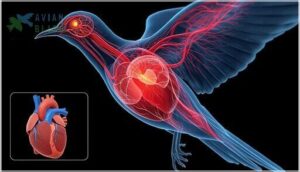
Unlike reptiles with three-chambered hearts, you’re looking at a circulatory system that never mixes oxygen-rich and oxygen-poor blood—a four-chambered design supporting heart rates exceeding 1,000 beats per minute in small species.
Respiratory efficiency in birds operates through:
- Airflow dynamics—one-way passage through parabronchi ensures continuous gas exchange during inhalation and exhalation
- Blood oxygenation—hemoglobin binds oxygen at low partial pressures, optimizing aerobic capacity
- Air sac bellows—nine to eleven sacs move air without participating in exchange
- Circulatory adaptations—preferential blood flow to flight muscles during takeoff maximizes performance
This evolutionary biology masterpiece distinguishes vertebrates within animal classification.
Frequently Asked Questions (FAQs)
Is A bird A Reptile or a Mammal?
Birds belong to their own class—Aves—distinguished by unique evolutionary biology traits like feathers and endothermy.
Despite shared ancestry with ancient reptiles, avian distinctions in animal taxonomy clearly separate them from both mammals and reptiles.
What are birds classified?
You’ll find birds classified in the Animal Kingdom, phylum Chordata, class Aves.
Bird classification relies on Avian Taxonomy principles—grouping species by feather evolution, wing structure, flight mechanics, and shared anatomical features.
What type of animal is a bird considered?
When you look at an eagle soaring overhead, you’re witnessing an animal that belongs to Class Aves—the vertebrate group defined by feathers, beaks, and specialized flight physiology that separates avian traits from all other taxonomy.
Do we share any DNA with birds?
Yes—humans and birds share about 60 percent of their genes. Genetic research reveals that DNA conservation extends to developmental pathways, organ formation, and cellular processes, reflecting our deep evolutionary connection through vertebrate ancestry.
Is a bird a reptile or mammal?
You’ll find birds in their own category—Class Aves. Despite bird evolution from ancient reptile ancestors, modern taxonomy treats them separately based on warm-blooded metabolism, feathers, and unique avian physiology that sets them apart.
What are birds classified as?
In biological taxonomy, you’ll find birds classified under Class Aves within the phylum Chordata and kingdom Animalia—a distinct lineage characterized by feathers, beaks, and specialized adaptations for flight across approximately 10,000 species.
Why do people think birds are reptiles?
You’ll often hear confusion about birds and reptiles because they share evolutionary biology and phylogenetics—both lay eggs, and the fossil record reveals birds descended from dinosaurs, making birds technically reptiles in modern cladistics.
Why is a not a reptile?
A frog isn’t a reptile—it’s an amphibian.
Frogs rely on moist skin for respiration and undergo metamorphosis from aquatic larvae, while reptiles possess scales, breathe through lungs, and develop directly from hard-shelled eggs.
Is a bird a reptile?
Looking back, you can say birds evolved from reptilian ancestors—specifically, theropod dinosaurs within the archosaur lineage—but modern birds aren’t reptiles due to warm-blooded metabolism, feathers, and avian anatomy.
Are birds mammals yes or no?
No, birds aren’t mammals. You’ll recognize mammal traits—fur, live birth, and milk production—that birds simply don’t have.
Birds belong to Class Aves with feathers, beaks, and egg-laying defining their unique classification.
Conclusion
Classification clarity comes from understanding that a bird is neither a mammal nor a reptile—it occupies Class Aves, a taxonomic category shaped by feathers, hollow bones, and warm-blooded metabolism. While birds descend from ancient reptilian ancestors, 150 million years of evolution created distinguishing traits that separate them from both groups.
You’re not observing a hybrid or intermediate form—you’re witnessing a distinct vertebrate lineage with adaptations no other class replicates.