This site is supported by our readers. We may earn a commission, at no cost to you, if you purchase through links.
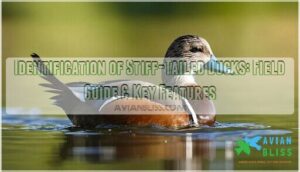 You’ll recognize stiff-tailed ducks instantly by their signature upright tails that stick straight up like tiny flagpoles, even when they’re just floating around minding their own business.
During breeding season, males sport brilliant chestnut bodies with bright blue bills and white cheek patches, while females wear more practical brownish-tan camouflage with subtle barred patterns.
These compact divers have swollen, scoop-shaped bills perfect for straining food from muddy lake bottoms, and their webbed feet sit far back on their bodies, making them underwater champions but awkward landlubbers.
The identification of stiff-tailed ducks becomes second nature once you spot that unmistakable erect tail posture that sets them apart from every other waterfowl species.
There’s more to these fascinating ducks than meets the eye.
Table Of Contents
- Key Takeaways
- Overview of Stiff-Tailed Ducks
- Identification Characteristics of Stiff-Tailed Ducks
- Comparison With Other Duck Species
- Distribution and Habitat of Stiff-Tailed Ducks
- Conservation and Threats to Stiff-Tailed Ducks
- Frequently Asked Questions (FAQs)
- What is a stiff tailed duck?
- What does a stifftail duck look like?
- How do stiff-tailed ducks differ from dabbling ducks?
- Do ducks resemble waterfowl?
- Do stiff tailed ducks migrate?
- What does a ruddy duck look like?
- Where do stiff tailed ducks live?
- What does a female ruddy duck look like?
- Can Ruddy Ducks take off from land?
- What tribe is the stiff tailed duck in?
- Conclusion
Key Takeaways
- You’ll instantly spot stiff-tailed ducks by their signature upright tails that stick straight up like flagpoles, even when they’re just floating casually on the water.
- Look for males with brilliant chestnut bodies and bright blue bills during breeding season, while females display more practical brownish-tan camouflage with subtle barred patterns.
- You can identify them by their distinctive swollen bills and webbed feet positioned far back on their bodies, making them excellent divers but awkward on land.
- You’ll easily distinguish them from other waterfowl by watching their diving behavior – they completely submerge underwater rather than just tipping forward like dabbling ducks.
Overview of Stiff-Tailed Ducks
Spotting stiff-tailed ducks in the wild starts with understanding their unique Duck Anatomy. These specialized divers belong to the Oxyurini tribe, featuring compact bodies with Webbed Feet positioned far back for underwater propulsion.
Their signature Stiff Tails act as rudders, often held erect while resting. Bill Shapes are distinctively swollen and broad, perfect for their aquatic lifestyle.
These specialized divers use their upright tails as underwater steering wheels while their swollen bills scoop up aquatic treats
Males display vibrant Feather Colors during breeding season, while females sport subtler tones. Stifftailed duck identification becomes easier once you recognize these duck identification characteristics that set them apart from typical waterfowl.
Identification Characteristics of Stiff-Tailed Ducks
You’ll find stiff-tailed ducks easier to identify once you know their signature features that set them apart from other waterfowl.
These unique ducks display distinctive physical traits that make field identification straightforward, even at a distance, thanks to their distinctive physical traits.
Plumage and Coloration
During breeding season, you’ll spot male stiff-tailed ducks sporting vibrant chestnut bodies and brilliant blue bills—nature’s flashy dating outfit.
Male stiff-tailed ducks transform into nature’s most dapper underwater gentlemen each spring, flashing blue bills like aquatic fashion statements
Females and nonbreeding males wear more subdued brownish-tan plumage with barred patterns, perfect camouflage gear.
This sex dimorphism makes identification tricky outside mating displays, when males trade their breeding colors for female-like feather patterns.
These ducks are uniquely adapted as tactile feeders, using their sensitive bills to find food.
Distinctive Bill and Head Markings
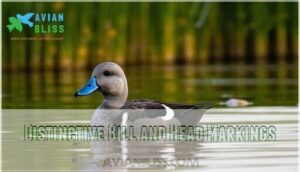
Two key features make identification straightforward: Bill Shapes vary dramatically between species, with ruddy ducks sporting swollen blue beaks during breeding season.
Head Markings show clear Sexual Dimorphism – males display white cheek patches and vibrant Feather Patterns, while Masked Duck Identification relies on distinctive Facial Markings with bold Head Stripes.
These Beak Colors and patterns simplify Duck Identification in the field.
Understanding bird identification with white stripes can also aid in recognizing similar characteristics among various bird species.
Tail Behavior and Shape
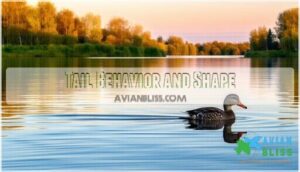
The tail feathers of stiff-tailed ducks stick straight up like tiny flagpoles when they’re swimming or resting.
These stiff tails work as underwater steering wheels, giving them amazing duck propulsion and rudder function while diving for food.
During breeding season, males put on spectacular courtship displays, using their tails like drumsticks to slap the water while inflating colorful throat sacs.
This unique tail behavior and tail shape makes duck identification simple—no other waterfowl holds their tail quite like this, making ruddy duck identification a breeze for birdwatchers.
Stifftails exhibit unique waterfowl characteristics that distinguish them from other duck species.
Comparison With Other Duck Species
You’ll find stiff-tailed ducks differ substantially from other waterfowl in several key ways that make identification straightforward once you know what to look for.
Their unique body structure, behavior, and habitat preferences set them apart from dabbling ducks, diving ducks, and other waterfowl you’re likely to encounter, making identification straightforward.
Contrasting Stiff-Tailed Ducks With Dabbling Ducks
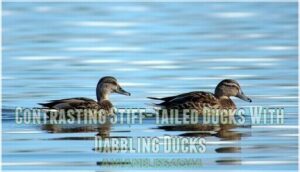
When identifying waterfowl, you’ll quickly notice how stiff-tailed ducks differ from their dabbling cousins.
Dabblers tip forward in shallow water, while stifftailed ducks dive completely underwater with powerful leg anatomy.
| Feature | Dabbling Ducks | Stiff-Tailed Ducks |
|---|---|---|
| Feeding Method | Surface tipping | Deep diving behavior |
| Bill Structure | Narrow, flat | Broad, swollen |
| Tail Position | Flat, flexible | Erect, stiff tails |
| Leg Anatomy | Centered placement | Far-back positioning |
This diving behavior and distinctive feather comparison make ruddy duck identification straightforward during duck migration seasons.
Contrasting Stiff-Tailed Ducks With Black Scoters

Black Scoters might fool you at first glance, but they’re completely different birds.
You’ll spot stiff-tailed ducks by their upright tail length and swollen beak size, while Black Scoters show sleek profiles.
Here’s your quick comparison guide:
| Feature | Stiff-Tailed Ducks | Black Scoters |
|---|---|---|
| Bill Shape | Swollen, scoop-shaped | Narrow with yellow knob |
| Feather Color | Chestnut/blue breeding | All-black males |
| Diving Ability | Quick, prolonged dives | Surface feeding |
Their waterfowl identification becomes easier once you know what to look for!
Unique Features of Stiff-Tailed Ducks

Beyond conventional waterfowl, stiff-tailed ducks showcase remarkable adaptations that set them apart.
You’ll notice their extraordinary diving ability powered by oversized webbed feet positioned far back on their bodies.
Their stiff tail feathers serve as underwater rudders, while males display vibrant blue bills during courtship displays.
These Oxyurinae subfamily members excel at aquatic life but struggle on land.
The study of stiff tailed duck products reveals interesting duck conservation efforts.
| Feature | Stiff-Tailed Ducks | Other Ducks |
|---|---|---|
| Tail Position | Erect, stiff feathers | Flat, flexible |
| Bill Color (Males) | Bright blue breeding | Various colors |
| Diving Style | Deep, powerful strokes | Surface feeding |
| Land Movement | Awkward, labored | Graceful walking |
| Courtship | Bubbling air sacs | Wing displays |
Distribution and Habitat of Stiff-Tailed Ducks

Stiff-tailed ducks call wetland ecosystems across North America home, showing remarkable adaptability in their choice of aquatic environments. You’ll spot these diving specialists in diverse freshwater habitats ranging from natural marshes to human-made reservoirs.
Their migration patterns often center around the Prairie Pothole Region, where prime breeding grounds offer ideal conditions for raising young.
When searching for waterfowl habitat that supports these unique freshwater diving ducks, look for these key features:
- Dense emergent vegetation like cattails and bulrushes for nesting cover
- Permanent or semi-permanent water sources with muddy bottoms rich in invertebrates
- Open water areas for diving and underwater foraging
- Shallow zones (1-3 feet deep) perfect for accessing aquatic plants
- Protected bays or coves that shield them from strong winds and predators
These stiff-tailed ducks aren’t picky about natural versus artificial settings. Duck habitat identification becomes easier when you understand they’ll happily inhabit everything from prairie potholes to golf course ponds, as long as the water’s deep enough for their signature diving behavior. Understanding california duck habitats is vital for recognizing the diverse range of environments that stiff-tailed ducks can thrive in.
Conservation and Threats to Stiff-Tailed Ducks

Unfortunately, stiff-tailed ducks face serious conservation challenges that threaten their survival.
Habitat loss from wetland drainage has caused a 40% population decline over recent decades, while water pollution degrades their food sources.
Climate change disrupts migration patterns and breeding cycles.
Hunting regulations help, but species like the white-headed duck remain endangered.
You can support conservation efforts by protecting local wetlands and reporting unusual sightings to wildlife authorities.
The decline of certain duck species, such as the rarest duck species, highlights the need for continued conservation efforts to protect these birds.
Frequently Asked Questions (FAQs)
What is a stiff tailed duck?
A stiff-tailed duck is a specialized diving waterfowl with long, rigid tail feathers that stick upright when resting.
You’ll recognize them by their compact bodies, blue bills, and awkward land movement since their legs sit far back, which is a key characteristic of these ducks, making blue bills a distinctive feature.
What does a stifftail duck look like?
You’ll spot them by their long, stiff tail feathers held upright like tiny flagpoles. Males sport bright blue bills and vibrant colors, while females wear subtler tones with compact bodies.
How do stiff-tailed ducks differ from dabbling ducks?
Unlike dabbling ducks that tip forward to feed at the surface, you’ll find stiff-tailed ducks diving underwater with their powerful legs.
They’ve got compact bodies, stubby necks, and those signature upright tails.
Do ducks resemble waterfowl?
Yes, ducks are waterfowl!
You’ll find that ducks belong to the waterfowl family called Anatidae, which includes geese and swans too.
They’re perfectly designed for aquatic life with webbed feet and waterproof feathers.
Do stiff tailed ducks migrate?
Like feathered nomads following ancient routes, you’ll find these ducks do migrate seasonally.
Ruddy ducks travel from Prairie Pothole breeding grounds to coastal wintering areas, while other species make shorter movements between wetlands.
What does a ruddy duck look like?
You’ll recognize a male ruddy duck by its bright chestnut body, white cheeks, and distinctive bright blue bill during breeding season.
Females sport mottled brown plumage with darker caps and smaller bills.
Where do stiff tailed ducks live?
From coast to coast, you’ll find stiff-tailed ducks in deep freshwater wetlands, marshes, lakes, and reservoirs with emergent vegetation.
They’re homebodies who rarely venture onto land, preferring permanent water sources for their diving lifestyle.
What does a female ruddy duck look like?
You’ll spot a female ruddy duck by her brown, mottled plumage and pale cheek patches.
She’s got that signature stiff tail held upright, compact body, and distinctive scoop-shaped bill that’s grayish rather than the male’s bright blue.
Can Ruddy Ducks take off from land?
Impossibly awkward on land, you’ll rarely see ruddy ducks attempt takeoffs from solid ground.
Their legs sit too far back, making them clumsy walkers who prefer water for everything, including getting airborne safely.
What tribe is the stiff tailed duck in?
Stiff-tailed ducks belong to the Oxyurini tribe within the Anatidae family.
You’ll find these unique waterfowl classified alongside other diving ducks, but they’re special enough to earn their own tribal designation.
Conclusion
When push comes to shove, you’ll master the identification of stiff-tailed ducks by remembering their telltale upright tails and compact diving build.
Their bright blue bills, chestnut breeding plumage, and awkward land movements make them unmistakable among waterfowl.
With practice, you’ll spot these unique ducks from across any wetland, confidently distinguishing them from similar species through their distinctive posture and behavior patterns.
- https://safariwest.com/wildlife/duck-ruddy/
- https://www.10000birds.com/male-ruddy-ducks-oxyura-jamaicensis-in-basic-plumage.htm
- https://bodegahead.blogspot.com/2013/04/stiff-tailed.html
- https://carolinabirds.org/HTML/Duck_StiffTail.htm
- https://digitalcommons.unl.edu/cgi/viewcontent.cgi?article=1013&context=biosciwaterfowlna