This site is supported by our readers. We may earn a commission, at no cost to you, if you purchase through links.
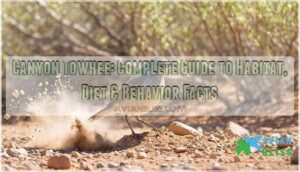 You’ll find the canyon towhee scratching through desert soil with both feet, hunting seeds and insects in America’s Southwest.
This plain brown, ground-dwelling sparrow calls the rocky terrain and sparse scrubland home, preferring remote areas over suburban neighborhoods.
Unlike its California cousin, the canyon towhee has distinct vocalizations that help identify it.
These desert specialists time their breeding perfectly with seasonal rains, ensuring plenty of food for their young.
They’re runners, not fliers—when startled, they’ll dash between bushes rather than take wing.
Their double-footed scratching technique and rain-synchronized breeding reveal fascinating survival strategies.
Table Of Contents
- Key Takeaways
- Physical Characteristics and Behavior
- Habitat and Feeding Habits
- Reproduction and Life Cycle
- Comparison With California Towhee
- Diet and Foraging Techniques
- Vocalization and Communication
- Geographical Distribution
- Conservation Status
- Human Interaction
- Interesting Facts
- Frequently Asked Questions (FAQs)
- Where do Canyon Towhees live?
- What are some interesting facts about the Canyon Towhee?
- What is the difference between Canyon and California Towhee?
- Is a California towhee a sparrow?
- What is the difference between Spotted Towhee and California Towhee?
- How do canyon towhees adapt to extreme desert temperatures?
- What are their main predators in their natural habitat?
- Do canyon towhees migrate seasonally?
- How long do canyon towhees typically live in the wild?
- Are there any folklore or cultural significance associated with canyon towhees?
- Conclusion
Key Takeaways
- You’ll recognize canyon towhees by their distinctive rusty-brown crown and robin-sized build – they’re perfectly camouflaged for desert living and use a signature "double-scratch" foraging technique to hunt seeds and insects under bushes, logs, and even parked cars.
- They’re desert specialists who time their breeding with seasonal rains – these monogamous birds raise 2-3 broods yearly, synchronizing reproduction with food availability to maximize their young’s survival chances.
- You’ll find them across the Southwest’s arid landscapes but they avoid urban areas – from Arizona to Texas, they prefer rocky canyons, desert scrub, and foothills between 1,000-7,500 feet elevation, staying away from cities and wet environments.
- They’re runners, not fliers, with stable populations despite environmental pressures – when startled, they dash between cover rather than take flight, and unlike many bird species, they maintain healthy numbers with over 2 million individuals classified as "Least Concern".
Physical Characteristics and Behavior
You’ll easily recognize canyon towhees by their robin-sized bodies, grayish-brown plumage, and distinctive reddish cap that helps them blend into their rocky desert surroundings.
These ground-dwelling birds display fascinating behaviors like their signature "double-scratch" foraging technique and show remarkable adaptability, ranging from shy wilderness dwellers to bold backyard visitors.
Appearance
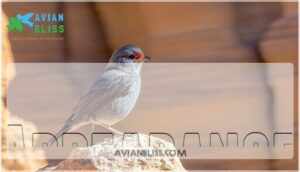
You’ll instantly recognize a canyon towhee by its robin-sized frame and distinctive plumage coloration. This medium-sized songbird sports grayish upper parts contrasting with its signature reddish-brown crown and whitish belly.
Its physical traits create perfect camouflage design for arid landscapes.
Key identification features:
- Size comparison – Measures 8-10 inches, similar to a robin’s dimensions
- Markings detail – Dark chest spot and buff undertail coverts stand out
- Juvenile appearance – Young birds show duller colors with streaked underparts
Behavior and Vocalization

The Canyon Towhee’s behavior reveals fascinating adaptive strategies through their distinctive vocalizations and social interactions.
You’ll observe these key behavioral patterns:
- Foraging behavior: Uses signature "double-scratch" method while ground-feeding
- Song variations: Produces melodic "chee-chee-chee" sequences with remarkable vocalization complexity
- Bird calls: Sharp "seep" alarm notes signal danger to nearby towhees
- Social interactions: Demonstrates non-aggressive flocking behavior unlike territorial bird behavior patterns
Their towhee song serves essential communication functions for survival and reproduction success.
Habitat and Feeding Habits
You’ll find canyon towhees thriving in the dry foothills, canyons, and scrublands of the Southwest, where they’ve mastered ground-level living.
These adaptable birds scratch through dirt and debris under bushes, logs, and even parked cars, using their signature double-scratch technique to uncover seeds and insects.
Preferred Habitat
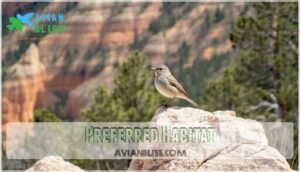
You’ll discover Canyon Towhee bird habitat spans the Desert Southwest’s Arid Scrublands, where these adaptable birds showcase remarkable Habitat Versatility.
From rocky canyons to pinyon-juniper woodlands, they thrive at various Elevation Preferences while consistently Avoiding Urbanization and wet environments.
Their arid habitats perfectly match their ground-foraging lifestyle.
To enhance nesting success, consider providing artificial nesting sites in suitable locations.
| Preferred Terrain | Avoided Areas |
|---|---|
| Rocky foothills | Urban developments |
| Chaparral brushlands | Wet riparian forests |
| Desert scrublands | Coastal regions |
Feeding Behavior

You’ll observe these southwest birds using their signature "double-scratch" feeding behavior, rapidly kicking back dirt and debris to uncover hidden treasures.
Their diet adaptations help them thrive in harsh foraging locations where food competition runs high.
You can supplement their diet with quality bird seed.
- Seeds and grains scattered beneath desert shrubs
- Protein-rich insects hiding under rocks and logs
- Seasonal berries during rare abundant periods
- Small gravel pieces supporting their nutritional needs for digestion
Reproduction and Life Cycle

You’ll find canyon towhees follow fascinating breeding patterns that reflect their desert adaptations.
These monogamous birds typically raise 2-3 broods each year, with females building sturdy nests in shrubs or cacti 3-12 feet above ground, which is a notable desert adaptation.
Nesting Habits
When you spot these ground-dwelling birds, you’ll notice their impressive nest construction skills.
Females carefully build cup-shaped nests using grasses, twigs, and plant stems, typically placing them 3-12 feet high in shrubs or small trees.
Each clutch contains 2-4 eggs with an 11-day incubation period.
Both parents share fledgling care duties while staying alert for nest predators like snakes and hawks.
Habitat loss substantially impacts available nesting sites, which is a significant conservation concern.
Life Cycle and Breeding
You’ll witness fascinating mating habits as these birds form lifelong partnerships through dawn songs and courtship displays.
During egg incubation, females spend eleven days warming their 3-4 spotted eggs while males stand guard.
Nestling development occurs rapidly—chicks fledge in just eight days but depend on parental care for weeks.
Their brood frequency of 2-3 cycles yearly maximizes reproductive success through opportunistic nesting behavior timing.
They’re commonly found in scrubby Desert Southwest habitats.
Comparison With California Towhee
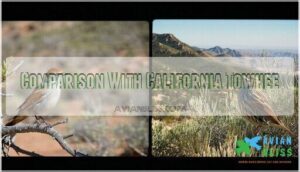
Now that you understand Canyon Towhee breeding habits, you’ll want to know how they compare to their California cousins. While these birds were once considered the same species, genetic divergence and morphological differences have clearly separated them.
Canyon towhees display a rusty crown and buff undertail coverts that California towhees lack. Their geographic range barely overlaps, with Canyon towhees preferring arid southwestern scrublands while California towhees stick to coastal chaparral.
Behavioral overlap exists in their ground-foraging habits, but vocalization similarities are minimal—Canyon towhees produce metallic "cheep" notes versus California towhees’ softer calls. For proper identification, focus on the Canyon towhee’s distinctive rusty cap and their preference for open, rocky terrain rather than dense vegetation.
| Feature | Canyon Towhee | California Towhee |
|---|---|---|
| Crown Color | Rusty-brown cap | Uniform brown |
| Habitat | Desert scrub, canyons | Coastal chaparral |
| Range | Southwest US/Mexico | California/Oregon |
| Calls | Metallic "cheep" notes | Soft, muted sounds |
| Urban Tolerance | Rural preference | Adapts to suburbs |
Diet and Foraging Techniques

You’ll find Canyon Towhees scratching through leaf litter and dirt with their signature "double-scratch" technique, hunting for seeds, insects, and small fruits.
These ground-dwelling birds prefer foraging under bushes, logs, and even parked cars, occasionally visiting backyard feeders for sunflower seeds and millet, where they may also eat small fruits.
Food Preferences
Throughout the year, you’ll find Canyon Towhees adapting their bird diet based on seasonal availability.
Their feeding behavior shifts from primarily insect consumption during breeding season to increased seed selection in winter months.
You can even find specialty seed mixes designed for them.
- Seeds from grasses, shrubs, and forbs – especially milo, millet, and sunflower varieties
- Insects like beetles, ants, and caterpillars – providing essential protein during nesting
- Foraging locations under bushes and logs – where food naturally accumulates
- Seasonal diet changes – reflecting dietary adaptations to environmental conditions
Foraging Behavior
You’ll discover ground foraging mastery when watching Canyon Towhees use their signature double-scratch technique.
They leap forward, then kick both feet back simultaneously, creating rustling sounds in leaf litter.
This foraging behavior efficiently uncovers seeds and insects year-round.
They’re commonly found in Southwest canyons, often near low brush.
Seasonal variation shows more insects in summer, mostly seeds in winter, demonstrating remarkable diet adaptations and foraging efficiency.
Vocalization and Communication

Canyon towhees possess a surprisingly diverse vocal repertoire that serves multiple communication purposes throughout their daily lives.
Unlike many songbirds with elaborate melodies, these desert dwellers rely on practical, efficient bird sounds that cut through their arid environments.
Their vocal learning abilities adapt to local conditions, with song complexity varying based on habitat density and social interactions.
You’ll notice three distinct communication patterns:
- Contact calls – Soft "chip" notes maintain pair bonds during foraging
- Alarm sequences – Rapid staccato patterns alert others to predators
- Territory songs – Loud "chee-chee-chee" calls establish breeding boundaries
Call variations include the distinctive "kyerr" sound, similar to woodpecker vocalizations, which functions in courtship displays.
Duet singing between mates creates the melodic "squeal duet" that strengthens pair bonds during nesting season.
Their acoustic adaptation allows bird calls to travel effectively across open scrublands, with frequencies ranging 4-8 kHz.
This vocal repertoire reflects their behavioral flexibility – from shy wilderness birds to bold suburban visitors.
Each call pattern serves specific social functions, making canyon towhees remarkably vocal despite their unassuming appearance in the brushy landscapes they call home.
Geographical Distribution

From the southwestern United States down into Mexico, you’ll discover this remarkable canyon bird thriving across diverse landscapes.
The Canyon Towhee’s geographical distribution spans from southern Colorado and Utah through Arizona, New Mexico, and Texas, extending into northern and central Mexico.
Habitat Variation defines their range perfectly.
These birds inhabit desert scrub, mesquite flats, and pinyon-juniper woodlands between 1,000-7,500 feet Elevation Range.
Regional Abundance peaks in foothills and canyon slopes below 6,000 feet, where rocky terrain meets scattered brush.
Climate Influence shapes their Southwest territories, favoring arid conditions over wet forests.
While Range Expansion remains limited by habitat availability, stable populations occupy the same bird range year-round.
Competition with California Towhees restricts westward movement, while Mexico’s northern regions provide southern habitat continuity for this adaptable species.
Conservation Status

Despite common concerns about habitat loss, Canyon Towhees actually enjoy a stable conservation status. The IUCN Red List classifies them as "Least Concern," with population trends showing over 2 million mature individuals worldwide.
You’ll find this resilience surprising given ongoing environmental challenges. While climate change and urban expansion pose future threats, current surveys reveal steady populations across most ranges.
Unlike many bird conservation stories, Canyon Towhees haven’t experienced substantial declines from habitat fragmentation. Climate impacts remain the primary long-term concern, potentially altering vegetation zones these birds depend on.
However, conservation efforts focus on maintaining shrubland quality through partnerships between state agencies and nonprofits. Bird conservation efforts include volunteer monitoring programs and habitat restoration projects.
Models project stable populations through 2050, barring major environmental disruptions. The species’ adaptability to various habitats—from remote wilderness to suburban edges—contributes notably to their conservation success story.
Human Interaction
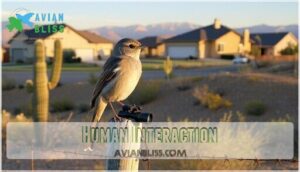
Unlike most birds that adapt to city life, Canyon Towhees practice urban avoidance, preferring wild landscapes over developed areas.
You’ll find these birds steering clear of heavily populated zones, though habitat encroachment from expanding suburbs continues pressuring their territories.
Human interaction with Canyon Towhees remains minimal since they favor remote, lightly trafficked areas.
However, birdwatching enthusiasts can observe these fascinating birds in their natural scrublands, where their distinctive behaviors and calls create memorable encounters.
Conservation efforts focus on protecting critical habitats from development pressures.
Public awareness campaigns highlight how urbanization fragments their territories, while climate change impacts threaten their arid ecosystem preferences.
These birds often participate in dominance hierarchy displays to secure resources.
Here’s how humans affect Canyon Towhees:
- Road construction increases fledgling mortality from vehicle strikes
- Suburban landscaping creates new foraging opportunities in residential areas
- Agricultural development exposes birds to harmful pesticides
- Conservation support through habitat preservation programs
- Citizen science projects track population trends and distribution changes
Their resilience inspires hope for successful coexistence.
Interesting Facts
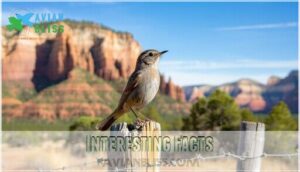
You’ll discover that Canyon Towhees have fascinating taxonomic history – they were once grouped with California Towhees as "brown towhees" until DNA analysis revealed they’re actually different species.
This versatile towhee serves as a speciation model for scientists studying how birds evolve.
These remarkable birds form lifelong bonds with their mates, staying together year after year.
You might spot them foraging under your parked car – they’re not picky about where they scratch for food!
Their interesting facts include being one of the most adaptable towhees, thriving everywhere from remote canyons to suburban backyards.
Flightless birds, like the kiwi, often exhibit smaller wing bone structures.
Unfortunately, population decline has been noted in recent surveys.
Unlike their California Towhee cousins who stick to coastal areas, Canyon Towhees roam the interior Southwest.
Birdwatching enthusiasts appreciate their subtle beauty and quiet nature.
Their bird behavior includes that distinctive double-scratch foraging technique that makes them easy to identify once you know what to look for.
Frequently Asked Questions (FAQs)
Where do Canyon Towhees live?
You’ll find these adaptable birds throughout the Southwest’s dry canyons, foothills, and desert scrublands from Arizona to Texas.
They thrive in rocky areas with scattered brush, avoiding urban centers and wet forests completely.
What are some interesting facts about the Canyon Towhee?
While other birds flee harsh desert heat, you’ll find Canyon Towhees thriving there, using their signature "double-scratch" foraging technique to uncover food beneath parked cars and logs.
What is the difference between Canyon and California Towhee?
Canyon Towhees feature faint rusty caps and spotty necklaces with central breast spots, while California Towhees lack these distinctive markings and appear more uniformly brownish-gray throughout their plumage.
Is a California towhee a sparrow?
California Towhees aren’t technically sparrows, though they’re closely related.
You’ll find them classified in the family Passerellidae alongside other towhees, while true sparrows belong to Passeridae.
Both groups share similar ground-foraging habits and seed-eating behaviors.
What is the difference between Spotted Towhee and California Towhee?
Like spotting twin birds through your binoculars, these towhees share scratching habits but wear different outfits.
Spotted Towhees show heavy white spotting on their upperparts, while California Towhees sport solid brown plumage without spots—think casual vs. formal dress codes!
How do canyon towhees adapt to extreme desert temperatures?
You’ll find these desert survivors use behavioral tricks to beat the heat.
They forage during cooler dawn and dusk hours, seek shade under shrubs, and reduce activity during scorching midday temperatures.
What are their main predators in their natural habitat?
Predators you’ll encounter hunting these birds include snakes that raid their nests, along with various predatory birds like hawks and owls that target both adults and young throughout their desert habitat.
Do canyon towhees migrate seasonally?
You won’t see canyon towhees packing their bags for winter getaways. They’re classified as non-migratory birds that stick around their southwestern territories year-round, staying sedentary in their favorite scrublands.
How long do canyon towhees typically live in the wild?
Time counts like grains of sand slipping away, yet the oldest recorded Canyon Towhee was at least 7 years, 2 months old.
You can expect these desert-dwelling sparrows to typically live shorter lifespans, though exact wild longevity data remains limited, which makes understanding their full lifespan limited.
Are there any folklore or cultural significance associated with canyon towhees?
Folklore around birds isn’t well-documented for this specific species.
However, general towhee symbolism includes prophecies and blessings from the spirit world in Native American traditions.
They represent stability, adaptability, resilience, and connection with nature.
Conclusion
Knowledge is power, and you’ve now gained valuable insights into the canyon towhee’s remarkable desert adaptations.
This hardy sparrow demonstrates nature’s ingenuity through its synchronized breeding, efficient foraging methods, and ground-dwelling lifestyle.
Whether you’re a birder exploring Southwest landscapes or simply curious about wildlife, understanding the canyon towhee enriches your appreciation for desert ecosystems.
These resilient birds continue thriving in harsh environments, proving that specialized adaptations guarantee survival in challenging habitats.
- https://www.allaboutbirds.org/guide/Canyon_Towhee/overview
- https://www.birdwatchingacademy.com/canyon-towhee/
- https://peecnature.org/learn/nature-guides/featured-critters/canyon-towhee/
- http://www.bird-friends.com/BirdPage.php?name=Canyon+Towhee
- https://www.biologicaldiversity.org/species/birds/Inyo_California_towhee/natural_history.html