This site is supported by our readers. We may earn a commission, at no cost to you, if you purchase through links.
 You’ll find the black rosy finch in North America’s highest mountain peaks, where these hardy birds thrive above the treeline on rocky cliffs and alpine terrain.
These medium-sized finches sport nearly black plumage with distinctive gray crowns and rosy-pink wing patches that catch the light.
During breeding season, males develop rich blackish coloring with pink highlights on wings and belly, plus a black bill.
Winter transforms them into brownish birds with yellow bills, though those signature rosy wing markings remain.
They’re tough survivors who descend to lower elevations when deep snow hits, often appearing at snow edges and backyard feeders.
Their notched tails and unique coloring patterns hold secrets that separate them from their rosy-finch cousins.
Table Of Contents
- Key Takeaways
- Black Rosy-Finch Habitat
- Comparison With Gray-crowned Rosy-Finch
- Breeding and Nonbreeding Plumage
- Distinguishing Features From Brown-capped Rosy-Finch
- Conservation Efforts and Climate Change Impacts
- Frequently Asked Questions (FAQs)
- What is a Black Rosy-Finch?
- Where does the Black Rosy-Finch live?
- What does a rosy finch look like?
- Where do black rosy finch nest?
- When do black rosy finch birds breed?
- Are black rosy finch endangered?
- Are black rosy-finches endangered?
- Where do black rosy-finches live?
- Is there a black finch?
- What is the rarest finch bird?
- Conclusion
Key Takeaways
- You’ll find black rosy finches thriving in North America’s highest mountain peaks – they breed above the treeline on rocky cliffs and alpine terrain, then descend to lower elevations during harsh winters.
- You can identify them by their distinctive seasonal appearance changes – breeding males show jet-black plumage with pink wing patches and yellow bills, while winter birds turn brownish with black bills but keep those signature rosy markings.
- You’re looking at an endangered species facing serious climate threats – with only about 4,000 pairs remaining globally, rising temperatures could eliminate 70% of their alpine habitat by 2100.
- You can distinguish them from similar rosy finches by their darker coloration – they’re much blacker than Brown-capped Rosy-Finches and maintain consistent dark tones compared to the lighter, more variable Gray-crowned species.
Black Rosy-Finch Habitat
You’ll find Black Rosy-Finch in Alpine Breeding Grounds above the treeline, where these hardy high altitude birds thrive among rock piles and cliffs.
This alpine bird species calls the northern Great Basin home, from northeastern Nevada to southwestern Montana.
During winter, they abandon their lofty perches for Winter Valley Havens in open country, mountain meadows, and high deserts.
This Altitudinal Migration helps them survive harsh conditions.
They’re clever foragers, hopping along melting snow edges to find exposed seeds and insects.
Their survival depends on unique bird habitats that provide necessary resources.
Unfortunately, Climate Impacts threaten their finch habitat through Habitat Loss.
Rising temperatures shrink their alpine territories, forcing these specialized birds to seek new breeding sites.
You’ll spot Black RosyFinch flocks moving between elevations seasonally, adapting to changing conditions in their rugged mountain homes.
Comparison With Gray-crowned Rosy-Finch

Distinguishing between the black rosy finch and Gray-crowned Rosy-Finch becomes easier when you know what to look for. The black rosy finch displays darker, almost uniform blackish plumage, while the Gray-crowned shows lighter coloration with its signature gray crown patch.
Range Overlap occurs in Rocky Mountain regions during winter, creating opportunities for direct comparison.
| Feature | Black Rosy-Finch | Gray-crowned Rosy-Finch |
|---|---|---|
| Body Color | Nearly black overall | Gray crown, lighter body |
| Size Differences | Slightly smaller build | Generally larger frame |
| Vocalizations | Harsh, buzzy calls | Melodic chittering notes |
Plumage Overlap similarities include pink wing highlights in both species, though the black rosy finch shows more consistent coloration. Genetic Divergence explains their distinct appearances despite shared ancestry.
During bird identification, focus on the crown coloring and overall darkness. The Gray-crowned’s variable subspecies create more plumage description complexity compared to the black rosy finch’s uniform appearance. Rosy finch identification relies heavily on these key visual differences.
Breeding and Nonbreeding Plumage
You’ll notice the Black Rosy-Finch transforms dramatically between seasons, making identification tricky without knowing what to look for.
During breeding season, males display striking jet-black plumage with bright pink highlights, while their winter appearance shifts to brownish-black with muted colors and a contrasting gray crown.
Breeding Plumage

Breeding adult black rosy finches transform dramatically during mating season.
Males develop intense black plumage with striking plumage brightness across their head, back, and breast.
Sexual dimorphism becomes obvious as female plumage remains slightly duller than males.
The crown patch stays gray, contrasting sharply with dark feathers.
Pink extent increases on wings and flanks through seasonal molting.
Many bird species use bright plumage for attraction to attract mates.
Key breeding features:
- Glossy black body with gray crown patch
- Bright pink highlights on wings and belly
- Yellow bill replacing winter’s dark coloration, which is a notable breeding feature and an example of sexual dimorphism in action.
Nonbreeding Plumage
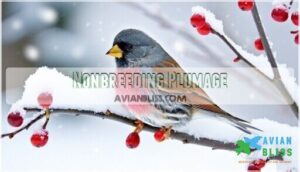
When winter arrives, you’ll notice the Black rosy finch transforms dramatically.
The nonbreeding adult loses its striking black coloration, becoming grayish-brown overall. Pink reduction occurs substantially on wings and belly, while the gray crown becomes more prominent.
Juveniles show buffy wingbars during this season. Bill coloration shifts from black to yellow, making winter appearance identification easier for birders studying nonbreeding plumage patterns.
Some birders even purchase items related to finch winter plumage to better understand these changes.
Bill Color

You’ll notice the black rosy finch undergoes dramatic seasonal changes in bill color.
During breeding season, its bill morphology features a striking yellow hue that contrasts beautifully with dark plumage. Come winter, the bill shifts to black, matching the bird’s subdued tones.
This color genetics adaptation helps with bird identification guide accuracy. Juvenile bill coloration follows similar patterns, though diet influence and age affect intensity.
Some speculate that diet affects vibrancy of the beak. Understanding these finch species traits makes bird coloration identification much easier for observers tracking these remarkable alpine birds.
Distinguishing Features From Brown-capped Rosy-Finch
You can tell Black Rosy-Finches apart from Brown-capped Rosy-Finches by looking at their overall darkness and head patterns.
Black Rosy-Finches show much darker plumage compared to the brownish tones of Brown-capped Rosy-Finches, and they maintain their gray crown patch year-round.
Brown-capped birds lack this distinctive head marking.
Coloration During Breeding
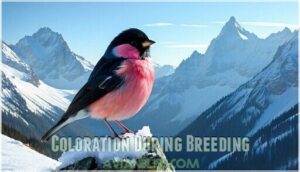
You’ll spot the Black Rosy-Finch’s darkest breeding plumage among finch bird species in the Fringillidae family.
Males showcase deep blackish-brown coloration with rosy-pink belly patches, demonstrating clear Sexual Dimorphism.
This Plumage Intensification creates striking Color Signaling for territory defense.
Factors influencing finch plumage variations can be complex.
The dramatic bird coloration shift from duller nonbreeding tones helps distinguish this bird species from brown-capped relatives during breeding season.
Beak Color Variations

When you’re examining finch bird species in the field, the Black Rosy-Finch’s seasonal bill color changes offer key diagnostic characteristics.
Unlike the Brown-capped Rosy-Finch’s consistent pale horn bill, Black Rosy-Finches show dramatic bill morphology shifts:
- Breeding colors: Deep black bill contrasts sharply with dark plumage
- Winter transformation: Bill turns bright yellow for easy identification
- Juvenile beaks: Display pale yellow similar to nonbreeding adults
- Diet influence: Bill color timing aligns with seasonal food availability changes
These physical characteristics make field identification reliable across seasons.
Seasonal Plumage Differences
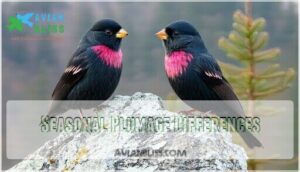
How do plumage transitions help you separate Black from Brown-capped Rosy-Finches?
Black Rosy-Finches maintain darker, more saturated colors year-round with distinct pink highlights on wings.
Their crown color stays markedly darker than Brown-capped species, and bill variation shifts from yellow (winter) to black (breeding).
Juvenile plumage appears brownish but still darker than Brown-capped counterparts, making rocky mountain birds identification clearer through consistent darker tones across seasons.
Conservation Efforts and Climate Change Impacts

Every year, scientists witness concerning population trends as Leucosticte atrata faces mounting climate threats. The species earned its Endangered status from the IUCN due to severe climate vulnerability affecting its specialized alpine habitat.
Climate change poses the greatest risk, with models predicting up to 70% habitat loss by 2100. Rising temperatures push suitable conditions higher up mountains, shrinking available breeding areas. This creates a real squeeze play – there’s literally nowhere left to go when you’re already at the top.
Conservation efforts involve over 85 stakeholders using structured decision-making to rank mitigation strategies. Researchers employ radio-frequency tracking and stable isotope analysis to understand movement patterns across protected areas. The Black Rosy-Finch frequents high alpine tundra, often near other bird species.
- Picture vast alpine snowfields slowly melting away, leaving behind bare rock where once-thriving finch colonies nested in cliff crevices.
Climate change is literally moving these birds off the map as their mountain homes disappear.
The U.S. Forest Service manages nearly all breeding range, making coordinated land management essential. While winter population trends show slight increases in Wyoming, the species remains vulnerable due to fragmented, specialized habitat requirements.
Frequently Asked Questions (FAQs)
What is a Black Rosy-Finch?
Birds of a feather flock together, and you’ll find Black Rosy-Finches are medium-sized alpine finches with striking black plumage, pink wing highlights, and gray crowns.
They breed above treeline in western mountains.
Where does the Black Rosy-Finch live?
You’ll find Black Rosy-Finches breeding in alpine areas above treeline across six western states—Montana, Idaho, Wyoming, Utah, Nevada, and Oregon.
They winter in lower valleys, deserts, and plains throughout the region.
What does a rosy finch look like?
You’ll spot a rosy finch by its medium size, conical bill, and striking seasonal changes.
Breeding adults display dark black plumage with gray crowns and pink wing highlights, while nonbreeding birds appear brownish-gray with subtle pink touches.
Where do black rosy finch nest?
Picture a mountaineer discovering a nest tucked in Glacier National Park’s cliff face.
You’ll find these birds nesting in well-protected rock crevices and cliff cavities above treeline, often in spots so inaccessible that predators can’t reach them.
When do black rosy finch birds breed?
You’ll witness their courtship during mid-summer when mountain peaks warm up.
These hardy birds breed only once yearly, timing their nesting with the brief alpine growing season when snowfields start melting.
Are black rosy finch endangered?
Approximately 4,000 pairs remain globally.
The International Union for Conservation of Nature (IUCN) considers it, and the Black Rosy-Finch, Endangered, while The U.S. Fish and Wildlife Service, Partners in Flight, Utah Division of Wildlife Resources, and U.S. Forest Service identify Black Rosy-finch as a species of conservation concern.
Are black rosy-finches endangered?
These birds aren’t officially endangered, but you’ll find them struggling. Climate change threatens 79 percent of their suitable habitat, making conservation essential for their alpine mountain survival.
Where do black rosy-finches live?
You’ll find these finches breeding in alpine areas above treeline across six western states – Montana, Idaho, Wyoming, Utah, Nevada, and Oregon, then moving downhill to valleys during winter.
Is there a black finch?
Yes, you’ll encounter the Black Rosy-Finch, a distinctive dark finch species.
These birds sport mostly black plumage with pink wing highlights and gray crown patches, making them unique among North American finches.
What is the rarest finch bird?
Like finding a needle in a haystack, you’ll discover the mangrove finch is your answer.
With just 100 individuals remaining, this critically endangered Darwin’s finch from the Galápagos represents the world’s rarest finch species, clinging to survival in diminishing mangrove habitats.
Conclusion
Recognizing the black rosy finch transforms your mountain birding adventures into rewarding identification challenges.
You’ll spot these resilient alpine specialists by their distinctive rosy wing patches, seasonal bill color changes, and preference for rocky terrain above treeline.
Climate change threatens their high-altitude habitats, making conservation efforts essential for their survival.
When you encounter these hardy birds during winter descents or at backyard feeders, you’re witnessing nature’s remarkable adaptation to extreme mountain environments.