This site is supported by our readers. We may earn a commission, at no cost to you, if you purchase through links.
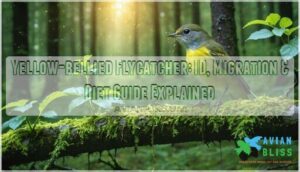 You’ll spot a yellow bellied flycatcher by its olive-green back, bright yellow belly, and distinctive white eye-ring that gives it a perpetually surprised expression.
This sparrow-sized insectivore inhabits dense boreal forests from Canada to the northeastern United States.
During breeding season, you’ll find them in moist, moss-rich environments where they expertly snatch flying insects from perches or glean prey from foliage.
These remarkable migrants navigate thousands of miles to Central American wintering grounds using star patterns and magnetic fields.
Despite their small stature, they’re surprisingly territorial and build well-camouflaged nests from moss and fine materials.
Their specialized diet and specific habitat requirements make them excellent indicators of forest ecosystem health.
Table Of Contents
- Key Takeaways
- Identifying Yellow-bellied Flycatchers
- Migration Patterns of Yellow-bellied Flycatchers
- Fun Facts About Yellow-bellied Flycatchers
- Dietary Needs of Yellow-bellied Flycatchers
- Conservation and Population Trends
- Physical Characteristics
- Vocalizations and Sounds
- Geographic Range and Habitat
- Breeding and Wintering Range
- Migration Routes
- Timing of Migration
- Unique Behaviors
- Breeding and Nesting Habits
- Ecological Importance
- Natural Diet in The Wild
- Feeding Preferences in Captivity
- Possible Supplements
- Overall Population Decline
- Specific Threats to Their Survival
- Conservation Efforts and Initiatives
- Frequently Asked Questions (FAQs)
- What does a yellow-bellied flycatcher look like?
- Where do yellow-bellied flycatchers live?
- What is a yellow-bellied flycatcher’s song?
- Are yellow-bellied flycatchers common at bird feeders?
- What does a yellow-bellied flycatcher eat?
- What does a small flycatcher look like?
- How do you identify a Yellow-bellied Flycatcher?
- Do Yellow-bellied Flycatchers migrate?
- What are some fun facts about Yellow-bellied Flycatchers?
- What to feed a Yellow-bellied Flycatcher?
- Conclusion
Key Takeaways
- You’ll identify yellow-bellied flycatchers by their olive-green backs, bright yellow bellies, and distinctive white eye-rings that create a spectacled appearance in dense boreal forests.
- You can witness their remarkable migration as they travel thousands of miles at night from Canadian breeding grounds to Central American rainforests using star patterns and magnetic navigation.
- You’ll find these specialized insectivores serving as excellent indicators of forest ecosystem health since they depend on moist, moss-rich environments where insects thrive.
- You should know their populations have declined 29% since 1966 due to habitat loss, climate change, and forest fragmentation threatening their survival across North America.
Identifying Yellow-bellied Flycatchers
Spotting a yellow bellied flycatcher requires attention to key plumage details. You’ll notice their vibrant yellow belly and throat contrasting with olive-green upperparts. The prominent white eye ring gives them a distinctive "spectacled" appearance that’s diagnostic among eastern flycatchers.
For size comparison, they’re sparrow-sized but smaller than an Eastern Phoebe. Their bill shape is remarkably broad and flat with an orange-pink lower mandible. Bird identification becomes easier when you recognize their compact build and big-eyed look.
Listen for vocal cues – their sharp "che-bunk" call is unmistakable. This bird color pattern and distinctive voice make field identification straightforward. Check your bird field guide for their preferred cool, moist coniferous habitats where these secretive birds hunt insects from low perches with quick, darting flights.
Migration Patterns of Yellow-bellied Flycatchers
Yellow-bellied flycatchers undertake remarkable journeys twice yearly, showcasing incredible endurance for such small birds.
These migratory birds face numerous challenges during their travels between breeding and wintering grounds.
Understanding their migratory patterns reveals fascinating adaptations:
- Nocturnal Migration: They travel primarily at night, using star navigation and magnetic fields to guide their journey across thousands of miles.
- Stopover Habitats: Forest edges, wetlands, and thickets provide essential rest stops where they refuel on insects before continuing their migration.
- Climate Impacts: Shifting weather patterns alter migratory timing, potentially disrupting synchronized arrival at breeding sites with peak insect abundance.
- Genetic Connectivity: Different populations follow distinct routes, maintaining genetic diversity across their range from Canada’s boreal forests to Central America’s highlands.
These bird migration strategies guarantee yellow-bellied flycatcher survival despite habitat fragmentation and environmental pressures affecting migratory patterns worldwide.
Protecting these vital stopover sites is essential for their continued success.
Fun Facts About Yellow-bellied Flycatchers
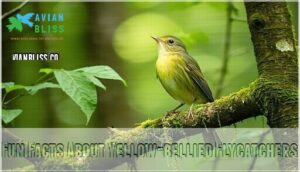
Behind the scenes of their well-documented migration routes, these small birds harbor some remarkable secrets. Often called the Moss Tyrant by researchers, this flycatcher species earned its nickname through its pugnacious defense of territory despite weighing less than half an ounce.
You’ll find their camouflaged nests are architectural marvels. Built entirely from moss and fine materials, they’re so well-hidden that even experienced ornithologists struggle to locate them. The female’s precision in construction reflects the species’ exacting nature.
Their short summers on breeding grounds last barely 70 days. That’s like cramming a year’s worth of work into two months. During this time, you’ll witness their agile flight patterns as they dart through dense canopy, catching insects mid-air with surgical precision.
Here’s what makes Yellowbellied Flycatcher truly unique among insectivorous birds: males perform elaborate aerial acrobatics during courtship, and their soft calls are easily mistaken for other species. Some birds also use anting for parasite control to maintain feather health. These bird identification tips prove invaluable when distinguishing this elusive small bird in the field.
Dietary Needs of Yellow-bellied Flycatchers

Understanding what fuels these insectivorous birds helps you appreciate their ecological role.
Empidonax flaviventris maintains a specialized insectivore diet, capturing flies, beetles, ants, wasps, moths, and spiders through precise foraging strategies.
You’ll notice they sally from perches to snatch flying prey or glean insects from foliage with remarkable accuracy.
Their menu occasionally includes seasonal berries during fall migration, providing essential fats for long journeys.
Habitat impact directly affects prey abundance – these birds depend on moist, moss-rich environments where insects thrive.
Their hunting behavior is an example of aerial feeding strategies.
Picture their hunting grounds:
Deep in misty boreal forests where insects thrive in every shadow and crevice
- Misty boreal forests buzzing with mosquitoes and gnats
- Damp moss beds harboring beetle larvae and spiders
- Shadowy spruce groves where moths flutter at dusk
- Bog edges alive with swarming midges
- Dense understory sheltering countless tiny invertebrates
When forests disappear or dry out, bird diet options shrink dramatically, affecting survival rates.
Conservation and Population Trends

You’ll find that Yellow-bellied Flycatchers face significant conservation challenges across their range.
These small forest guardians face an uncertain future as their boreal world shrinks beneath them
Climate change affects their migratory timing and habitat preferences, while habitat loss in both breeding and wintering areas threatens their survival.
Physical Characteristics
Most birders recognize this compact yellow bird by its distinctive plumage details and size comparison to other flycatchers.
Empidonax flaviventris displays olive-green upperparts with vibrant yellow underparts and throat.
Its prominent white eye ring creates a spectacled appearance, while the broad, flat bill shows orange-pink coloration on the lower mandible.
Juvenile markings include more buff-colored wing bars compared to adults, which can be a key identification feature.
Vocalizations and Sounds
Through careful listening, you’ll discover Empidonax flaviventris uses acoustic communication in fascinating ways.
Their vocalizations reveal complex song functions and call variations that make identification easier once you know what to hear:
- Sharp "che-bunk" call – primary contact sound during breeding season
- Soft "chu-wee" notes – territorial markers in dense forest canopy
- Whispered dawn songs – barely audible pre-breeding vocalizations
- Flight calls – high-pitched chips during nocturnal migration
- Regional dialects – subtle variations across different populations
These bird sounds demonstrate vocal learning abilities typical of flycatcher behavior patterns.
Geographic Range and Habitat
Yellow-bellied Flycatchers occupy specific geographic ranges across North America’s Boreal Forests.
Their bird habitat preferences center on:
- Dense, moist coniferous forests with thick moss layers
- Spruce bogs and forested peatlands in northern regions
- Mixed woodlands featuring balsam fir and white birch
- Cool, shady environments with damp ground cover.
Habitat Loss and Climate Impacts threaten their bird distribution patterns, specifically affecting their ability to thrive in these dense environments.
Breeding and Wintering Range
These breeding range birds nest in dense Canadian boreal forests, preferring cool nesting habitats with thick moss layers.
During wintering, they migrate south to Central American rainforests – a classic Neotropical birds pattern.
This altitudinal migration spans thousands of miles twice yearly.
Unfortunately, habitat loss threatens both their northern breeding grounds and tropical wintering locations, making conservation efforts essential for their survival.
Migration Routes
You’ll find these remarkable birds following three major bird migration routes across thousands of miles. Their nocturnal migration patterns connect Canadian boreal forests to Central America through complex flyway connectivity systems.
- Mississippi and Atlantic Flyways serve as primary corridors for bird species migration patterns
- Stopover habitats in southeastern wetlands provide essential refueling stations during long flights
- Genetic tracing reveals strong connections between breeding populations and wintering sites
Climate impacts increasingly affect traditional routes, forcing adaptations in these ancient pathways that have guided generations of flycatchers southward.
Timing of Migration
As migration routes wind south, Departure Dates shift with climate influence and insect abundance.
Arrival Peaks hit mid-May and early September, with Migration Speed varying nightly.
Stopover Duration depends on food and weather. These bird species migration patterns reflect population trends and nonbreeding season needs.
Peak migration occurs from late April to early May in many regions.
- Watch for sudden cold snaps sending flocks skyward
- Marvel at their precise timing year after year, which is crucial for successful migration.
Unique Behaviors
When observing these elusive birds, you’ll notice their pugnacious defense of territory despite their small size.
Males exhibit aggressive territorial behavior through sharp "che-bunk" vocalizations and agile flight patterns during courtship displays.
Their elusive nature makes them masters of stealth in mossy habitats.
| Behavior Type | Description |
|---|---|
| Territorial Defense | Aggressive calls and aerial displays |
| Courtship Ritual | Elaborate flight patterns with vocalizations |
| Feeding Strategy | Quick sallying flights to catch insects |
| Migration Pattern | Nocturnal long-distance travel |
| Nesting Approach | Secretive ground-level concealment |
Breeding and Nesting Habits
Peek into the Yellow-bellied Flycatcher’s nesting habits and you’ll spot careful routines:
- Courtship Rituals: Males sing and display to attract mates.
- Clutch Size: Females lay 2–5 eggs per nest.
- Nest Construction: Moss and rootlets create well-camouflaged ground nests.
- Fledgling Development: Naked nestlings stay 13–15 days, cared for by attentive parents, following a complete routine.
Ecological Importance
Like nature’s own pest control squad, Yellow-bellied Flycatchers act as tireless forest guardians maintaining ecosystem balance through their ecological importance.
These skilled insectivores keep insect populations in check while supporting forest health through complex ecosystem interdependence.
Their essential contributions include:
- Insect Population Control – reducing pest densities by up to 13% during breeding season
- Food Web Dynamics – transferring energy as both predator and prey species
- Habitat Health Indicator – their abundance signals intact boreal forest conditions
- Seed Dispersal assistance by controlling seed-eating beetles, boosting tree germination success
Natural Diet in The Wild
You’ll find Yellow-bellied Flycatchers maintain an insectivorous diet focused on aerial prey.
Their insect consumption includes flies, beetles, ants, wasps, and moths captured through precise foraging strategies.
These birds demonstrate remarkable prey variety, snatching gnats and mosquitoes mid-flight.
Their seasonal diet shifts slightly during fall migration when berry intake supplements their primary feeding preferences, supporting their energy needs through a slight change in their usual aerial prey consumption.
Feeding Preferences in Captivity
You’ll need a captive diet rich in live feeding options like mealworms, crickets, and fruit flies to mimic their natural insect prey.
Berry options become essential during colder months when insects aren’t available.
Insect substitutes should vary regularly to meet vitamin requirements and prevent deficiencies.
For specialized needs, consider exploring options for a complete captive diet.
Your feeding preferences must account for their supplementation needs through diverse feed additives and mineral supplementation for ideal health.
Possible Supplements
Nutritional support becomes essential when caring for captive Yellow-bellied Flycatchers.
These supplements help prevent nutritional deficiencies that wild birds avoid through diverse foraging.
- Vitamin requirements: Essential vitamins A, D, E, and K support immune function and bone development in captive diet programs.
- Mineral supplementation: Calcium and phosphorus maintain skeletal health, preventing common deficiency issues in confined birds.
- Feed additives: Mealworm benefits include protein-rich nutrition, while berry options provide natural antioxidants missing from basic diets.
Overall Population Decline
The numbers tell a sobering story.
Yellow-bellied Flycatcher populations have dropped 29% since 1966, with annual declines averaging 0.9% yearly.
North American Breeding Bird Surveys reveal major losses in southern boreal margins and fragmented habitats.
Habitat Loss from logging and Forest Fragmentation compound these population decline patterns.
Climate Change shifts breeding ranges northward while Insecticide Use reduces prey availability, creating a perfect storm threatening this species’ future survival across its breeding range.
Specific Threats to Their Survival
Currently, Yellow-bellied Flycatchers face mounting survival challenges.
Habitat loss and deforestation destroy their boreal breeding grounds, while forest fragmentation isolates remaining populations.
Climate change shifts suitable habitat northward, reducing available territory by 83% by 2080.
Industrial pollution introduces mercury and pesticides into their ecosystems.
Agricultural expansion eliminates wintering grounds in Central America.
These combined threats create a perfect storm driving population decline across their range.
They depend on boreal forest bogs for nesting.
Conservation Efforts and Initiatives
You can help protect Yellow-bellied Flycatchers through targeted conservation efforts.
These initiatives focus on habitat preservation and species conservation strategies that make a real difference.
- Habitat Preservation: Support protected reserves maintaining over 60% of breeding habitat
- Population Monitoring: Contribute to citizen science programs recording 5,000+ annual sightings
- Climate Resilience: Fund reforestation projects restoring 1,200+ acres of wintering habitat
- Reducing Pesticides: Advocate for forest management codes protecting boreal songbirds
Frequently Asked Questions (FAQs)
What does a yellow-bellied flycatcher look like?
You’ll spot this compact flycatcher’s olive-green back, bright yellow belly, and distinctive white eye-ring that gives it a big-eyed, spectacled look in mossy forests.
Where do yellow-bellied flycatchers live?
You’ll find these birds in Canada’s boreal forests, northern US coniferous woodlands, bogs, and swamps.
They prefer cool, moist environments with thick moss beds.
During winter, they migrate to Central American rainforests.
What is a yellow-bellied flycatcher’s song?
You’ll recognize this elusive songbird’s voice as a gentle whisper in the mossy wilderness.
The yellow-bellied flycatcher produces a soft "che-bunk" call and quiet songs that easily blend with forest sounds, making identification challenging even for experienced birders.
This makes identification challenging even for experienced birders.
Are yellow-bellied flycatchers common at bird feeders?
You won’t spot Yellow-bellied Flycatchers at your backyard feeders regularly. These insectivores rarely visit feeding stations, though they’ll occasionally grab mealworms or berries when offered during fall migration periods.
What does a yellow-bellied flycatcher eat?
Diet consists primarily of insects like flies, beetles, ants, wasps, and moths.
You’ll find them catching flying prey through quick sallying flights from perches.
They occasionally supplement with small berries during fall.
What does a small flycatcher look like?
You’ll notice these compact birds have big eyes and oversized heads that catch your attention immediately.
Their olive-green backs contrast with bright yellow bellies, while distinctive white eye rings create a spectacled look that’s unmistakable.
How do you identify a Yellow-bellied Flycatcher?
Like spotting a golden coin in moss-covered treasure, you’ll identify this small flycatcher by its bright yellow belly and throat, distinctive white eye ring, olive-green back, and broad flat bill.
In damp coniferous forests.
Do Yellow-bellied Flycatchers migrate?
Yellow-bellied Flycatchers migrate extensively between their northern breeding grounds and Central American wintering areas.
You’ll find them traveling at night, covering long distances from Canadian boreal forests to rainforests spanning southern Mexico through Panama.
What are some fun facts about Yellow-bellied Flycatchers?
Tiny yet fierce, you’ll discover these "moss tyrants" spend less than 70 days on breeding grounds.
They’re pugnacious nest defenders despite weighing only half an ounce, and they skillfully hide nests in damp moss beds.
What to feed a Yellow-bellied Flycatcher?
You’ll attract these insectivorous birds by offering live mealworms, small flies, or beetles rather than traditional birdseed. They prefer catching insects mid-flight, so consider creating a bug-friendly garden environment.
Conclusion
Like a tiny sentinel guarding the forest canopy, the yellow bellied flycatcher stands as nature’s perfect insect hunter.
You’ve now discovered how to identify these remarkable birds through their distinctive olive-green backs and bright yellow bellies.
Their incredible migration journeys span thousands of miles using celestial navigation.
You understand their specialized diet of flying insects and their role as ecosystem health indicators.
By recognizing their habitat needs and conservation challenges, you’re better equipped to appreciate these forest gems during your next birding adventure, and consider them as a forest gem.
- https://www.uwgb.edu/birds/greatlakes/species/ybfl.htm
- https://www.pa.gov/agencies/pgc/wildlife/discover-pa-wildlife/yellow-bellied-flycatcher.html
- https://www.naturalheritage.state.pa.us/factsheets/11078.pdf
- https://explorer.natureserve.org/Taxon/ELEMENT_GLOBAL.2.105866/Empidonax_flaviventris
- https://en.wikipedia.org/wiki/Yellow-bellied_flycatcher