This site is supported by our readers. We may earn a commission, at no cost to you, if you purchase through links.
If you’ve ever watched a flock of finches tear through a pine cone, you’ll notice most birds struggle—except the red crossbill. Its bill doesn’t just look odd; it’s a precision instrument, evolved for one purpose: prying seeds from the tightest conifer cones.
You’ll find these birds wherever evergreens dominate, from coastal rainforests to high mountain woods, tracking food with uncanny precision. Their nomadic lifestyle, striking plumage, and unusual feeding habits make them stand out in any forest.
Understanding the red crossbill means decoding a bird that’s shaped by its environment, its diet, and the unpredictable rhythms of the trees it calls home.
Table Of Contents
- Key Takeaways
- Red Crossbill Identification and Features
- Habitat and Geographic Distribution
- Diet and Foraging Behavior
- Social Structure and Breeding Habits
- Conservation Status and Ecological Role
- Frequently Asked Questions (FAQs)
- Where can I find Red Crossbills?
- Are Red Crossbills rare?
- What is the difference between a pine grosbeak and a Red Crossbill?
- How do you identify a Red Crossbill?
- Where are Red Crossbills found?
- What is the difference between a crossbill and a house finch?
- Are Red Crossbills endangered?
- How do you identify a red crossbill?
- What is the difference between a red crossbill and a pine grosbeak?
- What is the difference between purple finch and Red Crossbill?
- Conclusion
Key Takeaways
- The red crossbill’s crossed bill is a specialized adaptation that lets it efficiently extract seeds from tightly closed conifer cones.
- This finch tracks cone crops across North America’s mature coniferous forests, shifting its range and flocking patterns based on food availability.
- Males show brick-red plumage while females and juveniles display olive or brown tones, making identification easier alongside the unique bill shape.
- The species plays a key ecological role as a seed disperser in conifer forests, with stable global populations but localized threats from habitat loss and declining cone crops.
Red Crossbill Identification and Features
You can’t mistake a Red Crossbill once you know what to look for. This stocky finch has evolved one of nature’s most specialized tools—a bill with tips that cross like scissor blades, perfectly adapted for prying seeds from tightly closed conifer cones.
If you’re curious about how bill shapes help identify other birds, breaks it down with clear examples.
Understanding the key field marks, from that unusual bill structure to the striking differences between male, female, and juvenile plumage, will help you confidently identify this notable bird in the field.
Distinctive Crossed Bill Structure
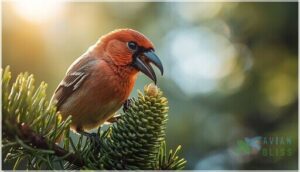
You’ll recognize the Red Crossbill’s most striking feature immediately—the upper mandibles cross near the tip, creating a specialized tool for seed extraction. This unique bill shape allows sideways twisting motions that pry seeds from tightly closed conifer cones.
The strongly arched culmen grips cone scales firmly, while reinforced keratin at the bill tip resists wear from hard cone material, optimizing foraging efficiency.
Male, Female, and Juvenile Plumage
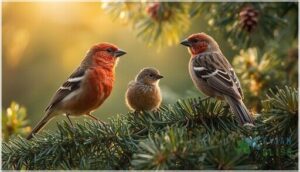
Beyond that impressive bill, you’ll spot Red Crossbill characteristics through distinctive sex differences. Males display brick-red to crimson plumage on the head and body, while females show brownish-olive tones with subtle streaking.
Juveniles wear streaked brown feathers until their first molt cycles reveal adult color variation:
- Males gain bright red interscapular feathers during initial molts
- Females maintain cryptic brownish-gray coloration year-round
- Juvenile plumage features softer colors and faint mottling
- Postbreeding molt replaces juvenile feathers with adult patterns
- Winter plumage becomes less vivid in males for energy conservation
To better understand molting and seasonal color changes, see.
Comparison With Similar Species
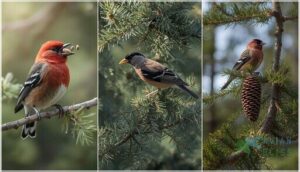
When you compare Red Crossbill (Loxia curvirostra) to the common crossbill or Cassia Crossbill, you’ll notice bill shape variations that reflect beak adaptations for seed extraction from different conifers.
Habitat partitioning reduces competition among bird species—White-winged Crossbills favor spruce stands while Red Crossbills concentrate on pine and Douglas-fir. Plumage comparisons reveal similar sexual dimorphism, though Purple Finches lack the crossed mandibles entirely.
For more on how Purple Finches adapt to mixed forests, check out this.
Bird Identification Techniques
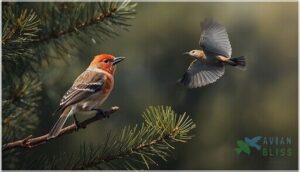
When identifying Red Crossbill in the field, you’ll want to note the distinctive silhouette ID—that uniquely curved bill profile is visible even at distance. Wing shape appears square with a short tail, while body length reaches 12 to 13 centimeters.
Listen for soft, high-pitched chip calls, and watch for the bobbing flight pattern that separates this species from other finches during rapid foraging movements.
For more tips, you can learn about the importance of size and shape identification keys to sharpen your birding skills.
Habitat and Geographic Distribution

Red Crossbills don’t settle just anywhere—they’re tightly tied to mature coniferous forests where cone crops are abundant and accessible.
You’ll find them spread across a vast range in North America, from coastal rainforests to high-elevation montane woodlands. Their distribution shifts constantly as they track food availability, making them one of the continent’s most nomadic finches.
Preferred Coniferous Forests
You’ll find Red Crossbills in mature coniferous forests where evergreens dominate the canopy. These forest habitats include spruce, pine, fir, and hemlock stands that produce abundant conifer seeds.
Tree species diversity varies by forest elevation, with taiga zones in the north and montane conifers at higher altitudes. Seed crop variability drives habitat selection, though habitat fragmentation can limit available conifer tree types across their range.
Regional Range in North America
Across North America, you’ll encounter Red Crossbills from Alaska’s boreal zones to Newfoundland’s taiga forests, with populations extending through the northern United States and into montane regions of the Appalachians, Rockies, and Sierra Nevada.
Their geographic distribution of birds follows coniferous corridors where forest ecology fosters cone production, though habitat fragmentation and climate influences drive regional range shifts and migration patterns reflecting geographic variations in seed availability.
Adaptation to Cone Crop Availability
You’ll see Red Crossbills master cone crop tracking through adaptive migration, shifting forests when seed crops fluctuate on multi-year cycles. Their nomadic lifestyle optimizes resource use.
Their strategies include:
- Foraging strategies targeting productive conifers while incorporating alternative seeds during scarcity
- Seed extraction techniques refined across seasons to enhance efficiency on varying cone types
- Avian adaptation allowing rapid relocation between regions as conifer cones appear or fail
Diet and Foraging Behavior
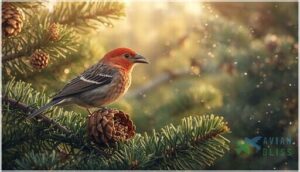
You won’t find many birds with a feeding strategy as specialized as the Red Crossbill’s. That distinctive crossed bill isn’t just for show—it’s a precision tool that opens up food sources other songbirds can’t access.
Here’s what you need to know about how these nomadic finches feed and what drives their unique foraging patterns.
Specialized Seed Extraction Methods
You’ll see the Red Crossbill‘s crossed bill work like precision pliers on conifer cones, prying scales apart to access hidden seeds. The upper and lower mandibles rotate independently, gripping cone surfaces while the tongue extracts individual seeds with notable efficiency.
This specialized feeding apparatus allows the bird to exploit tightly closed cones that other species can’t penetrate, functioning as both lever and wedge in rapid succession.
Primary and Supplementary Food Sources
Conifer cones supply your Red Crossbill’s primary diet, delivering high-fat seeds from pines, spruces, firs, and hemlocks that fuel daily flight and foraging activity.
When cone crops fail, you’ll observe these birds switching to alternative food sources—insect larvae extracted from bark, small hardwood seeds, catkins, and occasional berries—demonstrating impressive food adaptation strategies that maintain nutrient intake across unpredictable resource cycles.
Seasonal Feeding Patterns
You’ll notice your Red Crossbill’s foraging strategy shifts dramatically with cone crop variability, driving seasonal movements to track mast events. During abundant years, extended feeding bouts refine energy budgeting through efficient seed extraction methods on productive conifers.
Lean periods force diet diversification and longer daily foraging to maintain nutrient intake. This flexible feeding ecology—rooted in their specialized conifer seed diet and exceptional bird feeding adaptations—sustains populations across unpredictable resource landscapes.
Social Structure and Breeding Habits
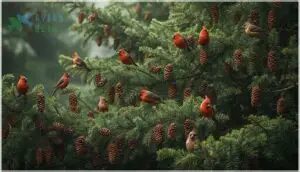
Red Crossbills don’t follow the typical songbird playbook in terms of social life and reproduction. Their unique lifestyle revolves around tracking unpredictable cone crops, which shapes everything from when they flock together to when they decide to nest.
Here’s what you need to know about their wandering ways and breeding patterns.
Flocking and Nomadic Movements
You’ll observe red crossbills in tight flocks that follow nomadic bird behavior, moving unpredictably across regions in pursuit of cone crops.
Their adaptive migration depends on flight coordination, where each bird reacts to roughly six neighbors through social learning.
These irruptive migrations can occur year-round, with flock dynamics enabling quick reassembly after roosting and cooperative foraging that reduces individual energy costs during long-distance nomadic patterns.
Breeding Timing and Nesting Sites
Red Crossbill breeding cycles follow cone crop availability rather than calendar dates, with nesting strategies that shift annually.
You’ll find their nests in forked branches or dense needle clusters of pines, spruces, and firs at mid to high canopy levels. Females select well-concealed sites using moss and lichen as nesting materials, which directly influences fledging success in these coniferous forests.
Parental Care and Chick Development
Once nesting is underway, your focus shifts to parental care—where both female and male crossbills excel. They use brooding behavior and feeding strategies to optimize chick growth.
Nest sanitation and parental bonding boost survival rates. You’ll see these four hallmarks:
- Frequent incubation bouts
- Regurgitated seed delivery
- Fastidious nest cleaning
- Continued provisioning post-fledging
Conservation Status and Ecological Role
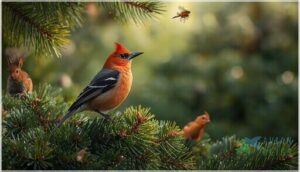
Understanding the Red Crossbill‘s place in forest ecosystems starts with its population status and role. You’ll want to know how these birds impact their habitat and what challenges they face.
Here are the key factors shaping their conservation outlook.
Current Population Trends
Have you ever wondered how Red Crossbill population dynamics mirror broader bird populations? Global estimates suggest 90–180 million mature individuals, with stable growth rates and low mortality factors.
Migration patterns respond directly to cone crop fluctuations, ensuring adaptive resilience. This conservation status reflects ongoing wildlife conservation efforts, highlighting the Red Crossbill’s ability to thrive amid environmental change and shifting population dynamics.
Ecological Importance in Forests
Cone crops form the heart of forest ecosystems, and your Red Crossbill acts as a keystone species in Biodiversity Conservation. By facilitating Seed Dispersal in coniferous forests, it aids bird habitat and distribution, enhances wildlife ecology, and bolsters Ecosystem Resilience.
The Red Crossbill is a keystone species, dispersing seeds that sustain conifer forests and strengthen ecosystem resilience
For instance, their foraging links Climate Regulation with nutrient cycling, maintaining ecological habitats across diverse conifers.
Conservation Efforts and Potential Threats
Resilience defines your Red Crossbill’s story, yet conservation biology highlights urgent needs.
Habitat Restoration and Forest Management counteract threats from logging, wildfires, and Climate Change.
Wildlife Protection relies on Seed Conservation and monitoring cone crops. You’ll find bird conservation programs weaving public outreach, collaborative research, and policy incentives, maintaining the conservation status of bird species and advancing wildlife conservation across fragmented conifer forests.
Frequently Asked Questions (FAQs)
Where can I find Red Crossbills?
You’ll locate these coniferous forest birds in mature pine, spruce, or fir stands across North America.
Their migration patterns follow seed availability, so flocking behavior shifts with habitat preferences and cone crops, demonstrating notable habitat specialization among conifers.
Are Red Crossbills rare?
With a global population estimated between 90–180 million, Red Crossbills aren’t rare overall.
However, Population Fluctuations and Rarity Patterns mean Regional Abundance varies, making them locally scarce in some areas despite their stable Conservation Status and Global Trends.
What is the difference between a pine grosbeak and a Red Crossbill?
Bill Shape and Beak Function set Pine Grosbeak apart from Red Crossbill—grosbeaks have stout, seed-cracking bills, while crossbills use specialized, crossed tips.
Plumage Variation and Foraging Style also differ, aiding bird identification techniques and species classification methods.
How do you identify a Red Crossbill?
Spotting a Red Crossbill comes down to its X-shaped bill—an essential clue in tricky bird identification.
Watch for intricate feather patterns, color variation in males and females, and unique beak function when applying your identification tips.
Where are Red Crossbills found?
You’ll find Red Crossbills across North America, especially in mature conifer forests.
Their broad geographic range shifts with cone crops, showcasing extraordinary adaptation.
Migration patterns are erratic; flocks follow conifer species abundance, revealing unique habitat diversity within forest ecology.
What is the difference between a crossbill and a house finch?
Imagine a bird with a toolkit for pinecones—crossbills possess crossed bills specialized for precise seed extraction in conifer forests.
While house finches, also from the finch family, use straight, conical bills and favor a broader seed diet and varied plumage color.
Are Red Crossbills endangered?
Red Crossbills aren’t endangered—their conservation status remains Least Concern with stable population trends.
However, localized forms like Newfoundland’s percna subspecies face critically endangered status due to habitat loss and declining cone crop availability, requiring targeted wildlife conservation efforts.
How do you identify a red crossbill?
Look for a distinctive crossed bill—the upper mandible curves over the lower. Males display brick-red plumage, females show greenish-yellow coloring, and both have dark wings with compact, stocky builds.
What is the difference between a red crossbill and a pine grosbeak?
Bill shapes separate these finch family members: crossbills wield crossed mandibles that pry conifer cones, while pine grosbeaks possess straight, sturdy beaks.
Plumage color differs too—crossbills display brick-red males versus grosbeaks’ rosy tones.
What is the difference between purple finch and Red Crossbill?
At a winter feeder, you’ll notice distinct bill shapes immediately.
Purple Finches have straight, conical bills for cracking seeds, while Red Crossbills possess crossed mandibles specialized for prying open conifer cones—a unique foraging adaptation.
Conclusion
Adaptation, movement, and specialization shape the red crossbill’s story—its crossed bill, its nomadic flocks, its relentless pursuit of conifer seeds.
You gain insight not just into a bird, but into a system: forests, cones, cycles of scarcity and abundance. Each observation reveals how finely tuned this species is to its environment.
If you spot a crossbill, you’re witnessing a living example of evolutionary ingenuity, a bird that thrives where others falter, and a key to understanding forest dynamics.
- https://macaulaylibrary.org/video/309251731
- https://science.nature.nps.gov/im/units/netn/monitor/programs/breedingLandbird/breedingLandbird.cfm
- http://ebird.org/ebird/map/redcro?neg=true&env.minX=-169.55275998787397&env.minY=-25.199942271260614&env.maxX=125.75974001212603&env.maxY=77.83375331946056&zh=true&gp=false&ev=Z&mr=1-12&bmo=1&emo=12&yr=cur
- https://www.allaboutbirds.org/science-at-work-how-many-kinds-of-red-crossbills-are-there-anyway/
- https://blogs.worldbank.org/en/opendata/world-population-day--trends-and-demographic-changes