This site is supported by our readers. We may earn a commission, at no cost to you, if you purchase through links.
 You’ll recognize a female woodpecker by her lack of bright red head markings that males display.
She sports muted browns, grays, and blacks with subtle patterns.
Her crest appears smaller or absent compared to males.
Female woodpeckers excel at excavating nest cavities and often lead territorial decisions.
They share feeding duties but focus more on nest preparation during breeding season.
Size varies by species – from tiny Downy Woodpeckers to large Pileated.
Look for their methodical foraging behavior and listen for their distinct calls.
Their understated appearance masks remarkable engineering skills and complex social behaviors worth understanding better.
Table Of Contents
- Key Takeaways
- Physical Characteristics of Female Woodpeckers
- Visual Differences Between Male and Female Woodpeckers
- Behavior of Female Woodpeckers
- Habitat Preferences of Female Woodpeckers
- Reproduction in Female Woodpeckers
- Diet of Female Woodpeckers
- Role of Female Woodpeckers in Ecosystem
- Conservation Status of Female Woodpeckers
- Identification Tips: Female Woodpeckers in North America
- Frequently Asked Questions (FAQs)
- Are female woodpeckers red?
- How can you tell a male from a female woodpecker?
- What do female woodpeckers look like?
- Do female woodpeckers have red heads?
- Do female woodpeckers drum for reasons besides communication?
- How long do female woodpeckers typically live?
- Can female woodpeckers change their plumage colors seasonally?
- Do female woodpeckers migrate differently than males?
- How do female woodpeckers cope with extreme weather conditions?
- Do female woodpeckers migrate seasonally?
- Conclusion
Key Takeaways
- You’ll identify female woodpeckers by their lack of bright red head markings – unlike males, who display vibrant red patches on their heads, faces, or throats, females typically show muted gray, black, or brown coloring instead.
- You’ll notice females excel at nest cavity excavation and territorial leadership – they take charge of selecting prime nesting sites in dead or dying trees and often make key territorial decisions during breeding season.
- You’ll observe their methodical foraging behavior focuses on bark surfaces – females prefer drilling into bark crevices to extract beetle larvae and wood-boring insects, playing a crucial role in natural pest control.
- You’ll find female woodpeckers serve as essential forest engineers – their cavity creation benefits over 40 bird species annually, while their insect control helps maintain forest health by reducing bark beetle populations by 28-40%.
Physical Characteristics of Female Woodpeckers
You’ll notice that female woodpeckers look remarkably similar to their male counterparts but with one key difference.
Female woodpeckers master the art of subtle beauty—less flashy, more functional than their vibrant male partners.
Most female woodpeckers lack the bright red patches or markings that males display on their heads and faces.
Plumage
You’ll notice female coloration in woodpeckers features muted tones compared to males.
Their plumage displays black and white patterns with camouflage patterns that blend into bark.
Female woodpecker plumage lacks bright red markings found on males.
Woodpecker gender differences show females have cryptic coloration for protection during nesting.
Juvenile plumage appears duller than adults.
Regional variations exist in shade intensity across different habitats.
Crest
You’ll quickly notice that female woodpecker crest size and shape vary dramatically across species.
The crest color in females typically shows less red than males.
Most female woodpeckers display shorter crests that don’t extend to their cheeks.
Crest function serves multiple purposes including species recognition and territorial displays.
Female Pileated woodpeckers have distinctive red crests but lack the male’s cheek stripe.
Juvenile crests appear duller without the bright adult coloration.
- Crest identification tip: Look for gray-black forecrests in female Pileated woodpeckers versus the full red crests of males – this key difference helps distinguish woodpecker gender differences in the field.
Visual Differences Between Male and Female Woodpeckers
You can distinguish female woodpeckers from males by looking at their head markings and facial features.
Most female woodpeckers lack the red patches that males display on their heads or faces.
Red Crest

Female woodpecker identification relies heavily on crest size and crest coloration differences.
In Pileated Woodpeckers, females display shorter red crests that stop at the forecrown. Male vs female woodpeckers show distinct patterns – Red-bellied Woodpecker females lack full red crowns.
Species variation affects crest function in communication. Juvenile crests appear duller than adults.
These red markings provide reliable woodpecker identification markers across North American species.
Male Pileated Woodpeckers, for example, have a distinct red cheek stripe absent in females.
Cheek Stripe
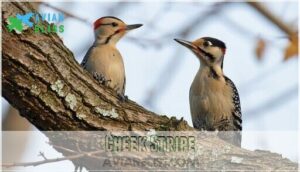
Looking beyond head markings reveals another telltale sign. You’ll spot the cheek stripe absence in females across most woodpecker species. Males flash bold red or black mustache marks while females show plain faces.
Here’s what to watch for in cheek stripe function and species variations:
- Northern Flickers – Males sport red mustaches, females have pale brown cheeks
- Pileated Woodpeckers – Males show red cheek patches, females display black
- Yellow-bellied Sapsuckers – Males have red throats, females show white
- Gilded Flickers – Males flash red mustache stripes, females lack this mark
This cheek pattern helps with woodpecker identification and bird gender identification in the field.
Behavior of Female Woodpeckers
You’ll notice female woodpeckers behave differently than males during nesting and feeding activities. Their behavior patterns focus on territory defense and food gathering near nest sites.
Nesting

When you study their nest site selection, female woodpeckers choose dead trees or soft wood for cavity excavation.
They dig holes 8-16 inches deep using their strong bills. After completing the cavity, they lay 3-5 white eggs for egg incubation.
Both parents share incubation duties for 11-14 days. Females handle most nestling care during daylight hours.
They feed insects to growing chicks every 20 minutes. Aiding conservation efforts includes using specialized nesting boxes.
Fledgling success depends on consistent food delivery and cavity protection from predators.
Feeding Patterns

You can spot female woodpeckers by their distinct feeding patterns. They prefer foraging on bark surfaces and tree trunks rather than smaller branches. These feeding behaviors help them access specific insect prey throughout different seasons.
According to research, females show a preference for dead substrates.
- Insect Consumption: Female woodpeckers target beetles and ants in bark crevices
- Bark Foraging: They use surface pecking methods more than deep excavation techniques
- Seasonal Diet: Winter brings increased reliance on stored seeds and suet feeders
- Unique Prey: Female Redbellied Woodpeckers hunt tree frogs and small vertebrates occasionally
Habitat Preferences of Female Woodpeckers
You’ll find female woodpeckers in mature forests with dead trees and thick canopies. They also adapt well to urban parks and neighborhoods with large shade trees.
Mature Forested Areas
Old-growth habitats serve as prime real estate for female woodpecker nesting activities.
These mature forested areas offer thick-trunked trees perfect for cavity nesting excavation.
You’ll find higher woodpecker density in established forests where dead snags provide ideal tree cavities.
Forest management practices that preserve older trees directly support female woodpecker populations.
Unfortunately habitat fragmentation threatens these woodpecker habitat zones.
Conservation efforts focus on maintaining continuous forest corridors.
Woodpecker nesting success rates drop substantially when old-growth patches become isolated from surrounding woodland areas.
Urban Environments
Female woodpeckers adapt well to urban adaptation and city nesting opportunities.
You’ll find them in parks and neighborhoods where food availability from bird feeders supports backyard birds.
Despite noise pollution and habitat fragmentation, they’ve mastered woodpecker habitat selection in cities.
Their flexible woodpecker diet helps them thrive where bird conservation efforts provide suitable nesting trees and feeding stations.
Reproduction in Female Woodpeckers

Female woodpeckers show distinct breeding behaviors that differ from males in several key ways.
You’ll notice females take on specific roles during nesting season while sharing parenting duties with their mates.
Nesting Behavior
Regarding nesting behavior, you’ll discover these birds take charge of selecting prime real estate.
Cavity excavation begins with females choosing dead or dying trees for their woodpecker nest. They work alongside males to dig chambers 8-24 inches deep.
Egg laying follows with 3-8 glossy white woodpecker eggs. The incubation period lasts 12-14 days.
Female Redbellied Woodpeckers show intense nest defense during woodpecker incubation. Both parents share duties until chick fledging occurs after 24-31 days in the cavity.
These woodpeckers often engage in drumming as courtship to attract mates.
Roles in Raising Young
Dedication drives female woodpeckers through the demanding stages of raising their young. These mothers balance multiple responsibilities that guarantee chick survival. Female incubation duties alternate with males in careful shifts. This cooperative breeding system maximizes egg development success.
You’ll witness remarkable parental defense behaviors when threats approach the nest. Nestling feeding becomes the female’s primary focus after hatching. She selects softer insects during the first critical week. Her feeding intervals occur every 15-30 minutes depending on conditions.
Fledgling care extends beyond the nest as mothers guide young birds through their first flights. Key maternal responsibilities include:
- Teaching survival skills through foraging demonstrations and alarm call recognition
- Maintaining nest sanitation by removing waste and food debris regularly
- Adjusting feeding patterns based on chick age and environmental factors
- Providing post-fledging support for up to two weeks after nest departure
This woodpecker breeding strategy strengthens species survival across diverse habitats.
Diet of Female Woodpeckers
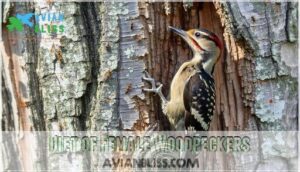
Female woodpeckers show specific feeding patterns that differ from males during breeding season.
You’ll notice females often forage closer to nest sites and spend more time on bark surfaces searching for insects to feed their young.
Feeding Habits
Female woodpeckers break free from the typical "insect-only" stereotype. These birds adapt their Seasonal Diet like skilled opportunists. Insect Consumption remains primary but they embrace variety.
| Food Type | Season | Foraging Techniques |
|---|---|---|
| Wood-boring insects | Year-round | Drilling bark surfaces |
| Tree sap | Spring | Shallow hole creation |
| Fruits/berries | Fall/Winter | Surface picking methods |
Woodpecker foraging involves powerful neck muscles for precise drilling. Bird feeding patterns shift seasonally. Spring brings sap flows. Summer offers peak insect activity.
Woodpecker diet flexibility guarantees survival across changing conditions. Foraging behavior adapts to available resources without complex Food Storage systems. To attract mates, males will use unique drumming patterns.
Foraging Preferences
You’ll spot female woodpecker foraging behavior through their strategic approach to bark foraging and insect consumption.
These birds show remarkable seasonal variation in their hunting patterns. They prefer different tree sections than males to reduce competition.
Here are four key foraging traits that showcase their survival mastery:
- Bark specialists – They probe deeper crevices for hidden larvae
- Food storage experts – Cache nuts and seeds in tree holes
- Unique prey hunters – Target carpenter ants and wood-boring beetles
- Seasonal adapters – Switch between insects and plant matter based on availability
Understanding their diet involves researching specialized feeding products.
Role of Female Woodpeckers in Ecosystem

Female woodpeckers play essential roles as forest engineers and ecosystem connectors. They control insect populations while creating nesting sites that benefit dozens of other species.
Impact on Tree Health
Many pest control agents work tirelessly in forests.
You’ll find female woodpeckers excelling at this essential role.
They hammer into bark to extract harmful insects that cause Tree Damage.
Their precise excavations target beetle larvae and wood-boring pests that threaten Forest Ecosystems.
This natural insect control prevents widespread tree mortality.
Woodpecker Benefits extend beyond pest management.
Their abandoned cavities become homes for other wildlife.
Habitat Management programs recognize their ecological importance.
The woodpecker ecological role includes maintaining forest health through systematic pest removal.
Interactions With Other Species
Throughout forest ecosystems you’ll discover female woodpeckers navigate complex relationships with other species.
Competition drives their interactions as females defend territories from European starlings and squirrels. Predator Avoidance shapes their behavior when hawks hunt nearby.
Symbiotic Relationships emerge through cavity creation that benefits over 40 bird species annually.
- Habitat Sharing occurs when females create nesting sites used by secondary cavity nesters
- Interspecies Communication involves alarm calls warning other birds of approaching threats
- Woodpecker ecology demonstrates how females reduce bark beetle populations by 28-40% through targeted foraging
Conservation Status of Female Woodpeckers
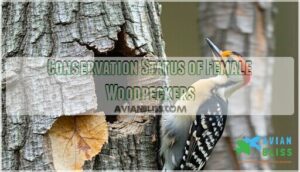
Female woodpeckers face similar threats to males but aren’t separately tracked in most conservation studies.
You’ll find that habitat loss affects their nesting success more than males since females select cavity sites and invest more time in nest preparation.
Threats
Female woodpeckers face mounting challenges across North America.
Habitat Loss destroys 47% of their nesting sites through deforestation.
Climate Change shifts ranges northward by 14 miles per decade.
Pesticide Use causes 17% nest failures in treated areas.
Invasive Species like starlings occupy 31% of available cavities.
Human Activity creates noise pollution that forces 15% nest abandonment annually.
Considering that 78% of bird species face extinction, these challenges are particularly concerning.
| Threat Category | Impact on Females |
|---|---|
| Habitat destruction | 47% habitat loss since 2010 |
| Chemical exposure | 17% reproductive failure rate |
| Invasive competitors | 31% cavity displacement |
| Climate effects | 10-day shorter breeding seasons |
These pressures substantially impact woodpecker conservation status and woodpecker population dynamics throughout their traditional woodpecker habitats.
Conservation Efforts
Woodpecker conservation strategies focus on habitat preservation and reducing pesticides to protect nesting sites.
Population monitoring tracks species numbers while public awareness campaigns educate communities about these birds’ ecological importance.
Bird conservation efforts address climate change impacts through forest management and protected area expansion.
Aiding reforestation efforts can be achieved by planting various native species.
These woodpecker conservation efforts support bird species conservation across North America.
Identification Tips: Female Woodpeckers in North America

Identifying female woodpeckers requires careful observation of specific markings and size details.
You’ll need to look for key differences in head coloration and body features that distinguish females from their male counterparts, focusing on complete concepts to ensure accurate identification.
Size Comparison
Size serves as your first clue when spotting female woodpeckers. Sexual dimorphism means females are typically smaller than males.
Weight differences average 8% less in females. Bill length is shorter in females. Wing span and tail length also measure smaller.
These bird gender differences help distinguish species. Compare a female Pileated’s crow-size to a tiny Downy’s sparrow-size for quick identification.
Markings and Coloration
Identifying female woodpeckers requires keen observation of bird gender coloration and plumage differences.
Unlike males, females display distinctive markings:
- Red Dimorphism – Females lack red patches on heads and cheeks
- Crest Differences – Gray-black crowns replace colorful male crests
- Juvenile Markings – Young birds show muted tones before adult plumage
Female woodpecker plumage serves a coloration purpose: camouflage during nesting.
Their subdued woodpecker markings include white facial stripes and barred wing patterns.
These plumage variations help distinguish gender in the field.
Frequently Asked Questions (FAQs)
Are female woodpeckers red?
Most female woodpeckers aren’t red. You’ll typically see black, white, and gray plumage instead. However, Red-headed Woodpecker females look identical to males with bright red heads.
How can you tell a male from a female woodpecker?
Over 95% of woodpecker species show sexual differences in red head markings.
You’ll spot males by their red patches on heads, crowns, or throats.
Females typically lack these red markings entirely, displaying gray or black coloring instead.
What do female woodpeckers look like?
You’ll spot females by their lack of red head markings that males typically display.
Most species show females with gray, black, or brown crowns instead of the vibrant red patches found on male heads.
Do female woodpeckers have red heads?
Most female woodpeckers don’t wear nature’s crimson crown.
You’ll typically spot gray or black heads instead of red. However, female Red-headed Woodpeckers break this rule completely—they’re identical to males with bright red heads.
Do female woodpeckers drum for reasons besides communication?
Yes, you’ll find female woodpeckers drum beyond communication.
They use drumming to establish territories, forage for insects, and excavate nesting cavities.
This rhythmic behavior serves multiple practical purposes in their daily survival.
How long do female woodpeckers typically live?
Like clockwork ticking away steadily, you’ll find that female woodpeckers typically live 4-12 years in the wild, though some species can reach 15 years with proper conditions and minimal predation threats.
Can female woodpeckers change their plumage colors seasonally?
Female woodpeckers don’t change their plumage colors seasonally like some birds do.
You’ll notice their feather patterns and colors remain consistent year-round, maintaining the same distinctive markings that help identify their species throughout all seasons.
Do female woodpeckers migrate differently than males?
Migration patterns don’t typically differ between male and female woodpeckers. You’ll find both sexes following similar routes and timing when species migrate, though individual birds may vary in departure dates.
How do female woodpeckers cope with extreme weather conditions?
Seeking shelter, securing food sources, conserving energy—you’ll find female woodpeckers adapt remarkably well to harsh conditions.
They roost in tree cavities, fluff feathers for insulation, and reduce activity during storms, which helps them conserve energy.
Do female woodpeckers migrate seasonally?
Most woodpeckers don’t migrate at all. You’ll find them year-round in their territories. However, some species like Northern Flickers and Yellow-bellied Sapsuckers do make seasonal journeys southward for winter.
Conclusion
Mastering female woodpecker identification reveals countless birding adventures ahead.
You’ll spot these remarkable birds by their muted plumage and smaller crests compared to flashy males.
Watch for their methodical foraging behavior and listen for distinct calls.
Female woodpeckers play vital roles in nest excavation and territorial decisions.
Their engineering skills shape forest ecosystems.
Practice these identification tips during your next outdoor adventure.
Soon you’ll recognize every female woodpecker species in your area with confidence and precision.
- https://a-z-animals.com/blog/male-vs-female-pileated-woodpecker-what-are-their-differences/
- https://www.reconnectwithnature.org/news-events/the-buzz/what-difference-male-vs-female-pileated-woodpecker/
- https://wildlifeillinois.org/identify-wildlife/woodpecker/
- https://www.allaboutbirds.org/guide/Pileated_Woodpecker/overview
- https://www.reddit.com/r/birding/comments/18tp31t/male_and_female_palliated_woodpecker_posted_to/