This site is supported by our readers. We may earn a commission, at no cost to you, if you purchase through links.

A dark silhouette cuts across the sky, then suddenly folds into a dive that reaches speeds over 240 miles per hour. The peregrine falcon doesn’t just hunt—it dominates the air with a precision that’s rewritten our understanding of biological limits.
These raptors have conquered every continent except Antarctica, thriving equally on arctic cliffs and downtown skyscrapers. Their comeback from near-extinction in the 1970s stands as one of conservation’s greatest victories, transforming them from endangered species to urban success story.
From their distinctive facial markings to their legendary stoop dive, peregrine falcons represent nature’s perfect balance of power and adaptation.
Table Of Contents
- Key Takeaways
- Peregrine Falcon Physical Characteristics
- Global Habitat and Distribution
- Behavior and Hunting Techniques
- Reproduction and Life Cycle
- Conservation Status and Recovery
- Frequently Asked Questions (FAQs)
- What is so special about peregrine falcon?
- Is a peregrine falcon faster than a hawk?
- How aggressive are peregrine falcons?
- Is the peregrine falcon the fastest animal ever?
- What is the role of the male during incubation?
- Why are peregrine falcon chicks called eyases?
- How do peregrine falcons adapt to urban environments?
- How long do peregrine falcons live in wild?
- What predators threaten adult peregrine falcons?
- Do peregrine falcons migrate during winter months?
- Conclusion
Key Takeaways
- Peregrine falcons reach dive speeds exceeding 240 mph during their signature hunting stoop, making them the fastest animals on Earth through specialized aerodynamic adaptations including nasal baffles that allow breathing at extreme velocities.
- These raptors achieved one of conservation’s greatest comebacks after DDT pesticides nearly eliminated North American populations in the 1960s, recovering from 324 breeding pairs in 1975 to a current global population of 340,000 individuals.
- Urban environments now serve as thriving habitats where peregrines convert skyscrapers into substitute cliff faces, with city-dwelling populations achieving higher breeding success rates than their rural counterparts due to abundant prey like pigeons.
- Sexual dimorphism gives females 50% more body mass than males, creating distinct hunting roles where agile males provide most prey while larger females defend nests and take down bigger targets.
Peregrine Falcon Physical Characteristics
You’ll recognize a peregrine falcon instantly once you know what to look for. These raptors pack some of the most striking physical features in the bird world, from their sleek build to their distinctive facial markings.
Their hunting prowess puts them among the elite types of birds of prey, capable of reaching speeds over 200 mph during their signature hunting dives.
Let’s break down the key characteristics that define this powerful predator.
Size, Weight, and Wingspan
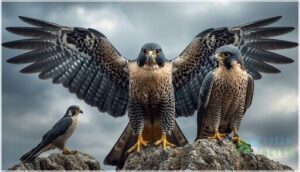
You’ll find adult Peregrine Falcons measuring 34 to 50 centimeters from bill to tail, with wingspans reaching 74 to 120 centimeters. Weight factors vary dramatically—males weigh 330 to 1000 grams while females tip the scales at 700 to 1500 grams. Size variations depend on subspecies, with coastal forms producing the largest birds.
Growth rates are explosive; chicks reach 85 percent of adult body proportions within three weeks. Remarkably, conservation efforts have led to a significant increase in California breeding pairs in recent decades.
Plumage and Coloration
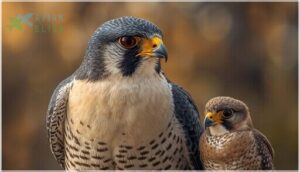
Adults display striking blue-gray upperparts and pale undersides marked with dark horizontal bars. You’ll notice three key features for bird identification:
- Bold black mustache stripe running down from each eye
- Dark crown creating a helmeted appearance
- Bright yellow cere at the bill base
Juvenile differences are obvious—young birds show brownish backs with vertical streaks below instead of adult plumage bars. The molting process gradually transforms juveniles into their final slate-colored form by their second year.
Sexual Dimorphism
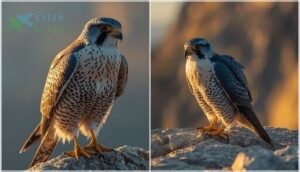
Beyond those flashy feathers, you’ll spot real sexual dimorphism in peregrine falcon characteristics. Females pack 50 percent more body mass than males—she might hit 1,300 grams while he tops out around 750. This size difference drives sex roles: males hunt with agile precision, while females guard nests and strike harder at threats.
Bird identification techniques lean on these dimorphic traits since body mass telegraphs which bird wears the crown.
For a detailed overview of the peregrine’s unique adaptations, check out these perfect flying machine features.
| Trait | Male Peregrine | Female Peregrine |
|---|---|---|
| Body Length | 34–45 cm | 45–58 cm |
| Weight Range | 330–1,000 g | 700–1,500 g |
| Hunting Role | Primary provider, agile pursuit | Larger prey capture, nest defense |
| Fledging Timeline | Earlier departure from nest | Later fledging, heavier growth curve |
| Survival Pattern | Lower mortality in some populations | Higher nest-defense risks observed |
Distinctive Features and Identification
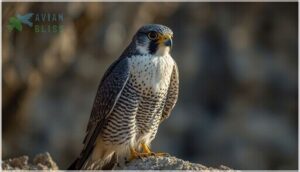
You can nail peregrine falcon identification by spotting that bold dark “mustache” dropping from each eye—no other bird of prey rocks that graphic facial pattern. Wing shape seals it: long, pointed primaries sweep back like scythes in flight.
For comparison, check out osprey characteristics and their distinctive facial patterns to see how different raptors use bold head markings for identification.
Feather color shifts with age—adults wear smooth slate-gray backs while juveniles show scalloped brown. That hooked beak structure and dark head plumage complete the profile.
Global Habitat and Distribution
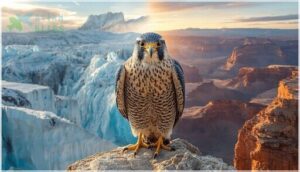
Peregrine falcons rank among the most widely distributed birds on Earth, inhabiting every continent except Antarctica. You’ll find them thriving across remarkably diverse landscapes, from windswept arctic tundra to scorching desert cliffs and bustling urban centers.
Their ability to adapt to different environments—and travel thousands of miles between them—makes their global range truly remarkable.
Natural Habitats and Range
You’ll find peregrine falcons on every continent except Antarctica, thriving across more geographic range than almost any raptor on Earth. Their habitat diversity spans open landscapes where hunting demands clear skies and room to dive.
Bird habitat preservation protects these adaptable hunters wherever they roam.
- Tundra to tropics – They occupy Arctic zones, temperate forests, deserts, and coastal habitats across North America and beyond.
- Cliff ecosystems – Nest ledges range from 25 to 1,300 feet high, offering protection and visibility.
- Migration routes – Northern birds travel thousands of miles to South America, following coastlines and mountain ranges.
- Avian migration patterns – Some populations stay year-round while others shift with prey availability and seasons.
Urban Adaptation and City Living
You’ll see these raptors transform skyscrapers into cliff faces, nesting on tall buildings, bridges, and transmission towers across cities worldwide. Urban adaptation turned peregrines into city wildlife success stories—over 200 UK structures now host nesting pairs, while New York and Chicago falcons thrive on high-rise ledges.
Urban habitats deliver steady prey like pigeons and starlings, boosting breeding success above rural rates and advancing falcon conservation through strategic nest box placement.
Migration Patterns and Distances
You’ll witness peregrine falcon migration across three major flyways—coastal routes, interior corridors, and open-water crossings spanning up to 25,000 km annually.
Tundra breeders travel from Arctic habitat to South America at 172 km daily, while temperate populations stay put year-round.
These raptors navigate at 100-900 m altitude, demonstrating exceptional route selection fidelity that aids wildlife conservation tracking efforts.
Behavior and Hunting Techniques

You’ll witness a master of the sky when you watch a peregrine falcon hunt. Their flight combines power with precision, using techniques that make them one of nature’s most effective predators.
Here’s what sets their hunting behavior apart from other raptors.
Flight Style and Speed
You’ll witness a Peregrine Falcon’s raw power the moment it locks onto prey. This bird of prey cruises at 40 to 55 km per hour, then explodes to 112 km per hour in level pursuit.
Its aerodynamic features—long, pointed wings and sleek body—slice through air with minimal drag. Watch it mix rapid wingbeats with tight glides, using flight maneuvers that would leave other raptors stalled.
The “Stoop” Dive
When a Peregrine Falcon commits to the stoop, you’re watching pure transformation—gravity becomes a hunting ally. This bird of prey climbs high, then tucks into a teardrop Aerodynamic Shape that slices air resistance.
When a peregrine falcon commits to the stoop, gravity becomes its hunting ally as it tucks into a teardrop shape that slices through air
The sequence unfolds in four deadly stages:
- Climb hundreds of meters using thermal currents
- Align on a collision course with the target
- Pull wings tight, hitting Dive Speed over 100 meters per second
- Level out and strike with partially closed talons
Bony nostril structures prevent breathing problems at extreme flying speed.
Prey Selection and Diet
You’ll find this raptor’s diet covers an astonishing range—from three-gram hummingbirds to 3.1-kilogram sandhill cranes. Prey Size Variation reveals extreme Dietary Adaptation in the Peregrine Falcon.
Urban Prey like pigeons dominate city Foraging Behavior, sometimes making up 95 percent of diet biomass. Hunting Strategies shift seasonally—coastal birds focus on ducks and shorebirds, while moorland pairs target grouse. This Raptor Behavior showcases unparalleled hunting flexibility.
Predatory Adaptations
Speed alone won’t catch your prey—you need a body built for impact. Aerial Streamlining gives this raptor a teardrop shape during the stoop, while nasal baffles let it breathe past 200 miles per hour.
Crushing talons deliver a knockout punch midair, then a hooked tom severs the spinal cord. Raptors like this turn hunting into precision engineering.
Reproduction and Life Cycle

Peregrine falcons form monogamous pairs that return to the same nesting sites year after year. Their breeding cycle includes dramatic aerial courtship displays, careful nest site selection on high cliff ledges or tall buildings, and shared parental duties.
You’ll find that reproduction follows a predictable pattern from egg laying through fledging, with specific behaviors at each stage.
Mating and Courtship Behaviors
You’ll witness breathtaking aerial rituals when peregrine falcon pairs renew their bonds. Males circle high above cliffs in figure-eight patterns, then dive toward females who flip upside down to catch food mid-air.
These courtship displays include synchronized chases, repeated ‘ee-chup’ calls, and ledge bowing ceremonies. Copulation increases as egg-laying approaches, cementing pair bonding that bolsters breeding populations and wildlife conservation efforts across avian biology.
Nesting Sites and Structure
After pair bonding, site selection begins. Males scout cliff ledge locations high above ground, presenting options to females who choose the final spot. You’ll find these peregrine falcon nesting sites on sheer rock faces or urban nesting platforms that mimic natural cliffs.
- Natural cliff ledges sit in the upper third of rock faces for wide visibility
- Urban structures like bridges and towers replace traditional habitat in cities
- Nest box design includes pea gravel layers for proper drainage and egg stability
- Adults scrape shallow bowls in loose substrate rather than building stick nests
Conservation groups install nest boxes on buildings where natural ledges are scarce, supporting avian biology research and bird of prey ecology. Proper nesting materials help clutches survive in both wild and urban environments.
Egg Laying and Incubation
Once the scrape is ready, females lay three to five eggs over a week, one every 48 hours. This clutch equals 20 percent of her body weight. Full incubation starts when the second-to-last egg appears, lasting 32 to 35 days.
| Incubation Role | Responsibility |
|---|---|
| Female | Night brooding, most daytime sitting |
| Male | Hunting, brief daytime shifts |
| Both | Temperature regulation |
| Timing | Mid-March through early April |
Eggs hatch within two days of each other.
Fledging and Juvenile Development
Young peregrines take their first flight at 40 to 44 days old, once wing feathers fully develop. Males fledge slightly earlier than females.
After departure, juveniles sport brown upperparts with streaked buff underparts, darker than adult plumage. Parents feed them four to six weeks post-fledging, often passing prey midair.
You’ll see fledglings practice sharp turns and mock stoops, building hunting skills through instinct and repetition.
Conservation Status and Recovery

The peregrine falcon’s story is one of dramatic collapse and outstanding recovery. Mid-20th century pesticide use nearly wiped out populations across North America and Europe, but targeted conservation efforts brought the species back from the brink.
Here’s what happened and where things stand today.
Historical Population Decline
You won’t believe how fast peregrine falcon populations collapsed. By the mid-1960s, peregrines vanished completely as breeding birds across the eastern United States. Western populations crashed by 90 percent, while shooting, egg collecting, and nest disturbance weakened what remained.
North America dropped from roughly 3,875 historic nesting pairs to only 324 pairs by 1975, triggering endangered species protections.
Impact of Pesticides
DDT triggered a cascade of devastation through biomagnification effects. Pesticide toxicity built up in falcon tissues, causing chemical exposure that thinned eggshells by up to 20 percent. You can trace the environmental contamination directly to endangered species listings.
- Heavy metal pollution compounded DDT’s damage, weakening immune systems
- Environmental impact of pesticides spread through prey populations
- Peregrine falcon reproductive success dropped to near zero
- Biomagnification concentrated toxins 10-100 times higher in top predators
Conservation Efforts and Reintroduction
You’ve seen comeback stories before, but peregrine falcon conservation rewrote the rules. Captive breeding launched in the 1970s using The Peregrine Fund’s hacking release techniques, placing young birds at hack sites until flight-ready.
Legal protection under the Endangered Species Act backed nest box installations on urban towers. Wildlife protection efforts and monitoring programs tracked banded peregrines through species reintroduction programs, turning raptor conservation into measurable recovery.
Current Population Trends and Outlook
Peregrine falcon conservation has delivered global population growth, with 340,000 individuals now carrying IUCN status as Least Concern. Habitat shift drives urban adaptation, and city nests are outperforming coastal sites in regions like New Jersey.
Climate impact threatens Arctic breeding grounds through increased rainfall, while global monitoring reveals stable trends masking local declines.
Raptor conservation requires ongoing wildlife conservation vigilance across 210 countries.
Frequently Asked Questions (FAQs)
What is so special about peregrine falcon?
You’d think the universe handed peregrines all the cheat codes—Falco peregrinus hits 200 mph stooping, owns every continent except Antarctica, and reinvented itself after DDT nearly wiped it out through bird conservation.
Is a peregrine falcon faster than a hawk?
Yes, you’ll find the peregrine falcon reaches over 200 mph in its hunting stoop, far outpacing hawks like the red-tailed, which top around 120 mph in dives.
How aggressive are peregrine falcons?
You’ll witness their territorial defense peak during nesting season when adults mount coordinated attacks on intruders.
These raptors show aggressive behavior toward other predatory birds and rivals, using defensive strategies including repeated high-speed dives.
Is the peregrine falcon the fastest animal ever?
When a predator plummets at 242 mph, record breaking speed comparisons settle: the peregrine falcon holds the title.
Its aerodynamic features and dive speed records during hunting stoops make it the fastest animal ever measured.
What is the role of the male during incubation?
During incubation, the male hunts and delivers prey so the female stays on the eggs.
He covers the clutch for short periods when she feeds, guards the nesting territory, and deters intruders.
Why are peregrine falcon chicks called eyases?
Falconry origins gave us “eyas,” a term from medieval French meaning nestling raptor.
Bird etymology traces it to nidus, or nest.
Your peregrine falcon chicks wear this raptor terminology because they match the original definition perfectly.
How do peregrine falcons adapt to urban environments?
You’ll spot peregrines using skyscrapers as substitute cliffs for urban nesting, hunting abundant city prey like pigeons along building corridors, and achieving higher breeding success than rural pairs despite urban challenges.
How long do peregrine falcons live in wild?
Many wild raptors defy expectations by surviving well beyond their average span. Your peregrine falcon usually lives 6 to 10 years in nature, though banding records show outstanding individuals reaching nearly 20 years.
What predators threaten adult peregrine falcons?
You won’t find many predators bold enough to take on these speed demons, but great horned owls strike at night, golden eagles use brute force, and territorial clashes with larger raptors occasionally turn deadly.
Do peregrine falcons migrate during winter months?
Like nomads reading invisible maps, some birds chase warmth while others stay anchored.
Peregrine falcon migration varies widely—Arctic breeders travel thousands of kilometers to wintering areas, while urban non-migratory populations remain year-round where prey stays abundant.
Conclusion
You might think a bird’s story ends with survival, but the peregrine falcon proves otherwise. These raptors didn’t just bounce back—they claimed new territory, turning glass towers into hunting grounds and rewriting the rules of adaptation.
Their journey from DDT’s devastation to thriving populations shows nature’s capacity for radical transformation. When you spot that telltale dark hood cutting through city skies, you’re witnessing resilience in its most powerful form.
- https://www.guinnessworldrecords.com/world-records/70929-fastest-bird-diving
- https://www.nwf.org/Educational-Resources/Wildlife-Guide/Birds/Peregrine-Falcon
- https://openbooks.library.umass.edu/thefalconproject/chapter/prey-and-hunting/
- https://australian.museum/learn/animals/birds/peregrine-falcon/
- https://macaulaylibrary.org/photo/288347741