This site is supported by our readers. We may earn a commission, at no cost to you, if you purchase through links.

You’ll spot a mountain chickadee by the bold white eyebrow cutting across its black cap—no other chickadee wears that stripe. This small songbird makes its home in the high coniferous forests of western North America, from British Columbia down to Baja California.
Gray wings, pale underparts, and a bright white cheek patch round out the field marks. Unlike its lowland cousins, this species sticks to elevation zones where pines and spruces dominate the canopy.
You won’t find it in urban parks or backyard feeders unless your property borders serious mountain terrain. The bird’s compact build and acrobatic foraging style let it thrive where winter temperatures drop hard and food grows scarce.
Table Of Contents
- Key Takeaways
- What is a Mountain Chickadee?
- Mountain Chickadee Range and Habitat
- Distinctive Appearance and Size
- Diet and Foraging Behavior
- Nesting and Breeding Habits
- Adaptations for Mountain Survival
- Attracting Mountain Chickadees to Your Yard
- Frequently Asked Questions (FAQs)
- What is the difference between a chickadee and a mountain chickadee?
- Are Mountain Chickadees rare?
- Do Mountain Chickadees have good memories?
- Where do Mountain Chickadees live?
- Where do chickadees live?
- What is a mountain chickadee?
- What does a mountain chickadee look like?
- Do mountain chickadees live together?
- Why is the mountain chickadee called Poecile?
- Do mountain chickadees live in Highland Pines?
- Conclusion
Key Takeaways
- You’ll identify the mountain chickadee by its diagnostic white eyebrow stripe cutting through a black cap—a field mark no other chickadee species carries.
- This bird survives harsh mountain winters through three specialized adaptations: scatter-hoarding thousands of cached seeds with precise spatial memory, maintaining dense multilayered plumage that triples insulation when fluffed, and foraging acrobatically across conifer canopies where others can’t reach.
- Mountain chickadees occupy a narrow ecological niche in western North America’s high-elevation coniferous forests between 4,000 and 11,000 feet, moving vertically with seasons but rarely straying to lowland habitats.
- You can attract these birds to mountain properties by offering black oil sunflower seeds in tube feeders, installing nest boxes with 1⅛-inch entrance holes, and preserving dead snags that provide natural roosting cavities and insect-rich foraging substrate.
What is a Mountain Chickadee?
The Mountain Chickadee is a small songbird that makes its home in the high conifer forests of western North America. You can pick one out by its white eyebrow stripe, a feature that sets it apart from its lowland cousins.
While the Mountain Chickadee thrives in higher elevations, its relative, the Carolina Chickadee, prefers the warmer lowland forests of the Southeast.
Let’s look at what defines this species, its key physical traits, and how it compares to other chickadees.
Species Identification
You’ll recognize the Mountain Chickadee (Poecile gambeli) by its bold white eyebrow stripe cutting across a black cap. This head marking separates it from all other chickadees.
Listen for its rapid chickadee-dee-dee call with metallic notes. The beak shape stays small and conical.
Feather patterns show gray backs and pale underparts. Wing structure displays subtle white bars against dark gray flight feathers.
For educators interested in bird identification, resources like this computer-assisted species-recognition program have proven useful in improving recognition accuracy.
Key Physical Features
Beyond that white eyebrow stripe, you’ll spot a black cap and throat framing a bright white cheek patch. The beak structure stays short and sturdy, built for cracking seeds.
Feather patterns reveal grayish wings and back with subtle barring. Head shape appears rounded with a compact profile. Tail features show dark central feathers edged in lighter gray, spanning roughly one-third of the bird’s total length.
Comparison With Other Chickadees
You’ll separate Mountain Chickadees from Black-capped Chickadees by that white eyebrow stripe running through the eye—Black-cappeds lack it entirely.
Bird call differs too; Mountains deliver a hoarser, raspier “chick-a-dee-dee” compared to the clearer Black-capped version.
Habitat preferences split geographically: Mountain Chickadee species claim western high-elevation conifers while Black-capped chickadees range continent-wide through varied forests at lower elevations.
For further help, consult the key chickadee identification features outlined by birding experts.
Mountain Chickadee Range and Habitat

Mountain chickadees don’t wander far from the high country. You’ll find these birds wherever conifers stretch across western peaks, from the Yukon down through the Rockies and into California’s mountain ranges.
Their range follows a clear pattern tied to elevation, forest type, and the year-round availability of cone-bearing trees.
Geographic Distribution
You’ll find Mountain Chickadees spread across western North America, from southern British Columbia down to northern Baja California and east through the Rocky Mountains into New Mexico.
These birds inhabit High Mountains and coniferous forest zones, rarely affected by Range Expansion or Migration Patterns. Geographic Isolation keeps populations concentrated in evergreen forests along elevation zones, particularly where spruce and pine dominate the landscape.
Preferred Forest Types
You’ll encounter Mountain Chickadees primarily in Conifer Forests and Mixed Woodlands that blanket the high peaks of western North America. These birds show a marked preference for four distinct forest types:
- Pure needleleaf stands dominated by pine, spruce, or Douglas-fir
- Mixed conifer-broadleaf zones with diverse canopy layers
- Dense spruce-fir communities in cool, moist montane settings
- Subalpine Trees near treeline with stunted, wind-sculpted growth
Evergreen forests with year-round needle cover provide the stable foraging structures these acrobatic insectivores require.
Elevation Range
Mountain Chickadee populations span a broad vertical range across western high-elevation coniferous forests, usually settling between 4,000 and 11,000 feet.
You’ll notice elevation shifts with the seasons—birds descend in winter when snow buries food, then climb back to subalpine habitat zones come spring.
Climate influence and mountain ecology shape these vertical migration patterns, driving chickadees through diverse ecosystems and habitats as conditions change.
Distinctive Appearance and Size
You can identify a mountain chickadee by its compact frame and bold field marks. These birds measure just 5 to 6 inches long with a wingspan around 7.5 inches, weighing roughly 0.38 ounces.
Their plumage shows distinct seasonal changes that affect visibility in the field.
Plumage Patterns
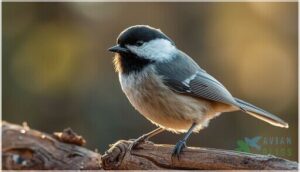
You’ll spot the Mountain Chickadee by its sharp contrasts—a black cap, white cheeks, and that signature white eyebrow stripe cutting clean across its face. The grayish wings and back stay muted, letting the bold head pattern do the talking.
- Mottling effects create irregular patches on upperparts for camouflage
- Bar patterns show faint horizontal bands across breast and flanks
- Color gradients fade smoothly from pale gray crown to deeper olive back
Iridescence appears subtly on crown feathers in direct sunlight. Feather textures shift with seasonal molts, affecting overall contrast and aiding bird identification.
Size and Weight

You’re looking at one of the tiniest acrobats in the Rockies. Mountain Chickadee size comparisons put them at 4.7 to 5.5 centimeters long, weighing just 6 to 8 grams—lighter than two nickels.
Body mass variations trace back to weight factors like elevation, food supply, and season. Growth patterns show chicks doubling in mass distribution within weeks, a marvel of avian ecology and conservation worth celebrating.
Seasonal Plumage Variations
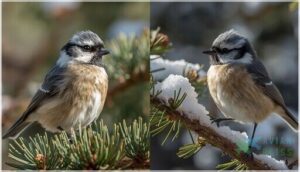
You’ll notice subtle camouflage changes as this mountain chickadee shifts from lighter gray-brown tones in summer to deeper grays come winter.
Molt timing syncs with snow cover, while winter feathering becomes denser around the nape, blocking wind. The eyeb—that white eyebrow stripe—stays bright year-round, a constant field mark.
These plumage shifts reflect adaptive strategies central to avian ecology and conservation in high-elevation ornithology and bird research.
Diet and Foraging Behavior
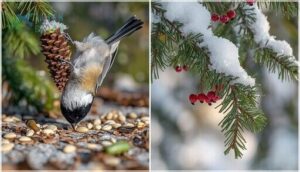
Mountain Chickadees shift their menu with the seasons, balancing protein-rich insects in summer against energy-dense seeds when snow covers the high country.
You’ll spot them working the canopy with acrobatic precision, probing every crack and cone for hidden food. Their survival strategy includes three distinct feeding patterns that keep them thriving in harsh mountain environments.
Primary Food Sources
You’ll find mountain chickadees shifting their diet and feeding habits throughout the year to survive harsh alpine conditions. Their forage strategies balance insect foraging during breeding season with seed consumption and berry feeding when temperatures drop.
Primary nutrient acquisition sources include:
- Insects and spiders for protein during spring nesting
- Conifer seeds from pine and spruce cones in winter
- Juniper and other wild berries in fall
- Black oil sunflower seeds and suet at bird feeders
- Beetles, caterpillars, and ants from understory habitats
Foraging Techniques
When these mountain birds hunt, they use acrobatic tree climbing to inspect bark crevices and needle clusters. You’ll spot them hovering briefly at branch tips before landing—a gleaning technique that flushes hidden insects from tight spaces. Their insect hunting involves quick pecking sequences up tree trunks, while seed extraction requires prying scales from pine cones with surprising force.
| Foraging Strategy | Target Food |
|---|---|
| Bark probing | Scale insects, beetles |
| Hover-gleaning | Aphids, caterpillars |
| Cone manipulation | Conifer seeds |
Food Caching Strategies
After finding food, you’ll see these birds hide it across their territory instead of stockpiling in one spot—that’s scatter hoarding in action. Mountain Chickadee food caching relies on spatial memory to relocate thousands of seeds tucked behind bark or under moss. Seasonal storage peaks in autumn when they’re preparing for winter scarcity.
Key bird behavior patterns in avian ecology include:
- Location selection prioritizes hidden bark crevices and needle clusters
- Memory-based retrieval using landmarks like distinctive rocks
- Thief deterrence through dispersed cache placement
- Recaching when rival birds threaten stored resources
- Winter feeding habits shift toward cached conifer seeds
Nesting and Breeding Habits
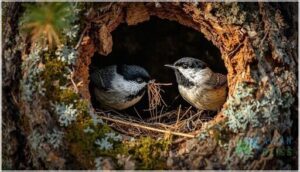
Mountain chickadees nest in tree cavities, choosing sites that offer protection from weather and predators. They show notable adaptability in both selecting nest locations and constructing their homes.
You’ll find their breeding cycle follows distinct phases from site preparation through fledging.
Nest Site Selection
When you’re scouting good cavity nesting sites, mountain chickadees favor mature conifers with natural hollows or old woodpecker holes, usually 2 to 8 meters up. Site characteristics include dense canopy cover for stable microclimate factors and vertical escape routes for predator avoidance.
They’ll reuse nesting sites where nesting success was high, and they’ll readily adopt a well-placed nesting box near quality nesting behavior territories.
Nest Construction
Once you’ve secured a suitable cavity nesting site, construction begins with weaving a foundation of moss, bark strips, and soft plant fibers.
You’ll notice material selection focuses on insulation—fur, feathers, and fine grasses line the cup, creating a snug microclimate. This nest architecture uses layered construction techniques where coarse materials anchor the outer structure while downy components insulate eggs from mountain cold.
Egg Laying and Incubation
Egg Formation begins with you laying one egg daily until your clutch of 5 to 9 eggs completes the sequence.
The Incubation Period spans 12 to 14 days at 37.5 to 38.5 degrees Celsius, maintained through constant parental warmth. Hatching Success depends on temperature stability—chicks fledge after 15 to 20 days, ready for mountain survival.
Adaptations for Mountain Survival

Mountain chickadees thrive in conditions that would challenge most songbirds. Surviving freezing temperatures and scarce winter food at high elevations requires specialized physical and behavioral adaptations.
These birds have evolved three key strategies that allow them to flourish where others can’t.
Winter Survival Tactics
You’ll find these tiny acrobats thriving where winter’s grip would crush most birds. Their winter survival toolkit includes seeking sheltered spots in dense conifers and tucking into tree cavities overnight.
They fluff up their feathers to trap warm air and burn cached food reserves for energy. When temperatures plummet, controlled shivering generates critical heat.
Cold weather adaptations like hypothermia prevention through constant movement and strategic shelter building keep them alive through brutal mountain conditions.
Insulation and Feather Adaptations
Your mountain chickadee’s feather layering system is a masterclass in thermal regulation. Downy underlayers trap air close to the skin while contour feathers form a windproof shell. These birds fluff up their feathers when temperatures drop, tripling their insulation mechanics through air trapping.
- Dense foliage provides sheltered spots where they compress plumage to minimize heat loss
- Winter survival depends on seasonal molting that refreshes worn insulators before harsh months
- Cold weather adaptations include melanistic pigments that absorb solar warmth on sunny days
- Interlocking barbules create micro air pockets that slow convective cooling around sensitive organs
Memory and Food Storage
Your chickadee’s brain operates like a living GPS, storing hundreds of cache locations across its mountain territory. These birds hide pine nuts and sunflower seeds in bark crevices, relying on spatial memory patterns rather than scent to recover food weeks later. Cache retrieval depends on environmental landmarks—tree features and rock formations anchor each hiding spot.
Mountain chickadees use spatial memory like a living GPS, caching hundreds of seeds and recalling each hiding spot by landmarks alone
| Food Storage Behavior | Memory Strategy |
|---|---|
| Cache high-fat seeds in multiple sites | Use landmarks to recall locations |
| Store perishable items first in autumn | Remember cache quality across days |
| Disperse stores across microhabitats | Retrieve based on predicted energy needs |
Attracting Mountain Chickadees to Your Yard

You can bring these lively mountain birds right to your backyard with the right setup.
Mountain chickadees respond well to specific feeders, foods, and habitat features that mirror their natural forest environment. Here’s what works best to attract and keep them coming back.
Best Feeders and Foods
You’ll draw these quick-witted birds in with tube feeders or hopper feeders stocked with black oil sunflower seeds—their top pick for energy-rich nutrition. Suet cakes mixed with peanut butter provide vital fat reserves during harsh winters.
Chickadees also cache cracked corn in bark crevices, demonstrating impressive food storage behavior. Mounting multiple feeder types at varied heights mimics their natural foraging strategies across conifer canopies.
Creating Suitable Habitat
Your yard becomes habitat when you plant native conifers and deciduous shrubs in a mosaic pattern that mimics Mountain Chickadee range and preference. Bird conservation starts with landscape planning.
Bird conservation starts with planning, which includes several key steps:
- Install nest boxes with 1⅛-inch entrance holes 5–15 meters high
- Add shallow water features with gradual slopes
- Preserve dead snags for roosting and insect-rich foraging
- Create connecting corridors using mixed native plantings for habitat preservation
Tips for Bird Watching
Once you’ve created habitat, birding gear elevates your bird watching experience. Keep binoculars at eye level and wear muted clothing to observe without disrupting natural behavior.
Spend ten quiet minutes per spot, jotting field notes on head patterns and wing bars for bird identification and classification. Early mornings offer peak activity for bird call analysis and wildlife photography, supporting both ornithology and wildlife conservation through careful documentation.
Frequently Asked Questions (FAQs)
What is the difference between a chickadee and a mountain chickadee?
When you’re comparing species, look for the white eyebrow stripe—that’s your giveaway. Black-capped chickadees lack this feature entirely, while mountain chickadees carry it prominently through their dark cap.
Are Mountain Chickadees rare?
Mountain Chickadees aren’t rare. The IUCN Status lists them as Least Concern across western North America.
You’ll find healthy populations in conifer forests from southern Yukon to California, though local numbers fluctuate with habitat loss.
Do Mountain Chickadees have good memories?
You could say they’re the savants of birds. Mountain Chickadees possess outstanding spatial memory, enabling cache recovery of thousands of food stores through precise recall accuracy linked to hippocampal function.
Where do Mountain Chickadees live?
You’ll find these birds across western North America’s coniferous forests, from British Columbia south through the Rockies and Sierra Nevada, usually between 6,500 and 12,000 feet in high-elevation mountain ecosystems.
Where do chickadees live?
Think of chickadees as forest architects, crafting homes in tree cavities across North America’s coniferous forests and woodland edges, from sea-level shadows to 10,000-foot peaks where wildlife habitats meet sky.
What is a mountain chickadee?
You’ll recognize this small songbird by its black cap, white eyebrow stripe, and gray plumage. A western mountain specialist, it thrives in high-elevation conifer forests across North America’s mountainous regions.
What does a mountain chickadee look like?
Like a masked bandit of high peaks, you’ll spot this songbird by its striking facial markings—a bold white eyebrow stripe cuts through its black cap, while gray feather patterns and compact beak shape complete its distinctive appearance.
Do mountain chickadees live together?
You’ll spot these chickadee family members in small winter flocks year-round, with pair bonding keeping mates together through multiple seasons.
Their group behavior shifts between tight social flocking and territorial cavity nesters during breeding.
Why is the mountain chickadee called Poecile?
The genus name Poecile stems from the ancient Greek word poikilos, meaning “many-colored” or “variegated.”
Taxonomists reclassified chickadees from Parus to Poecile based on molecular studies revealing their distinct evolutionary lineage.
Do mountain chickadees live in Highland Pines?
Yes, mountain chickadees live in Highland Pines. The habitat suitability matches their species distribution perfectly—ponderosa pines at 6,300 feet create ideal forest ecology for these high-elevation cavity nesters year-round.
Conclusion
Don’t judge a book by its cover—that white eyebrow stripe tells you everything. The mountain chickadee earns its place in high-elevation forests through measured adaptations: cached seeds, dense plumage, spatial memory that outlasts the snow.
You’ll find this species where the air thins and conifers crowd steep slopes. Watch for acrobatic foraging along branch tips. Listen for the hoarse three-note call. Recognition starts with that bold supercilium cutting across black cap feathers.
- https://www.nps.gov/romo/learn/nature/mountain_chickadee.htm
- https://www.mbr-pwrc.usgs.gov/id/framlst/i7380id.html
- https://cpw.state.co.us/species/mountain-chickadee
- https://www.audubon.org/field-guide/bird/mountain-chickadee
- https://www.kimberleynaturepark.ca/single-post/2018/01/18/winter-survival-for-chickadees