This site is supported by our readers. We may earn a commission, at no cost to you, if you purchase through links.
 You can’t actually "get rid of" Chuck-will’s-widows because they’re protected birds that play essential roles in pest control.
Instead of removal, focus on coexistence. These nocturnal hunters catch thousands of insects nightly, making them natural allies for your property.
If their distinctive calls bother you during nesting season, try white noise machines or earplugs. Reduce outdoor lighting that attracts insects they hunt, and they’ll likely move on naturally.
Remember, they’re declining in many areas due to habitat loss, so disturbing them isn’t just illegal—it’s counterproductive. Understanding their behavior patterns and seasonal movements reveals simple strategies that benefit both you and these remarkable night singers.
Table Of Contents
- Key Takeaways
- Understanding Chuck-will’s-widow Behavior
- Identifying Chuck-will’s-widow Habitat
- Conservation Efforts for Chuck-will’s-widow
- Challenges to Chuck-will’s-widow Population
- Responsible Bird Observation
- Community Engagement in Chuck-will’s-widow Conservation
- Promoting Coexistence With Chuck-will’s-widow
- Frequently Asked Questions (FAQs)
- Are Chuck-will’s-widows endangered?
- Are Chuck-will’s-widows the same as Whippoorwills?
- What sound does a Chuck-will’s-widow make?
- What is a Chuck-will’s-widow?
- Do Chuck-will’s-widows fly?
- Why should I donate to Chuck-will’s-widow?
- Do Chuck Will’s-widows migrate?
- Are Chuck Will’s-widows endangered?
- What does a Chuck-will’s-widow eat?
- Why is the Chuck-will’s-widow declining?
- Conclusion
Key Takeaways
- You can’t legally remove Chuck-will’s-widows since they’re federally protected birds that provide valuable pest control by eating thousands of insects nightly.
- Use white noise or earplugs during nesting season if their calls bother you, rather than attempting removal methods that are both illegal and ineffective.
- Reduce outdoor lighting to naturally encourage them to move on since bright lights attract the insects they hunt, making your property more appealing to them.
- Focus on coexistence strategies like preserving their habitat because these declining birds are beneficial allies that help control mosquitoes, moths, and other pests around your property.
Understanding Chuck-will’s-widow Behavior
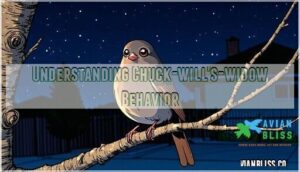
Before you can effectively coexist with Chuck-will’s-widows, you’ll need to understand what makes these fascinating nocturnal birds tick.
These ground-nesting insect hunters have evolved remarkable behaviors that help them thrive in darkness while staying hidden from predators during the day, which is a key aspect of their ability to thrive.
Masters of darkness, Chuck-will’s-widows turn night into their hunting advantage through silent flight and incredible camouflage skills.
Nocturnal Nature
The Chuck-will’s-widow transforms into a nocturnal hunting machine when darkness falls.
These feathered phantoms possess extraordinary night vision and dark adaptation abilities, making them masters of moonlight foraging.
Their silent flight allows stealthy insect pursuit while you sleep peacefully.
Understanding their nocturnal nature helps with effective chuck wills widow removal strategies:
- Nocturnal hunting peaks between 9 PM and 3 AM
- Night vision surpasses most other bird species substantially
- Silent flight enables undetected prey capture techniques
- Dark adaptation allows navigation in minimal moonlight conditions
- Nocturnal bird deterrents work best during active hours
Foraging Behavior
Once darkness settles, nocturnal birds like chuck wills widow become aerial acrobats.
They’re insectivorous birds with impressive flying tactics for night hunting. Watch them snatch insect prey mid-flight using their bucket-sized mouths!
Their foraging behavior provides amazing pest control benefits:
- Moths drawn to porch lights become midnight snacks
- Beetles buzzing through gardens meet their match
- Cicadas singing summer songs turn into food sources
These bird behavior modification experts truly earn their keep as nature’s vacuum cleaners.
Nesting Habits
Now that you’ve watched their hunting prowess, let’s peek into their secret nesting world. Chuck-will’s-widows are ground-nesting champions who’ve mastered the art of disappearing acts.
These master magicians nest right under your nose—completely invisible until they choose to reveal themselves.
They skip fancy tree houses, instead laying their precious cargo directly on leaf litter across forest floors. Their egg camouflage game is absolutely incredible – those speckled patterns blend so perfectly with fallen leaves, you’d walk right past without noticing.
When danger lurks nearby, these helicopter parents don’t mess around. They’ll physically relocate their chicks to safer spots, proving that nocturnal birds take chick protection seriously.
Their nesting materials? Nature’s own carpet of decomposed leaves. Understanding their nesting behavior involves recognizing the importance of bird nesting habits in ensuring the survival of their offspring.
Identifying Chuck-will’s-widow Habitat
Before you can address any Chuck-will’s-widow concerns, you’ll need to know where these fascinating night birds actually hang out.
Understanding their habitat preferences helps you make informed decisions about coexistence rather than removal—because these insect-eating champions are actually doing you a favor by controlling pest populations naturally.
They are insect-eating champions, which means they are beneficial to have around, as they control pest populations naturally.
Preferred Environments

Understanding where these remarkable nightjar birds call home helps you appreciate their conservation needs.
Chuck-will’s-widow thrives in diverse Woodland Habitats that offer the perfect balance of cover and hunting grounds.
You’ll discover these upland ground birds in four key environments:
- Oak groves and mixed hardwood forests – Dense canopies with rich Forest Floors of decomposing leaves
- Pine plantations and coniferous stands – Mature trees providing Shaded Areas for daytime roosting
- Forest edge habitats – Where Open Spaces meet wooded areas, creating ideal insect-hunting corridors
- Subtropical woods and lowland rain forest – Southern Rural Landscapes with thick understory vegetation
Geographic Distribution
Geographic distribution reveals these fascinating night birds across the Eastern Range from Eastern Canada down to the Southeast and Texas.
Their Migration Patterns follow predictable routes—breeding throughout eastern states, then heading to Winter Habitats in Central America and northern South America.
Geographic Boundaries stretch from southern New England to Florida year-round.
Habitat Preferences include mixed woodlands and forest edges.
Understanding Chuckwillswidow distribution helps you appreciate their remarkable seasonal journeys spanning thousands of miles.
Nesting Locations

When you’re tracking down these birds, you’ll discover their nest sites are pure genius. Chuck-will’s-widows practice ground nesting on woodland floors and forest floors, creating invisible nurseries in leaf litter. These master hide-and-seekers don’t build traditional nests—they simply lay eggs directly on nature’s carpet.
Nesting locations reveal why standard bird control methods won’t work. They are:
- Camouflaged perfectly among fallen leaves and forest debris
- Located in dense vegetation where bird exclusion techniques can’t reach
- Constantly relocated if disturbed, making bird nuisance control ineffective
- Protected by federal law, requiring conservation-focused approaches over traditional get rid of birds strategies
Conservation Efforts for Chuck-will’s-widow

You can’t truly "get rid of" Chuck-will’s-widows since they’re protected by federal law, but you can support conservation efforts that help manage their populations naturally.
Three major programs work to balance these nocturnal birds with human needs: wildlife sanctuaries that provide safe havens, habitat stewardship that creates bird-friendly spaces, and restoration projects that rebuild healthy ecosystems.
Wildlife Sanctuary Program
Wildlife sanctuaries aren’t just bird havens—they’re strategic Wildlife Conservation tools that redirect Chuck-will’s-widows to better homes.
Think of sanctuaries as exclusive bird clubs where your feathered visitors get VIP treatment away from your property.
Here’s how Sanctuary Design creates effective Species Protection:
- Habitat Creation provides prime nesting sites with natural leaf litter
- Ecosystem Management maintains insect populations for abundant food sources
- Habitat Modification creates buffer zones between birds and human activity
- Wildlife Conservation research helps develop better bird control methods
These sanctuaries work like natural bird deterrent devices, offering Chuck-will’s-widows everything they need elsewhere.
Effective wildlife sanctuary management is essential for conservation success.
Habitat Stewardship Program
When you join a Habitat Stewardship Program, you’re transforming your property into a Chuck-will’s-widow paradise.
These bird conservation initiatives teach you native planting techniques that create perfect roosting spots.
You’ll learn sustainable landscaping methods like reducing light pollution and selecting plants that attract their insect prey.
Through habitat management practices, you’re providing essential ecosystem services while supporting wildlife conservation.
It’s natural bird control at its finest—you’re helping these nocturnal hunters thrive naturally!
Habitat Restoration
Moving beyond stewardship basics, habitat restoration becomes your hands-on toolkit for Forest Regeneration. Through Native Planting and invasive species removal, you’re creating Wildlife Corridors that boost insect biomass by 60%.
This Ecosystem Repair transforms degraded landscapes into thriving Chuck-will’s-widow sanctuaries.
- Biodiversity Conservation that restores 70% of original habitat heterogeneity within five years
- Bird habitat preservation supporting 20% more breeding pairs in restored areas
- Natural bird control through enhanced prey abundance and nesting success
Challenges to Chuck-will’s-widow Population
You’re witnessing a bird that’s facing some serious challenges in today’s changing world.
Chuck-will’s-widows are struggling with habitat loss, climate shifts, and dangerous building collisions that threaten their survival across their range.
Loss of Habitat

While conservation programs work tirelessly to protect Chuck-will’s-widows, habitat loss remains their biggest enemy.
Deforestation Impact and Urban Expansion destroy the woodlands these birds call home. When you clear forests for development, you’re creating Habitat Fragmentation that splits populations apart.
This Ecosystem Disruption leads to Biodiversity Loss, making it harder for these nocturnal hunters to find suitable nesting sites and food sources.
| Threat Type | Impact on Chuck-will’s-widows |
|---|---|
| Deforestation | Removes nesting areas and insect habitats |
| Urban Development | Fragments remaining bird habitat into isolated patches |
| Agricultural Expansion | Eliminates forest understory needed for camouflage |
| Infrastructure Projects | Creates barriers that disrupt migration routes |
Habitat conservation isn’t just about saving trees—it’s about preserving entire ecosystems that support bird species decline prevention.
Climate Vulnerability

Climate change isn’t just affecting polar bears—it’s reshaping Chuck-will’s-widow survival. Temperature shifts force these birds northward, while climate models predict habitat shrinkage.
Extreme weather patterns disrupt breeding cycles, and sea level rise threatens coastal nesting sites. Ecosystem disruption reduces insect prey availability.
Climate threats are exacerbated by habitat loss effects on bird populations.
Climate threats facing bird species at risk:
- Breeding ranges shifting 42% northward by 2050
- Nesting success dropping to 47% during hot summers
- Migration routes extending 120 kilometers since 2000
- Insect prey declining 18% over the past decade
Building Collisions

Nocturnal bird crashes into illuminated buildings remain a deadly threat for Chuck-will’s-widows.
These night flyers mistake lit windows for open sky, leading to fatal building collisions.
| Collision Prevention Method | Effectiveness | Cost |
|---|---|---|
| Window Decals | High | Low |
| Lighting Control | Very High | Medium |
| Bird Friendly Glass | Excellent | High |
| Urban Planning | Maximum | Very High |
| Motion Sensors | Good | Medium |
You can protect these nocturnal bird species by installing birdsafe windows and reducing nighttime illumination.
Simple bird proofing methods like bird control solutions save countless lives yearly.
Responsible Bird Observation

When you’re out spotting Chuck-will’s-widows, remember that these nocturnal birds are protected by federal law, so hands-off observation is the only way to go.
Your camera and binoculars are your best friends here—keep a respectful distance and let these amazing insect hunters do their thing without any interference from you.
This allows for hands-off observation, which is essential for respecting these birds’ space.
Photography Guidelines
Bird photography requires patience and proper preparation.
Set your camera settings beforehand—adjust ISO, aperture, and shutter speed for low-light conditions.
Avoid flash usage, which can startle Chuck-will’s-widows and disrupt their natural behavior.
Use wildlife lenses with longer focal lengths to maintain respectful distance.
Focus on capturing authentic bird portraits that showcase their cryptic plumage patterns.
Remember, birdwatching ethics come first—no photo’s worth disturbing these protected nocturnal hunters during their critical foraging time.
Investing in good wildlife camera equipment enhances the overall photography experience.
Conservation Photography
Camera traps capture Chuck-will’s-widows without human disturbance, making conservation photography truly hands-off.
Your wildlife lenses become powerful tools for bird portraits while maintaining respectful distance.
Photo ethics demand we prioritize bird conservation over perfect shots. Practice conservation framing that showcases their natural behavior without stress.
Remember, wildlife conservation starts with bird species identification through patient observation.
Your bird conservation efforts shine when photographs educate rather than exploit these magnificent nocturnal hunters.
Wildlife Respect
Through thoughtful wildlife respect practices, you’ll master humane bird control that benefits both species and ecosystems.
- Maintain respectful distance – Use telephoto lenses instead of approaching nests, ensuring animal welfare while capturing stunning photos.
- Skip flash photography – Bright lights disrupt nocturnal behavior and stress these sensitive birds during critical activities.
- Stay on designated trails – Trampling destroys habitat and disturbs ground-nesting sites, undermining bird friendly conservation efforts.
Community Engagement in Chuck-will’s-widow Conservation

You can make a real difference in Chuck-will’s-widow conservation by joining hands with your community – it’s way more fun than going it alone.
From citizen science projects that let you become a bird detective to volunteer programs where you’ll meet fellow nature lovers, there are tons of ways to help these amazing night birds thrive.
Volunteer Programs
Want to make a real difference? Volunteer programs connect you with local wildlife conservation groups doing hands-on Chuck-will’s-widow protection work.
Through community outreach and volunteer recruitment, you’ll join habitat restoration projects, population surveys, and event planning activities.
These programs offer bird deterrent tips training while supporting wildlife conservation goals.
Membership drives and donation management opportunities let you expand conservation impact beyond fieldwork.
Educational Initiatives
Someone told me educational initiatives are just fancy words for "let’s talk about birds." Well, they’re not wrong! These programs transform skeptics into Chuck-will’s-widow champions through hands-on learning experiences that make conservation feel personal.
Here’s how you can get started with educational initiatives:
- Workshop Ideas – Join one of 90+ identification workshops offered by state bird clubs annually
- Bird Courses – Enroll in environmental science curricula where 38% of southeastern schools integrate Chuck-will’s-widow habitat lessons
- Outreach Events – Attend community workshops that reached 4,700 participants in 2024 with habitat activities
These awareness campaigns aren’t your typical bird deterrent tips or bird control services – they’re conservation education at its finest, reaching 12,000 middle school students yearly.
Community Science Projects
Beyond traditional birdwatching, citizen science projects let you contribute real data to chuck-will’s-widow research.
Join bird surveys during nesting season to monitor species populations through systematic data collection. Volunteer training programs teach proper identification techniques and recording methods.
Your observations support research collaboration between scientists and communities, creating valuable datasets for conservation efforts. This community engagement transforms casual birding into meaningful bird conservation awareness activities that directly impact species monitoring initiatives.
By participating in these initiatives, you can gain a deeper understanding of bird conservation methods and their role in preserving species populations.
Promoting Coexistence With Chuck-will’s-widow

You don’t need to "get rid of" Chuck-will’s-widows – these helpful night hunters actually control the bugs that bother you most.
Instead of pushing them away, you can create a win-win situation where both you and these remarkable birds thrive together in your shared space.
Nesting Season Awareness
Chuck-will’s-widows aren’t pests—they’re nocturnal pest controllers working overtime during nesting season.
Understanding their seasonal awareness and nesting patterns helps you appreciate these beneficial birds rather than seeking nest removal or bird deterrents.
Here’s your nesting season awareness guide:
- March to August breeding period – Peak activity for fledgling care
- Ground-level nests in leaf litter require gentle footsteps
- Nighttime calls signal active parenting, not disturbance
- Natural camouflage makes detection nearly impossible
- Insect control services intensify during chick-rearing season
The provided guide offers insights into the behavior and needs of Chuck-will’s-widows during their nesting season, highlighting their importance as pest controllers and the need for gentle coexistence.
Mitigating Human Impact
Understanding human impact means recognizing how our daily activities affect Chuck-will’s-widows.
Light management tops the priority list since artificial lighting disrupts their nocturnal foraging by 30%.
Noise reduction helps too—loud sounds stress nesting birds.
Effective conservation requires addressing the habitat loss effects on local ecosystems.
| Impact Type | Problem | Solution |
|---|---|---|
| Lighting | Disrupts foraging efficiency | Install shielded, warm LED lights |
| Noise | Stresses nesting birds | Limit loud activities near habitats |
| Property | Habitat destruction | Preserve native vegetation patches |
Smart conflict resolution beats bird repellent strategies every time.
Supporting Local Ecosystems
Want to transform your yard into a Chuck-will’s-widow haven? Supporting local ecosystems isn’t just bird repellent strategies turned upside down—it’s wildlife management that benefits everyone.
Here’s your ecosystem balance starter pack:
- Plant native vegetation – Choose indigenous trees and shrubs that provide natural insect buffets
- Reduce outdoor lighting – Dark-sky friendly practices support nocturnal wildlife preservation during breeding season
- Maintain brush piles – Create shelter zones that boost biodiversity conservation and environmental sustainability
Using native plant seeds can enhance the overall native seed quality of your local ecosystem.
Frequently Asked Questions (FAQs)
Are Chuck-will’s-widows endangered?
Don’t count your chickens before they hatch when evaluating conservation status. Chuck-will’s-widows aren’t endangered—they’re classified as "Least Concern" but face population declines from habitat loss and climate change threats.
Are Chuck-will’s-widows the same as Whippoorwills?
No, they’re different birds! While both are nightjars, Chuck-will’s-widows are substantially larger than Whip-poor-wills, with richer buffy-brown coloration and distinctive square-tipped tails versus rounded ones.
What sound does a Chuck-will’s-widow make?
Imagine this: you’re camping and suddenly hear a mysterious call echoing through the darkness.
The Chuck-will’s-widow produces a distinctive, mellow song that sounds exactly like its name – "chuck-will’s-widow" – with a deep, low "chuck" followed by whistled notes.
What is a Chuck-will’s-widow?
A Chuck-will’s-widow is North America’s largest nightjar, a nocturnal bird with cryptic brown plumage that hunts flying insects at night.
You’ll recognize its distinctive "chuck-will’s-widow" call echoing through southeastern forests during breeding season, which is a key feature to identify this bird, especially with its nocturnal behavior.
Do Chuck-will’s-widows fly?
You’d be amazed how these nocturnal acrobats transform into feathered fighter jets after dark.
They’ve got those long, raptor-like wings that slice through night air with incredible precision, hawking insects mid-flight with their bucket-sized mouths.
Why should I donate to Chuck-will’s-widow?
You’ll support essential conservation efforts that protect Chuck-will’s-widows and their ecosystems. These nocturnal birds control agricultural pests naturally, maintaining biodiversity while facing habitat loss threats that donations help combat effectively.
Do Chuck Will’s-widows migrate?
Like feathered nomads following ancient stars, Chuck-will’s-widows migrate seasonally. You’ll find them traveling from southeastern U.S. breeding grounds to Central America, Caribbean, and northern South America for winter warmth.
Are Chuck Will’s-widows endangered?
No, Chuck-will’s-widows aren’t endangered. They’re classified as "Least Concern" by conservationists, though their numbers are slightly declining due to habitat loss and development pressures across their southeastern range.
What does a Chuck-will’s-widow eat?
You’ll find Chuck-will’s-widows are voracious insect hunters, swooping through the night sky to snare moths, beetles, cicadas, and flying ants with their impressively wide mouths.
Why is the Chuck-will’s-widow declining?
Chuck-will’s-widows are declining because you’re seeing habitat loss from deforestation and urban sprawl eating up their nesting grounds. Climate change disrupts their migration patterns while pesticides eliminate their insect prey.
Conclusion
Dancing around the question of how to get rid of chuck wills widow isn’t the answer—embracing these feathered pest controllers is.
You’ve learned that coexistence beats conflict every time. These night hunters aren’t your enemies; they’re your allies against mosquitoes and moths.
By reducing outdoor lighting, respecting nesting seasons, and supporting habitat conservation, you’re not just helping chuck-will’s-widows thrive—you’re creating a balanced ecosystem that benefits everyone in your neighborhood.