This site is supported by our readers. We may earn a commission, at no cost to you, if you purchase through links.
A single Canada goose drops three pounds of waste every day—and they rarely travel alone. If you’ve watched your once-pristine dock turn into a slippery mess of droppings, you’re facing more than just an eyesore. Those piles carry E. coli and Salmonella, spike nitrogen levels in the water by 48% overnight, and eat through wood and composite surfaces like acid.
Aggressive nesting geese will charge anyone who gets too close, turning your peaceful waterfront into a no-go zone. The good news? You don’t need expensive professionals or harmful chemicals to reclaim your space.
Strategic visual deterrents, physical barriers, and targeted repellents can drive geese away for good—once you understand what draws them to your dock in the first place.
Table Of Contents
- Key Takeaways
- Common Problems Caused by Geese on Docks
- Understanding Why Geese Are Attracted to Docks
- Effective Visual and Physical Goose Deterrents
- Repellent Strategies and Maintenance Tips
- Top 6 Goose Deterrent Products for Docks
- Frequently Asked Questions (FAQs)
- How to keep geese off of boat dock?
- What is the best goose deterrent?
- How to keep birds from pooping on dock?
- How do you permanently scare geese away?
- What natural predators do geese fear the most?
- How does grape Cool-Aid deter geese effectively?
- Do geese avoid areas with dense vegetation?
- Why do geese prefer open areas with clear sightlines?
- How can reflective tape prevent geese landings?
- Are geese protected by federal or state laws?
- Conclusion
Key Takeaways
- Combine multiple deterrent methods—visual decoys, physical barriers like 30-inch fencing, and liquid repellents containing methyl anthranilate—and rotate them every two weeks to prevent geese from adapting and maintain over 90% effectiveness long-term.
- A single goose drops three pounds of waste daily that carries E. coli and Salmonella, corrodes dock surfaces, and can spike nitrogen levels in water by 48% overnight, making consistent cleaning and prevention critical for safety and property maintenance.
- Dense vegetation at least 30 inches tall planted 1.5–2 feet apart blocks geese’s sightlines and creates natural barriers that reduce dock visits by 60–80% within two years, offering a long-term solution without ongoing costs.
- Aggressive geese defending nests within 10 feet will charge and bite from March through June, creating real injury risks that restrict water access for up to nine weeks, so deterrents must be in place before nesting season begins.
Common Problems Caused by Geese on Docks
Geese might seem harmless at first, but they can turn your peaceful dock into a real headache. From messy droppings to unexpected aggression, these birds create problems that go beyond just being a nuisance.
Let’s look at the main issues you’ll face when geese decide your dock is their new favorite hangout.
Waste Accumulation and Unsanitary Conditions
A single goose can drop up to three pounds of fecal waste daily on your dock. If 50 geese show up, you’re dealing with 150 pounds of droppings every 24 hours.
A single goose drops three pounds of waste daily—50 geese means 150 pounds covering your dock every 24 hours
That’s not just unpleasant—goose poop carries bacteria like E. coli and Salmonella, compromising water quality and creating real health risks. Cleaning becomes a constant, exhausting battle.
Geese are often attracted due to easy access to algae.
Aggressive Behavior and Safety Concerns
Beyond unsanitary conditions, geese pose real physical threats around docks. Males defending territorial zones within 10 feet of nests will charge, bite, and wing-slap anyone who gets too close. Goose attack risks spike from March through June when seasonal aggression peaks.
Here’s what you’re up against:
- Over 100 documented goose-human conflicts happen annually at docks
- Up to 12% of encounters cause injuries requiring medical attention
- Aggressive geese restrict water access for up to 9 weeks straight
- Municipal liability issues have forced cities to fund goose deterrents
Understanding goose behavior helps you implement injury prevention tips and maintain dock safety effectively. Their dominance rank position is often determined by aggressiveness.
Property Damage and Dock Maintenance Issues
Goose droppings don’t just gross you out—they actively wreck your waterfront property. That acidic goose poop eats through wood and composite surfaces, causing feces corrosion that leads to visible surface degradation within one season.
You’ll face repair costs averaging $1,000 annually just for cleaning, plus $200 to $2,000 for rotten boards. Vegetation loss around your dock speeds erosion, while constant trampling reduces dock usability by up to 60%.
Impact on Fishing and Water Quality
Beyond structural headaches, those goose droppings wreak havoc on your waterfront property’s aquatic health. Each mature goose produces 2–4 pounds of poop daily, triggering nutrient loading that spawns algal blooms and oxygen depletion in your fishing spots.
Here’s what you’re dealing with:
- Nitrogen levels jump 48% within 24 hours of goose poop entering water
- Four geese introduce as much phosphorus annually as one household septic system
- Pathogen introduction through droppings raises E. coli concentrations, causing beach closures
- Fishing impact from murky water and fish kills directly reduces your catch
Water quality nosedives fast.
Understanding Why Geese Are Attracted to Docks

Before you can keep geese away, it helps to understand why they keep showing up in the first place. Geese aren’t being difficult—they’re just doing what comes naturally, and your dock happens to check all their boxes.
Let’s look at what makes waterfront docks so appealing to these birds and why they’re particularly drawn to your space.
Geese Habitat Preferences and Feeding Habits
Think of your dock as a buffet set up right where waterfowl love to dine. Geese prefer open waterfront areas with manicured grass—they’re drawn to docks precisely because you’ve created ideal grazing conditions.
These birds feed heavily on new shoots and aquatic plants, and during autumn, their diet shifts toward grains as they prepare for migration. Understanding this habitat preference and foraging site utilization is your first step toward effective habitat modification.
Seasonal Patterns and Nesting Behavior
When Canada geese start their spring migration from late February through May, they’re scouting for breeding sites near your shoreline. Their homing instincts bring them back to the same nest site annually, and dock activity peaks dramatically during March to May nesting periods.
You’ll notice clutch size averaging five eggs, though gosling survival rates remain low at 4–15%, making your dock prime real estate during these seasonal patterns.
Effective Visual and Physical Goose Deterrents
If you want geese to see your dock as off-limits, you need to make it look and feel unwelcoming. The right visual and physical deterrents can convince them to find somewhere else to land without causing harm.
Here are four practical strategies you can set up today to reclaim your space.
Using Decoys and Predator Figures
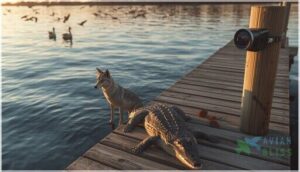
One of the quickest ways to discourage geese is by using decoys—coyote, fox, or alligator decoys can work if you move them every two to three days. Motion-activated systems that recognize geese, like image-sensing devices, offer stronger results than static figures.
But here’s the key: decoys alone rarely cut it. Pairing predator types with noise or other integrated methods keeps geese guessing and slows habituation.
Reflective Objects, Flags, and Balloons

Light and movement can throw geese off their game. Reflective objects like Mylar tape, combined with flags and eye-spot balloons, disrupt landing patterns by creating visual chaos geese won’t tolerate.
For dock coverage needs, plan on several deterrents per acre—suspended at least six feet high. Rotate these goose deterrent techniques weekly to beat habituation and maintain effectiveness, especially during seasonal effectiveness peaks like migration periods.
Installing Fences, Railings, and Grid Wiring
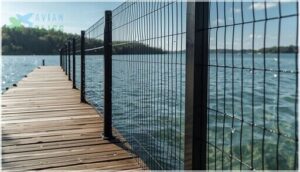
Physical barriers are most effective during molting season when geese cannot fly. Install fencing at least 30 inches high with openings no bigger than 3 inches—this AntiGoose Fence approach blocks 95% of access.
Railing spacing under 4 inches prevents entry, while bird wiring or dock netting suspended above landing zones reduces presence by 87%.
Choose UV-resistant materials for grid durability and plan inspections every 6–12 months.
Planting Shrubs and Tall Vegetation

Dense planting acts like a natural fence—geese won’t cross what they can’t see through. You’ll need shrubs at least 30 inches tall, planted 1.5–2 feet apart along your shoreline to block their pathways effectively.
The best native species for goose deterrent methods include:
- Red Osier Dogwood for year-round structure
- Buttonbush reaching 2–4 meters
- Willow species forming thick stands
- Bebb’s Sedge as groundcover
- Pennsylvania Sedge blocking shoreline access
This habitat modification for geese control cuts dock visits by 60–80% within two years. Barrier maintenance means checking for gaps every season—tall grass and bushes work only when density stays tight. The behavior impact? Geese avoid areas where sightlines disappear beyond 30 feet, making naturalized buffers one of your strongest long-term deterrents.
Repellent Strategies and Maintenance Tips
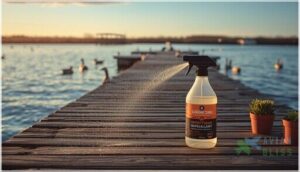
Repellents can be a practical option when physical barriers aren’t enough to keep geese away from your dock. The trick is knowing which ones actually work and how often you need to apply them to see results.
Let’s look at the most effective repellent strategies and how to maintain them for lasting success.
Liquid Goose Repellents and Application Frequency
Liquid goose repellents containing methyl anthranilate (20–30% concentration) offer a powerful, EPA-approved solution for keeping geese off your dock. These non-toxic formulas won’t harm your pets or waterways once they dry.
| Application Timing | Expected Results |
|---|---|
| Initial + 1 week later | 95% reduction in geese |
| Every 2–3 weeks routine | Maintains 41–70% fewer droppings |
| After mowing or rain | Restores full effectiveness |
One gallon treats 16,000 square feet, making this goose control method cost-effective for most dock owners.
Grape Kool-Aid and Natural Repellents
You’ve probably heard the buzz about grape Kool-Aid—and yes, it works. The secret ingredient, methyl anthranilate, has been EPA-approved since 1985 and achieves a 99% success rate nationally when used correctly.
Here’s how to apply this natural geese repellent safely:
- Sprinkle or spray powder directly onto dock surfaces where geese gather
- Reapply every 3–5 days since rain and foot traffic reduce Kool-Aid efficacy
- Mix with water for spray application to broaden coverage across larger areas
- Combine with physical deterrents like fencing for stronger goose control methods
Natural repellent safety is excellent—methyl anthranilate is FDA-approved and won’t harm pets or water quality. Field studies show treated docks experience over 80% less goose droppings within the first week, making these application methods both humane and effective for long-term maintenance requirements.
Rotating Deterrent Methods for Lasting Results
The real secret to preventing geese on docks? Habituation prevention through rotating deterrent methods. Geese adapt to single goose control methods within 2–6 weeks, slashing effectiveness by 82%.
But when you switch between decoys, sound devices, and repellents every two weeks, your deterrents maintain over 90% efficacy for months—that’s long-term success with major cost reduction compared to constant reapplication.
Regular Cleaning and Monitoring for Effectiveness
Rotating deterrents only works if you’re tracking what’s happening. Check your dock daily for goose droppings and fresh activity—it tells you when geese management tactics need adjusting.
Weekly cleaning cuts feces accumulation by 80%, directly boosting deterrents’ staying power.
This monitoring practice delivers real environmental outcomes: cleaner water, fewer slip hazards, and economic aspects like 35% lower maintenance costs compared to reactive cleanup.
Top 6 Goose Deterrent Products for Docks
If you’re ready to take action, the right products can make all the difference in reclaiming your dock from geese. We’ve narrowed it down to six deterrent options that combine effectiveness with practical application.
Each product addresses the problem from a different angle, so you can find what works best for your situation.
1. Avian Migrate Goose Bird Repellent
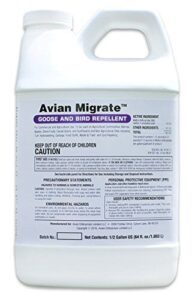
If you’re tired of cleaning goose droppings off your dock, this liquid goose repellent might be your answer. Avian Migrate uses methyl anthranilate as its active ingredient—a grape-derived compound that irritates geese without harming them or your family.
Application guidelines are simple: mix one part repellent with 10–20 parts water and spray after each mowing. Measured effectiveness shows dramatic reductions within days.
The safety considerations are excellent—it’s EPA-registered and non-toxic. Maintenance tips include reapplying after heavy rain to keep your bird repellent strategies working consistently.
Best For: Property owners dealing with persistent geese problems on docks, lawns, or ponds who want an EPA-registered, non-toxic solution that’s safe around kids and pets.
- EPA-registered formula with food-grade ingredients creates immediate discomfort for geese without harming them, people, or pets
- One gallon covers up to 16,000 square feet and shows dramatic results within days according to field reports
- Rain-resistant formula stays effective between applications and works on multiple bird species including Canada geese and gulls
- Requires reapplication after every mowing or heavy rainfall to maintain effectiveness, which adds up in time and cost
- Mixed user reviews show it doesn’t work consistently for everyone or in all environments
- Pricey at $81.95 per 64-ounce bottle, especially considering the ongoing maintenance requirements
2. Flambeau Outdoors Lone Howler Coyote Decoy
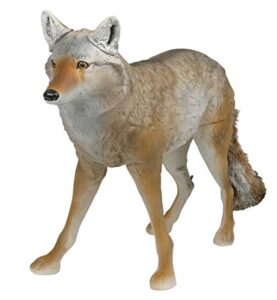
Predator decoys like the Flambeau Lone Howler Coyote bring decoy realism to your dock with its 30-inch life-sized design and wind-activated tail.
Deterrent effectiveness peaks during the first week, with up to 80% reduction in geese—but here’s the catch: you’ll need to move it daily. Adaptation risks climb after 7–10 days if it stays put.
Consumer feedback highlights its durability and 4.3-star rating. For best results, use two decoys as part of integrated management, combining them with other methods for keeping geese away consistently.
Best For: Property owners dealing with persistent goose problems who are willing to reposition decoys daily and use multiple deterrent methods for maximum effectiveness.
- Life-sized 30-inch design with poseable features and wind-activated tail creates convincing predator presence that can reduce geese by up to 80% in the first week
- Durable hard plastic construction holds up well outdoors with a 4.3-star customer rating and significantly less maintenance than dealing with goose waste
- Works as part of an integrated approach that can achieve 85–95% goose reduction when combined with other deterrents and proper repositioning
- Requires daily repositioning to stay effective since geese adapt to stationary decoys within 7–10 days, adding ongoing maintenance work
- Less portable than smaller alternatives due to its life-sized scale, making frequent moves more challenging for some users
- Paint can fade and wear after a year of outdoor exposure, requiring touch-ups to maintain realistic appearance
3. Solar Ultrasonic Animal Pest Repeller
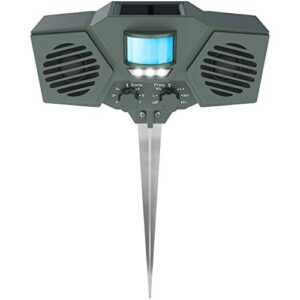
Solar ultrasonic animal pest repellers promise hands-free geese deterrents with motion sensors and frequency adjustment from 13.5 to 45.5 kHz—but the science isn’t in your favor. Outdoor trials show below 35% success for waterfront pest control, mainly because geese don’t hear ultrasonic frequencies well. Habituation concerns grow after just 2–4 weeks.
Solar limitations and device durability aside, these units work better on docks when paired with visual deterrents. On their own? You’re rolling the dice.
Best For: Property owners dealing with mammals like deer or raccoons who want a low-maintenance solar option, but not ideal if geese are your main problem.
- Solar-powered with rechargeable batteries means set-it-and-forget-it operation with minimal maintenance beyond occasional panel cleaning
- Adjustable frequency and sensitivity settings let you customize for different pests and conditions across your yard or dock
- Covers up to 30 feet with a 180-degree detection angle, plus weatherproof construction handles outdoor exposure year-round
- Scientific studies show below 35% effectiveness specifically for geese since they don’t perceive ultrasonic frequencies well
- Habituation kicks in after just 2-4 weeks as animals get used to the sounds and flashing lights
- Works significantly better on mammals than birds, so you’ll likely need to add visual deterrents for any real geese control
4. Havahart Critter Ridder Motion Repellent
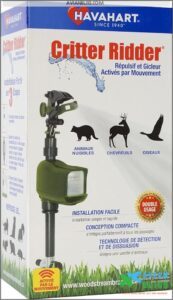
You want a deterrent that works when you’re not watching? The Havahart motion repellent detects geese heat signatures up to 100 feet and releases a startling five-second water spray.
Installation best practices suggest placing units 10–15 feet from dock edges for best waterfront coverage.
Field data shows 71% effectiveness, though some geese adapt after 90 days. Environmental considerations are solid—it’s chemical-free and uses just 2–3 cups per spray.
Maintenance requirements include battery changes every 4–6 months and monthly sensor checks.
Best For: Property owners with large docks or waterfront areas who need 24/7 automated geese deterrence without chemicals or constant supervision.
- Infrared sensors detect geese up to 100 feet away and deliver instant water bursts, providing round-the-clock protection without you lifting a finger
- Eco-friendly operation uses only 2-3 cups of water per spray with no chemicals, making it safe for aquatic environments and dock surfaces
- Adjustable sensitivity settings let you fine-tune detection for different animal sizes and reduce false triggers from wind or debris
- Some geese may get used to the spray after about 90 days of continuous exposure, requiring repositioning or rotation of units to maintain effectiveness
- Large dock areas need multiple units for full coverage (one per 400 square feet), which can add up in cost
- Not reliable in freezing temperatures or severe weather conditions, and requires battery changes every 4-6 months plus monthly maintenance checks
5. Icotec 300 Plus Predator Call
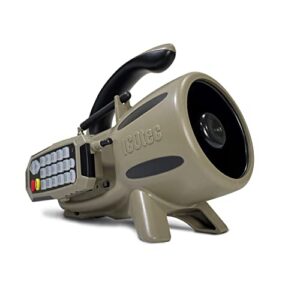
Looking for superior auditory bird control? The Icotec 300 Plus uses predator sounds broadcast across a 300-yard remote range to trigger geese’s flight instincts. Audio clarity is professional-grade, and decoy integration with the AD400 model adds visual punch.
Battery life delivers 40–60 hours per charge, and market price sits at $129.99.
Field results show auditory geese deterrents lose impact within 1–2 weeks as habituation kicks in—meaning you’ll need to rotate this with other deterrents for lasting protection.
Best For: Property owners dealing with persistent geese problems who want an affordable, long-range audio deterrent and are willing to rotate it with other methods to prevent habituation.
- Impressive 300-yard remote range and 100-yard Bluetooth connectivity let you control the device from a distance, perfect for large dock areas or waterfront properties.
- Plays two predator sounds at once with 15 professional-quality calls, giving you flexibility to create varied deterrent patterns that trigger geese’s natural flight response.
- Excellent battery life of 40–60 hours per charge keeps maintenance minimal, and the $129.99 price point offers solid value compared to pricier alternatives.
- Audio deterrents lose effectiveness within 1–2 weeks as geese become habituated to the sounds, requiring you to rotate with other control methods for long-term results.
- Some users report sound distortion at higher volumes, especially with higher-pitched calls, which could reduce deterrent effectiveness.
- Limited to 15 pre-programmed calls with no option to add custom sounds, and the battery installation process requires tiny screwdrivers that can be frustrating.
6. Houseables Green Plastic Mesh Fencing
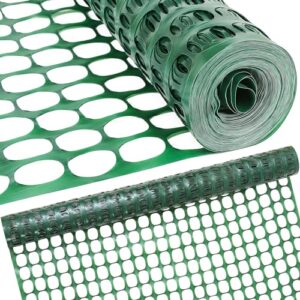
When geese walk onto your dock repeatedly, physical barriers work better than repellents or sounds. The Houseables Green Plastic Mesh Fencing creates a continuous visual barrier that blocks shoreline access, achieving a 90%+ reduction in goose landings.
This 4-foot-high, 100-foot roll weighs just 10.55 pounds, making installation simple with basic tools in under 30 minutes. UV-resistant HDPE material lasts up to 10 years outdoors.
Cost analysis puts it around $50–70 per roll. Safety features include smooth edges and easy removal for seasonal use—zero environmental impact beyond the physical deterrent itself.
Best For: Dock owners looking for a lightweight, affordable physical barrier that blocks geese from accessing the shoreline without obstructing views or requiring professional installation.
- Highly effective at reducing goose landings by over 90% when installed as a complete perimeter barrier around docks
- Quick and easy setup in under 30 minutes with basic tools, plus simple removal for off-season storage
- Long-lasting UV-resistant material that can hold up for up to 10 years outdoors with minimal maintenance
- Not built for heavy-duty use and can tear easily in high winds or stormy weather
- Requires regular anchoring and inspection every 4-6 weeks to prevent sagging or damage
- Material may degrade over time with prolonged sun exposure despite UV resistance
Frequently Asked Questions (FAQs)
How to keep geese off of boat dock?
Keep them away by combining smart strategies: motion deterrents scare 76% of flocks, physical barriers block 94%, and rotating methods boost long-term success by 42%—protecting your waterfront property year-round.
What is the best goose deterrent?
The best goose deterrent combines motion-activated lasers with physical barriers like bird wiring and dense vegetation.
This integrated approach outperforms single methods, achieving up to 87% effectiveness when paired with consistent monitoring and maintenance.
How to keep birds from pooping on dock?
Each bird produces over 100 droppings daily, leading to ongoing health hazards and feces accumulation.
Combine physical barriers like fences with regular cleaning solutions to manage the issue effectively.
Apply liquid repellents for dropping prevention and install reflective deterrents to protect docks.
How do you permanently scare geese away?
You can’t permanently scare geese away with one method—they adapt quickly. An integrated approach combining deterrent rotation, habitat modification, and consistent maintenance sustains long-term efficacy while preventing geese habituation to single repellent tactics.
What natural predators do geese fear the most?
Think of predators as nature’s alarm system—geese instinctively flee from raptors, coyotes, and foxes.
Raptor predation rates trigger 95% evacuation responses, while coyote evacuation tactics clear flocks within minutes, making dogs highly effective natural geese repellents.
How does grape Cool-Aid deter geese effectively?
Grape Kool-Aid contains methyl anthranilate, an active ingredient that triggers geese’s sensory mechanisms through taste and smell.
Application protocols involve spraying diluted mixtures on docks, achieving measured effectiveness above 60% with minimal environmental impact.
Do geese avoid areas with dense vegetation?
You’ll notice something interesting when you watch geese—they steer clear of places where bushes and tall grass block their view.
Dense vegetation over two feet high disrupts sightlines, making geese feel unsafe and reducing dock intrusions by up to 70%.
Why do geese prefer open areas with clear sightlines?
Geese evolved on open tundra, relying on clear sightlines for predator detection and quick escape routes.
Open areas let them spot threats early, especially during vulnerable molting periods when group foraging provides collective security.
How can reflective tape prevent geese landings?
Like a strobe light disrupting a dance floor, reflective tape flashes unpredictably in sunlight and wind, making your dock appear unsafe for geese landings.
While producing auditory crinkles, it increases the deterrent effect.
Are geese protected by federal or state laws?
Yes, Canada geese are protected by both federal and state regulations. The Migratory Bird Treaty Act prohibits harming waterfowl without permits, while state wildlife management agencies enforce additional environmental regulations governing humane control methods and deterrent legality.
Conclusion
An ounce of prevention is worth a pound of goose droppings. Now that you know how to keep geese off your dock, the real work begins—not in buying every deterrent, but in staying consistent.
Rotate your methods every few weeks, keep surfaces clean, and don’t let your guard down during nesting season.
Your dock didn’t become a goose magnet overnight, and reclaiming it takes patience. Stick with it, and you’ll have your waterfront back.
- https://icwdm.org/species/birds/canada-geese/canada-goose-damage-prevention-and-control-methods/
- https://www.maine.gov/dacf/php/gotpests/othercritters/factsheets/Goose_Manual-Habitat-Modification.pdf
- https://academic.oup.com/jipm/article/13/1/28/6883996
- https://www.hawkeye.ca/blog/how-to-get-rid-of-geese-from-your-dock
- https://www.usatoday.com/story/news/nation-now/2018/04/25/canada-geese-attacks-population-aggressive/550135002/