This site is supported by our readers. We may earn a commission, at no cost to you, if you purchase through links.

You might mistake the American kestrel for a small songbird at first glance—until it drops like a stone from a power line and strikes prey with surgical precision. This compact falcon, no bigger than a mourning dove, hunts with the same intensity as raptors twice its size.
Males sport russet backs and slate-blue wings, while females wear earth-tone camouflage. You’ll find them hovering above highway medians and farm fields across the Americas, from Alaska to Tierra del Fuego.
These adaptable hunters thrive in open country where grasshoppers, mice, and small birds provide steady meals. Understanding their identification markers, habitat preferences, and hunting behaviors helps you appreciate North America’s smallest and most colorful falcon.
Table Of Contents
- Key Takeaways
- American Kestrel Identification
- Habitat and Geographic Range
- Behavior and Hunting Techniques
- Diet and Feeding Habits
- Reproduction and Life Cycle
- Frequently Asked Questions (FAQs)
- Do American kestrel eat chickens?
- What is the American kestrel behavior?
- Is an American kestrel a falcon or a hawk?
- How big is an American kestrel?
- Do American Kestrels eat hummingbirds?
- Are American Kestrels aggressive?
- Is an American Kestrel a hawk or a falcon?
- What is special about the American Kestrel?
- Are American Kestrels rare?
- Can you have an American Kestrel as a pet?
- Conclusion
Key Takeaways
- You can identify American kestrels by their small size (9-12 inches), bold facial markings with black “mustache” stripes, and sexual dimorphism—males display slate-blue wings while females wear barred cinnamon tones for nest camouflage.
- These adaptable falcons thrive across diverse habitats from Arctic tundra to urban parks by combining perch-hunting and hovering techniques to capture insects, small mammals, and birds sized 10-60 grams.
- American kestrels don’t build nests but rely on existing cavities in trees or nest boxes 3-20 meters high, laying 4-6 eggs with 26-29 day incubation and extended parental care up to 6 weeks after fledging.
- Their hunting efficiency stems from exceptional vision that detects ultraviolet light in rodent urine trails, plus cognitive abilities for food caching and retrieval memory that helps them survive seasonal prey fluctuations.
American Kestrel Identification
You’ll know an American Kestrel when you see one—if you know what to look for. This small falcon has distinct markings and features that set it apart from other raptors.
Their sleek build and hunting prowess make them a standout among types of birds of prey, especially when diving for small mammals and insects.
Here’s what you need to spot in the field.
Size and Physical Characteristics

The American Kestrel measures 9 to 12 inches in length with a wing span of 20 to 24 inches. Body mass ranges from 80 to 155 grams in males and 90 to 190 grams in females.
Tail length accounts for roughly one third of total size shape. The beak shape is short and hooked, measuring 8 to 10 millimeters at the culmen tip.
Plumage and Color Patterns
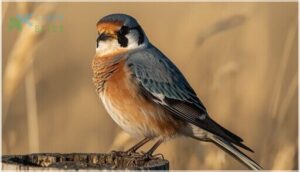
Beyond size and shape, you’ll notice the American Kestrel’s striking color pattern. Feathers display two tone plumage with slate blue gray backs and warm brown streaked underparts. A rusty crown patch sits above the eyes, while dark facial stripes create a masked look. Iridescence effects appear on wing edges under certain light.
- Melanin pigments produce sharp black to brown contrasts
- Molt cycles renew feather structure and color fidelity annually
- Plumage maintenance keeps color variations consistent through seasons
The kestrel’s plumage demonstrates how birds utilize adaptive coloration strategies for survival and communication.
Male Vs. Female Differences

You’ll spot sexual dimorphism right away when comparing male and female American Kestrels. Male American Kestrels flash cobalt blue wings against rusty backs, while female American Kestrels wear warmer cinnamon tones with heavy barring. Size variations show males averaging 110–130 grams versus females at 95–110 grams. Reproductive roles dictate plumage contrast—males display brighter colors for courtship, females rely on camouflage for nest protection.
Male kestrels flash cobalt blue wings for courtship while females wear camouflaged cinnamon tones to protect their nests
| Feature | Male | Female |
|---|---|---|
| Wing Color | Slate blue with minimal barring | Rusty brown with black bars |
| Back Pattern | Rufous with sparse spots | Cinnamon with dense barring |
| Body Mass | 110–130 grams average | 95–110 grams average |
| Underparts | Light with bold patterning | More uniform coloration |
| Behavioral Traits | Territorial aerial displays | Concealment and nest defense |
Key Identification Features
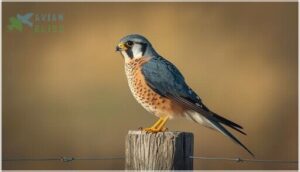
You’ll recognize an American Kestrel by its bold facial markings—black “mustache” stripes flanking a white throat patch. Plumage patterns reveal blue-gray back feathers contrasting with rufous tones, while the strong hooked beak shape signals raptor classification.
To contrast with these prairie hunters, check out the mountain chickadee’s unique black-and-white head pattern, which relies on softer colors rather than bold stripes.
Tail length extends noticeably when perched, and wing tips appear pointed in flight. Relative size sits between robin and crow, making bird species identification straightforward once you’ve spotted these features.
Habitat and Geographic Range

You’ll find American Kestrels across a vast range of landscapes, from Arctic tundra to desert scrublands. These adaptable falcons thrive wherever open hunting grounds meet suitable perching spots and nesting cavities.
Understanding where they live—and what they need to survive—reveals why you might spot them along a country highway or perched above a city park.
Preferred Environments
You’ll find these compact falcons thriving across a vast range of Habitat Diversity—from grasslands and deserts to alpine meadows and wetland edges. American Kestrel Habitat includes agricultural fields, marsh margins, and even Urban Landscapes like parks and golf courses.
Grassland Ecology and open scrub with scattered perches are essential. Wetland Conservation and Ecosystem Management support hunting success by maintaining prey-rich environments they need.
Distribution in North and South America
You’ll spot American Kestrels across a stunning Geographic Range—from southern Canada through most of the United States into central Mexico, then south through the Andes to Tierra del Fuego. Northern populations follow Migration Patterns southward in winter, while South American birds stay put year-round.
- In North America, breeding density peaks in grasslands east of the Rockies and scattered western zones
- Climate Effects and Regional Variations shape local abundance across tropical northern South America
- Habitat Fragmentation in agricultural zones creates both challenges and new hunting corridors
Adaptation to Urban and Rural Areas
You’ll find American Kestrels thriving through Habitat Flexibility in both city and countryside.
Urban wildlife populations exploit man-made structures for Urban Roosting and nest boxes, while rural birds rely on dead trees and hedgerows for Rural Foraging.
Prey Adaptation varies—city kestrels hunt abundant roadside insects, whereas rural populations target voles in pastures. Both demonstrate impressive Nesting Strategies despite habitat fragmentation, adjusting territories and behaviors to local prey density and ecological habitats and ecosystems.
Nesting Site Requirements
You’ll recognize kestrels as cavity nesters requiring specific Nesting Sites. Tree Cavity Selection focuses on diameters of 3 to 4.5 centimeters, while Nest Box Design should measure 15 to 20 centimeters wide internally. Cavity Orientation toward morning sun optimizes egg warming.
Perch Proximity matters—hunting posts within 100 meters support quick aerial sorties. Nesting Material consists of minimal grass lining.
These Nesting Requirements and Nesting Habits dictate breeding success across their range. Insights from bird nest trait characteristics reveal the diversity of nest sites and structures found across various avian species.
Behavior and Hunting Techniques

You’ll notice the American Kestrel’s hunting style sets it apart from most other raptors. These small falcons combine patience with precise aerial skills to capture prey.
Let’s break down the key behaviors that make them such effective hunters.
Perching and Flight Patterns
You’ll spot American Kestrels mastering wind and space with precise aerodynamic techniques. Their flight mechanics and adaptations reveal outstanding wing control during perch landing sequences.
- Dive-to-climb transitions: They swoop from perches in powered dives, then shift to upward glides, dissipating speed within meters for accurate landings.
- Hovering mastery: Birds adjust tail surfaces and wing angles mid-flight, countering gusts with micro-adjustments.
- Kestrel flight mechanics: Talons clutch perches within 0.1 seconds of contact, showcasing evolutionary precision in bird behavior.
Hunting Strategies and Senses
You’ll witness kestrels deploying vision techniques that rival high-powered optics—tracking targets up to 100 meters away.
Hunting tactics blend perch-based ambush strategies with hovering scans, while binocular vision provides depth perception essential for rapid stoops.
Sensory adaptations include acute hearing for rustling prey and heat perception at dawn. Their prey detection system demonstrates why bird of prey efficiency defines raptor survival across open habitats.
Prey Selection and Specialization
American Kestrels favor prey sized between 10 and 60 grams—grasshoppers, mice, and small birds within 3 to 6 inches. These hunting tactics improve energy return, targeting ground-foraging voles along field edges and hedgerows where prey density peaks.
Seasonal dietary adaptations shift foraging strategies: spring brings insect-rich feeding behavior, while winter predation patterns emphasize cached small mammals and birds for raptor diet and nutrition stability.
Food Caching Behavior
After capturing surplus prey, kestrels often store it for lean times. This feeding behavior enhances raptor diet and nutrition across seasons. Cache types range from scattered insects hidden beneath bark to small mammals tucked in tree hollows. You’ll notice these birds employ retrieval memory to relocate hundreds of stored items months later.
Key caching strategies include:
- Thief deterrence through vigilant guarding and diversified storage locations
- Environmental impact adjustments based on weather and habitat structure
- Cognitive factors guiding cache placement decisions and recovery success
- Seasonal shifts in caching frequency aligned with prey abundance patterns
Diet and Feeding Habits

The American Kestrel’s diet reflects its role as an opportunistic predator. You’ll find these fierce little falcons hunting everything from grasshoppers to small birds, depending on what’s available.
Understanding what they eat, when they eat it, and how they hunt reveals how this species thrives across diverse landscapes.
Primary Prey Types
You’ll spot kestrels targeting three main prey categories. Insect prey dominates the diet, especially grasshoppers, crickets, beetles, and dragonflies.
Small mammals like mice, voles, and shrews form the vertebrate prey base. Bird species such as finches and sparrows are taken regularly. The reptile diet includes lizards and small snakes in southern ranges.
Rodents and small birds require more effort to capture than insects.
Seasonal Dietary Changes
You’ll notice the American Kestrel’s diet shifts with seasonal prey and food availability. During summer, dietary adaptation centers on insects like grasshoppers.
Winter brings a switch to small mammals and birds as nutrient cycling slows insect populations. Migration patterns also influence kestrel hunting strategies and senses, with resident birds showing more pronounced avian diet and foraging shifts than migrants.
Bird feeding behavior adapts constantly to resource changes.
Foraging Methods
You’ll observe three primary foraging strategies in kestrel hunting strategies and senses. Perch hunting involves scanning from elevated wires or posts, watching for insect prey like grasshoppers. Hover techniques position the bird stationary above fields through rapid wingbeats. Ground foraging targets concealed mice and voles in open areas.
Prey handling follows capture with head-first orientation. These bird feeding behavior patterns define avian diet and foraging efficiency.
Role in Ecosystem
American Kestrel populations shape ecosystem balance through predation. You’ll find these raptors controlling rodent and insect numbers in open habitats, reducing agricultural pest pressures without chemical pesticides.
Their ecological conservation value includes:
- Predator control that regulates prey populations and prevents overabundance
- Nutrient cycling through droppings and prey remains that enrich soils
- Biodiversity support as indicators of wildlife habitat health and ecosystem resilience
This bird behavior maintains natural wildlife ecology across diverse landscapes.
Reproduction and Life Cycle

American Kestrels begin their breeding season in early spring, with courtship displays that include aerial dives and vocal calls.
These birds don’t build their own nests—they rely on natural cavities or human-made structures to raise their young.
Understanding their reproductive cycle reveals how they’ve adapted to breed successfully across diverse environments.
Mating and Courtship Behavior
Males court females through visual displays that include high hovering flights and tail flicks. Vocal signals—shrill shrieks and soft calls—help synchronize pair bonding and announce territory.
Courtship feeding strengthens bonds; males present prey to demonstrate provisioning skill. Hormonal shifts align with daylight length and prey abundance, triggering mating readiness. These American Kestrel behaviors guarantee successful reproduction across diverse habitats.
Nesting Habits and Sites
Tree cavity selection drives American Kestrel habitat and distribution success. You’ll find cavity nesters claiming abandoned woodpecker holes, utility pole crevices, or nest box design installations 3 to 20 meters high.
Urban nesting adapts these bird nesting habits to human structures. Nesting sites require open flight paths and prey visibility. Cavity defense involves rapid mobbing of threats. Minimal nesting material lines each cup.
Egg Laying and Incubation
Clutch size runs 4 to 6 eggs laid one per day, pale blue with brown speckles measuring 34 to 40 millimeters. Incubation period spans 26 to 29 days starting immediately after the first egg appears.
- Females handle most incubation duties while males deliver food
- Temperature and humidity inside the cavity control embryo development
- Regular nest exchanges between parents prevent overheating
This American Kestrel reproduction strategy ensures synchronized hatching and fledgling survival across bird nesting habits.
Fledging and Parental Care
Young leave the nest 28 to 31 days after hatching, but parental guidance extends 2 to 6 weeks beyond fledging. Both parents increase feeding trips during early fledgling growth, delivering insects and small mammals at dawn and late afternoon.
Juveniles practice hovering and short flights under supervision, learning prey identification through trial and error. Post fledging survival depends on weather, food abundance, and nest safety maintained by vigilant adults.
Frequently Asked Questions (FAQs)
Do American kestrel eat chickens?
You won’t lose sleep over kestrels raiding your coop. These small falcons target insects and mice, not full-grown chickens.
Newly hatched chicks might occasionally attract attention, but adult birds remain safe from these petite raptors.
What is the American kestrel behavior?
You’ll spot these small falcons perching on wires, scanning for prey during daylight hours. They hover facing the wind, then swoop suddenly.
Males perform aerial displays during breeding season, defending territory with sharp whistles.
Is an American kestrel a falcon or a hawk?
You’ll find this Raptor is a true Falcon—family Falconidae, not a hawk. Despite its old “sparrow hawk” nickname, DNA evidence and Falcon Characteristics like pointed wings confirm its Species Distinction as Falco sparverius among Birds of Prey.
How big is an American kestrel?
You’ll notice the American Kestrel measures 22 to 31 centimeters in body length with a wingspan spanning 51 to 61 centimeters. Weight ranges from 80 grams in males to 165 grams in females.
Do American Kestrels eat hummingbirds?
Imagine a hunter eyeing a jeweled prize just out of reach.
Hummingbirds rarely fall prey to American Kestrels. These falcons prefer insects and small mammals.
Bird feeding happens, but hummingbird predation remains uncommon in their diet.
Are American Kestrels aggressive?
American Kestrels show territorial defense during breeding season, diving at intruders near nest sites. They display bold aggression toward competing birds and predators but rarely attack humans unless directly threatened.
Is an American Kestrel a hawk or a falcon?
Falcon characteristics define this species—not hawk differences. Bird classification places it firmly in Falco sparverius, the falcon family.
Raptor evolution shaped its flight patterns and hooked beak, distinguishing this sparrow hawk from true hawks entirely.
What is special about the American Kestrel?
You’ll spot this falcon hovering mid-air, scanning fields with precision eyesight.
Falco sparverius excels at detecting ultraviolet light in rodent urine trails—a unique characteristic among North American raptors that demonstrates outstanding bird intelligence and specialized falcon abilities.
Are American Kestrels rare?
Drive through farm country and you’ll likely spot one perched on a wire—American Kestrels aren’t rare overall, but declining numbers in parts of North America reflect habitat loss and conservation concerns.
Can you have an American Kestrel as a pet?
You can’t legally own one without special permits and credentials.
Pet Legislation and Wildlife Conservation laws protect these raptors.
Ownership Risks include specialized housing, daily care, and raptor welfare concerns that most people can’t meet.
Conclusion
The American kestrel proves that fierce predators don’t always come in large packages. You’ve learned to spot their distinctive markings, track their hunting grounds, and recognize their lethal efficiency.
These small falcons claim territories where others see only empty fields and fencerows. Watch for their hovering silhouette against open sky—once you recognize their hunting style, you’ll find them everywhere. North America’s smallest raptor demands your attention through sheer skill, not size.