This site is supported by our readers. We may earn a commission, at no cost to you, if you purchase through links.
A pair of albatrosses returning to the same cliff after months apart don’t just recognize each other—they perform an intricate dance lasting hours, reaffirming a bond that may stretch decades. This isn’t romantic anthropomorphism; it’s documented behavior in birds that mate for life, species where pair bonds deliver measurable advantages in reproductive success and offspring survival.
While genetic fidelity varies, social monogamy—where two birds share territory, nest duties, and chick-rearing across multiple breeding seasons—defines these partnerships. From swans reuniting each spring through synchronized displays to bald eagles sharing incubation duties for years, you’ll discover which species commit to lifelong pairs, the unique behaviors that strengthen these bonds, and why habitat loss threatens partnerships formed over generations.
Table Of Contents
- Key Takeaways
- What Does “Mating for Life” Mean in Birds?
- Iconic Birds That Mate for Life
- Unique Mating Behaviors of Monogamous Birds
- Habitats and Nesting of Lifelong Pairs
- Conservation Challenges for Monogamous Birds
- Frequently Asked Questions (FAQs)
- What birds mate for life?
- Which animals mate for life?
- What percentage of birds mate with a single partner?
- Why do birds mate for life?
- Do birds cheat if they mate for life?
- Can a bird mate if its partner dies?
- What birds mate for a lifetime?
- What do birds do when their mate dies?
- Which bird is most loyal to their partner?
- What is a monogamous bird?
- Conclusion
Key Takeaways
- Social monogamy in birds means pairs share territory and parenting duties across multiple breeding seasons, but genetic fidelity varies widely since many species engage in extra-pair copulations despite maintaining lifelong social bonds.
- Species like swans, albatrosses, bald eagles, whooping cranes, and puffins strengthen pair bonds through elaborate courtship rituals—including synchronized dances, vocal duets, and gift-giving—that allow partners to assess genetic quality and cooperation skills before committing.
- Lifelong pair bonds deliver measurable reproductive advantages because experienced partners coordinate nest defense, incubation, and feeding far more efficiently than newly formed pairs, boosting chick survival rates by up to 30 percent over time.
- Habitat loss and fragmentation pose severe threats to monogamous species by destroying nesting sites, forcing mates apart, and disrupting partnerships that took years to establish, making conservation efforts essential for preserving both individual bonds and entire population stability.
What Does “Mating for Life” Mean in Birds?
When you hear that birds “mate for life,” it might sound like a fairytale romance, but the reality is more nuanced than you’d think. The term covers a spectrum of behaviors, from pairs that stay together season after season to those that might share a nest but not always share fidelity.
Some species, like the chestnut-sided warbler, form strong bonds during breeding but often switch partners the following year.
Let’s break down what lifelong pairing actually means in the bird world, starting with the key distinctions you need to know.
Social Vs. Genetic Monogamy
When you observe monogamous pairs in the wild, you’re often witnessing social monogamy—a long-term bond where two birds share territory and parental duties, yet mating may not be exclusive.
Genetic fidelity, by contrast, means offspring are sired by a single mate, with no extra-pair paternity. This distinction in avian monogamy and breeding strategies reveals how pair bond dynamics and mate choice theory shape monogamy evolution, balancing cooperation with genetic diversity.
In fact, research highlights the role of oxytocin and vasopressin systems in the evolution and regulation of monogamous behaviors across species.
Courtship and Pair Bond Formation
Beyond the distinction between social and genetic fidelity, you’ll find that courtship rituals and mate selection truly forge pair bonding in avian monogamy.
Monogamous pairs rely on these steps during pair formation:
- Visual displays like wing bows signal readiness and compatibility
- Song duets coordinate partnership and reinforce mate fidelity
- Dance-like movements, including synchronized plunges, assess vigor
- Repeated greeting rituals at nest sites foster trust
- Seasonal return strengthens bond through consistent cooperation
These courtship and mating rituals drive monogamy evolution, helping you understand how bond strengthening unfolds.
The broader dynamics of animal relationships are shaped by courtship and pair-bond formation.
Benefits of Lifelong Pair Bonds
When you understand how courtship builds trust, you’ll appreciate why lifelong bonds deliver measurable advantages. Monogamous pairs that stay together across multiple breeding seasons coordinate nest defense, feeding, and incubation far more efficiently than newly formed partnerships, boosting reproductive success and chick survival rates substantially over time.
Pairs like the yellow-headed blackbird demonstrate this effect clearly, with experienced mates achieving higher fledgling rates than first-time breeders through refined coordination.
| Pair Bond Strength | Social Benefits | Longevity Factors |
|---|---|---|
| Reduced mate selection energy | Lower stress hormones | Stable territory defense |
| Synchronized laying and hatching | Cooperative sentinel behavior | Enhanced immune resilience |
| Improved feeding coordination | Predictable caregiving routines | Greater lifetime reproductive output |
Iconic Birds That Mate for Life
Some of the most fascinating examples of lifelong devotion in the avian world come from species you’ve probably heard of, and a few you mightn’t expect.
These birds don’t just pair up for a season—they build relationships that can span decades, weathering migrations, harsh winters, and the challenges of raising multiple broods together. Let’s look at five iconic species that truly embody what it means to mate for life.
Swans (Trumpeter, Mute, Whooper)

You’ll find swans among the most devoted birds that mate for life, with mute swans and their kin forming monogamous pairs that reunite each spring through synchronized courtship displays.
These pair bonds strengthen over multiple breeding seasons, as both partners share nesting habits like incubation duties and territorial defense, delivering significant monogamy benefits through improved coordination and offspring survival that reinforce swan conservation efforts.
Albatrosses (Laysan, Snowy)

Albatrosses, including Laysan and Snowy species, demonstrate bird fidelity through courtship rituals lasting months before pairing, with these monogamous traits enabling synchronized albatross migration across vast ocean ranges for oceanic feeding.
You’ll see both parents sharing incubation duties and feeding trips for decades, returning to identical breeding sites year after year, making seabird conservation critical for protecting these birds that mate for life and their lifelong monogamy.
Bald Eagles

You’ll witness bald eagles forming pair bonds across multiple nesting seasons, with both parents sharing nest construction, egg incubation, and eaglet provisioning duties that showcase their monogamy among bird species.
These breathtaking courtship displays, including synchronized sky dances, reinforce their partnerships and hunting strategies, making wildlife conservation essential for protecting their nesting habits, talon strength development, and eagle migration patterns that sustain lifelong fidelity.
Whooping Cranes
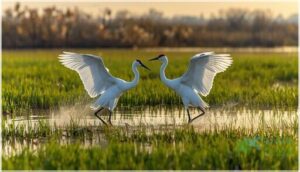
You’ll marvel at whooping cranes, endangered species known for synchronized courtship dances and lifelong pair bonds across wetland conservation sites. Their monogamy among birds that mate for life strengthens through:
- Crane migration journeys where mated pairs defend fixed nesting territories in bird sanctuary habitats
- Coordinated parenting with both adults guiding young until independence
- Habitat preservation efforts supporting site fidelity that reinforces continued pairing across decades of wildlife conservation
Puffins

You’ll find Atlantic puffins exemplify avian monogamy through burrow nesting practices that reinforce pair bonding across multiple breeding seasons. These bird species demonstrate notable colony dynamics, with mated pairs returning to identical burrows year after year, coordinating synchronized feeding habits to deliver fish to chicks.
Their breeding success depends on this partnership, where puffin mating rituals include mutual vocal exchanges that strengthen bird mating habits essential for lifelong fidelity.
Unique Mating Behaviors of Monogamous Birds

When birds commit to a lifelong partner, they don’t just show up and start building nests—they’ve developed some pretty impressive ways to court, cooperate, and raise their young together. From dazzling aerial dances to shared construction projects that can weigh over a ton, these behaviors strengthen pair bonds and improve breeding success across seasons.
Let’s look at three distinctive ways monogamous birds cement their partnerships and work as a team.
Elaborate Courtship Displays
When you’re watching monogamous birds form their lifelong partnerships, you’ll notice courtship displays that rival any Broadway production. These elaborate bird mating rituals strengthen avian monogamy and pair bonding, proving that birds who mate for life invest heavily in winning over their chosen partner through:
- Dance rituals featuring synchronized wing flutters, tail fanning, and intricate footwork that showcase health
- Vocal signals encoding territory quality through complex, species-specific songs and calls
- Plumage displays revealing iridescent feathers and ornaments during choreographed stretches
- Gift giving where males present food or nesting materials as commitment tokens
- Multimodal performances combining visual, auditory, and tactile elements to intensify mate interest
These courtship displays don’t just look impressive—they’re functional assessments of bird behavior, allowing partners to evaluate genetic quality, parental ability, and cooperation skills before cementing their bond.
Nest Building and Site Fidelity
Once you’ve watched lifelong pairs master their courtship, you’ll see them channel that same commitment into nest building and site fidelity—two behaviors that make breeding success possible year after year.
Bird nesting and breeding depend on smart site selection, with pairs choosing familiar locations that fledged chicks before, then constructing nest architecture using locally sourced nesting materials like twigs, grass, and feathers to create sturdy, insulated structures.
Cooperative Parenting Roles
After pairs secure their nesting site, you’ll notice both parents split the work—cooperative parenting roles that make lifelong pair bonds so effective.
In monogamous birds that mate for life, biparental care means one adult might incubate eggs while the other hunts, then they swap duties. This avian social behavior boosts survival rates because raising offspring demands constant coordination, turning nesting strategies into a true partnership.
Habitats and Nesting of Lifelong Pairs

Where a bird chooses to build its nest can make or break its chances of raising healthy chicks, and for lifelong pairs, that choice becomes even more critical.
Monogamous species have carved out niches across nearly every habitat you can imagine, from windswept coastal cliffs to dense forests and open wetlands. Let’s look at where these devoted pairs set up house, what their nests look like, and how human activity is reshaping the places they call home.
Preferred Habitats of Monogamous Birds
Across ecosystems, you’ll find monogamous birds occupying habitats that support repeated nesting and reliable food. Forest ecology provides tall trees and understory cover for songbirds that mate for life, while wetland conservation protects reeds and shallow water essential to waterfowl pairs.
Coastal habitats shelter seabird colonies on cliffs, grassland management maintains open territories for ground nesters, and urban planning creates green corridors where lifelong bonds thrive.
Nest Types and Locations
Once you know the habitat, you’ll spot notable bird nesting diversity. Tree cavities shelter songbirds 2 to 20 meters high, while cliff nests perch on ledges safe from ground predators.
Wateredge habitats host floating platforms anchored to reeds, and ground scrapes lie camouflaged under sparse vegetation. These nesting habits reveal how avian ecology shapes bird behavior—each bird species adapting structure and location to survive, cooperate, and raise healthy young.
Impact of Habitat Loss on Pair Bonds
When nesting site loss fragments bird species’ landscapes, you’ll see pair bond disruption ripple through populations—isolated territories force mates apart, breeding failure climbs, and divorce rates spike after repeated nesting setbacks.
Habitat fragmentation reduces encounter rates between established partners, weakening lifelong bonds that once anchored stable populations. That’s why habitat preservation and restoration anchor ecological conservation efforts—protecting continuous breeding grounds keeps pair bonds intact and slows population decline across vulnerable wildlife conservation targets.
Conservation Challenges for Monogamous Birds

When birds mate for life, they’re putting all their eggs in one basket—quite literally—which makes them especially vulnerable to environmental changes and human interference.
Habitat destruction, climate shifts, and pollution don’t just threaten individual birds; they can tear apart partnerships that took years to build and perfect. Let’s look at the specific threats these devoted pairs face and why their protection matters more than you might think.
Threats to Lifelong Pairing Species
You mightn’t realize how many forces can tear apart lifelong bonds in birds. Climate shift drives prey farther offshore, forcing albatross partners to abandon incubation duties mid-cycle.
Here’s what endangers endangered bird species most:
- Habitat fragmentation reduces nesting sites by 22 percent, breaking up swan territories
- Disease outbreaks like avian influenza reset entire colony pair bonds
- Human disturbance from boating elevates stress hormones, weakening species conservation outcomes
Why Protecting Monogamous Birds Matters
When you protect lifelong bonds in monogamous birds, you’re safeguarding ecological balance and monogamy evolution shaped over millennia.
Species preservation hinges on habitat restoration that maintains stable pair bonds, since experienced partners boost chick survival by 30 percent.
Protecting bird habitats preserves stable pair bonds that boost chick survival by 30 percent
Wildlife conservation efforts targeting these species strengthen entire ecosystems, ensuring that bird conservation programs preserve the intricate social frameworks that define species conservation success.
Frequently Asked Questions (FAQs)
What birds mate for life?
Picture a pair of wings returning to the same partner season after season—that’s lifelong pairing.
Swans, albatrosses, bald eagles, whooping cranes, and puffins form strong pair bonds, demonstrating notable bird fidelity patterns.
Which animals mate for life?
Beyond birds, you’ll find lifelong bonds in wolves, beavers, gibbons, and seahorses.
These monogamous species form enduring pair bonds through coordinated mating rituals, proving that longterm monogamy strengthens survival across diverse animal pairings.
What percentage of birds mate with a single partner?
About 90 percent of bird species practice social monogamy, forming pair bonds during breeding seasons, but genetic monogamy—where offspring share one father—is considerably less common, with many species experiencing extra-pair copulations.
Why do birds mate for life?
Birds form lifelong pair bonds because social monogamy brings evolutionary benefits: shared parenting duties boost chick survival, experienced partners cooperate efficiently season after season, and stable relationships reduce the energy cost of repeated mate selection.
Do birds cheat if they mate for life?
Yes, many lifelong pairs engage in extra-pair copulations, producing offspring fathered by males outside the social bond.
Genetic testing reveals infidelity rates vary widely, though most maintain their pair bonds despite occasional breeding strategies involving mate switching.
Can a bird mate if its partner dies?
When a partner dies, you’ll see most monogamous species seek a new mate, often within the same breeding season, though remating strategies and grief behavior vary widely across different bird populations.
What birds mate for a lifetime?
Swans, albatrosses, bald eagles, whooping cranes, and puffins form longterm pair bonds that span multiple breeding seasons.
These monogamous species maintain social monogamy through synchronized courtship displays, shared nest defense, and cooperative chick rearing.
What do birds do when their mate dies?
When their partner dies, the surviving bird often shows grief signals through reduced activity and altered vocalizations, then usually seeks rapid rebinding with a new mate to maintain territorial adjustments and social bonding.
Which bird is most loyal to their partner?
In terms of mate fidelity and bird loyalty, the Mute Swan stands out—these loyal species maintain monogamous traits through remarkably strong pair bonds, demonstrating extraordinary devotion in bird mating and monogamy that persists year after year.
What is a monogamous bird?
A monogamous bird forms a pair bond with one partner during a breeding season, sharing territory defense, incubation, and parental care, though genetic fidelity varies across species and populations.
Conclusion
When a storm destroys a decades-old nest, the returning pair doesn’t simply rebuild—they reconstruct a foundation for lineage itself, a commitment that outlasts weather, migration, and countless seasons.
Understanding which birds that mate for life, from albatrosses to whooping cranes, reveals partnerships where survival hinges on trust. Yet habitat fragmentation doesn’t just displace nests; it severs bonds formed across generations, making conservation efforts not about saving species, but about preserving promises written in instinct.