This site is supported by our readers. We may earn a commission, at no cost to you, if you purchase through links.

A single great cormorant can consume over a pound of fish daily, plunging depths exceeding 45 feet in pursuit of prey. Its dark, glossy plumage and five-foot wingspan make it unmistakable among colonial nesters, yet conflicts with commercial fisheries have sparked heated debates about its ecological role.
This hefty waterbird spans five continents, claiming coastlines from Iceland’s fjords to Japan’s rocky shores with equal tenacity. You’ll find subspecies shaped by geographic isolation, each adapted to local climates and food sources.
Understanding this bird’s identification markers, habitat preferences, and underwater hunting prowess reveals why it thrives across such diverse environments—and why its conservation status remains contentious.
Table Of Contents
- Key Takeaways
- Great Cormorant Identification
- Habitat and Global Distribution
- Behavior and Social Structure
- Diet and Feeding Habits
- Breeding and Conservation Status
- Frequently Asked Questions (FAQs)
- Where do Great Cormorants live?
- What is the difference between a cormorant and a Great Cormorant?
- Where is the great cormorant found?
- What does a great cormorant look like?
- What is a great cormorant?
- Is the great cormorant a competitor for fish?
- Is the great cormorant a threatened species?
- Is a cormorant a duck or a goose?
- How big are the Great Cormorants in Australia?
- Where are Great Cormorants found?
- Conclusion
Key Takeaways
- Great cormorants consume over a pound of fish daily and dive beyond 45 feet using specialized adaptations like webbed feet, waterproofed plumage, and extended breath-hold capacity up to two minutes.
- This species spans five continents with distinct subspecies shaped by geographic isolation, thriving in both coastal marine ecosystems and inland freshwater habitats from Iceland to Japan.
- Breeding pairs share incubation and chick-rearing duties over a two-month cycle, with both parents delivering frequent high-energy fish meals to support rapid growth rates during the first fortnight.
- Despite holding “Least Concern” conservation status globally, great cormorants face ongoing conflicts with commercial fisheries over prey competition, habitat loss from coastal development, and pollution effects in aquatic systems.
Great Cormorant Identification
You’ll recognize a great cormorant by its hefty build and dark, glossy plumage—this isn’t a bird that blends into the background. With a wingspan stretching over five feet and a hooked bill built for grabbing fish, it’s unmistakable once you know what to look for.
In flight, you might briefly confuse it with a golden eagle, though the cormorant’s longer neck and low-skimming water approach give it away.
Here’s what sets this seabird apart from the rest.
Physical Characteristics and Size

You’ll spot the Great Cormorant by its blocky, heavyweight build and unmistakable profile. Body proportions lean toward power—think thick neck, broad wingspan (115–130 cm), and a stiff tail for steering underwater. Measurements reveal adults stretching 80–90 cm long and weighing 1.2–2.0 kg. Size and shape scream “diving machine,” with legs set far back for propulsion.
- Relative size: larger than a duck, smaller than a pelican
- Beak shape: hooked upper mandible, 9–13 cm long
- Feather structure: dense, oil-gland waterproofed plumage
- Wing span: usually 115–130 cm across adults
- Color pattern: dark overall with bluish gloss (details next)
Plumage, Coloration, and Markings
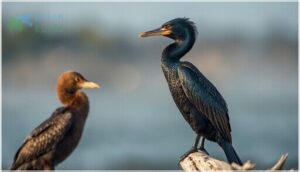
You’ll see the Great Cormorant’s plumage shift through molting cycles—adults wear dark bluish-black feathers with subtle iridescence patterns that flash green or bronze in sunlight, while juveniles show brownish tones. Color genetics dictate these bird characteristics, and feather maintenance through preening keeps the glossy look sharp.
Plumage variation across seasons remains minimal, but bird attributes like sheen intensity reveal health and breeding readiness in this species’ color pattern. Many of these changes reflect the complex roles played by bird plumage patterns and functions.
Beak, Legs, and Distinctive Features
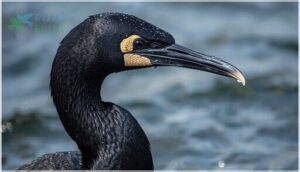
You’ll notice the Great Cormorant’s beak structure—a dark, hooked bill about 7 to 9 inches long—grabs slippery fish with precision. Leg adaptations place webbed feet far back, driving powerful underwater thrusts.
Facial features include a sleek neck and pale eye-ring, while diving mechanics rely on aerodynamic physical description and sharp beak tips that cut through water resistance.
Comparison With Similar Species

Distinguishing this species from the Double-crested Cormorant reveals key ornithological research markers. Both share colony dynamics and foraging strategies—diving up to 5 meters—but size shape differences tell the story.
The Great Cormorant stretches 84 to 90 centimeters with a blockier head, while its cousin maxes out smaller. Plumage comparison shows bluish gloss versus bronzier tones. Beak morphology and species differentiation sharpen your bird watching tips considerably.
Habitat and Global Distribution

You’ll find great cormorants across five continents, from the rocky coasts of North America to the inland waters of Europe and Asia. Their range spans the nearctic, palearctic, oriental, ethiopian, and australian biogeographic regions.
Here’s where these birds live and how they’ve adapted to different environments around the world.
From tropical coastlines to high-altitude salt lakes, flamingos thrive in diverse habitats that shape their unique feeding and nesting behaviors.
Geographic Range and Subspecies
Great Cormorants don’t recognize political borders—they’ve claimed coastlines and waterways from Iceland to Japan, painting a continental sweep across Europe, Asia, Africa, and parts of North America.
Range expansion continues as populations climb, with subspecies variation shaped by geographic isolation and climate adaptation.
Regional genetics reveal distinct forms: European coastal birds differ from inland Asian relatives, while North American populations show unique breeding traits tied to local environments.
Coastal Vs. Inland Habitats
You’ll find Great Cormorants conquering both coastal migration routes and inland waterways, defying simple habitat fragmentation patterns. Shoreline ecology along coasts sustains saltwater specialists, while inland populations thrive in freshwater lakes and rivers.
These bird species identification challenges matter—coasts and shorelines host different subspecies than interior zones, shaping wildlife conservation priorities. Ecosystem services vary: coastal birds filter estuarine nutrients, inland cousins regulate freshwater fish populations through ecological conservation dynamics.
Adaptation to Various Environments
You witness climate resilience when cormorants tackle everything from frigid Arctic shores to tropical coastlines—their feather insulation and dive physiology equip them for environmental flexibility across continents.
Water adaptation strategies include:
- Salt glands excrete excess salt after marine foraging
- Metabolic adjustments sustain performance in varying temperatures
- Flexible nesting on cliffs, islands, or human structures
This adaptability strengthens habitat conservation and ecological conservation efforts worldwide.
Migration Patterns and Movements
You’ll track flyway dynamics as cormorants navigate coastal routes and stopover sites during seasonal movements. Northern populations shift south between October and March, while others make altitudinal shifts between sea-level and mountain lakes. Migration triggers include daylight changes and water temperature cues that drive these species’ migration patterns, connecting bird migration to broader wildlife conservation efforts in conservation biology.
| Migration Type | Distance Range | Timing |
|---|---|---|
| Latitudinal | North-south routes | October-March |
| Coastal-inland | 50-200 km | Off-peak seasons |
| Altitudinal | Variable elevations | Post-breeding |
| Partial | Colony-dependent | Year-round options |
Behavior and Social Structure
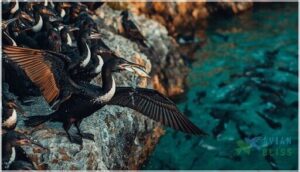
You’ll find great cormorants are far from solitary creatures—they thrive in crowded colonies where social bonds shape nearly every aspect of their lives.
Their behavior reveals a bird perfectly adapted to underwater hunting, with diving skills that rival many marine specialists.
From dawn fishing expeditions to intricate territorial displays, these cormorants follow predictable rhythms worth understanding.
Colony Formation and Social Interactions
You’ll find great cormorant colonies forming dense social networks on cliff faces and islets, ranging from dozens to thousands of individuals. Social hierarchy emerges through ritualized displays and vocalizations during nest site reuse, minimizing conflict while strengthening cooperative bonds.
Breeding habits show synchronized dawn departures toward shared feeding grounds, demonstrating how colony dynamics boost survival through coordinated group foraging and collective vigilance against predators.
Foraging and Diving Abilities
You’ll witness dive dynamics that push your understanding of avian biology—great cormorants plunge beyond 30 meters, chasing demersal fish with burst-powered acceleration. Their underwater vision adjusts to dim light at depth, while webbed feet deliver powerful propulsion during pursuit.
Great cormorants dive beyond 30 meters, using underwater vision and webbed feet to chase fish through the depths
Foraging strategies shift with habitat: shallow bays near kelp or deep offshore dives. Submersion techniques balance oxygen debt against energy return, defining feeding behaviors across diverse wildlife ecology zones.
Daily Activity Patterns
Dawn pulls these birds from roosts, triggering circadian rhythms that govern their activity cycles. You’ll track foraging strategies clustered in morning and late afternoon, with resting behaviors between bouts—wings spread on pilings to dry.
Migration patterns shift daily routines with seasonal light, while environmental cues like tidal currents recalibrate when and where they hunt, defining avian behaviour across their range.
Communication and Displays
Beyond activity rhythms, you’ll decode great cormorant communication through visual signals and vocal repertoire. Males croak during courtship while throat sacs inflate, amplifying calls across colony interactions. Wing claps, tail quivers, and puffed chest feathers broadcast territorial intent.
Environmental factors—wind, tide, light—modulate display behaviour, ensuring vocalisation carries through turbid water or open air, shaping avian behaviour and social cohesion.
Diet and Feeding Habits

Great cormorants are carnivorous specialists, feeding primarily on fish they catch through skilled underwater pursuit. Their hunting success depends on physiological adaptations for diving and regional prey availability.
Understanding their feeding ecology reveals how these birds function within aquatic food webs.
Primary Food Sources
You’ll find Great Cormorants thriving on fish consumption across marine ecosystems and inland waters. Their avian diet demonstrates exceptional adaptability:
- Primary prey: marine and freshwater fish species supplying high-quality proteins
- Supplemental food: crustaceans and amphibians as opportunistic targets
- Energy storage: essential fatty acids from aquatic prey fuel extended foraging
- Nutrient acquisition: proteins support feather growth and muscle maintenance
- Metabolic support: prey water content aids hydration during active hunting
Hunting Techniques and Underwater Adaptations
You’ll witness Great Cormorants mastering underwater vision and streamlining techniques when they chase fish through coastal depths. Their dive physiology enables a two-minute breath-hold capacity, while webbed feet provide thrust.
These seabirds employ feeding strategies resembling the Double-crested Cormorant—plunging from the surface, then weaving through schools with their necks aligned for minimal drag. Bird identification confirms their hunting prowess through specialized adaptations across avian species in wildlife biology.
Seasonal and Regional Diet Variations
You’ll notice Great Cormorant food habits shift dramatically with seasons and coastlines. Seasonal foraging patterns follow fish migration cycles, while prey size variation reflects local aquatic ecosystems.
- Spring diets feature 6–12 cm juvenile herring and sand eels in temperate zones
- Winter brings smaller demersal fish and crustaceans when surface schools vanish
- Regional diet differences emerge as subtropical populations target mullet over northern sand eels
Bird identification confirms these adaptive strategies across marine ecosystem management studies.
Role in Aquatic Ecosystems
You’re watching ecosystem engineering in action when Great Cormorants hunt. Their trophic dynamics link fish populations to terrestrial nutrient cycling through guano deposits that fuel coastal productivity.
These water birds strengthen aquatic connectivity between freshwater and marine systems, regulating invasive species while creating biodiversity hotspots.
Marine ecosystem management increasingly recognizes their role in ecological resilience and ecological conservation efforts across marine biology research.
Breeding and Conservation Status

You’ll find that great cormorants follow a structured breeding cycle, with monogamous pairs returning to the same nesting sites year after year. Both parents share duties from incubation through fledging, a process that takes roughly two months from egg to independent juvenile.
Understanding their reproductive patterns helps explain current population trends and the conservation measures needed to protect these notable seabirds.
Nesting and Reproductive Cycle
Courtship displays start when males claim ledges or sturdy branches, performing wing-waving rituals that show off bright white thigh patches. You’ll spot pairs engaging in neck-writhing and gargling calls that cement their bond through egg incubation and beyond.
Nest site selection favors cliff ledges and offshore islands where ground predators can’t reach. Females lay 3 to 5 pale bluish eggs, with both parents sharing incubation duties for 28 to 31 days, determining breeding success.
Parental Care and Chick Development
You’ll see both parents take turns brooding chicks for the first two weeks, regulating body temperature through constant attention.
- Chicks receive small, frequent meals every 15 to 30 minutes initially
- Growth rate peaks during the first fortnight, then gradually slows
- Parents deliver high-energy fish species to fuel rapid development
- Fledging occurs at 45 to 55 days old
- Independence arrives around 2 to 3 months
Population Trends and Threats
Great cormorant populations in western Atlantic and European regions have rebounded dramatically over five decades, yet threats persist. These challenges include habitat loss from coastal development, pollution effects in aquatic systems, and human conflict over fishing resources, all of which impact their conservation status. Additionally, climate change alters prey distribution, while overfishing depletes food stocks regionally.
| Threat Category | Primary Impact |
|---|---|
| Habitat Loss | Coastal development reduces nesting sites |
| Pollution Effects | Contaminants accumulate in fish prey |
| Overfishing | Depletes regional food availability |
| Climate Change | Shifts prey species distribution patterns |
Despite these localized declines and susceptibility to diseases such as Newcastle disease and avian influenza outbreaks, the IUCN status of great cormorants remains “Least Concern.
Conservation Efforts and Legal Protection
You’ll find great cormorants protected under multiple Wildlife Laws and international agreements that safeguard their Conservation Status across continents. Species Protection measures combine local enforcement with global cooperation to counter ongoing Threats and Conservation challenges.
- Habitat Preservation through coastal refuges and wetland restoration projects secures nesting and foraging sites
- Conservation Policies under the Ramsar Convention and Convention on Migratory Species coordinate Environmental Advocacy efforts
- Wildlife Conservation Efforts include monitoring programs and community education to reduce human-wildlife conflict
Frequently Asked Questions (FAQs)
Where do Great Cormorants live?
Though they wear ocean’s salt on their wings, you’ll find these dark wanderers thriving where fresh meets salt.
They claim rocky coastal habitats, freshwater lakes, and riverine areas across Old World marine ecosystems and northeastern North America’s island colonies.
What is the difference between a cormorant and a Great Cormorant?
Cormorant” refers to the entire family of diving birds, while the Great Cormorant (Phalacrocorax carbo) is one specific species within that group—the largest and most widespread cormorant across multiple continents.
Where is the great cormorant found?
You’ll spot this cosmopolitan seabird across five continents—from Eastern Canada and New England to Europe, Asia, Africa, and Australia—inhabiting coastal habitats and inland waters, and following migration patterns shaped by seasons and food availability.
What does a great cormorant look like?
If you’re winging it on bird ID, this one’s hard to miss—Great Cormorant biology reveals a bulky dark bird with a thick hooked beak, white thigh patches when breeding, and a distinctive yellow throat patch.
What is a great cormorant?
You’ll find the great cormorant (Phalacrocorax carbo) across Europe, Asia, Africa, and parts of North America—a heavyset seabird that’s mastered both coastal waters and inland lakes with impressive diving prowess.
Is the great cormorant a competitor for fish?
Yes. In heavily fished waters, you’ll see them clash with the fishing industry over commercially valuable species.
Their impact on fish population structure challenges ecological balance, though wildlife preservation efforts recognize their role in aquatic ecosystem dynamics.
Is the great cormorant a threatened species?
No, cormorants hold Least Concern IUCN Status despite local declines.
Human conflict and management challenges exist in some regions, but conservation biology research shows bird species conservation and wildlife preservation efforts maintain stable populations globally.
Is a cormorant a duck or a goose?
Neither—though their silhouette resembles a goose-loon hybrid, cormorants belong to a distinct waterbird family. They’re closely related to frigatebirds and boobies, not ducks or geese, despite sharing aquatic habitats.
How big are the Great Cormorants in Australia?
In Australia, you’ll encounter adults reaching 80 cm in length and weighing 0–5 kg, with a wingspan of 2–6 meters.
They represent the largest cormorant species on the continent, showcasing impressive size variations across regional populations.
Where are Great Cormorants found?
You’ll spot these hefty fish-eaters lounging on every continent but Antarctica and South America—talk about world domination.
Their geographic range spans Europe, Asia, Africa, Australia, and northeastern North America, thriving in coastal colonies and freshwater habitats alike.
Conclusion
As fisheries expand and coastal development accelerates, the great cormorant’s future hangs in a delicate balance. You’ve seen its anatomical adaptations, five-continent distribution, and polarizing impact on commercial fishing.
Whether you view this species as an ecosystem engineer or economic competitor, its survival depends on science-driven management that weighs ecological roles against human interests.
The next decade will determine whether these colonial nesters maintain their foothold or vanish from contested waters worldwide.