This site is supported by our readers. We may earn a commission, at no cost to you, if you purchase through links.
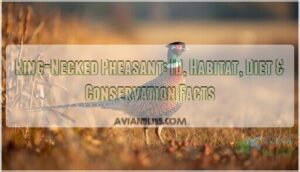
You don’t need binoculars to spot a ring-necked pheasant strutting through a cornfield—the male’s iridescent copper feathers and white collar catch light like a billboard in brown stubble. These Asian natives weren’t content with their original range across China and Mongolia.
Thanks to introduction programs spanning 150 years, they’ve claimed territory from Iowa prairies to European hedgerows, transforming themselves into one of the world’s most recognizable game birds. Their success story isn’t just about adaptation—it’s about thriving in the fractured landscapes between wild spaces and human cropland, where most wildlife struggles.
Whether you’re tracking them for sport, photography, or simple curiosity, understanding their habits, habitats, and current conservation challenges reveals why these bold, resourceful birds continue to flourish across five continents.
Table Of Contents
- Key Takeaways
- Ring-necked Pheasant Identification
- Native Range and Global Distribution
- Habitat Preferences and Behavior
- Diet, Foraging, and Reproduction
- Conservation Status and Management
- Frequently Asked Questions (FAQs)
- Are Ring-necked Pheasants native to the US?
- How much is a ringneck pheasant worth?
- Are Ring-necked Pheasants good to eat?
- Are ring neck pheasants endangered?
- Are ringneck pheasants loud?
- What do ring-necked pheasants eat?
- What does a ring-necked pheasant look like?
- Are ring-necked pheasants common?
- Are ringnecked pheasants native to South Dakota?
- Are ring-necked pheasants native to North America?
- Conclusion
Key Takeaways
- Ring-necked pheasants are not native to North America—they are Asian imports introduced in the 1880s that now thrive across five continents by exploiting the fractured edges between farmland and wild spaces where most wildlife struggles.
- Males flash iridescent copper-gold plumage with a white neck ring and reach up to 35 inches, while females wear muted brown camouflage, making identification straightforward once you know the sexual dimorphism patterns.
- These opportunistic ground-dwellers need semi-open habitat mixing tall grasses (30-90 cm) with brushy cover and agricultural edges—when habitat loss exceeds 30 percent, populations crash within a decade.
- Though listed as Least Concern globally, local pheasant flocks face serious decline from habitat fragmentation and intensive farming, requiring active conservation efforts like habitat restoration and controlled hunting regulations to sustain populations.
Ring-necked Pheasant Identification
You can’t mistake a ring-necked pheasant once you know what to look for. These striking game birds have features that set them apart in open fields and farmland habitats.
Males can reach up to 35 inches in length, placing them among the larger birds you might spot in open country.
Here’s how to identify males, females, and the key physical traits that make this species stand out.
Scientific Name and Classification
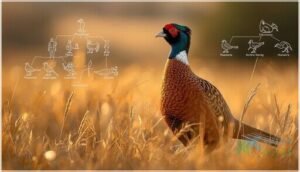
You’ll find this bird in field guides under its official name: Phasianus colchicus. Classification systems place it within the family Phasianidae and order Galliformes, grouping it with other ground-dwelling game birds.
Binomial nomenclature gives us this two-part species designation, a standard that taxonomic ranks follow worldwide. Phylogenetic analysis confirms the ringnecked pheasant’s position within bird classification, connecting it to relatives across Asia and beyond.
Distinctive Male and Female Features
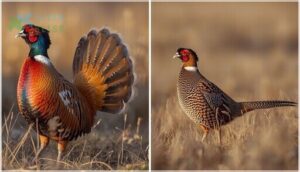
You can spot the difference between male and female pheasants at a glance. Males boast a white neck ring, red facial wattles, and an iridescent blue neck that catches the light during courtship displays. Females wear muted brown tones for camouflage.
- Plumage differences: Males flash copper-and-gold feathers; females blend into fields with tan patterns
- Beak shapes: Males carry larger, angular beaks while females have shorter, stouter ones
- Tail variations: Males sport long, ornate tails; females keep theirs short for concealment
- Leg spurs: Males develop prominent spurs for territorial fights; females show minimal spur growth
Plumage, Size, and Body Structure
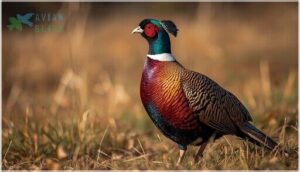
Beyond field marks, you’ll notice males reach 90 to 100 centimeters in body proportions, while females measure 60 to 70 centimeters. Males weigh 1.2 to 2.5 kilograms with that signature white neck ring and iridescent blue neck.
Red and golden underparts shimmer through iridescent effects created by feather coloration. Their skeletal adaptations—broad chest, powerful legs—support explosive takeoffs when danger strikes.
These distinctive features are closely tied to the species’ complex plumage patterns which play essential roles in avian communication and survival.
Native Range and Global Distribution

The ring-necked pheasant didn’t just show up in North America on its own. This colorful game bird originally comes from Asia, where it roamed grasslands and agricultural areas for thousands of years.
Interestingly, while pheasants prefer drier habitats, they often share their range with moisture-loving species like the sandhill crane, which frequents wetlands and marshes throughout similar migration corridors.
Today, you’ll find these birds scattered across the globe in places far from their ancestral home.
Origin in Asia
The ring-necked pheasant‘s native range stretches across Asia, from China and Korea to Mongolia’s grasslands. You’ll trace this avian species‘ genetic lineage back to agricultural landscapes where crop fields and hedgerows shaped habitat diversity.
These introduced species adapted to Asia’s climate variations, developing the resilience you see today. Asian origins provided the foundation for populations of pheasants and grouse now found worldwide.
Current Distribution Worldwide
Today you’ll find this introduced game bird thriving across five continents in over 50 countries. Release programs transformed ringnecked pheasant populations from their avian species native to Asia origins into a global range phenomenon.
Major strongholds include:
- North America – southern Canada through the U.S. into northern Mexico
- United Kingdom – farmland hedgerows and brushy margins
- Germany and France – established agricultural populations
- Italy and Spain – managed game lands
- Czech Republic – protected farmland zones
Habitat fragmentation and hunting pressure shape persistence, while migration patterns remain limited in most introduced game birds worldwide.
Habitat Preferences and Behavior
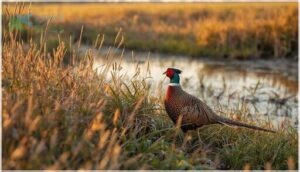
Ring-necked pheasants won’t settle for just any patch of ground—they need the right mix of cover, food, and water to thrive.
You’ll find them in semi-open country where farm fields meet brushy edges, tall grasses, and wetland margins. Here’s what drives their habitat choices and how they behave throughout the year.
Preferred Habitats and Vegetation
You’ll find pheasants thriving where grassland ecology meets shrub landscapes—think agricultural borders lined with hedgerows and weedy cover. They prefer habitat with tall grasses (30-90 centimeters) mixed with scattered brush, giving them escape routes from predators.
Riparian zones along streams and forest edges also draw these birds, offering dense vegetation for concealment. Effective wildlife habitat management and habitat preservation mean protecting these patchy, diverse environments.
Seasonal Flocking and Social Structure
Watch these birds shift their social game with the seasons—flock dynamics reveal impressive group coordination. During non-breeding months, you’ll see stable groups exploiting patchy food sources, while breeding season triggers territorial behavior in males.
Here’s how their social learning works:
- Core members show high site fidelity to foraging patches
- Mixed flocks form outside breeding periods
- Coordinated sweeps improve foraging strategies across fields
- Social ties persist for weeks, transferring predation risk information
- Juvenile recruitment enhances overall efficiency in bird species
Understanding this avian ecology helps guide wildlife conservation and habitat preservation efforts in conservation biology. The complex play a key role in shaping their adaptive behaviors.
Predator Avoidance and Adaptations
You’ll notice these birds master survival through layered defenses that showcase impressive ecology. Camouflage tactics blend brown plumage with leaf litter, while alarm signals coordinate group escapes into dense habitat.
Flight strategies involve explosive takeoffs reaching 40-50 kilometers per hour, paired with evasive maneuvers through zigzag patterns. Defensive feathers break up their outline, supporting bird conservation and wildlife management efforts focused on preserving protective cover.
Diet, Foraging, and Reproduction
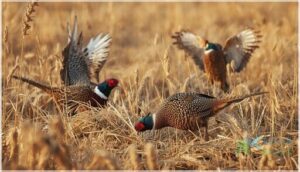
Ring-necked pheasants are opportunistic feeders that shift their diet with the seasons, relying on whatever’s available in their agricultural and grassland homes.
During breeding season, males put on dramatic displays to win over females, who then take on all nesting duties solo. Understanding how these birds forage, mate, and raise their young gives you insight into their survival strategies in varied landscapes.
Foraging Habits and Seasonal Diet
You’ll spot ring-necked pheasants scratching through leaf litter and crop stubble year-round, using foraging strategies that shift with the seasons. Their dietary adaptations balance seed selection—grains and acorns—with invertebrates during warmer months, ensuring nutrient acquisition even during food scarcity.
This flexible approach enhances habitat quality and plays into wildlife management efforts for bird conservation, environmental conservation, and biodiversity preservation across agricultural landscapes.
Mating Displays and Breeding Season
Male ring-necked pheasants don’t wait around—they strut, puff their chests, and fan their tails at dawn in arenas called leks, where courtship rituals unfold. You’ll hear sharp calls as they compete for central spots, maximizing female attention.
Display behaviors peak during early spring breeding season, with females sampling multiple suitors before making their choice. Lek dynamics and mate selection determine which males win the reproduction jackpot.
Nesting, Eggs, and Chick Development
After breeding, females build shallow ground nests hidden in dense vegetation—a risky choice that leaves eggs vulnerable to nest predation. You’ll find clutches of 9 to 12 olive-brown eggs undergoing 23 to 28 days of egg incubation.
Chick growth happens fast; precocial hatchlings walk and feed within hours, though brood survival depends heavily on cover quality and your habitat enhancement efforts supporting their first critical weeks.
Conservation Status and Management
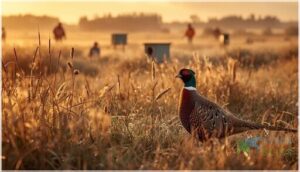
Ring-necked pheasants hold a unique spot in North America’s wildlife landscape—they’re not native, but they’ve become one of the continent’s most hunted game birds.
Managing their populations takes effort, and not all flocks can survive without human help.
You’ll find their conservation story shaped by hunting traditions, habitat loss, and ongoing release programs that keep certain populations going strong.
Population Trends and Threats
You’ll find ring-necked pheasant populations facing serious pressures across their range. While IUCN status lists them as Least Concern, bird population dynamics reveal troubling local declines. Climate change shifts breeding timing, habitat fragmentation from urban sprawl cuts nesting cover, and disease outbreaks hit dense flocks hard. Human impact through agricultural expansion drives population decline in many regions.
- Habitat loss reduces ground cover essential for nesting and winter survival
- Temperature extremes affect chick survival during critical early weeks
- Agricultural monocultures limit food diversity and seasonal foraging success
Conservation Efforts and Game Bird Management
You can join conservation efforts through habitat restoration programs that convert former cropland into perennial grass cover, giving pheasants the nesting space they need. Wildlife refuges and game bird regulations work together through permit-based hunting and controlled releases.
Conservation funding promotes biodiversity conservation by connecting habitat patches across landscapes. Sustainable hunting practices use monitoring data to adjust harvest limits, protecting breeding populations while you enjoy responsible field time.
Impact of Hunting and Habitat Change
Habitat fragmentation hits ring-necked pheasant populations hard—when habitat loss exceeds 30 percent, you’ll see declines within a decade.
When habitat loss exceeds 30 percent, ring-necked pheasant populations decline within a decade
Hunting pressure shapes age structure and reproductive success, while climate shifts misalign food availability with chick growth. Predator dynamics intensify as reduced cover exposes nests and juveniles.
Conservation strategies balance harvest regulations with habitat management, protecting game bird hunting traditions through wildlife conservation efforts that restore the edges and grasslands pheasants need.
Frequently Asked Questions (FAQs)
Are Ring-necked Pheasants native to the US?
Ever wonder why these striking birds roam our fields today?
Ring-necked Pheasants aren’t native to the US—they’re Asian imports from the 1880s.
This introduction reshaped North America’s upland game landscape and sparked ongoing wildlife conservation efforts.
How much is a ringneck pheasant worth?
You’ll pay around $13 to $19 per ringneck pheasant for hunting and stocking purposes, with roosters costing slightly more than hens.
Bulk orders and timing affect game bird costs substantially for pheasant hunters.
Are Ring-necked Pheasants good to eat?
Yes, you’ll find ringneck pheasant meat delivers mild, lean protein with a delicate gamey flavor.
Game bird hunters prize this wild harvest for its tender breast and rich legs, making it an excellent culinary choice.
Are ring neck pheasants endangered?
Ring-necked pheasants aren’t endangered—they’re listed as Least Concern globally.
However, local populations face conservation threats from habitat loss and intensive farming, requiring active game bird management to sustain wildlife conservation efforts in affected regions.
Are ringneck pheasants loud?
Male ringneck pheasants produce a loud, rasping auditory signals that carries across open fields, especially during breeding season.
These vocalization patterns help with bird identification and establish territory, making their vocalization patterns quite distinctive in avian biology.
What do ring-necked pheasants eat?
During dawn and dusk, you’ll discover diverse dining desires drive these dazzling upland birds.
Ring-necked pheasants consume seeds, grains, insects, earthworms, and berries—showcasing dietary adaptations through seasonal foraging strategies that meet avian biology’s nutrient requirements year-round.
What does a ring-necked pheasant look like?
You’ll spot males by their bold iridescent copper-gold plumage, bright green head, red facial patch, and distinctive white neck ring.
Females show mottled brown feather colors with buff undersides—classic sexual dimorphism for bird identification.
Are ring-necked pheasants common?
You’ll find these game birds across managed landscapes where habitat quality maintains stable numbers.
Population density varies regionally—bird counting shows higher species abundance in agricultural zones with hedgerows and grasslands versus fragmented or overgrazed areas.
Are ringnecked pheasants native to South Dakota?
Ringnecked pheasants aren’t native to South Dakota.
This nonnative species arrived from Asia in the 1880s through deliberate species introduction, establishing thriving populations that now define the state’s wildlife conservation identity and hunting tradition.
Are ring-necked pheasants native to North America?
No, you won’t find ring-necked pheasants in their native range here. These Asian origins game birds arrived from China in the 1880s, establishing North American populations through intentional wildlife introductions.
Conclusion
Whether you’re tracking ring-necked pheasants through November cornfields or spotting that white collar from your truck window, you now recognize what makes them tick.
You know where they nest, what they eat, and why their populations rise and fall with every hedgerow bulldozed.
That knowledge doesn’t just make you a better observer—it makes you part of the solution.
Their survival depends on the habitat choices we make today, not tomorrow.