This site is supported by our readers. We may earn a commission, at no cost to you, if you purchase through links.
 If you’re wondering how rare leucistic albino birds are, you’re looking at some truly uncommon sights.
Leucistic birds appear in roughly one in 30,000 individuals, while albino birds are even rarer at less than 0.1% of wild populations.
When scientists examine 100 birds with unusual plumage, 82 show leucism but only three display true albinism.
These genetic mutations affect pigment production differently – leucistic birds retain some coloration while albinos lack melanin entirely.
The rarity varies by region, with higher reporting rates in North America and Europe where active birdwatching communities keep detailed records.
Understanding what triggers these stunning mutations reveals fascinating insights about bird genetics and survival.
Table Of Contents
- Key Takeaways
- How Rare Leucistic Albino Birds?
- How Rare Are Leucistic Birds?
- What is Rarer: Albino or Leucistic Birds?
- What Causes a Bird to Be Leucistic?
- Do All Leucistic Birds Look Alike?
- What is The Difference Between Leucism and Albinism?
- Do Leucistic Birds Have Problems With Having Different Plumages?
- How to Identify Leucistic Birds?
- Leucistic Robin Sightings
- Frequently Asked Questions (FAQs)
- Is leucistic rare than albino?
- What is a leucistic albino?
- How rare are leucistic birds?
- What is rarer albino or leucistic?
- What is the difference between leucistic and albino birds?
- What causes a bird to be leucistic?
- How often do leucistic robins appear?
- Are there different types of leucism?
- Do leucistic birds have a harder life?
- What other birds are leucistic?
- Conclusion
Key Takeaways
- You’re witnessing something incredibly rare – leucistic birds appear in just 1 in 30,000 individuals, while true albino birds are even scarcer at less than 0.1% of wild populations
- You can tell them apart by their eyes – leucistic birds keep their normal dark eye color and retain some original plumage, while albino birds have pink or red eyes and completely white feathers
- You’ll spot leucistic birds more often than albinos – when scientists examine 100 birds with unusual plumage, 82 show leucism but only 3 display true albinism
- You’re looking at birds with serious survival challenges – albino birds face 70% lower survival rates due to poor vision and weak feathers, while leucistic birds struggle with camouflage and predator avoidance
How Rare Leucistic Albino Birds?
When you encounter leucistic birds in the wild, you’re witnessing something truly extraordinary.
These rare birds occur in roughly one in 30,000 individuals due to genetic mutations affecting pigment production.
Albino birds are even scarcer, appearing in less than 0.1% of wild populations with their distinctive white plumage and pink eyes.
Global distribution shows higher reporting frequency in regions with active birdwatching communities across North America and Europe.
Both conditions create significant survival challenges – albino birds face 70% lower survival rates than normal individuals.
Growing public awareness helps researchers track these fascinating leucism and albinism cases worldwide.
How Rare Are Leucistic Birds?

Leucistic birds aren’t as rare as you might think, though they’re still uncommon enough to make your heart skip a beat when you spot one. Leucism prevalence shows these rare birds appear roughly once in every 1,000 to 10,000 individuals, making them substantially more common than albino birds.
- Species susceptibility varies dramatically – blackbirds and house sparrows show higher rates
- Regional variations mean you’re more likely to spot leucistic birds in North America and Europe
- Data limitations exist because many sightings go unreported in remote areas
- Reporting bias occurs since active birdwatching communities document more cases
What is Rarer: Albino or Leucistic Birds?

If you’re wondering which is rarer, albino birds win the rarity comparison hands-down.
While leucistic birds make up roughly 82% of abnormal plumage cases, true albinism accounts for only 3%. Here’s why this genetic prevalence difference exists:
- Survival rates: Albino birds face 70% lower survival rates due to weakened feathers and poor vision
- Environmental factors: Leucistic birds blend better with surroundings, avoiding predators more successfully
- Conservation efforts: Researchers find albino birds rarely reach breeding age, limiting population growth
The identification challenges between these conditions often confuse birdwatchers, but remember—pink eyes always indicate true albinism, while dark eyes suggest leucism.
Leucistic birds often exhibit partial white plumage, unlike their albino counterparts.
What Causes a Bird to Be Leucistic?

You’ll find that leucism happens when a bird’s genetic code gets scrambled, causing faulty pigment production in their feathers.
Environmental stress, poor nutrition, or random mutations can trigger this condition, leaving birds with patchy white plumage instead of their normal coloring.
Genetic Bird Colouration
Two key genes control bird coloration: one determines pigment inheritance patterns, while another regulates gene expression during feather development.
Mutation rates in these genes create colour polymorphism, producing the striking white patches you’ll see in leucistic birds.
Unlike albino birds, bird genetics in leucism affects only melanin distribution, not production.
This evolutionary significance helps scientists understand bird mutations and how bird coloration adapts over time.
Leucisms Impact on Camouflage
When leucistic birds lose some of their natural pigmentation, they become sitting ducks for predators.
Nature’s spotlight makes leucistic birds easy targets for hungry predators
Their plumage variations create habitat visibility issues—white patches stand out like flags against natural backgrounds.
This predator vulnerability substantially impacts survival rates.
However, some leucistic birds develop behavioral adaptations like staying closer to cover.
Surprisingly, their unique camouflage patterns might actually boost breeding success with certain mates.
Bird Survival
When faced with unusual plumage, these birds encounter serious survival challenges that can drastically reduce their lifespan. Predator Avoidance becomes nearly impossible when leucistic birds lose their natural camouflage, making them sitting ducks for hawks and cats.
Feather Weakness compromises flight ability, while Vision Impairment affects their hunting skills. The Camouflage Impact extends beyond predators—it affects mate selection and social interactions within flocks.
Bird survival faces these harsh realities:
- Albino birds have 70% lower survival rates than normal individuals
- Heat Retention drops substantially with lighter feathers in cold climates
- Predators easily spot leucistic birds against natural backgrounds
- Bird genetics create weaker feather structures that break easily
- Vision problems make finding food and avoiding dangers more difficult
Do All Leucistic Birds Look Alike?
While each leucistic bird sports its own unique "fashion statement," no two individuals look exactly the same. Leucistic variations create a stunning spectrum of appearances, from subtle pale patches to dramatic white markings mixed with normal coloration.
The degree of leucism can shift with each molt, meaning your backyard robin might sport different plumage patterns year after year. Some birds display symmetrical white patches, while others showcase random splotches that make identification challenges more interesting for birdwatchers.
| Species | Common Leucistic Pattern | Unique Features |
|---|---|---|
| Robin | White wing patches, red breast intact | Retains orange-red coloration |
| Cardinal | Patchy white mixed with red | Bright red areas remain vibrant |
| Blue Jay | Pale blue or white sections | Normal blue pigments may persist |
| House Sparrow | White head patches, brown streaking | Dark eye stripes often retained |
Regional differences also influence plumage patterns, as genetic diversity varies between populations. Air pollution may also contribute, as environmental factors affect feather coloration. Urban leucistic birds often display different patterns than their rural cousins, creating endless variety in bird plumage expressions across different environments.
What is The Difference Between Leucism and Albinism?

Spotting the difference between leucism and albinism isn’t just about feather color—it’s about understanding two distinct genetic conditions.
Albinism results from complete melanin absence due to genetic defects in the TYR gene, creating birds with pure white plumage and distinctive pink or red eyes, beaks, and legs.
You’ll notice these birds lack all pigmentation entirely.
Leucistic birds tell a different story, their condition stems from faulty pigment distribution rather than total melanin absence, causing partial white patches or muted colors while retaining normal eye color.
Think of it as nature’s paintbrush running dry in certain spots rather than losing all its paint.
The eye color gives it away every time—dark eyes mean leucism, while pink or red eyes confirm albinism.
Leucistic birds often keep some of their original beauty, whereas albino birds appear completely washed out, which is a key difference between the two conditions, with albino birds having a distinct appearance.
Do Leucistic Birds Have Problems With Having Different Plumages?

You’ll quickly discover that leucistic birds face real challenges with their altered plumage.
Nature’s misfits: leucistic birds struggle with survival when their white patches become bullseyes for predators
Their camouflage effectiveness drops substantially when white patches make them stand out against natural backgrounds.
This plumage impact creates serious predator avoidance problems, as hawks and cats easily spot these conspicuous birds.
Mate selection becomes trickier too—potential partners may reject birds with unusual coloration patterns.
Feather health often suffers in leucistic birds, with weaker structure compared to normal plumage.
Unlike albino birds with complete albinism, leucism allows some pigment retention, giving these birds slightly better survival odds in the wild.
These challenges contrast sharply with the vibrant plumage displays seen in other species.
How to Identify Leucistic Birds?
Why does identifying leucistic birds feel like solving a puzzle with missing pieces? These remarkable creatures present unique identification challenges that test even experienced birdwatchers’ skills.
Key identification markers for leucistic birds:
- Plumage Patterns: Look for patchy white feathers mixed with normal coloration, creating distinctive mottled or piebald appearances across the body.
- Eye Color: Unlike albino birds with pink or red eyes, leucistic birds retain their species’ normal eye color—this is your most reliable identification clue.
- Feather Pigment Distribution: White birds with some retained pigmentation in wings, tail, or head regions indicate leucism rather than complete albinism.
Species Variation complicates bird identification since abnormal plumage can mask familiar field marks. You’ll need to rely on body shape, bill structure, and behavior patterns when visual cues are diminished.
Watch for Identification Challenges when leucistic birds flock with normally colored individuals—this association often reveals their true species identity despite altered appearances. Consider purchasing leucistic bird spotting equipment to enhance your viewing experience.
Leucistic Robin Sightings
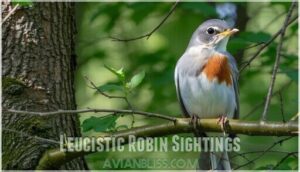
You’ll find leucistic American Robin sightings reported roughly 1 in 30,000 individuals across North America, from Alaska to southern states.
These rare birds display white patches mixed with normal red breast coloring, making Robin Identification Tips essential for proper documentation.
Unlike albino birds with pink eyes, leucistic birds retain dark eyes and normal bills.
Regional Robin Prevalence peaks during spring migration when large flocks gather.
Individual leucistic robins often return to the same suburban locations yearly due to site fidelity, creating exciting opportunities for repeat observations in your neighborhood.
The study of leucistic robin characteristics is vital for understanding these unique birds.
Frequently Asked Questions (FAQs)
Is leucistic rare than albino?
No, leucism isn’t rarer than albinism in birds. Leucism is actually much more common, accounting for 82% of abnormal plumage cases, while true albinism represents only 3% of these rare conditions.
What is a leucistic albino?
Picture spotting a rare bird that’s caught between two worlds—that’s what happens when you encounter a "leucistic albino."
This term describes birds showing both leucism (partial pigment loss creating white patches) and albinism (complete melanin absence with pink eyes).
How rare are leucistic birds?
You’ll spot leucistic birds roughly once in every 1,000 to 30,000 sightings, making them uncommon but not impossibly rare finds for dedicated birdwatchers.
What is rarer albino or leucistic?
Albino birds are substantially rarer than leucistic ones. While leucism accounts for 82% of abnormal plumage cases, albinism represents only 3%. You’ll spot leucistic birds more often since they survive better.
What is the difference between leucistic and albino birds?
You’ll notice leucistic birds have partial white patches while keeping some original colors, whereas albino birds are completely white with pink eyes and lack all pigment entirely.
What causes a bird to be leucistic?
Leucism in birds results from genetic mutations, nutritional deficiencies, or environmental factors.
You’ll see it when recessive genes disrupt melanin migration, poor nutrition affects pigment production, or mutagens increase mutation rates in developing feathers.
How often do leucistic robins appear?
You’ll encounter leucistic robins roughly once in every 30,000 birds, though some estimates suggest they appear in 1 in 1,000 to 10,000 individuals depending on local conditions and genetics.
Are there different types of leucism?
With 82% of abnormal plumage cases being leucistic, you’ll find several distinct types.
Partial leucism creates white patches, progressive leucism causes gradual graying, and pied leucism produces asymmetrical patterns while preserving some original coloration.
Do leucistic birds have a harder life?
Leucistic birds face fewer challenges than albino birds but still struggle more than normally pigmented ones. You’ll find they retain better camouflage and stronger feathers, giving them improved survival odds.
What other birds are leucistic?
You’ll spot leucistic birds across many species, with gulls, sparrows, finches, starlings, crows, cardinals, owls, hummingbirds, and woodpeckers showing this striking white-patched plumage most commonly in wild populations.
Conclusion
Like finding treasure in your own backyard, discovering how rare leucistic albino birds truly are reveals nature’s most extraordinary secrets hiding in plain sight.
You’ve learned that leucistic birds occur roughly once in 30,000 individuals, while true albinos appear in less than 0.1% of populations.
These stunning genetic variations create unforgettable encounters for any observer lucky enough to spot them in the wild, making each sighting a precious moment worth celebrating and documenting.