
This site is supported by our readers. We may earn a commission, at no cost to you, if you purchase through links.
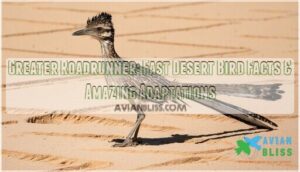 The greater roadrunner breaks all the rules—it’s a cuckoo that doesn’t cuckoo, a bird that prefers sprinting to soaring.
This desert speedster can clock 20 mph while chasing down rattlesnakes, lizards, and even hummingbirds.
Standing 20-24 inches tall with mottled brown camouflage, it’s perfectly built for life in America’s southwestern deserts.
You’ll spot its distinctive X-shaped tracks from zygodactyl feet that grip terrain like natural cleats.
Beyond raw speed, this remarkable hunter conserves precious water through specialized salt glands and regulates body temperature by sunbathing each morning.
The greater roadrunner’s hunting prowess involves teamwork, stealth tactics, and fearless attacks on venomous prey that reveal nature’s most ingenious survival strategies.
Table Of Contents
- Key Takeaways
- What is The Greater Roadrunner?
- Where Do Greater Roadrunners Live?
- How Does The Greater Roadrunner Behave?
- What Does The Greater Roadrunner Eat?
- Reproduction, Conservation, and Human Connections
- Frequently Asked Questions (FAQs)
- How fast can a Roadrunner run?
- Where do Roadrunners live?
- What is the scientific name of the Great Roadrunner?
- What is a greater roadrunner?
- Are Roadrunners migratory?
- What does a greater roadrunner look like?
- What is the difference between a roadrunner and a greater roadrunner?
- What is unique about the greater roadrunner?
- Can greater roadrunners fly?
- What is the lifespan of the greater roadrunner?
- Conclusion
Key Takeaways
- You’ll witness desert survival mastery – Greater roadrunners conserve water through specialized salt glands near their eyes and regulate body temperature by sunbathing each morning, eliminating the need for frequent drinking in harsh southwestern environments.
- You’re looking at nature’s fearless speed demon – These desert athletes can sprint up to 20 mph while hunting dangerous prey like rattlesnakes, scorpions, and lizards, using teamwork and stealth tactics to take down venomous opponents.
- You’ll discover they’re cuckoos that broke the rules – Unlike their tree-dwelling relatives, greater roadrunners are ground-dwelling birds that prefer running to flying, leaving distinctive X-shaped tracks with their zygodactyl feet across desert terrain.
- You’ll find them thriving as non-migratory desert specialists – These monogamous birds maintain year-round territories across the American Southwest, adapting perfectly to arid landscapes from scrublands to open deserts without ever needing to migrate.
What is The Greater Roadrunner?
You’ve likely seen this speedy desert bird in cartoons, but the real Greater Roadrunner (Geococcyx californianus) is even more impressive than its animated counterpart.
This remarkable member of the cuckoo family can reach up to two feet long and sprint at speeds of 20 miles per hour while hunting rattlesnakes and other prey across the American Southwest.
Desert’s ultimate predator: two feet of speed, cunning, and rattlesnake-hunting prowess wrapped in feathers
Scientific Name and Classification
You’ll discover the roadrunner’s scientific identity through these classification details:
- Scientific name: Geococcyx californianus (meaning "California earth-cuckoo")
- Order and Family: Cuculiformes order, Cuculidae family (cuckoo family)
- Genus: Geococcyx (earth-cuckoo genus)
This bird classification places roadrunners firmly within cuckoo family taxonomy systems, though they’ve evolved dramatically different from their tree-dwelling relatives.
Zoological naming reveals their terrestrial nature—"geococcyx" literally means "ground cuckoo."
Species identification becomes straightforward once you understand this desert speedster belongs to the same bird classification as traditional cuckoos, making it nature’s rebellious cousin.
Physical Description and Size
You’ll recognize this roadrunner bird by its impressive body length of 20-24 inches from beak to tail.
The greater roadrunner’s mottled brown and white feather color provides perfect desert camouflage.
Its strong, straight beak shape helps catch prey, while sturdy leg structure supports high-speed chases.
The bird’s long tail size aids balance during sprints, and its lean build weighs just 8-19 ounces despite its substantial bird size appearance, showcasing a remarkable example of desert camouflage.
Unique Traits and Adaptations
You’ll find roadrunners equipped with remarkable desert adaptations that make them supreme survivors.
Their zygodactyl feet create X-shaped tracks, while desert camouflage helps them blend into arid environments.
Speed adaptation allows them to reach 15-20 mph, essential for hunting in open terrain.
Water conservation occurs through specialized salt glands near their eyes, eliminating the need for frequent drinking.
Thermal regulation involves lowering body temperature during cold desert nights and sunbathing to warm up during cooler mornings.
These adaptations are vital for thriving in desert bird habitats.
Where Do Greater Roadrunners Live?
You’ll find greater roadrunners across the southwestern United States and northern Mexico, where they’ve perfectly adapted to life in harsh desert environments.
These remarkable birds prefer arid landscapes including deserts, scrublands, chaparral, and dry grasslands, avoiding cultivated areas and cities where their specialized hunting skills aren’t as effective.
Natural Habitat Preferences

You’ll discover greater roadrunners thriving in desert landscapes and arid ecosystems where survival demands freedom from dense vegetation.
These adaptable birds prefer open habitats like dry grasslands and brushy terrains that allow quick movement across their territory.
Their desert habitat choices include scrublands and chaparral, environments that perfectly match their ground-running lifestyle and hunting needs in arid environments.
The roadrunners’ ability to thrive in these areas is also due to their unique physical adaptations, such as a desert heat exchanger that helps them regulate their body temperature.
Geographic Range and Distribution

You’ll find Greater Roadrunners roaming the American Southwest from Texas to California, with their geographic distribution stretching into Mexico.
These desert habitat specialists have recently shown remarkable range expansion, pushing eastward into Missouri and Louisiana.
Unlike migratory southwest birds, roadrunners maintain strict territorial boundaries year-round, with geographic isolation creating distinct regional populations across their bird range.
The roadrunners’ ability to thrive in their native environment is closely tied to their natural roadrunner habitat conditions, which is a key factor in their native environment.
Environmental Adaptations

You’ll witness desert survival mastery through the roadrunner’s physiological adaptations.
These birds conserve water by secreting salt through eye glands instead of urinating, while their diet provides most needed moisture.
Climate tolerance lets them lower body temperature during cold nights and sunbathe for warmth.
Their terrain navigation skills help them thrive in arid ecosystems from sea level to 8,200 feet across diverse environmental conditions, showcasing their remarkable ability to adapt to various environmental conditions.
How Does The Greater Roadrunner Behave?

You’ll witness some of the most fascinating behavior in the animal kingdom when observing a greater roadrunner in its natural desert environment.
This remarkable bird combines lightning-fast ground speeds with surprisingly complex social interactions and unique communication methods that have evolved perfectly for life in harsh southwestern landscapes.
Daily Activity and Movement
When sunrise activity peaks, you’ll spot roadrunners launching into their daily routes with impressive bird running speed reaching 20 mph.
Their foraging tactics involve systematic terrain navigation through desert wildlife corridors, darting between shrubs and cacti.
These remarkable birds maintain consistent roadrunner behavior patterns, covering extensive ground while hunting.
Their roadrunner habitat knowledge guides efficient movement through challenging landscapes during prime morning hours.
Territorial and Social Behavior
Greater roadrunners establish fierce territorial boundaries, with breeding pairs claiming 700-800 square meters of desert real estate.
These monogamous pairs maintain their bond year-round, working together to patrol and defend their turf from intruders.
Males display aggressive dominance behavior through chasing and physical confrontations, while courtship displays strengthen their pair bond beyond simple mate selection.
The roadrunners’ defense strategies include exhibiting strong nest defense behaviors to protect their territory and offspring.
Communication Methods
Beyond their territorial displays, roadrunners use diverse vocalizations and physical signals to communicate effectively.
You’ll hear their signature dovelike cooing echoing across desert landscapes, while bill clapping creates sharp warning sounds.
Their vocal calls range from soft purrs to harsh barks, depending on the situation.
- Dovelike cooing – Low-pitched, melodic calls used for long-distance communication between mates
- Bill clapping – Sharp clattering sounds made by rapidly snapping their slender beaks together as alarm signals
- Visual displays – Dramatic head bobs, tail fanning, and wing spreading during courtship rituals
- Territorial vocalizations – Harsh barking calls that warn other roadrunners away from claimed areas
- Soft purring sounds – Gentle bird sounds used between parent and chick or during intimate pair bonding
What Does The Greater Roadrunner Eat?
You’ll be amazed at how opportunistic the Greater Roadrunner’s diet really is—these desert hunters consume everything from venomous rattlesnakes and scorpions to lizards, insects, small mammals, birds, and even fruits when available.
Nature’s ultimate predator tackles venomous snakes with fearless precision and lightning speed
Their fearless approach to dangerous prey and lightning-fast hunting skills make them one of nature’s most versatile predators.
Primary Diet and Prey

You’ll find the roadrunner’s omnivorous diet remarkably diverse, making it a true desert survivor.
These opportunistic feeders tackle everything from tiny insects to dangerous rattlesnakes, showcasing impressive predator avoidance skills while hunting venomous prey.
| Animal Prey | Plant Food Sources |
|---|---|
| Rattlesnakes, scorpions | Desert fruits, seeds |
| Lizards, small mammals | Cactus pads, berries |
| Insects, spiders | Seasonal vegetation |
| Birds, eggs, carrion | Available plant matter |
Hunting Strategies and Techniques
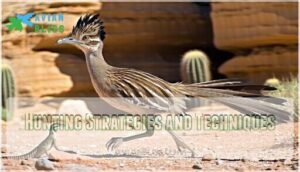
You’ll witness master-level Speed Tactics when roadrunners hunt.
These opportunistic predators use Stealth Approaches, stalking prey before lightning-fast strikes.
Their Hunting Methods include cooperative snake-killing behavior and Prey Capture through pursuit or ambush.
Roadrunners bash venomous prey against rocks, showcasing impressive predator-prey dynamics.
Their hunting prowess makes them formidable desert survivors.
The roadrunner’s effective hunting techniques rely on specialized hunting gear equipment to thrive in the desert environment.
Adaptations for Survival
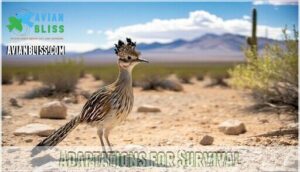
Surviving desert life requires ingenious adaptations that make roadrunners nature’s ultimate desert warriors.
These remarkable desert bird species showcase adaptations for survival that would make any survivalist jealous.
- Water Conservation – Roadrunner characteristics include secreting excess salt through eye glands instead of urinating, maximizing precious water retention in arid regions.
- Desert Camouflage – Mottled plumbing blends seamlessly with dusty shrub environments, making this opportunistic predator nearly invisible to prey and threats.
- Speed Adaptation – Running up to 20 mph helps escape danger and catch fast-moving lizards across open desert terrain.
- Thermal Regulation – Lowering body temperature at night conserves energy, while morning sunbathing sessions restore ideal operating temperature.
The roadrunner’s ability to thrive in harsh environments is a demonstration of its effective bird adaptations for survival strategies.
Reproduction, Conservation, and Human Connections

You’ll discover that Greater Roadrunners have fascinating breeding habits, from their elaborate courtship dances involving gift-giving to their shared parenting duties throughout the long breeding season.
While these remarkable desert survivors face some habitat pressures, they’ve also captured human imagination for generations, earning nicknames like "Paisano" and becoming iconic symbols of the American Southwest, with a unique ability to inspire and endure as a symbol of the wild, earning them a special place as desert survivors.
Mating and Breeding Habits
You’ll discover that Greater Roadrunners form monogamous pairs that often mate for life, creating strong pair bonds through elaborate courtship rituals.
During breeding season from March to October, males perform intricate mating behaviors including gift-giving and dramatic dances.
These courtship rituals involve food offerings and synchronized movements that strengthen their partnership. Monogamous pairs work together throughout incubation periods, sharing nesting duties equally, which is a key aspect of their pair bonds.
Conservation Status and Threats
Greater Roadrunners maintain stable global populations with a Least Concern conservation status, but they’re not bulletproof.
Habitat Loss from urban sprawl threatens their large territories, while Climate Change pushes their range northeast.
Human Impact includes vehicle strikes and pesticide contamination, though Species Decline affects localized areas like California.
Targeted Conservation Efforts focus on habitat conservation and wildlife corridors to guarantee species conservation success, and effective roadrunner conservation products can also support these conservation goals.
Cultural Significance and Human Interaction
Beyond Looney Tunes, you’ll find the roadrunner carries deep Native American symbolism, representing protection and good fortune.
Its X-shaped tracks ward off evil spirits in Pueblo traditions, while Hopi stories feature it as a desert guide.
- Folklore Symbolism – Indigenous cultures view roadrunners as spiritual messengers and cunning survivors
- Cartoon Influence – Warner Bros. created global recognition, though exaggerating the bird’s actual speed capabilities
- Cultural Icons – New Mexico’s state bird appears in regional artwork, festivals, and educational programs throughout the Southwest
Frequently Asked Questions (FAQs)
How fast can a Roadrunner run?
Forget what cartoons taught you—real roadrunners won’t outpace speeding cars.
You’ll clock these desert sprinters at impressive speeds reaching 20 mph, though they typically cruise around 15 mph while hunting lizards and snakes.
Where do Roadrunners live?
Roadrunners call the American Southwest home, thriving in desert regions from Arizona to Texas and south into Mexico.
You’ll spot them in arid grasslands, scrublands, and open desert areas where they hunt prey and build nests.
What is the scientific name of the Great Roadrunner?
Like a scientific passport stamped with authority, you’ll find the Greater Roadrunner’s official name is Geococcyx californianus, meaning "California earth-cuckoo," reflecting its terrestrial nature and southwestern origins.
What is a greater roadrunner?
You’re looking at a fascinating desert bird that’s basically nature’s speed demon.
The greater roadrunner is a ground-dwelling cuckoo that can outrun you at 20 mph while hunting rattlesnakes and lizards across America’s southwestern deserts.
Are Roadrunners migratory?
Migration myths crumble when you examine roadrunners closely.
These desert-adapted birds stay put year-round, never migrating, they’re non-migratory residents who’ve mastered surviving harsh southwestern conditions through behavioral adaptations rather than seasonal travel.
What does a greater roadrunner look like?
You’ll spot a large, mottled brown-and-white bird about two feet long with a bushy blue-black crest, long tail, and lean body.
That runs nearly parallel to the ground—resembling a feathered velociraptor.
What is the difference between a roadrunner and a greater roadrunner?
There’s no difference – "roadrunner" and "greater roadrunner" refer to the same bird species, Geococcyx californianus.
You’ll find both terms used interchangeably when describing this desert speedster that reaches 20-24 inches long, which is a distinct characteristic of this bird.
What is unique about the greater roadrunner?
You’ll find this bird breaks the mold—it’s a ground-dwelling cuckoo that can’t fly well but runs 15 mph, kills rattlesnakes, and leaves distinctive X-shaped tracks.
Can greater roadrunners fly?
Like a bird shackled to earth’s embrace, you’ll find these desert sprinters can fly—but barely.
They’re built for ground speed, not soaring, with weak flight muscles that limit them to short, clumsy glides when absolutely necessary.
What is the lifespan of the greater roadrunner?
You’ll discover these remarkable desert runners can survive 7-8 years in the wild, though some lucky individuals have hit 9 years in captivity.
Wild roadrunners typically live 7-8 years, while captive ones can reach 9 years.
That’s impressive staying power for such speedy desert athletes!
Conclusion
Absolutely mind-blowing, the greater roadrunner stands as nature’s ultimate desert survivor.
You’ve discovered a bird that defies conventional expectations, combining lightning speed with remarkable intelligence.
From their salt-filtering glands to fearless snake-hunting tactics, these desert athletes showcase evolution’s finest work.
Whether you’re hiking southwestern trails or simply appreciating wildlife from afar, the greater roadrunner reminds us that nature’s most incredible adaptations often come in the most unexpected packages, making it a true marvel of nature’s ultimate adaptations.