This site is supported by our readers. We may earn a commission, at no cost to you, if you purchase through links.
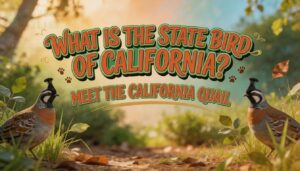
Somewhere in a California backyard, a small bird with a bobbing head plume forages through the leaf litter like it owns the place—because, in a sense, it does.
The California Quail has worn the title of state bird since June 12, 1931, when the legislature made it official after more than 61,000 public votes swung in its favor.
That kind of endorsement says something.
Compact, boldly marked, and built for the scrubby landscapes that define so much of California, this bird shows up everywhere from coastal sage scrub to suburban garden edges.
Table Of Contents
- Key Takeaways
- What is California’s State Bird?
- California Quail is The State Bird
- California Quail Identification
- California Quail Habitat and Behavior
- California Quail in California Culture
- Frequently Asked Questions (FAQs)
- What is the state bird of California?
- When did California become a state bird?
- Are quails a state bird?
- What is California’s state bird and animal?
- Do quails get attached to humans?
- Where do birds sleep when it rains in the winter?
- What year was the California quail adopted as the state bird?
- What colors are the official colors of California?
- What eats the California quail?
- What is the state insect of California?
- Conclusion
Key Takeaways
- California’s state bird is the California Quail (Callipepla californica), officially designated on June 12, 1931, after earning 61,559 votes in a statewide public poll.
- Its iconic forward-curving head plume, bold black bib, and three-note chi-ca-go call make it one of the easiest birds to identify across the state.
- The species thrives in a wide range of habitats—from coastal sage scrub to suburban backyards—living in tight social groups called coveys of 20 to 25 birds.
- Beyond being a legislative symbol, the California Quail is deeply embedded in the state’s culture, appearing in Native American traditions, school programs, public art, and conservation campaigns.
What is California’s State Bird?
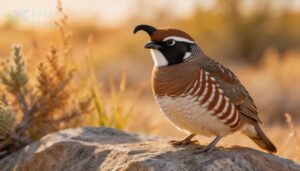
California’s state bird is one of those symbols that actually makes sense once you know the bird. The California Quail is a small, plume-headed native species with a personality as recognizable as its call.
Its bobbing topknot and cheerful call make it one of the most charming small birds native to California you’re likely to spot in the wild.
Here’s a quick look at the basics.
Official State Bird Overview
If you’ve ever wondered which bird represents the Golden State, the answer has been settled since June 12, 1931 — when the California Legislature officially designated the California Quail as its state bird. This wasn’t random.
It carried real symbolic significance, connecting California’s identity to its native wildlife. Today, it remains one of the state’s most recognized official symbols.
Common Name: California Quail
Most people just call it the California Quail — and that name has stuck for good reason. It’s the state bird of California, a familiar face in California wildlife from suburban backyards to oak-covered hillsides.
Here’s what makes this bird worth knowing:
- Adapts well to urban settings (Urban Adaptation at its best)
- Faces real Predation Threats from feral cats and raccoons
- Follows a distinct spring Breeding Cycle
- Benefits from ongoing Conservation Efforts statewide
- Has surprisingly flexible Dietary Preferences
The species thrives in dense shrub cover, providing essential shelter and nesting sites.
Scientific Name: Callipepla Californica
Behind the familiar name sits a tidy scientific label: Callipepla californica. The genus Callipepla comes from Greek meaning "beautiful robe" — fitting for such a sharply dressed bird.
The species epithet meaning simply points back to California itself.
| Classification Detail | Value |
|---|---|
| Scientific Name | Callipepla californica |
| Taxonomic Authority | Shaw, 1798 |
| Family Odontophoridae | New World Quails |
| Genus Etymology | "Beautiful robe" (Greek) |
| Phylogenetic Relationships | Distinct species within Odontophoridae |
Also Known as Valley Quail
You might also see this bird listed as the Valley Quail in older field guides — a habitat-specific moniker that separates it from the Gambel Quail and Mountain Quail. In birdwatcher terminology, regional naming usage like California Valley Quail still appears in checklists today.
Both names point to the same species: Callipepla californica, the official California state bird.
California Quail is The State Bird
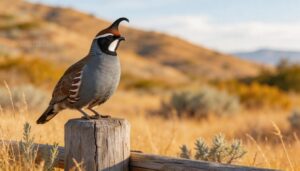
California Quail didn’t just get handed the title of state bird — it earned it.
From its bold plume to its scrappy survival instincts, the California Quail embodies a resilience you’ll also spot in other striking species like the black bird with white stripe on wing, whose distinctive markings tell their own conservation story.
There’s a real story behind the designation, from the date it became official to why this particular bird stood out among California’s wildlife.
Here’s what makes it the state’s recognized symbol.
Official Designation by The California Legislature
Making something official in California isn’t as simple as a handshake.
The Designation of the California Quail as the state bird went through a real Legislative Bill Process — committee hearings, public testimony, and a Governor’s signature.
That Statutory Citation now lives in California’s official codes, right alongside other state symbols.
It’s how California makes things permanent, and the official state bird earned every step of it.
Designation Date: June 12, 1931
On June 12, 1931, a legislative vote made it official — the California Quail became the state bird of California. That June 12 anniversary still marks a proud moment in the 1931 Conservation Era.
The Designation of the California Quail as the state bird reflects real public support:
- A statewide public poll numbers showed 61,559 votes in its favor
- The Governor’s Signing followed a full legislative process
- No other state shares this official state bird
Why The California Quail Was Chosen
The California Quail didn’t win by accident. With an abundant population spread across a broad geographic range, it simply made sense. Its adaptable habitat tolerance — from chaparral to suburban yards — meant Californians everywhere already knew this bird.
Public poll support confirmed it: 61,559 votes sealed the deal. Low conservation concern mattered too, ensuring a symbol that felt stable, not threatened.
Its Place Among California’s Official State Symbols
The California Quail doesn’t stand alone — it’s part of a whole family of official symbols that shape Californian identity through legislative symbolism and symbolic cohesion.
- Shares status with the state flower, seal, and mammal
- Promotes conservation messaging about native wildlife
- Facilitates cross iconic branding in state materials
- Drives educational integration in school programs
- Reinforces the cultural significance of the California Quail statewide
California Quail Identification
Once you spot a California Quail, you’ll never mistake it for anything else. This bird has a handful of features that make it instantly recognizable, from its bold head plume to its famously chatty call.
Here’s what to look for.
Distinctive Forward-curved Topknot
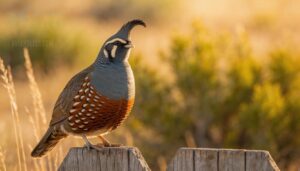
That forward-curved topknot is basically the California Quail’s signature look. The head plume sits just above the beak, arcing gently forward in a semicurved feather arrangement reaching 2–3 cm in adults. Crest anatomy relies on feather rigidity — stiff contour feathers hold that distinctive curve even in the wind. Crest development completes within the first year.
| Crest Feature | California Quail | Related Species |
|---|---|---|
| Curve direction | Forward-arcing | Flatter or angular |
| Length (adult) | 2–3 cm | Often longer |
| Feather rigidity | High | Variable |
| Display signaling | Twitches during alerts | Less pronounced |
| Species comparison | Reliable field mark | Less distinctive |
Male and Female Plumage Differences
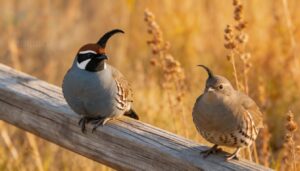
Male and female California Quails don’t look alike — and that gap tells you a lot. Males carry bold bright plumage: a chestnut-colored crown, black plume, white stripe framing the face, and gray tails. Females stay muted and cryptic.
This pattern variation isn’t random — it’s behavioral significance at work, with structural pigment and crest display serving very different survival roles.
- Males show a rich chestnut-colored crown; females wear soft brown-gray
- The black plume and white stripe are bolder and sharper in males
- Female coloring provides nest camouflage during incubation
- Color brightness in males peaks during breeding season
- Pattern variation between sexes reflects distinct roles in survival
Size, Shape, and Scaled Underparts
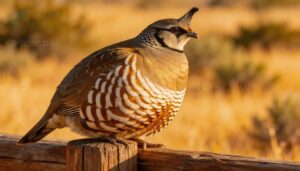
Beyond the bold patterns of male and female plumage, the California quail’s body itself tells a quiet story.
It measures 9–11 inches long, with a compact convex belly curve that gives it that classic squat silhouette.
The belly scale pattern — alternating light and dark feather edges — creates creamy white scaling with subtle golden-brown tones.
Underpart proportions cover roughly a third of the bird’s total length, and the tidy feather arrangement keeps the body silhouette remarkably sleek.
Black Bib, White Markings, and Body Color
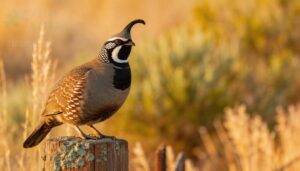
That sleek body pairs with some sharp contrast signaling on the face and chest. The black bib sits boldly on the upper breast, framed by crisp white markings — classic field identification cues you won’t miss in low brush.
The back shows brownish-gray camouflage adaptation built for chaparral scrub. Plumage wear effects can subtly dull these tones over time, but pattern stays reliably consistent year-round.
Recognizable “chi-ca-go” Call
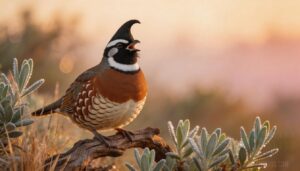
That sharp contrast on the chest is just the start — the California Quail’s voice is equally unmistakable. The three-note chi-CA-go assembly call drives social cohesion, keeping coveys connected through dense chaparral.
- Call rhythm stays steady, rarely lasting over a second
- Pitch variation rises on the middle syllable, cueing nearby birds
- Juvenile imitation helps young quail integrate into adult groups
Dawn chorus is when you’ll hear it most.
California Quail Habitat and Behavior
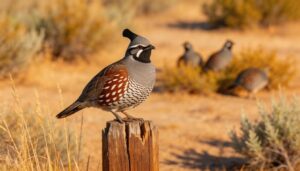
The California quail is a surprisingly adaptable bird, turning up in everything from rugged chaparral to neighborhood backyards.
Understanding where it lives and how it behaves helps explain why it thrives across so much of the state. Here’s a closer look at the key aspects of its habitat and daily life.
Native Range Across California
The California Quail doesn’t pick just one corner of the state to call home — it’s everywhere. As California’s native state bird, it ranges from Coastal Sage Scrub along the Pacific to Central Valley Hedgerows, Sierra Foothill Oakwood, and even Desert Fringe Riparian corridors near the Mojave.
You’ll also find small Channel Islands Populations thriving in isolated scrub patches.
Few native bird species match this kind of statewide reach.
Preferred Habitats: Chaparral, Scrub, and Oak Woodland
Three habitat types define where the California Quail truly thrives: chaparral, scrub, and oak woodlands.
These brushy areas share dry, patchy, low vegetation, shallow soils, and an irregular fire regime influence — conditions that shape shrub density effects and seasonal food availability year‑round.
Soil moisture patterns determine which plant communities dominate, and denser shrubs give birds reliable predator cover strategies, making these landscapes ideal California Quail territory.
Ground Foraging and Quick Escape Flights
Watch a California Quail work the ground and you’ll see Litter Scratching Tactics in action — steady pecking, short pauses to scan, then back to scratching. This ground-dwelling bird relies on Microhabitat Selection, choosing loose soil and cover-rich edges.
When threatened, it launches into short but explosive flight toward dense brush. That’s predator avoidance, keeping energy trade-offs practical and survival efficient.
Covey Formation and Social Structure
These birds don’t just flock together — they build a society.
California Quail form coveys of 20 to 25 individuals with real Leadership Dynamics and a flexible Pecking Order.
Older birds guide safer routes while Juvenile Learning happens through daily observation.
Coordinated Foraging keeps competition low, and Alarm Communication — soft chirps, tail flicks — holds the group tight.
Quail social structure and covey formation make them remarkably effective social birds.
Seasonal Movement in Suburban and Wild Areas
Seasonal patterns of California Quail shift with every change in weather. In spring, coveys push toward edge habitats for fresh plant growth — a behavior called Spring Edge Migration.
Summer Drought Refugia, like moist washes, keep them alive through dry spells.
Fall Dispersal Patterns scatter young birds outward.
Winter Shrub Covey clustering offers warmth.
Rain-triggered Insect Foraging pulls them into open patches across suburban regions and chaparral alike.
California Quail in California Culture
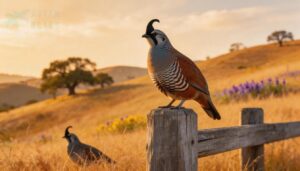
The California quail isn’t just a bird you spot on a hike — it’s woven into the state’s identity in ways that go deeper than a legislative vote. From Native American traditions to school textbooks to local artwork, this small bird shows up in more places than you’d expect.
The California Quail is woven into the state’s identity far deeper than any legislative vote
Here’s a closer look at what makes it such a lasting part of California culture.
Symbol of California’s Wildlife Heritage
The California Quail isn’t just a bird — it’s a living state emblem that quietly defines California’s identity. As the official state bird of California, Callipepla californica carries real symbolic weight in environmental education programs, ecotourism promotion, and conservation messaging across the state.
- Appears in cultural iconography on logos, signage, and state symbols
- Anchors environmental education programs in schools statewide
- Drives ecotourism promotion across wildlife refuges and parks
- Represents state emblem usage in California’s official materials
- Connects residents to the symbolism of California’s natural heritage
Historical Importance in Native American Culture
Long before 1931 made it official, Native American communities across California already knew this bird well. Storytelling Traditions wove the quail into oral histories, teaching patience and cooperation.
Ceremonial Symbolism showed up in regalia and harvest dances. Ecological Knowledge guided seasonal foraging routes.
Foodways Practices paired quail with acorns and sage. Even Hunting Tools honored the bird’s cultural and historical significance as a native species.
Presence in Education, Art, and State Promotion
That cultural significance didn’t stay in the past — it shows up in everyday California life today.
- Classroom field trips to chaparral habitats bring quail identification to life for students.
- Artistic murals across the state feature the quail’s iconic forward crest in public spaces.
- State tourism campaigns use quail imagery to represent California’s natural heritage.
- Citizen science projects track quail populations through volunteer sighting programs.
- Museum interactive displays let visitors hear the "chi-ca-go" call firsthand.
Why The Bird Remains a Familiar California Emblem
All of this — the tourism branding, the state park signage, the youth survey projects counting quail in neighborhood yards — adds up to something real. The official state bird of California stays familiar because people keep meeting it.
Its cultural significance runs from Native storytelling to community mascot programs today, making conservation awareness feel personal rather than distant.
Frequently Asked Questions (FAQs)
What is the state bird of California?
The California Quail—a living symbol of the state’s wild spirit—is the official state bird of California, designated by the California Legislature on June 12,
When did California become a state bird?
The designation of California’s state bird happened on June 12, 1931, following a 1931 statewide poll where the California Quail earned 61,559 votes — winning the legislative vote count decisively.
Are quails a state bird?
Yes, quails can be state birds.
California’s state bird is the California Quail (Callipepla californica), officially designated on June 12, 1931 — making it one of the few quail species honored as a state symbol.
What is California’s state bird and animal?
California’s official state bird is the California Quail (Callipepla californica), and its state animal is the grizzly bear. The California Quail earned its designation from the California Legislature on June 12,
Do quails get attached to humans?
Quails can bond with you through patient, gentle handling and daily routines. Imprinting effects in hatchlings run deep. Attachment signs include soft vocalizations and approaching you for food.
Where do birds sleep when it rains in the winter?
In winter rain, birds sleep under evergreen canopy cover, nest in hollows, or huddle in rainy roost shelters like dense shrubs for cover.
Social thermoregulation and ground leaf litter help them stay warm.
What year was the California quail adopted as the state bird?
Like a law quietly etched into history, the California Legislature officially designated the California quail as the state bird on June 12, 1931 — a significant event in historical wildlife advocacy still recognized today.
What colors are the official colors of California?
The official colors are blue and gold, designated in Blue symbolizes the sky and sea, while gold honors the Golden State’s mineral legacy and prosperity.
What eats the California quail?
California quail face threats from bobcat predation, raptor attacks by Cooper’s hawks, and feral cat impacts.
Snake predation targets eggs, while raccoons and domestic dog threats round out this bird’s daily survival gauntlet.
What is the state insect of California?
The state insect of California is the California dogface butterfly (Zerene eurydice), officially designated in Its striking yellow-and-black wing pattern, resembling a dog’s profile, earned it that recognition.
Conclusion
Investigate the truth of a theory that California’s diverse landscapes are mirrored in its iconic wildlife. The California Quail, with its distinctive topknot and bold markings, embodies the state’s spirit.
As the official state bird since June 12, 1931, it represents California’s rich natural heritage. What’s the state bird of California?
It’s the California Quail, a symbol of the state’s unique blend of rugged and serene environments, thriving in your backyard or local park.