
This site is supported by our readers. We may earn a commission, at no cost to you, if you purchase through links.
 You’ll recognize the tufted puffin (Fratercula cirrhata) by its dramatic seasonal transformation.
During breeding season, this North Pacific seabird sports jet-black plumage, bright white facial patches, and distinctive golden-yellow head tufts that flutter like oceanic feathers in coastal winds.
Its massive triangular bill shifts from dull winter gray to vibrant orange, red, and yellow hues.
Measuring 15 inches long with a 25-inch wingspan, these remarkable birds spend most of their lives on open ocean waters, only returning to remote cliff colonies to breed.
Their waterproof plumage and streamlined diving abilities make them perfectly adapted marine hunters, capable of plunging 15 mph underwater to catch small fish like sand lance and herring.
Table Of Contents
- Key Takeaways
- Tufted Puffin Appearance and Identification
- Habitat and Range
- Behavior and Social Life
- Diet and Feeding Habits
- Conservation and Challenges
- Frequently Asked Questions (FAQs)
- Where do Tufted Puffins live?
- What is the difference between a puffin and a Tufted Puffin?
- Are tufted puffins rare?
- Can a Tufted Puffin fly?
- How long do tufted puffins live?
- What do tufted puffin chicks look like?
- How do tufted puffins care for their young?
- Are tufted puffins endangered?
- Where do tufted puffins migrate to?
- How long do tufted puffins typically live?
- Conclusion
Key Takeaways
- You’ll witness a dramatic seasonal transformation – these seabirds sport jet-black plumage with bright white facial patches and distinctive golden-yellow head tufts during breeding season, while their bills shift from dull gray to vibrant orange, red, and yellow hues.
- You’re observing skilled underwater hunters – tufted puffins can dive at 15 mph underwater using their waterproof plumage and streamlined bodies to catch small fish like sand lance and herring, carrying multiple fish crosswise in their colorful bills.
- You’ll find them in remote North Pacific locations – these seabirds spend most of their lives on open ocean waters, only returning to coastal cliffs and offshore islands from California to Alaska during breeding season to dig burrows in grassy clifftops.
- You’re witnessing a species under threat – tufted puffin populations have declined dramatically (by 90% in some regions) due to climate change, habitat loss, overfishing, and pollution, making conservation efforts essential for their survival.
Tufted Puffin Appearance and Identification
You’ll easily recognize a tufted puffin by its striking black body, white face patches, and distinctive golden-yellow feather tufts that curve backward from its head during breeding season.
Nothing beats the thrill of spotting these distinctive tufted seabirds soaring over Pacific waters
The bird’s massive, triangular bill transforms from dull gray to brilliant orange, red, and yellow when it’s ready to mate, which is a key part of its breeding season.
Size and Plumage

When you spot a tufted puffin, you’ll notice this seabird species measures about 15 inches long with a wingspan reaching 25 inches.
Body mass typically ranges from 1.5 to 1.7 pounds.
Their plumage color transforms dramatically – breeding adults sport jet-black feathers contrasting with bright white bellies, while winter brings duller brown tones.
Puffin feathers provide excellent waterproofing for ocean life.
Distinctive Head Tufts

You’ll recognize tufted puffin birds by their striking golden-yellow head plumage that cascades dramatically behind their eyes during breeding season.
These ornamental puffin feathers serve multiple purposes – from attracting mates to establishing social status within seabird species colonies.
The tuft function extends beyond mere decoration, as feather structure helps with aerodynamics during flight. Tuft colors intensify with age and health, making older birds more impressive to potential partners.
Bill Coloration and Seasonal Changes

You’ll notice the tufted puffin’s bill transforms dramatically with seasonal adaptation. During breeding season, beak pigmentation intensifies into brilliant orange-red hues, while bill morphology expands substantially.
This color change reverses in winter when the massive breeding bill sheds its colorful outer layers, revealing a smaller, duller structure.
These plumage variation patterns help researchers identify breeding adults in puffin habitat studies, supporting essential seabird conservation efforts and bird conservation programs monitoring puffin nesting colonies across their range.
Flight Capabilities

Tufted puffins harness remarkable Wing Structure adaptations for both aerial and aquatic environments. Their compact wings generate impressive Flight Speed reaching 55 mph, while specialized Aerodynamic Feathers reduce drag during rapid Dive Patterns.
Tufted puffins transform into underwater missiles, harnessing wing adaptations for breathtaking 55 mph aerial and aquatic mastery
These adaptations enable tufted puffins to perform complex Airborne Maneuvers, showcasing nature’s engineering brilliance. The unique characteristics of their flight can be seen in the following features:
- Wings beat frantically at 400 beats per minute – like tiny helicopter rotors
- Short wingspan creates bullet-like trajectories through ocean waves
- Webbed feet act as rudders during underwater pursuit flights
- Dense bone structure prevents buoyancy issues while diving
- Rapid takeoff requires running start across water surface
This wing design perfectly balances puffin nesting requirements with marine wildlife hunting demands, supporting both puffin habitat navigation and essential puffin behavior patterns vital for seabird conservation efforts. The unique characteristics of tufted puffins can be attributed to advanced bird flight patterns that enable them to thrive in their environment.
Unique Vocalizations

You’ll hear their distinctive calls echoing across puffin colonies during breeding season.
These ocean birds produce deep groaning sounds and growling notes that carry through coastal winds.
Seabirds of North America like tufted puffins use specific call patterns for mate recognition and territory defense, with sound waves traveling efficiently over water.
| Vocalization Type | Purpose |
|---|---|
| Deep groaning calls | Territory establishment |
| Growling notes | Mate attraction |
| Soft purring sounds | Parent-chick communication |
| Harsh alarm calls | Predator warnings |
| Bill rattling | Courtship displays |
Bird watching enthusiasts can identify these Arctic seabirds through their unique vocal signatures.
Frequency analysis reveals their calls range from low-pitched rumbles to sharp warning notes.
Puffin behavior includes vocal learning, where young birds develop colony-specific dialects.
Bird songs aren’t typical for puffins – instead, they rely on these distinctive vocalizations for communication within their bustling communities.
Habitat and Range
You’ll find tufted puffins nesting on remote coastal cliffs and offshore islands throughout the North Pacific, from California to Alaska and across to Russia and Japan.
These seabirds spend most of their lives on the open ocean, only coming to shore during breeding season to dig their characteristic burrows in grassy clifftops.
Coastal and Island Nesting Sites

Ninety-seven active puffin colony sites dot the North Pacific coastline, where these ocean birds select treeless islands and steep coastal bluffs for nesting habitat.
You’ll find massive seabirds of North America colonies thriving on offshore islands like Triangle Island, protected from predators by surrounding waters.
Site selection depends on soft soil for digging, proximity to rich marine ecosystem waters, and elevation above storm surges.
Island geology and coastal erosion continuously reshape available puffin colony locations.
The discovery of Tufted Puffins in estuarine habitat challenges previous assumptions about their nesting preferences.
Burrow Construction and Nesting Habits

You’ll discover these clever seabirds excavate impressive tunnel systems using their strong claws and beaks.
Burrow architecture extends 3-6 feet deep into clifftop soil, creating secure egg chambers lined with grass and feathers.
Each tufted puffin colony features hundreds of interconnected burrows, providing essential burrow safety from predators.
These tunnel systems protect the marine ecosystem’s future generation through strategic nesting materials placement.
The use of underground burrows for nesting is similar to the burrowing owl habitats found in various regions, showcasing a unique aspect of marine ecosystem.
Open Ocean and Foraging Areas
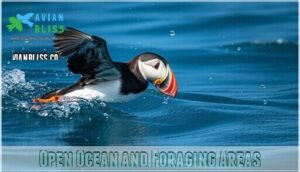
Beyond their burrow homes, you’ll find these seabirds embracing the vast Marine Ecosystem of the open Pelagic Zone.
Ocean Foraging becomes their primary focus as they employ diverse Foraging Strategies, diving beneath waves to hunt near the Sea Floor.
Their bird habitat extends hundreds of miles offshore, making ocean conservation essential for their survival.
Wildlife photography enthusiasts often capture these remarkable birds traversing endless blue waters with surprising grace.
Migration Patterns
You’ll witness their remarkable journey as tufted puffins follow established flyways along the continental shelf.
These birds make strategic stopovers during migration, with males averaging fewer stops than females. Their seasonal movements span roughly 600 kilometers from breeding colonies to wintering grounds in deep offshore waters.
Wildlife conservation efforts now track these route maps to protect critical bird habitat, supporting both ocean conservation and wildlife photography opportunities.
The tufted puffin’s migration patterns play a vital role in understanding their behavior and conservation needs.
Behavior and Social Life

You’ll observe fascinating social behaviors when tufted puffins gather on rocky cliffs during breeding season.
These seabirds demonstrate complex courtship rituals, cooperative parenting strategies, and remarkable underwater hunting techniques that showcase their adaptability to marine environments, including remarkable underwater hunting techniques.
Surface Diving Technique
You’ll watch these tufted seabirds transform from surface swimmers to underwater missiles in seconds.
Their surface diving technique showcases remarkable adaptations for catching prey beneath the waves.
Key diving mechanics include:
- Dive Speed reaches 15 mph underwater through powerful wing strokes
- Feather Control creates streamlined profiles reducing drag during descent
- Beak Angle adjusts for precise fish targeting in mid-water zones
- Wing Movement uses flying motions for propulsion and maneuverability
- Dive Depth typically ranges 60-200 feet for ideal foraging
This tufting species demonstrates incredible underwater flight abilities, making birds and wildlife conservation efforts vital for protecting these specialized ocean hunters.
The tufted puffin’s ability to employ predator avoidance strategies is essential for its survival in the wild.
Courtship Displays
You’ll witness spectacular mating rituals when tufted puffins gather during breeding season.
Males perform elaborate display dances, showcasing their vibrant courtship feathers and colorful bills.
These nesting ceremonies involve synchronized head movements and bill tapping that strengthens pair bonding.
Their unique body language communicates readiness to mate, supporting wildlife conservation through successful breeding cycles in nature and environment.
Social Interactions
You’ll find tufted puffins gathering in massive colonies during breeding season, where colony dynamics shape their entire social world.
Their flock behavior includes synchronized diving and coordinated foraging expeditions.
Social learning occurs as younger birds observe experienced adults’ techniques, and group communication happens through distinctive calls and head movements.
Their characteristic tuft displays signal status within the colony hierarchy, while they develop strong pair bonding relationships that last multiple seasons.
Parental Care and Feeding Young
Once social bonds form, you’ll witness remarkable Nesting Habits as puffin pairs work together.
These devoted parents showcase impressive Chick Rearing through coordinated Feeding Strategies. Their Brood Care involves fastidious attention, while Fledgling Support continues until independence.
Like tufted grasses with clustered growth patterns, puffin families stick together through thick and thin.
Key Parental Behaviors:
- Both parents take turns incubating the single egg for 40-45 days
- Adults carry multiple fish crosswise in their colorful bills to feed chicks
- Parents protect burrows aggressively from predators and rival puffins
Diet and Feeding Habits
You’ll find that tufted puffins are skilled underwater hunters, capable of catching multiple small fish in a single dive using their specialized bills.
Their diet varies dramatically with the seasons, shifting from energy-rich fish during breeding season to whatever marine prey they can find during their oceanic wanderings.
Primary Food Sources
Tufted puffins fuel their high-energy lifestyle with diverse marine prey.
Fish Prey dominates their menu, with sand lance, herring, and anchovy comprising up to 95% of breeding season meals.
Krill Consumption supplements this diet alongside Cephalopod Diet components like squid.
Crustacean Feeding includes amphipods and euphausiids, while Plankton Sources provide additional nutrition.
| Prey Category | Primary Species | Seasonal Importance |
|---|---|---|
| Fish Prey | Sand lance, herring, pollock | Peak breeding (95% of meals) |
| Krill Consumption | Euphausiids, copepods | Year-round supplement |
| Cephalopod Diet | Squid, small octopus | Non-breeding emphasis |
This dietary vocabulary reflects their definition as opportunistic marine predators, unlike terrestrial birds that depend on botany, plants, or grass sources.
Foraging Techniques
You’ll witness these remarkable seabirds employ sophisticated underwater hunting methods.
Tufted puffins master surface diving through coordinated wing-propulsion, reaching depths where their prey congregates. Understanding effective seabird foraging tools is essential for their survival.
Here are five key foraging techniques that’ll amaze you:
- Dive Patterns – Systematic spiral descents targeting fish schools
- Food Tracking – Visual pursuit of silvery prey movements underwater
- Prey Capture – Lightning-fast bill strikes securing multiple fish
- Foraging Depth – Precise depth selection based on prey distribution
- Feeding Strategies – Coordinated group hunts maximizing success rates
Seasonal Food Availability
Throughout summer months, you’ll observe dramatic shifts in prey distribution that shape tufted puffin foraging strategies.
Ocean currents carry different food sources closer to nesting colonies, creating predictable fishing patterns that these seabirds have mastered over millennia.
| Season | Primary Prey | Availability |
|---|---|---|
| Spring | Small fish larvae | Moderate |
| Summer | Adult anchovies | High |
| Fall | Juvenile rockfish | Variable |
| Winter | Deep-water squid | Low |
| Year-round | Krill swarms | Consistent |
Nutrient cycles in marine ecosystems follow seasonal rhythms much like plants and grass respond to changing conditions on land.
This botanical vocabulary helps explain oceanic patterns – just as terrestrial vegetation blooms predictably, marine food webs pulse with life during specific months.
The etymology of "seasonal" itself suggests nature’s clockwork precision in delivering sustenance when puffins need it most.
Feeding Chicks
During breeding season, you’ll witness dedicated Parental Care as adult puffins make countless trips to feed their chicks.
These seabirds demonstrate remarkable Feeding Methods and Chick Nutrition strategies that guarantee healthy Chick Growth.
Key feeding behaviors include:
- Multiple fish delivery – Parents carry 10-20 small fish crosswise in their bills
- Frequent feeding trips – Adults make 4-12 foraging runs daily during peak season
- Progressive independence training – Foraging Lessons begin as chicks approach fledging age
Unlike tufted grass or other plants with steady botany patterns, puffin feeding intensifies dramatically during the 40-day chick-rearing period.
Conservation and Challenges

Tufted puffins face mounting pressures from human activities, climate shifts, and habitat loss that threaten their survival across the North Pacific.
You’ll discover how scientists and conservationists work together to protect these charismatic seabirds through monitoring programs and targeted research efforts.
Threats to Population
Across southern colonies, you’ll find tufted puffins fighting for survival against mounting pressures.
Habitat Loss devastates nesting sites through coastal development and erosion.
Pollution Effects include oil spills killing thousands, while microplastics accumulate in their systems.
Overfishing depletes their forage fish diet, creating deadly competition.
Human Impact brings introduced predators like rats and foxes to once-safe islands.
These threats don’t exist in botanical vocabulary—unlike resilient plants adapting to environmental shifts, puffins face cascading challenges that push populations toward extinction.
The combination of these factors results in a significant Human Impact on puffin populations.
Climate Change Impacts
Rising temperatures dramatically reshape tufted puffin survival prospects. When sea surface temperatures exceed 9.9°C, breeding colonies face near-zero fledging success rates.
Ocean acidification compounds these thermal stresses, while extreme weather events trigger mass mortality episodes. The tufted puffin’s vulnerability to climate change effects is a significant concern for conservation efforts.
- Habitat loss: Over 92% of California Current nesting sites may become unsuitable by 2050
- Prey disruption: Warming waters shift key forage fish northward, leaving puffins starving
- Breeding failure: Ideal reproduction requires precise 8.9–9.9°C sea temperatures
- Range contraction: Southern colonies abandon traditional territories as conditions deteriorate
Conservation Efforts and Research
Multiple organizations collaborate to safeguard tufted puffin populations through innovative conservation strategies.
The National Audubon Society, Bird Alliance of Oregon, and federal agencies form research initiatives focusing on habitat restoration and species monitoring.
Scientists remove invasive plants from nesting islands while studying the etymology of declining colonies.
Wildlife protection efforts include predator management and nest box placement, drawing from Atlantic Puffin recovery programs for effective solutions.
Conservation teams utilize specialized conservation tools to monitor and protect puffin habitats.
Population Monitoring Initiatives
Scientists track tufted puffin populations using sophisticated census methods and GPS tracking devices to understand population trends.
You’ll find researchers conducting habitat surveys across coastal breeding colonies, deploying miniature sensors on these charismatic seabirds.
These monitoring efforts reveal essential data about colony health, feeding patterns, and migration routes, directly informing conservation strategies for protecting their cliff-top tuft-adorned breeding sites.
Frequently Asked Questions (FAQs)
Where do Tufted Puffins live?
Like nomads seeking their perfect homeland, you’ll find these remarkable seabirds nesting along North Pacific coastlines from Alaska to California, choosing rocky cliffs and offshore islands as their breeding sanctuaries.
What is the difference between a puffin and a Tufted Puffin?
Puffins encompass multiple species, while Tufted Puffins represent one specific type.
You’ll recognize Tufted Puffins by their distinctive golden-yellow head plumes during breeding season, unlike other puffin species that lack these ornamental feathers.
Are tufted puffins rare?
Shadows dance through declining populations—you’re witnessing something precious slipping away like morning mist.
These charismatic seabirds have plummeted dramatically, with populations dropping by nearly 90% in some regions, making them endangered in Washington state.
Can a Tufted Puffin fly?
Yes, you can watch tufted puffins soar through the air with surprising grace.
These seabirds use their wings to fly above ocean waves and dive underwater for fish, making them skilled aerial and aquatic athletes.
How long do tufted puffins live?
Nature’s clock shows these seabirds breaking free from life’s constraints at around 20-25 years old.
Atlantic puffins are long-lived, averaging 30 plus years, while their Pacific cousins follow similar timelines in their ocean-bound existence.
What do tufted puffin chicks look like?
Chicks hatch as open-eyed balls of soft down that dry into puffy balls. They’re covered in down, able to walk, but stay in burrows while parents deliver fresh fish daily.
How do tufted puffins care for their young?
Beneath deep ocean burrows, you’ll witness remarkable dedication as both parents share feeding duties completely.
Couples share parenting duties, like nest building, egg incubation, and feeding their chick.
They masterfully carry up to 20 small fish crosswise in their bills for hungry pufflings underground.
Are tufted puffins endangered?
Federal protection isn’t required for these seabirds, yet they’re experiencing dramatic population crashes.
While not federally endangered, they’ve declined from nearly 5,000 to just 553 in Oregon alone, earning state-level endangered status in Washington.
Where do tufted puffins migrate to?
You’ll find that 85% of these seabirds actually spend their winter months wandering the open Pacific Ocean, sometimes traveling up to 60-120 miles offshore.
They’re probably the most pelagic of the alcids during their non-breeding season, with many birds wintering 60-120 miles offshore, which makes them highly mobile.
How long do tufted puffins typically live?
You’ll reach sexual maturity around 4-6 years old and can potentially live 20-30 years in wild conditions. These hardy seabirds weather harsh Pacific storms throughout their lifetime.
Conclusion
Picture golden tufts dancing against storm-darkened cliffs as waves crash below.
You’ve now discovered how the tufted puffin transforms from drab winter wanderer to breeding season showstopper.
These remarkable seabirds face mounting challenges from climate change and habitat loss, making conservation efforts essential.
By understanding their unique lifecycle and ecological needs, you’re better equipped to appreciate and protect these charismatic marine hunters for future generations to witness their spectacular seasonal displays.
- https://www.alaskasealife.org/aslc_resident_species/26
- https://www.fws.gov/story/2022-06/tufted-puffins-sea-sentinels
- https://www.aquariumofpacific.org/onlinelearningcenter/species/tufted_puffin
- https://www.oregonconservationstrategy.org/strategy-species/tufted-puffin/
- https://sanctuaries.noaa.gov/education/teachers/tufted-puffin-natural-history.html