This site is supported by our readers. We may earn a commission, at no cost to you, if you purchase through links.
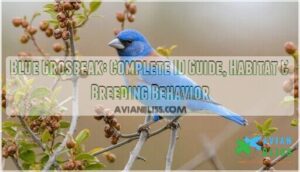 You’ll recognize a blue grosbeak by its stocky build and massive triangular bill that can crack tough seeds other songbirds can’t handle. Males sport stunning cobalt-blue plumage with distinctive chestnut wingbars, while females display brown feathers with lighter undersides and subtle streaking.
These 6-inch birds prefer shrubby habitats like old fields and woodland edges, where they forage for insects during breeding season and seeds in fall and winter. They’re expanding their range northward, with populations growing 45% since 1970.
Blue grosbeaks nest low in shrubs, with females handling most parental duties while males defend territory through melodious songs that sometimes include vocal mimicry of other species.
Table Of Contents
- Key Takeaways
- Blue Grosbeak Identification Guide
- Habitat, Range, and Migration
- Diet, Feeding, and Foraging Behavior
- Breeding and Nesting Habits
- Conservation, Threats, and Interesting Facts
- Frequently Asked Questions (FAQs)
- Where do you find Blue Grosbeaks?
- How to tell the difference between an indigo bunting and a Blue Grosbeak?
- What does a female Blue Grosbeak look like?
- Is the Blue Grosbeak endangered?
- How can I attract blue grosbeaks to my garden?
- Are blue grosbeaks rare?
- Do blue grosbeaks migrate?
- What do blue grosbeak chicks eat?
- How can I identify a blue grosbeak nest?
- What is the Blue Grosbeaks lifespan?
- Conclusion
Key Takeaways
- You’ll identify blue grosbeaks by their stocky build and massive triangular bill, with males displaying brilliant cobalt-blue plumage and chestnut wingbars, while females show brown coloring with lighter undersides.
- You’ll find these adaptable birds in shrubby habitats like old fields and woodland edges across the southern United States, where they’re expanding their range northward, with populations growing 45% since 1970.
- You can attract them to your yard by offering sunflower seeds and millet in platform feeders, providing shallow water sources, and maintaining native grasses with dense shrub cover for nesting.
- You’ll hear their distinctive melodious warbling songs during the breeding season, when females build low nests in shrubs while males defend territories, switching from insect-heavy diets in summer to seeds in fall and winter.
Blue Grosbeak Identification Guide
You’ll easily recognize a Blue Grosbeak by its stocky build and massive triangular bill that seems to dominate its face. This distinctive songbird stands out with its vibrant coloring and sturdy appearance, making identification straightforward once you know what to look for.
Distinctive Features of Males
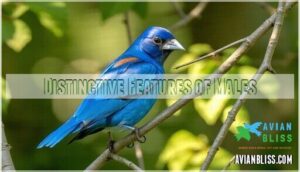
You’ll recognize male Blue Grosbeaks by their stunning cobalt-blue plumage that catches sunlight beautifully. Their massive silver bill dominates their face, making identification straightforward even from a distance. Look for distinctive chestnut wingbars contrasting against their blue feathers.
These stocky birds measure 5.9-6.3 inches, appearing noticeably larger than Indigo Buntings but smaller than Brown-headed Cowbirds in your backyard.
Identifying Females and Immatures
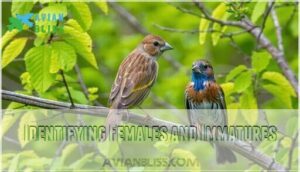
Female Blue Grosbeaks sport brown plumage with lighter undersides, making identification trickier than their vibrant male counterparts. Molting patterns help with age determination – juveniles show mixed brown and blue feathers during their first fall. You’ll notice immature markings include subtle streaking and buffy wing bars.
These color pattern differences require careful observation for accurate bird identification. Using a detailed field guide is essential for confirming these subtle differences.
Color Patterns and Size Comparison
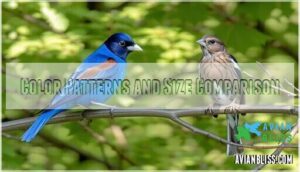
Understanding Blue Grosbeak color patterns starts with recognizing their striking sexual dimorphism and size variations across populations.
- Male plumage variation: Deep cobalt blue with chestnut wingbars and silver bill
- Female color pattern: Rich brown upperparts with buff underparts and subtle streaking
- Size overlap: Both sexes measure 5.9-6.3 inches, larger than Indigo Buntings
- Regional differences: Northern populations show slightly more vibrant blue coloration
Similar Species and Lookalikes
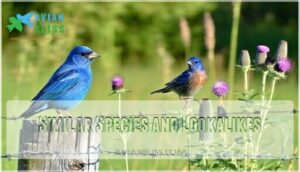
Blue Grosbeak confusion often stems from similar-sized birds sharing your backyard. Indigo Buntings appear smaller with more vibrant blue, while Cowbird Confusion occurs with brown females resembling female cowbirds. Female Identification requires noting the Blue Grosbeak’s larger size, shape, and distinctive bill.
Regional variations exist, but compare species carefully—hybridization risks between cardinals create unusual plumages. Relative Size helps with identification help.
Habitat, Range, and Migration
You’ll find Blue Grosbeaks in shrubby habitats, old fields, and areas with low vegetation across the southern United States.
These stocky songbirds are expanding their range northward, making them increasingly common in backyard settings with suitable open spaces and scattered trees.
Preferred Habitats and Regional Presence
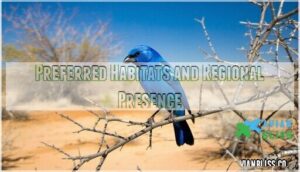
You’ll find Blue Grosbeaks across diverse landscapes throughout North America, from Texas’s brushy fields to shrublands spanning the southern United States. These adaptable birds show strong habitat preferences for areas blending open spaces with dense cover.
Blue Grosbeaks thrive where open spaces meet dense cover—the perfect blend for these adaptable songbirds
Their preferred breeding habitat includes:
- Shrubby old fields with scattered trees and thick undergrowth
- Woodland edges where forests meet grasslands or agricultural areas
- Riparian zones along streams with dense vegetation and low shrubs
Regional variations appear across their range, with Texas populations favoring mesquite and thorny scrublands while eastern birds prefer abandoned farmland. This habitat diversity fosters ongoing range expansion as climate change and habitat conservation efforts create new suitable territories.
Migration Routes and Patterns

Blue Grosbeaks follow predictable migration routes through North America’s central flyway each spring and fall. These vibrant birds depart wintering grounds in Central America around April, traveling through Texas corridors before reaching breeding territories. Weather patterns substantially influence their migration timing, with favorable winds accelerating northward journeys. Stopover habitats along these routes provide essential refueling opportunities. Understanding bird navigation methods is key to unraveling the mysteries of their precise journeys.
| Migration Phase | Timing | Key Locations |
|---|---|---|
| Spring Departure | March-April | Central America |
| Peak Movement | Late April-May | Texas, Oklahoma |
| Fall Migration | August-September | Same corridors |
| Winter Arrival | October | Mexico, Central America |
Range Expansion and Population Trends

You’ll witness notable Population Change as Blue Grosbeak numbers have grown 45% since 1970. Climate Impacts and Habitat Alteration from increased precipitation and Agricultural Land abandonment fuel their northward expansion across North America.
Breeding Bird Survey data shows Population Stability with 0.81% annual growth, while the Texas Range remains highly variable yet stable.
These birds are easily identified by their distinctive rich blue plumage.
Backyard Sightings and Attracting Tips
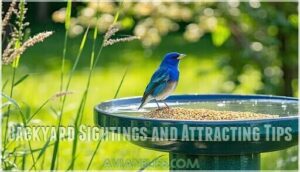
Looking for blue grosbeak sightings in your own backyard? These stocky songbirds occasionally visit residential areas, especially properties near shrubby edges or old fields.
Here are proven Attracting Methods to increase your chances:
- Feeder Types: Offer millet and sunflower seeds in platform or hopper feeders placed near shrub cover
- Water Sources: Install shallow birdbaths or dripping fountains to provide drinking and bathing opportunities
- Backyard Plants: Plant native grasses and weedy areas that produce seeds blue grosbeaks prefer
- Nesting Boxes: While they don’t use boxes, maintain dense shrubs and small trees for potential nesting sites
To guarantee a good supply, consider purchasing high quality millet.
Diet, Feeding, and Foraging Behavior

Blue Grosbeaks adapt their diet throughout the year, switching from primarily insects during breeding season to seeds and grains in fall and winter.
You’ll find them foraging on the ground and in low vegetation, using their powerful bills to crack open tough seeds and capture grasshoppers, beetles, and caterpillars.
Primary Food Sources and Seasonal Diet
A Blue Grosbeak’s appetite shifts dramatically with the seasons, making their dietary adaptations fascinating to observe. During breeding season, insects dominate their menu, while seeds and grains take center stage come fall.
| Season | Primary Diet |
|---|---|
| Spring/Summer | Grasshoppers, beetles, caterpillars, cicadas |
| Fall/Winter | Grass seeds, corn, rice, oats, millet |
| Late Summer | Wild berries and fruit supplements |
| Migration | Energy-rich seeds and waste grains |
| Year-round | Spiders, snails (supplemental protein) |
This seasonal variation in diet reflects their foraging strategies perfectly—protein-packed insect consumption fuels breeding efforts, while seed preferences support migration energy needs. As a finchlike bird, the blue grosbeak’s diet is heavily influenced by its habitat. Their dietary adaptations showcase notable flexibility across diverse habitats.
Feeding Behavior and Foraging Habits
You’ll observe Blue Grosbeaks actively foraging in shrubs and low vegetation throughout the day. Their feeding behavior involves methodical searches through dense cover, plucking insects from leaves and bark crevices.
They demonstrate impressive seasonal diet variation, switching between heavy insect consumption during breeding season to increased seed preference in fall. Their foraging techniques include ground feeding and aerial captures.
Attracting Blue Grosbeaks to Feeders
Attracting these vibrant birds requires strategic planning, though they’re less predictable than other feeder visitors. Blue Grosbeaks prefer mixed seed blends containing sunflower seeds and millet, which align with their natural seed diet that complements their insect diet during breeding season. To keep feeders appealing, clean feeders weekly to prevent disease.
- Feeder types: Use platform or hopper feeders placed 4-6 feet high
- Seed preferences: Offer sunflower seeds, safflower, and white millet blends
- Water sources: Provide shallow birdbaths near dense shrubs for predator protection
Breeding and Nesting Habits

Blue Grosbeaks are devoted parents who build their nests low in shrubs or small trees, usually 3-10 feet off the ground.
You’ll discover their breeding season extends well into summer, with females handling most parental duties while males fiercely defend their territory through song.
Nest Location and Construction
You’ll find Blue Grosbeak nests strategically positioned in shrubby areas, usually 3-10 feet above ground, though occasionally reaching 25 feet. Their nest construction showcases exceptional adaptability, incorporating diverse materials for both structure and camouflage. Birds exhibit diverse bird nesting habits, carefully choosing locations for safety and food.
| Nest Component | Materials Used | Purpose |
|---|---|---|
| Foundation | Twigs, weeds, rootlets | Structural support |
| Walls | Leaves, bark strips | Insulation, shape |
| Additions | Snakeskin, paper | Camouflage techniques |
| Lining | Fine grass, rootlets | Comfort for eggs |
| Hair/Fur | Animal hair | Soft nest interior |
Breeding Season and Nesting Activity
Blue Grosbeaks begin their breeding season in late spring, with males establishing territories through song and display. You’ll notice increased nesting activity from May through August, as pairs may raise multiple broods. Territorial defense becomes intense during peak breeding periods.
Key breeding timeline elements:
- Territory establishment – Males arrive first and claim prime nesting areas
- Courtship displays – Singing and chasing behaviors intensify in early summer
- Peak activity – Most nest construction occurs between June and July
- Extended season – Late broods can extend nesting activity into August
Broods, Egg Description, and Parental Care
Female Blue Grosbeaks usually lay 3-5 pale blue to bluish white eggs per clutch, with four being most common. The incubation period lasts 11-12 days, handled exclusively by females.
During this time, nestlings receive constant care and feeding from their mothers, who provide insects and protein-rich foods essential for proper development and successful fledgling outcomes.
Social Structure and Territorial Behavior
Males establish Nesting Territory through aggressive displays and rich warbling songs that echo across their Blue Grosbeak Habitat. During Behavior observations, you’ll notice complex social dynamics involving:
- Pair Bonding – mates coordinate through synchronized calls
- Territory Defense – males chase intruders from nesting areas
- Dominance Hierarchies – established through posturing and vocalizations
- Communication Signals – wing flicks and bill pointing convey intentions
- Social Learning – juveniles mimic adult territorial patterns
These habitat-defending strategies guarantee successful Nesting within their chosen territory.
Conservation, Threats, and Interesting Facts

Blue Grosbeaks currently enjoy stable populations with around 20 million individuals across their range, and they’re actually expanding northward thanks to climate change and habitat modifications.
While habitat loss from development and cowbird nest parasitism pose ongoing challenges, these resilient songbirds belong to the cardinal family and produce some of the most melodious warbling songs you’ll hear in shrubby grasslands.
Conservation Status and Population Change
Despite habitat loss from development, Blue Grosbeak populations show encouraging growth. North American Breeding Bird Survey data reveals populations increased roughly 0.7-1% annually from 1966-2019, with a 45% rise from 1970-2014. This population change reflects successful conservation efforts and the species’ adaptability to changing landscapes through range expansion.
Climate Change Impacts and Range Shifts
Climate change is reshaping where you’ll find Blue Grosbeaks across North America. These adaptable birds have expanded northward by 45% since 1970, driven by increasing precipitation and habitat alteration that creates ideal conditions.
Range Expansion Drivers affecting Blue Grosbeak populations:
- Precipitation Effects – Higher rainfall promotes insect abundance and suitable nesting conditions
- Habitat Alteration – Abandoned farmland creates perfect shrubland habitats
- Population Resilience – Flexible habitat use helps colonize new territories
- Conservation Strategies – Land management practices foster range expansion
- Bird Migration Patterns – Some populations show dual breeding attempts moving north mid-summer
Closest Relatives and Taxonomy
Within the Cardinalidae family, you’ll find the Blue Grosbeak (Passerina caerulea) sharing genetic relations with cardinals and buntings in the order Passeriformes. Avian taxonomy places this species among North America’s most colorful songbirds, though subspecies debate continues among researchers studying species evolution.
| Taxonomic Level | Classification |
|---|---|
| Order | Passeriformes |
| Family | Cardinalidae |
| Genus | Passerina |
Hybridization with Indigo Buntings occurs occasionally where ranges overlap.
Unique Songs and Birdwatching Tips
Blue grosbeaks deliver rich, warbling songs that’ll help you spot them before you see them. Their melodic phrases often include mimicked notes from other species, making song identification both challenging and rewarding.
Here are three key birdwatching tips:
- Listen for their distinctive grosbeak sounds – warbling phrases with pauses between musical segments
- Check shrubby edges and old fields during dawn and dusk when they’re most vocal
- Use patience and binoculars since they often sing from hidden perches
These vocal mimicry experts frequent birding locations with dense cover, so focus your observation techniques on areas where open spaces meet thick vegetation for best results. To improve your viewing experience, consider investing in high-quality viewing optics.
Frequently Asked Questions (FAQs)
Where do you find Blue Grosbeaks?
Like a compass pointing to diverse landscapes, you’ll find these stocky songbirds in shrubby habitats, old fields, and areas with low vegetation across the southern United States, particularly in central and southern Illinois.
How to tell the difference between an indigo bunting and a Blue Grosbeak?
Size matters most here – Blue Grosbeaks are noticeably larger than Indigo Buntings. You’ll spot their massive triangular bill and distinctive rust-colored wingbars that buntings lack completely.
What does a female Blue Grosbeak look like?
Female Blue Grosbeaks display warm brown plumage that’s lighter underneath, contrasting sharply with their male counterparts’ vibrant blue. You’ll notice their distinctive large, thick bill and subtle wingbars.
Is the Blue Grosbeak endangered?
No, you won’t find the Blue Grosbeak on endangered lists. This species enjoys "Least Concern" status with roughly 20 million individuals thriving across their range, showing stable to increasing population trends over recent decades.
How can I attract blue grosbeaks to my garden?
Plant native grasses and wildflowers in open areas with scattered shrubs. Provide water sources like bird baths. Offer mixed seeds, especially sunflower and millet. Create brushy edges between lawn and wooded areas for nesting.
Are blue grosbeaks rare?
Ever wondered if these blue beauties are elusive treasures? Blue grosbeaks aren’t rare birds—they’re **widespread across the southern U.S.
** with stable populations around 20 million individuals, though they’re not abundant everywhere you look.
Do blue grosbeaks migrate?
Yes, blue grosbeaks migrate seasonally. You’ll find them breeding across southern United States during summer months, then they’ll head south to Central America and Mexico for winter.
What do blue grosbeak chicks eat?
During their tender early days, these little feathered bundles rely entirely on mom’s carefully curated menu. You’ll find female blue grosbeaks delivering protein-packed insects like grasshoppers, beetles, and caterpillars to fuel their chicks’ rapid growth and development needs.
How can I identify a blue grosbeak nest?
Look for a compact open cup nest positioned low in shrubs, trees, or vines, usually 3-10 feet high, constructed from twigs, weeds, rootlets, and bark strips lined with fine grass.
What is the Blue Grosbeaks lifespan?
Notably, Blue Grosbeak lifespan data isn’t well-documented in scientific literature. You’ll find most songbirds of similar size live 4-6 years in the wild, though some individuals may reach 8-10 years under ideal conditions.
Conclusion
Picture yourself scanning a meadow edge where shrubs meet open grassland, and a flash of vibrant azure catches your eye. You’ve successfully identified a blue grosbeak through its distinctive triangular bill, chestnut wingbars, and stocky build.
These adaptable songbirds continue expanding northward, rewarding patient observers with their melodious songs and striking plumage. Whether you’re attracting them to feeders or locating their low shrub nests, understanding their habitat preferences and seasonal behaviors improves your birdwatching success and appreciation for this outstanding species.