This site is supported by our readers. We may earn a commission, at no cost to you, if you purchase through links.
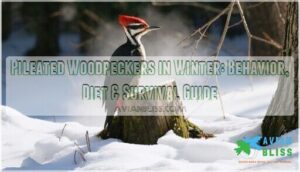 When winter arrives, pileated woodpeckers in winter don’t head south like many birds—they’re year-round residents that stick around and adapt. These crow-sized forest dwellers shift their daily routines to concentrate activity during midday warmth, conserving precious energy when temperatures drop.
They become more solitary, abandoning group behaviors to focus on individual survival. Their diet pivots to energy-rich carpenter ants and wood-boring beetle larvae, which they extract by excavating deep into dead wood and fallen logs.
This specialized winter foraging strategy helps them thrive while other birds struggle. Their exceptional cold-weather adaptations reveal survival secrets that showcase nature’s ingenuity.
Table Of Contents
- Key Takeaways
- Winter Habits of Pileated Woodpeckers
- Winter Feeding and Foraging Strategies
- Roosting and Shelter in Cold Weather
- Identifying Pileated Woodpeckers in Winter
- Conservation and Ecosystem Importance
- Frequently Asked Questions (FAQs)
- Where do pileated woodpeckers go in the winter?
- Do woodpeckers come out in the winter?
- Is it rare to see a pileated woodpecker?
- Should I feed woodpeckers in the winter?
- What do pileated woodpeckers sound like?
- How do they build their nests?
- How long do they live?
- Do they ever eat anything other than insects?
- Do they migrate?
- How cold temperatures affect pileated woodpecker health?
- Conclusion
Key Takeaways
- You don’t need to worry about pileated woodpeckers leaving in winter – they’re year-round residents who stay put and adapt their behavior rather than migrating south like other birds.
- You’ll find them most active during midday warmth – they shift their daily routines to concentrate foraging when temperatures peak, conserving energy during the coldest parts of the day.
- They become specialized winter hunters – you’ll see them targeting energy-rich carpenter ants and wood-boring beetle larvae by excavating deep rectangular holes in dead trees and fallen logs.
- They’re ecosystem engineers that benefit your local forest – their winter excavations create shelter for dozens of other species while accelerating natural decomposition and controlling pest populations.
Winter Habits of Pileated Woodpeckers
You’ll find pileated woodpeckers staying active throughout winter in mature North American forests, displaying fascinating behavioral adaptations that guarantee their survival. These impressive birds don’t migrate and instead develop specialized strategies for feeding, roosting, and maintaining territories during the coldest months.
Do Pileated Woodpeckers Migrate?
Pileated Woodpeckers don’t migrate—they’re year-round residents throughout their habitat range. Bird tracking studies confirm these woodpeckers stay put in winter, defending territories in mature forests across North America. Unlike many species showing seasonal movements, pileated woodpecker migration patterns simply don’t exist.
Their winter residence strategy relies on local resources rather than traveling south for survival. Their winter residence strategy highlights their adaptability to harsh conditions without the need for long-distance travel.
Daily Activity Patterns in Cold Months
Efficiency drives winter survival for these impressive Forest Bird Habitat specialists. You’ll notice Pileated Woodpeckers adjusting their Daily Routine Changes by concentrating activity during midday warmth when Temperature Tolerance peaks.
This Energy Conservation Methods strategy reduces metabolic costs during harsh Cold Weather Adaptations periods. Their Woodpecker Behavior shifts dramatically – they’ll spend extended periods foraging on fallen logs where Winter Foraging Strategies prove most effective, minimizing energy expenditure while maximizing Woodpecker diet habits success.
Territorial and Solitary Behaviors in Winter
While you’ll spot these impressive Woodpecker Species maintaining their Winter Territory during daylight hours, their social patterns shift dramatically as temperatures drop. Cold Weather Adaptations include increased Social Isolation, with Pileated Woodpeckers abandoning group behaviors for Solitary Roosting. This Woodpecker Behavior guarantees Forest Dominance through reduced competition, allowing individual birds to optimize energy conservation in their established territories.
Winter Feeding and Foraging Strategies
When winter arrives, you’ll find these impressive birds adjusting their feeding strategies to survive harsh conditions. Pileated woodpeckers shift their focus to energy-rich carpenter ants and wood-boring beetle larvae hidden deep within dead trees and fallen logs.
Main Food Sources: Carpenter Ants and Beetle Larvae

During winter months, carpenter ants become your pileated woodpecker’s primary insect prey. These powerful birds excavate deep into dead wood, using specialized food extraction techniques to reach ant colonies and wood boring beetle larvae. Their consumption of larvae helps control forest pests while providing essential protein. You’ll notice larger rectangular feeding holes where they’ve accessed these hidden food sources beneath bark layers.
Effective carpenter ant bait management involves understanding the ant colony dynamics to better appreciate the woodpecker’s role in the ecosystem.
Foraging in Dead Trees and Logs
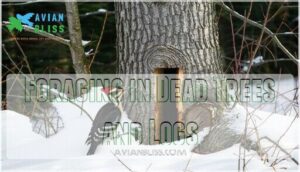
Where should you look when deadwood becomes your winter treasure map? Effective Log Foraging Tactics involve methodical Bark Inspection Methods along fallen timber and standing snags. Pileated Woodpeckers use powerful Wood Boring Strategies during Deadwood Exploration, creating distinctive rectangular excavations. Their systematic Tree Cavity Creation process reveals carpenter ants hiding beneath bark layers, making winter survival possible through strategic foraging.
Understanding key winter feeding strategies is vital for attracting and supporting bird species like the Pileated Woodpecker during the cold months.
Seasonal Diet Shifts: Nuts and Fruits
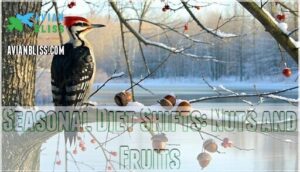
Adaptability transforms survival for Pileated Woodpeckers during harsh winters. These resourceful birds shift from their primary insect diet to embrace diverse plant foods when Cold Climate Adaptations become essential for survival.
Winter forces pileated woodpeckers to become nature’s ultimate survivors, trading bugs for berries when temperatures drop
Here’s what drives their Seasonal Diet Shifts:
- Fruit Consumption increases dramatically – wild berries like elderberries and dogwood provide essential winter calories
- Nut Foraging becomes a critical survival strategy – acorns and beechnuts offer energy-rich sustenance during cold snaps
- Winter Berries from sumac and holly supplement dwindling insect supplies in frozen landscapes
- Seed Eating at backyard feeders demonstrates notable dietary flexibility when natural sources grow scarce
- Woodpecker Characteristics include opportunistic feeding that helps them thrive in variable Pileated Woodpecker Habitat conditions
This dietary flexibility allows Pileated Woodpeckers to maintain territories year-round, with roughly 25% of winter nutrition coming from fruits and nuts rather than traditional carpenter ants and beetle larvae. The Pileated Woodpeckers’ ability to adapt is closely tied to their mature forest habitats and availability of food sources.
Benefits of Winter Excavations

Beyond just filling their bellies, Pileated Woodpecker excavations serve as ecosystem engineering marvels that benefit entire forest communities. These powerful birds create rectangular cavities that accelerate deadwood management and forest regeneration processes.
Their winter drilling provides critical shelter for owls, squirrels, and other species while enhancing biodiversity. The woodpecker drumming sounds you’ll hear signal this essential deadwood decomposition work in action.
Roosting and Shelter in Cold Weather
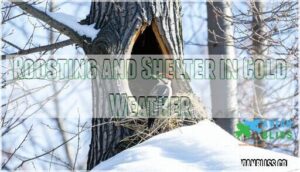
When temperatures drop, you’ll find pileated woodpeckers seeking shelter in carefully chosen roost cavities within dead trees and snags. These large birds prioritize energy conservation by selecting cavities that provide maximum thermal protection and wind shielding throughout the harsh winter months.
Use of Roost Cavities and Snags
You’ll find these impressive birds strategically using roost cavity selection throughout winter months. Pileated Woodpeckers excavate multiple cavities in snags and dead trees, creating essential winter roosting sites that provide vital protection from harsh weather conditions. The use of woodpecker nesting boxes, such as those found in woodpecker products, can support their survival by providing additional shelter options.
Consider how these woodpecker nesting behaviors support survival:
- Cavity insulation keeps body temperatures stable during freezing nights
- Deadwood utilization provides perfect excavation material for secure shelter
- Snag habitat offers wind protection and predator avoidance
- Forest habitat connectivity ensures multiple roosting options
Energy Conservation Through Shelter Selection
You’ll find thermal insulation becomes your best friend when studying pileated woodpecker shelter engineering. These forest habitat masters select roost sites with precision, choosing wind-sheltered snags that boost energy efficiency by maintaining interior temperatures up to 18°F warmer than outside air.
Smart winter refuge decisions directly impact pileated woodpeckers’ survival rates during harsh months. Understanding their forest habitat needs is essential for effective conservation efforts.
Cavity Reuse and Protection From Predators
You’ll find that Pileated Woodpeckers are smart about reusing their excavated roosts throughout winter. These strategic birds often maintain multiple roosting sites, rotating between them for ideal predator avoidance and roost protection. This nest reuse behavior saves precious energy during harsh months.
Here’s how woodpeckers enhance their tree excavation investments:
- Cavity Defense – They’ll aggressively protect established roosts from competitors.
- Strategic rotation – Multiple sites reduce predator detection patterns.
- Woodpecker conservation – Reused cavities benefit other forest species seeking winter shelter.
Understanding effective winter bird feeding strategies can also support the well-being of these woodpeckers during the cold season.
Identifying Pileated Woodpeckers in Winter
You’ll easily spot pileated woodpeckers in winter by their unmistakable flaming-red crest and crow-sized black bodies with bold white neck stripes.
Their loud drumming echoes through quiet winter forests, while rectangular excavation holes and wood chips scattered around dead trees reveal their recent activity.
Distinctive Plumage and Red Crest

Even seasoned birdwatchers can spot a Pileated Woodpecker from a football field away thanks to its striking Plumage Patterns. The species displays bold black bodies with crisp white Facial Markings running down their necks. Their flaming-red Crest Functions as nature’s beacon, making Woodpecker Identification straightforward. Males show red mustache stripes, while females lack this Coloration Variations feature, helping distinguish between sexes during winter observations.
Understanding the importance of habitat preservation is vital for the survival of many woodpecker species.
Drumming Sounds and Vocalizations

You’ll recognize Pileated Woodpeckers by their powerful drumming patterns that echo through winter forests like nature’s percussion section. Their communication strategies include deep, resonant drumming on dead trees and loud whinnying calls.
These woodpeckers produce distinctive sound waves with lower call frequencies than smaller species, making woodpecker identification easier even when you can’t see them clearly.
Signs of Activity: Holes, Chips, and Tracks

Looking for Pileated Woodpeckers means spotting their signature calling cards throughout winter forests. These impressive birds leave unmistakable evidence of their presence through distinctive excavation patterns and foraging activity.
- Rectangular woodpecker holes – Large, distinctively shaped openings in dead trees and logs, often 3-4 inches wide
- Fresh wood chips – Piles of light-colored wood fragments scattered around tree bases from recent excavation work
- Deep cavitation effects – Extensive tree damage showing systematic removal of bark and wood layers during insect hunting
Conservation and Ecosystem Importance
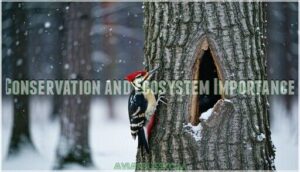
You’ll find that pileated woodpeckers serve as keystone species that create essential habitat for dozens of other forest animals through their winter excavations. Their year-round presence fosters forest health by controlling insect populations and accelerating the natural decomposition of dead trees, making them critical to maintaining balanced woodland ecosystems.
Role in Forest Biodiversity and Deadwood Decomposition
Through forest ecosystems, Pileated Woodpeckers function as ecosystem engineers driving biodiversity conservation. Their excavation accelerates wood decay processes by exposing deadwood to fungi and bacteria.
These woodpeckers create over thirty cavities annually, supporting thirty-five vertebrate species including owls and mammals.
Their deadwood management activities increase invertebrate density twofold, enhancing ecological balance in old growth forests.
Impact of Habitat Loss on Winter Survival
Habitat Fragmentation devastates Pileated Woodpecker populations during winter months. Forest Degradation removes critical deadwood needed for foraging and shelter, directly increasing Winter Mortality rates. When mature forests disappear, these impressive birds can’t find adequate food sources or safe roosting sites, creating dangerous Ecosystem Disruption that threatens their survival. Understanding the habitat loss effects is essential for developing effective conservation strategies.
- Fragmented forests lack sufficient snags – Woodpecker conservation requires at least 8 dead trees per hectare for ideal winter survival.
- Smaller forest patches can’t support territories – Each bird needs 150-200 acres of continuous habitat during cold months.
- Loss of large-diameter trees – Forest habitat loss eliminates the massive snags these crow-sized birds prefer for excavation.
- Reduced insect populations – Forest Ecosystems with fewer dead trees provide insufficient carpenter ant colonies for winter feeding.
- Increased predator exposure – Conservation Efforts must address how habitat loss forces birds into vulnerable open areas.
Supporting Pileated Woodpeckers in Your Area
You can transform your backyard into a haven for these spectacular birds through simple Eco Friendly Practices. Install suet feeders following Bird Feeding Tips from Project FeederWatch for reliable winter nutrition. Keep dead trees standing when safe—they’re essential for Woodpecker Friendly Gardens.
Support Forest Restoration efforts and Wildlife Conservation initiatives. Practice responsible Backyard Birding by providing heated water sources and preserving natural shelter for effective Woodpecker conservation. Using proper suet feeder types can also improve their winter survival.
Frequently Asked Questions (FAQs)
Where do pileated woodpeckers go in the winter?
Like winter ghosts haunting their familiar territories, you’ll find pileated woodpeckers don’t migrate—they stay put year-round in mature forests, excavating cozy roost cavities in dead trees for shelter while continuing their relentless hunt for carpenter ants.
Do woodpeckers come out in the winter?
Yes, woodpeckers absolutely come out in winter! They don’t migrate and stay active year-round, foraging for insects in dead wood, using roost cavities for warmth, and continuing their territorial drumming throughout cold months.
Is it rare to see a pileated woodpecker?
Picture a massive black bird with a striking red crest hammering against dead wood—that’s your pileated woodpecker sighting! You’re witnessing something special since they’re uncommon but not rare, with stable populations of 6 million birds across North America.
Should I feed woodpeckers in the winter?
You can feed pileated woodpeckers suet, nuts, and seeds during winter months. They’ll appreciate high-energy foods that supplement their natural diet of carpenter ants and beetle larvae found in deadwood.
What do pileated woodpeckers sound like?
Thunder-like drumming echoes through forests as pileated woodpeckers communicate. You’ll hear their loud, resonant drumming on dead trees plus wild, laughing calls that sound like "wuk-wuk-wuk." Their vocalizations carry far distances.
How do they build their nests?
You’ll find pileated woodpeckers excavating deep rectangular cavities in dead trees using their powerful chisel-shaped bills, creating secure nest chambers that can take several weeks to complete.
How long do they live?
Time moves like clockwork for these resilient drummers. Pileated woodpeckers average 9-12 years of life, with the oldest recorded reaching 12 years and 11 months. That’s surprisingly long for forest birds.
Do they ever eat anything other than insects?
Yes, pileated woodpeckers diversify their diet beyond insects. You’ll observe them consuming wild fruits, berries, and nuts, especially during winter months when insect prey becomes scarce and harder to locate in frozen ground.
Do they migrate?
Pileated woodpeckers don’t migrate – they’re year-round residents. You’ll find them staying put in their mature forest territories throughout winter, relying on dead wood for carpenter ants and beetle larvae sustenance.
How cold temperatures affect pileated woodpecker health?
Cold temperatures force you to increase energy expenditure for thermoregulation, but you adapt by fluffing feathers for insulation, selecting wind-protected roost cavities, and timing peak activity during warmer midday hours to minimize metabolic stress.
Conclusion
Understanding pileated woodpeckers in winter reveals nature’s outstanding adaptability. These resilient birds master energy conservation, refine foraging efficiency, and increase shelter utilization. They don’t migrate but transform their behaviors to thrive in harsh conditions.
By concentrating activity during warmer midday hours, targeting nutrient-dense prey, and utilizing strategic roosting sites, they’ve perfected winter survival. Protecting their forest habitats guarantees future generations can witness these impressive adaptations that make pileated woodpeckers true winter champions.
- https://docs.google.com/forms/d/1GAQr3Kn1cURCVHUA82hAga1Wv8DCH0IuqDLRUrOpN7M/viewform?ts=63f4f653&entry.1515682415=https://www.merriam-webster.com/dictionary%2Fpileated
- https://premium.britannica.com/mw-unabridged/?utm_source=mw&utm_medium=inline-def&utm_campaign=evergreen
- http://feederwatch.org/learn/common-feeder-birds/
- http://nestwatch.org/learn/all-about-birdhouses/birds/pileated-woodpecker/
- https://www.merriam-webster.com/dictionary/succumb