This site is supported by our readers. We may earn a commission, at no cost to you, if you purchase through links.
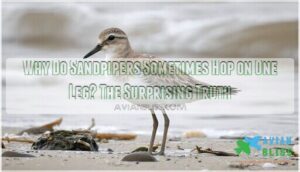 You’ve probably wondered why sandpipers sometimes hop on one leg when you spot them along the shoreline. These clever shorebirds aren’t just showing off – they’re using a clever thermoregulation strategy to survive harsh coastal conditions.
By tucking one leg up into their warm belly feathers, sandpipers minimize heat loss through their poorly insulated feet, which act like tiny ice cubes in cold water and sand. This energy conservation technique becomes their lifeline during migration and harsh weather, when every calorie counts.
Their specialized tendons actually lock the standing leg in place without using muscle energy, making this balancing act easy. The behavior reveals fascinating adaptations that help these small birds thrive in environments that would challenge much larger creatures.
Table Of Contents
- Key Takeaways
- Sandpiper Hopping: a Thermoregulation Strategy
- Anatomy of Sandpiper Legs and Feet
- When Do Sandpipers Hop on One Leg?
- Benefits of One-Legged Hopping for Sandpipers
- Sandpiper Species Exhibiting One-Legged Hopping Behavior
- Scientific Research on Sandpiper Hopping Behavior
- Environmental Factors Influencing Sandpiper Hopping
- One-Legged Hopping in Sandpiper Migration Patterns
- Evolutionary Adaptations Leading to Sandpiper Hopping
- Conservation Implications of Sandpiper Hopping Behavior
- Frequently Asked Questions (FAQs)
- How do sandpipers survive on the beach?
- Do sandpipers sweat?
- Do sandpipers have long legs?
- Why do some birds hop and others walk?
- Why do Hawks stand on one leg?
- Why do Sandpipers hop on one leg?
- What does it mean when a bird raises one leg?
- What bird hops on one leg?
- Why do flamingos stand on one leg?
- How do sandpipers maintain balance while hopping on one leg?
- Conclusion
Key Takeaways
- You’ll notice sandpipers hopping on one leg primarily for thermoregulation – they’re tucking one foot into their warm belly feathers to minimize heat loss through their poorly insulated feet, especially during cold weather and harsh coastal conditions.
- You’re witnessing an energy conservation strategy that’s crucial for their survival during long migrations – this behavior reduces metabolic demands and preserves fat reserves needed for thousands of miles of flight between feeding areas.
- You’ll see this behavior most frequently when temperatures drop below 50°F, during rest periods between foraging, and when they’re standing in cold water or on chilly substrates like wet sand or mud.
- You’re observing specialized anatomy at work – sandpipers have unique tendon structures that lock their standing leg in place without using muscle energy, plus a counter-current blood vessel system that prevents heat loss and maintains circulation in their elevated leg.
Sandpiper Hopping: a Thermoregulation Strategy
You’ll notice sandpipers tucking one leg up against their body, and this isn’t just a quirky habit—it’s actually a smart thermoregulation strategy.
When you observe this behavior, you’re watching these coastal birds minimize heat loss through their poorly insulated feet while conserving precious energy for survival.
You’re witnessing a sandpiper’s clever way to conserve heat and energy—nature’s solution to surviving chilly coastal winds
Heat Conservation Mechanism
Nature’s thermostat at work! You’re witnessing thermal regulation mastery when sandpipers hop on one leg. Their specialized feather coverage and leg insulation create an efficient energy conservation system.
By tucking one leg into warm belly feathers, they conserve heat and maintain an ideal body temperature. This cold adaptation strategy delivers remarkable energy savings, allowing these impressive thermoregulation strategies to keep them comfortable in harsh coastal environments.
Reducing Surface Area Exposed to Cold
When you watch a sandpiper lift one leg, you’re witnessing smart cold adaptation in action. This leg retraction behavior dramatically reduces the bird’s surface area exposed to freezing temperatures and wind chill. By tucking one leg deep into their warm feathers, sandpipers achieve impressive heat conservation while maintaining perfect balance.
This thermal regulation strategy works like pulling your hands into your sleeves on a cold day. The tucked leg stays toasty while feather insulation traps body heat around it. Meanwhile, blood circulation continues normally through specialized vessels that prevent freezing.
- Leg retraction reduces exposed surface area by approximately 25-30%
- Feather insulation creates a warm microclimate around the tucked leg
- Alternating legs prevents muscle fatigue during extended cold exposure
- Blood vessel countercurrent exchange maintains circulation in cold environments
This thermoregulation technique helps sandpipers conserve heat and energy during harsh weather conditions, making survival possible in cold environments where other birds might struggle.
Adapting to Harsh Coastal Environments
Beyond surface area reduction, sandpipers showcase notable coastal adaptation skills. These shorebird survival experts handle strong winds, intense storms, and widely fluctuating temperatures through environmental resilience strategies.
Their specialized counter-current exchange system prevents heat loss through those spindly legs when hopping on one leg during harsh weather. This thermoregulation technique maintains ecosystem balance while they’re foraging, proving that energy conservation isn’t just about staying warm—it’s about staying alive in unforgiving coastal environments.
The birds’ ability to adapt to changing weather conditions is a key aspect of their coastal bird migration patterns.
Energy Conservation During Rest Periods
Sandpipers don’t just hop to handle harsh coastal environments—they’ve mastered energy conservation during resting patterns. These birds use smart conservation tactics to reduce fatigue and preserve essential resources:
- Tucking one leg muscle reduces metabolic demands
- Alternating legs prevents overuse and fatigue reduction
- Decreased surface area helps conserve heat efficiently
- Minimal muscle activity during thermoregulation saves energy
This behavior allows sandpipers to conserve energy while maintaining alertness. By reducing active leg muscle engagement, they cut energy expenditure substantially during rest periods.
Anatomy of Sandpiper Legs and Feet
When you examine a sandpiper’s legs and feet up close, you’ll discover notable anatomical features that make their one-legged hopping possible. These birds possess specialized tendons that lock their legs in place without using muscle energy, while their unique blood vessel arrangement creates an efficient heat exchange system that prevents frostbite in freezing coastal waters.
Specialized Tendons for Balance
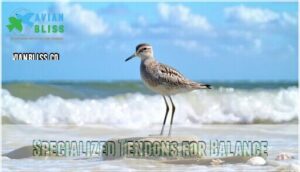
Sophisticated tendon structure enables sandpipers’ outstanding stability during hopping on one leg. These specialized fibers work like natural shock absorbers, creating balance mechanisms through muscle physiology adaptations.
Joint stability emerges from intricate leg anatomy, where tendons coordinate with muscles. This hopping behavior demonstrates how tendon structure facilitates their one-legged stance, allowing efficient movement across uneven coastal surfaces.
The study of bird leg anatomy, including leg brace systems, can provide further insights into the unique characteristics of sandpiper legs.
Blood Vessel Arrangement in Legs

Precision engineering defines sandpipers’ leg anatomy, where blood vessel arrangement creates a natural thermoregulation system. You’ll find their rete mirabile – a specialized network where warm arterial blood flows alongside cooler venous blood. This vessel structure facilitates efficient heat exchange, maintaining ideal blood flow patterns for thermal regulation. When hopping on one leg, this circulatory efficiency keeps the elevated limb warm while conserving body temperature. The unique leg anatomy of sandpipers also inspires leg warmer designs.
- The intricate blood vessel network prevents frostbite in freezing coastal waters
- Efficient heat exchange allows extended foraging in harsh conditions
- This notable adaptation saves energy that would otherwise heat cold extremities
Adaptations for Cold Weather Survival
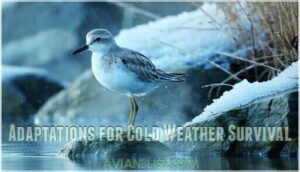
How do these birds stay warm when temperatures drop? Sandpipers possess outstanding Cold Adaptation mechanisms beyond their specialized leg anatomy. Feather Insulation creates multiple air pockets that trap warm air close to their bodies, while Leg Retraction helps conserve heat by reducing exposed surface area.
Their thermoregulation system maintains Thermal Balance through energy conservation strategies that include shivering thermogenesis and metabolic adjustments. During Winter Foraging, sandpipers conserve heat by alternating which leg touches cold substrates. These cold environments demand efficient body temperature regulation, making their one-legged stance a vital survival tool for coastal living.
Comparison With Other Shorebird Species
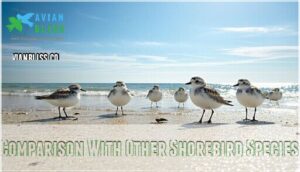
While shorebird diversity across coastal environments reveals fascinating behavioral adaptations, sandpipers aren’t unique in their one-legged hopping. Species comparison shows turnstones, red knots, sanderlings, and plovers exhibit similar thermoregulatory behaviors.
These migratory shorebirds share common ecological roles and migration patterns, developing parallel adaptations for energy conservation in harsh coastal conditions. Their shared evolution demonstrates how different species develop identical solutions to environmental challenges.
When Do Sandpipers Hop on One Leg?

You’ll notice sandpipers hopping on one leg most often during cold weather conditions, when water temperatures drop below their comfort zone.
These birds also switch to one-legged stances during extended resting periods between foraging sessions, particularly when they’re conserving energy for long migrations.
Cold Weather Conditions
When temperatures plummet, you’ll witness sandpipers’ notable cold adaptation strategy. These birds implement thermoregulation through hopping on one leg, effectively reducing heat loss by fifty percent.
During winter foraging in ice habitat conditions, this energy conservation mechanism becomes critical for frost survival. The tucked leg stays warm against their body, while snow camouflage provides additional protection in harsh cold environments.
Resting Periods During Foraging
Between foraging bursts, you’ll notice sandpipers adopting their signature one-legged stance. This resting behavior maximizes energy conservation during feeding patterns by reducing muscle fatigue. Hopping on one leg allows thermoregulation while maintaining alertness for prey detection.
Foraging Strategies during rest include:
- Energy Savings – Alternating leg postures prevents muscle exhaustion
- Migration Tactics – Conserving strength for long-distance travel
- Resting Behaviors – Staying ready to resume feeding instantly
Tidal Influence on Hopping Behavior
When tidal cycles reach their extremes, you’ll notice these coastal specialists performing a behavioral balancing act.
High tide forces sandpipers onto exposed shoreline areas where wave action disrupts their typical coastal foraging patterns.
They increase hopping on one leg frequency during these periods, using thermoregulation to maintain body temperature while traversing changing beach morphology and waiting for favorable shoreline dynamics.
Seasonal Variations in One-Legged Stance
You’ll observe sandpipers hopping on one leg more frequently during specific seasonal patterns. Cold adaptation becomes pronounced during autumn migration routes when dropping temperatures trigger thermoregulation responses. Their specialized leg muscle contractions help maintain body temperature while conserving energy.
Environmental cues like shorter daylight hours increase hopping frequency. During breeding seasons, foraging efficiency takes priority over energy conservation behaviors.
Benefits of One-Legged Hopping for Sandpipers
You’ll discover that one-legged hopping isn’t just quirky behavior – it’s a complex survival mechanism that helps sandpipers conserve precious energy during their demanding migrations while maintaining ideal body temperature in harsh coastal environments.
This thermoregulatory strategy allows them to reduce heat loss by up to 50% through their poorly insulated feet, giving them a significant advantage when foraging in cold water and windy conditions.
Minimizing Heat Loss in Cold Environments

When cold winds bite, sandpipers employ complex thermoregulatory mechanisms to survive harsh environments. These Arctic athletes tuck one leg into their feather insulation, creating effective heat conservation strategies.
- Cold Climate Adaptations: Leg tucking behavior reduces exposed surface area by 50%
- Feather Insulation: Dense plumage creates thermal barriers around tucked limbs
- Heat Conservation Strategies: Blood vessel positioning minimizes heat transfer to extremities
- Thermoregulatory Mechanisms: Controlled circulation maintains ideal body temperature
- Energy Conservation: Less metabolic effort needed to conserve heat in cold environments
Conserving Energy During Migration

Beyond keeping warm, one-legged hopping becomes a migratory lifesaver. When you’re traveling thousands of miles, every calorie counts. This energy conservation technique helps sandpipers optimize fuel efficiency along demanding migration routes.
- Energy Savings: Reduces metabolic demands during critical resting periods at stopover sites
- Fuel Efficiency: Preserves fat reserves needed for long-distance flights between feeding areas
- Foraging Strategies: Allows birds to conserve energy while maintaining alertness for food opportunities
Maintaining Body Temperature in Shallow Water
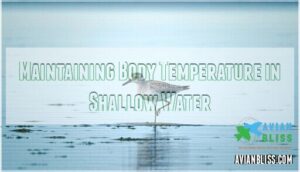
When sandpipers wade through chilly shallow water, you’ll witness their exceptional thermoregulation strategies in action. Hopping on one leg while standing in cold water helps them conserve heat by reducing the surface area exposed to frigid temperatures.
This cold adaptation maintains ideal body temperature and facilitates energy balance in demanding coastal habitats. By alternating which leg stays tucked, sandpipers achieve effective energy conservation while foraging in water that would otherwise drain their body heat rapidly.
Improved Stability in Windy Conditions

When gusty winds threaten stability on beaches, sandpipers employ a unique strategy: hopping on one leg. This behavior offers aerodynamic benefits by reducing wind resistance. Tucking one leg also enhances their balance techniques, showcasing their remarkable leg strength and coastal adaptations. These abilities allow them to navigate uneven surfaces with ease.
In windy conditions, one-legged hopping transforms sandpipers into nature’s perfectly engineered storm riders. Their ability to maintain balance is closely tied to their bird balance systems, which enable them to thrive in diverse environments.
Sandpiper Species Exhibiting One-Legged Hopping Behavior
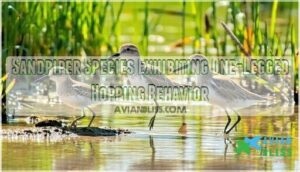
You’ll find that Western Sandpipers, Least Sandpipers, and Spotted Sandpipers all exhibit this one-legged hopping behavior, though each species shows distinct patterns in frequency and duration.
Research indicates that smaller species like Least Sandpipers hop more frequently than their larger relatives, demonstrating how body size affects thermoregulatory strategies across different sandpiper populations.
Western Sandpiper Hopping Patterns
Understanding these benefits sets the stage for examining specific species. Western sandpipers showcase extraordinary hopping behavior during their coastal migrations. Their specialized leg muscle structure facilitates efficient thermoregulation while traversing migration routes through diverse coastal habitats.
- Temperature-triggered hopping – They increase one-legged hopping frequency when air temperatures drop below 50°F
- Strategic energy conservation – Hopping techniques help conserve heat during extended foraging strategies
- Ideal positioning – They position one leg against their warm belly while hopping on the other
- Adaptive timing – Peak hopping behavior occurs during early morning and evening hours when temperatures fluctuate most dramatically
Least Sandpiper One-Legged Stance Frequency
Among all sandpiper species, you’ll notice the Least Sandpiper has mastered the art of hopping on one leg like a feathered balancing champion. These pint-sized coastal habitat specialists frequently adopt this one-legged hopping stance, particularly during migration seasons when energy conservation becomes paramount. Their specialized leg muscle structure and exceptional feather insulation make thermoregulation incredibly efficient through this behavior.
Here’s why Least Sandpipers perfect this one-legged technique:
- Energy expenditure rates drop substantially during rest periods
- Enhanced ability to conserve heat in cold mudflat environments
- Reduced muscle fatigue during extensive bird migration patterns
- Improved stability on uneven shoreline surfaces
- Quick response capability when predators approach their feeding areas
The unique adaptations of Least Sandpipers, such as their migration patterns, play a vital role in their ability to thrive in various environments.
Spotted Sandpiper Hopping Observations
Researchers have documented spotted sandpipers’ thermoregulation techniques through detailed field observations. These birds exhibit distinct hopping behavior patterns that enhance heat conservation while maintaining their active lifestyle.
| Behavior Context | Frequency | Duration (minutes) |
|---|---|---|
| Foraging breaks | High | 2-5 |
| Wind exposure | Very high | 3-8 |
| Cold substrate | Moderate | 1-3 |
| Rest periods | High | 5-15 |
| Preening sessions | Low | 1-2 |
You’ll notice spotted sandpipers demonstrate notable leg muscle structure adaptations that support extended one-legged hopping during migration patterns and flocking behavior.
Differences Among Sandpiper Species
Different sandpipers exhibit notable Species Variation in their hopping on one leg behavior. Western Sandpipers demonstrate frequent one-legged stances during cold weather, while Least Sandpipers show more selective Behavioral Adaptations.
Spotted Sandpipers display unique Sandpiper Behavior tied to their Foraging Strategies and Leg Morphology. These Species Adaptations reflect distinct Migration Patterns, with each species evolving specific thermoregulatory responses to their environmental challenges.
Scientific Research on Sandpiper Hopping Behavior
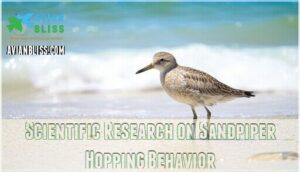
You’ll find that researchers have conducted extensive studies on sandpiper thermoregulation, using both field observations and controlled laboratory experiments to understand this fascinating behavior.
Scientists have compared heat loss patterns across different shorebird families, revealing that sandpipers’ one-legged stance reduces energy expenditure by up to 2.5% during cold conditions.
Thermoregulation Studies in Shorebirds
Scientists discover sandpiper thermoregulation secrets through careful study. Modern research examines how these birds master thermal balance in harsh environments:
- Heat flux measurements track energy loss during hopping on one leg
- Metabolic rate analysis reveals energy conservation benefits
- Feather insulation testing shows cold climate adaptations
- Blood flow studies document shorebird adaptations
- Behavioral recordings capture avian thermoregulation patterns
These findings explain bird behavior and energy efficiency strategies. Birds also employ special cold climate adaptations to survive in extreme conditions.
Field Observations of Sandpiper Flocks
Watch field researchers track massive sandpiper flocks during migration patterns. These migratory birds reveal complex flock dynamics through coordinated habitat selection and synchronized foraging strategies. When predator threats emerge, you’ll see lightning-fast collective responses throughout the entire group.
| Observation Focus | Field Research Finding |
|---|---|
| Flock Coordination | Birds synchronize hopping on one leg behavior |
| Social Hierarchy | Dominant birds lead habitat selection decisions |
| Foraging Efficiency | Groups share information about food locations |
| Predator Response | Collective vigilance enhances survival rates |
| Bird Socialization | Mixed-species flocks demonstrate adaptive learning |
Laboratory Experiments on Heat Loss
How do you measure something as tiny as heat escaping from a sandpiper’s leg? Scientists use thermal imaging cameras and controlled temperature chambers to study heat transfer patterns.
These laboratory experiments reveal how feather insulation and cold acclimation affect metabolic rate. When sandpipers are hopping on one leg, researchers can precisely measure body temperature regulation and energy conservation.
This data shows exactly how much energy birds save while conserving heat through this notable behavior.
Comparative Analysis With Other Bird Families
While sandpipers aren’t the only birds mastering this one-legged trick, comparative studies reveal fascinating patterns across bird family trees. Researchers have documented similar avian adaptations in multiple shorebird species, each with unique leg morphology:
- Flamingos use specialized tendons for seamless balancing
- Herons employ counter-current blood flow systems for heat retention
- Storks rely on enhanced feather insulation around leg joints
- Cranes demonstrate different migration patterns affecting hopping frequency
These bird adaptation mechanisms showcase nature’s clever thermoregulation strategies across diverse species.
Environmental Factors Influencing Sandpiper Hopping
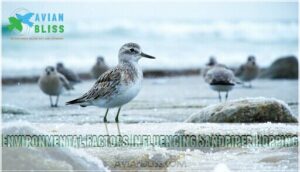
You’ll notice that temperature changes dramatically affect sandpiper hopping patterns, with wind chill and substrate conditions acting as primary behavioral triggers.
When air temperatures drop below specific thresholds or water becomes too cold, these shorebirds increase their one-legged stance frequency to minimize heat loss through their poorly insulated feet.
Impact of Wind Chill on Behavior
When winter winds cut through coastal areas, you’ll witness nature’s clever engineering at work. Wind Chill Effects trigger a Cold Stress Response in sandpipers, prompting them to hop on one leg.
This behavior maximizes Feather Insulation efficiency while reducing exposed surface area. These Behavioral Adaptations offer Aerodynamic Benefits by creating a sleek profile against harsh gusts.
In cold environments, Energy Conservation becomes critical. One-legged hopping helps sandpipers weather the storm while maintaining ideal body temperature.
Water Temperature Effects on Leg Tucking
When water temperatures drop below 50°F, sandpipers’ Temperature Sensitivity Responses kick into high gear. These birds demonstrate notable Cold Water Adaptations through their Leg Tucking Mechanisms.
You’ll notice sandpipers quickly pulling up one leg when wading in chilly water, using hopping on one leg behavior as part of their Thermal Regulation Strategies. This Energy Conservation technique prevents heat loss through their poorly insulated leg muscles.
Aquatic Environment Impact directly influences their hopping frequency, maintaining foraging efficiency while protecting core body temperature.
Substrate Temperature and Hopping Frequency
Ground heat dramatically affects sandpiper hopping behavior through thermal conductivity. Cold substrates with low soil moisture trigger increased one-legged hopping for leg insulation and energy conservation.
Temperature gradients between sand and air create comfort zones where birds adjust their hopping frequency. This behavioral adaptation maintains foraging efficiency while minimizing heat loss through poorly insulated feet during extended feeding sessions.
Air Temperature Thresholds for One-Legged Stance
When you’re shivering at the beach, sandpipers are making smart choices about Temperature Limits. Their leg muscles activate Cold Adaptation behaviors around 5-10°C (41-50°F). This Thermal Regulation maintains Energy Balance through:
- Strategic hopping on one leg to reduce heat loss
- Enhanced foraging efficiency despite cold environments
- Energy Conservation through one-legged hopping stance
- Reduced surface area exposed to wind chill
- Optimized thermal regulation during rest periods
One-Legged Hopping in Sandpiper Migration Patterns
You’ll notice that sandpipers use one-legged hopping as a vital energy-saving strategy during their marathon migrations, allowing them to rest muscle groups while maintaining alertness at stopover sites.
This behavior becomes more frequent when they’re adapting to different temperature zones along their migration routes, helping them conserve precious energy reserves needed for thousands of miles of flight.
Energy Conservation During Long Flights
During migration, sandpipers face enormous Energy Conservation challenges. Migratory birds like these must refine Flight Patterns for maximum Energy Efficiency. Their one-legged stance provides Aerodynamic Benefits by reducing drag during flight.
This Fuel Conservation technique helps them maintain foraging efficiency throughout their journey. These Migration Strategies showcase how Sandpiper Migration Patterns evolved to conserve energy across thousands of miles.
Resting Behavior at Stopover Sites
At stopover sites, sandpipers strategically balance energy conservation with survival needs. These migratory birds use one-legged resting to preserve energy budgets while maintaining vigilance.
Habitat selection influences their resting patterns substantially:
- Foraging proximity – Birds choose sites near rich feeding areas
- Predator visibility – Open areas allow threat detection during rest
- Wind shelter – Protected spots reduce heat loss through exposed legs
Stopover ecology research shows shorebirds refine migration strategies through calculated resting behaviors.
Adaptation to Various Climates Along Routes
Sandpipers showcase notable Climate Adaptation as they journey thousands of miles across diverse environments. These migratory birds adjust their one-legged hopping behavior based on temperature gradients encountered along their routes. Energy Efficiency drives their Environmental Resilience – they’ll hop more frequently in arctic conditions but reduce this behavior in temperate zones.
| Climate Zone | Hopping Frequency | Energy Conservation Strategy |
|---|---|---|
| Arctic Tundra | High (80-90%) | Maximum heat retention |
| Temperate Coasts | Moderate (40-60%) | Balanced thermoregulation |
| Tropical Shores | Low (10-20%) | Heat dissipation priority |
| Mountain Passes | Variable (30-70%) | Altitude-dependent adaptation |
| Desert Edges | Minimal (5-15%) | Water conservation focus |
Route Optimization becomes critical as sandpipers navigate coastal ecosystems with varying thermal demands, ensuring successful Migration Patterns.
Hopping Frequency in Breeding Vs. Wintering Grounds
You’ll notice sandpipers adjust their hopping behavior based on location. During Breeding Ground Habits, they hop less frequently in warmer territories, focusing energy on reproduction.
Wintering Site Preferences show increased hopping on one leg as Energy Expenditure becomes critical. These Migration Patterns reveal how Leg Resting Techniques refine foraging efficiency across different habitats, with hopping behavior serving as nature’s thermostat for survival.
Evolutionary Adaptations Leading to Sandpiper Hopping
You’ll discover that sandpipers’ one-legged hopping behavior didn’t develop overnight but evolved through millions of years of natural selection pressures.
These coastal birds gradually developed specialized leg muscles and genetic programming that allows them to conserve energy and regulate body temperature more efficiently than their ancient shorebird ancestors.
Development of Specialized Leg Muscles
Evolution crafted specialized leg muscles in sandpipers through selective pressure for energy efficiency. These muscles contain unique muscle fiber types optimized for sustained muscle contraction during hopping on one leg.
Their leg anatomy features enhanced tendon structure that facilitates one-legged hopping with minimal effort. This hopping behavior allows one leg to rest while the other maintains balance, maximizing survival in harsh coastal environments.
Genetic Factors in Thermoregulatory Behavior
Genetic Variation drives sandpipers’ one-leg hopping behavior through Heritable Traits passed across generations. Molecular Mechanisms control Thermal Adaptation, with specific genes regulating heat conservation during foraging efficiency activities.
Evolutionary Genetics research reveals populations in colder climates show stronger genetic selection for energy conservation behaviors. You’re witnessing nature’s genetic programming optimizing sandpipers survival through inherited hopping patterns.
Comparison With Ancestral Shorebird Species
Many ancestral shorebirds shared similar leg structures, but phylogenetic analysis reveals fascinating species divergence. The fossil record shows ancestral traits like extended one-legged resting evolved gradually.
Evolutionary origins suggest early shorebirds developed hopping behaviors for stability on mudflats. Modern sandpipers refined this one leg technique through millions of years of adaptation.
Natural Selection Pressures on Coastal Birds
Four major environmental pressures shaped sandpipers’ one-legged hopping through coastal adaptation. Predator threats, harsh weather conditions, and limited food resources drove these evolutionary traits.
Bird migration demands forced energy conservation strategies, while survival strategies like one-legged hopping emerged from thousands of years facing unforgiving coastal environments where only the most efficient birds thrived.
Conservation Implications of Sandpiper Hopping Behavior
You’ll discover that sandpiper hopping behavior isn’t just fascinating—it’s essential for conservation efforts.
Understanding how climate change and human disturbance affect their thermoregulatory hopping patterns helps scientists protect the coastal habitats these birds depend on for survival.
Habitat Protection for Thermoregulation Needs
You can’t protect what you don’t preserve. Habitat Preservation requires strategic Coastal Management to maintain critical wetland areas where sandpipers perform thermoregulation behaviors.
These coastal zones provide essential Ecosystem Services through effective Conservation Strategies that guarantee Climate Resilience. Protected habitats allow sandpipers to safely tuck one leg while maintaining ideal body temperature during rest periods.
Climate Change Effects on Hopping Frequency
Climate change creates a ripple effect that’s reshaping how sandpipers hop on one leg. As our planet warms, these birds face new challenges that directly impact their hopping behavior. The climate shift disrupts their finely tuned thermoregulation system, forcing behavioral adaptations that affect their survival strategies.
Rising temperatures reduce the frequency of one-legged stances, as birds need less heat conservation. However, extreme weather events create environmental stress that can trigger more frequent hopping as birds work harder to maintain their ideal body temperature. These hop patterns now vary unpredictably throughout the seasons.
Consider how these environmental pressures affect sandpiper populations:
- Temperature fluctuations force birds to constantly adjust their energy-conserving strategies
- Altered precipitation changes foraging locations, affecting when birds need to conserve energy
- Shifting seasonal patterns disrupt traditional hopping behavior cycles
- Increased storm frequency creates more situations requiring rapid thermoregulation
- Habitat temperature changes modify the effectiveness of one-leg positioning for heat management
Understanding the climate change impact is vital for predicting how sandpipers will adapt their hopping behavior in response to environmental pressures.
Human Disturbance Impact on Resting Behavior
When visitors flock to coastal habitats, sandpipers face a tough choice between resting and fleeing. Human Impact forces these birds to abandon their preferred resting spots, interrupting essential activities like energy conservation through one-legged hopping.
Behavioral Responses include frequent takeoffs that drain Energy Expenditure reserves.
Habitat Disruption shifts Resting Patterns as sandpipers avoid popular coastal areas, seeking predator-safe habitats away from human activity.
Importance of Undisturbed Coastal Ecosystems
Human activities disrupt sandpipers’ natural resting patterns, but undisturbed coastal ecosystems offer sanctuary for their thermoregulatory needs. Coastal erosion and marine biodiversity loss threaten these essential wetland habitats. Conservation protects ecosystem services that support wildlife preservation:
- Migration stopover sites – Undisturbed coastal areas provide temperature-controlled resting zones
- Foraging grounds – Protected habitats maintain invertebrate populations sandpipers need
- Breeding territories – Quiet coastal ecosystems guarantee successful reproduction cycles
- Thermoregulation zones – Shoreline management preserves microhabitats for one-legged hopping behavior
Frequently Asked Questions (FAQs)
How do sandpipers survive on the beach?
Beach-bound beauties like you’ll witness use specialized bills to probe sand for crustaceans, insects, and worms.
You’ll see them employing tactile foraging while maintaining vigilance against predators with their distinctive teetering movements.
Do sandpipers sweat?
You can’t break a sweat watching sandpipers because they can’t either. Birds lack sweat glands, so sandpipers rely on panting and gular fluttering to release heat through evaporative cooling instead.
Do sandpipers have long legs?
You’ll notice sandpipers usually sport proportionally long legs relative to their body size. These elongated limbs help them wade through shallow water and mudflats while foraging efficiently for invertebrates.
Why do some birds hop and others walk?
You’ll notice different locomotion styles because bird anatomy determines movement strategy. Birds that spend most of their time in trees tend to hop because this is faster and easier on narrow twigs.
Why do Hawks stand on one leg?
Picture a red-tailed hawk perched motionless on a winter fence post. You’ll see hawks stand on one leg primarily for thermoregulation—they’re conserving body heat by tucking one unfeathered leg into their warm, insulating feathers while reducing heat loss.
Why do Sandpipers hop on one leg?
You’ll spot sandpipers hopping on one leg as their clever thermoregulation trick. They’re conserving body heat by tucking one foot up, reducing heat loss through poorly-insulated feet while maintaining balance.
What does it mean when a bird raises one leg?
Like an old telegraph operator tapping out Morse code, you’re witnessing a bird’s thermoregulation system in action.
When birds raise one leg, they’re conserving heat by tucking it into warm belly feathers while reducing energy expenditure through specialized muscle control.
What bird hops on one leg?
You’ll commonly observe sandpipers exhibiting this distinctive one-legged hopping behavior. This adaptive mechanism helps them conserve precious energy during extensive migrations while maintaining ideal thermoregulation in varying environmental conditions.
Why do flamingos stand on one leg?
Flamingos stand on one leg primarily for thermoregulation – you’ll see them tucking one leg up to reduce heat loss through their poorly insulated feet, conserving precious energy for survival.
How do sandpipers maintain balance while hopping on one leg?
You’ll master balance through specialized leg muscles and biomechanics. Your center of gravity shifts as you alternate legs, while flexor tendons act like springs.
This creates active stability on unstable surfaces like mudflats, letting you forage efficiently.
Conclusion
Like nature’s own thermal engineers, these exceptional coastal acrobats demonstrate that survival often requires elegant simplicity.
Understanding why sandpipers sometimes hop on one leg reveals their complex adaptation to harsh shoreline environments. You’ve discovered how these small birds use thermoregulation strategies that would impress any efficiency expert.
Their one-legged stance isn’t quirky behavior—it’s evolutionary brilliance that conserves precious energy during migration and cold weather. Next time you observe sandpipers along the coast, you’ll appreciate the intricate science behind their seemingly simple hopping technique.
- https://www.yahoo.com/news/why-many-one-legged-birds-110000742.html
- https://www.reddit.com/r/birding/comments/momlj7/why_do_sandpipers_tug_one_of_their_legs_up_like/
- https://www.audubon.org/news/why-do-birds-rest-one-leg
- https://www.birdsnz.org.nz/wp-content/uploads/2021/12/Harker___Harker_2010.pdf
- https://nationalzoo.si.edu/animals/news/why-do-shorebirds-stand-one-leg