
This site is supported by our readers. We may earn a commission, at no cost to you, if you purchase through links.
 You’ll spot Audubon’s oriole by its vibrant lemon-yellow body contrasting with a jet-black head, wings, and tail. Unlike other orioles, both males and females share identical coloring, making identification straightforward once you locate them.
These secretive birds stick to dense mesquite forests and thorn-scrub along the Rio Grande in South Texas and Mexico. Listen for their distinctive slow, melodic whistles that rise and fall like musical questions.
They’re methodical foragers, gleaning insects from leaves while also enjoying mesquite beans and cactus fruit. Though globally stable, local Texas populations face pressure from habitat loss and development, making each sighting increasingly special for birders exploring this unique border ecosystem where specialized field techniques can dramatically improve your chances.
Table Of Contents
- Key Takeaways
- Audubon’s Oriole: Key Identification Features
- Natural Habitat and Geographic Range
- Behavior, Diet, and Ecology
- How to Find and Observe Audubon’s Oriole
- Conservation Status and Ongoing Threats
- Frequently Asked Questions (FAQs)
- What is the nest of the Audubon oriole?
- What bird looks like a Baltimore Oriole but isn t?
- How can you tell the difference between an oriole and a Baltimore Oriole?
- Are there two different kinds of orioles?
- How long do Audubons Orioles live?
- What predators threaten Audubons Oriole nests?
- How do Audubons Orioles communicate beyond their song?
- Do Audubons Orioles form flocks or live solitarily?
- How can I attract Audubons Orioles to my backyard?
- How long do Audubons Orioles typically live?
- Conclusion
Key Takeaways
- You’ll identify Audubon’s orioles by their distinctive lemon-yellow body with black head, wings, and tail—both males and females look identical, making field identification straightforward once spotted.
- You’ll find them exclusively in dense mesquite forests and thorn-scrub along the Rio Grande in South Texas, where they stay hidden in thick vegetation and communicate through slow, melodic whistles.
- You’ll need patience when searching since fewer than 1,000 breeding pairs remain in Texas due to habitat loss and development pressure, making every sighting increasingly valuable.
- You’ll improve your chances by listening for their distinctive rising-and-falling calls, checking eBird reports for recent locations, and focusing on areas like Salineño where dense brush meets water sources.
Audubon’s Oriole: Key Identification Features
You’ll recognize Audubon’s Oriole by its striking lemon-yellow body contrasting sharply with its black head, wings, and tail—a pattern that’s identical in both males and females.
Listen carefully for their distinctive slow, rising-and-falling whistles echoing from dense thickets, as these secretive birds often remain hidden in thick vegetation where only their melodic calls reveal their presence.
Distinctive Yellow and Black Plumage
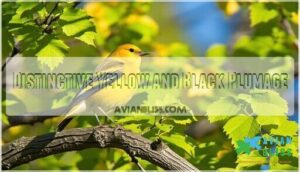
When you spot an Audubon’s Oriole, you’ll immediately notice its striking color pattern – a vibrant lemon-yellow body contrasting sharply with jet-black feather structure on the head, wings, and tail.
This distinctive plumage pattern creates bold visual displays that make Icterus graduacauda unmistakable in the field, though coloration variance between individuals remains minimal across their range.
Similar Appearance Between Sexes

Unlike many bird species where males sport flashier plumage patterns, Audubon’s Oriole breaks the mold with notable sex similarity. Both males and females display identical blackheaded oriole coloration—vibrant yellow bodies contrasting sharply with jet-black heads, wings, and tails.
This monochromatic trait makes visual identification challenging, since you can’t rely on typical color variations between sexes for oriole identification.
Shy and Elusive Nature
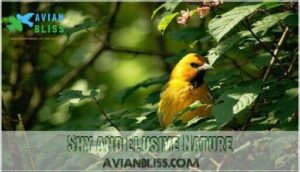
Despite their striking yellow plumage, Audubon’s Orioles (Icterus graduacauda) master the art of disappearing. These secretive birds employ stealthy movements through dense vegetation, making oriole identification challenging even for experienced birders.
Their elusive behavior includes staying low in thick cover and engaging in solitary activities. Bird watching tips emphasize patience—their quiet nature means you’ll often hear them before spotting their secretive habits in action.
Melodic Rising-and-Falling Whistles

Through thick vegetation, you’ll hear Audubon’s Oriole’s signature song before spotting the bird. These hesitant, slow whistles rise and fall melodically, creating distinctive song patterns that serve as your best identification clue.
- Vocal Learning: Both males and females sing back-and-forth duets during Oriole Breeding Habits season
- Whistle Types: Audio Recordings reveal three distinct call variations for territory and mate communication
- Bird Calls: Listen for deliberate, spaced notes unlike other Bird Species Information you’ll encounter
This Icterus Graduacauda uses Bird Identification through sound effectively.
Natural Habitat and Geographic Range
You’ll find Audubon’s Orioles exclusively in the dense mesquite forests and thorn-scrub habitats along the Rio Grande in far southern Texas and northeastern Mexico.
This secretive species restricts itself to larger, undisturbed tracts of native brushland within the Tamaulipan Biotic Province, making it one of North America’s most geographically limited songbirds.
Preferred Open Woodlands and Brush

You’ll find Audubon’s Oriole thriving in the Tamaulipan Biotic Province’s open habitat structure. These birds favor dense mesquite forests and thorn-scrub environments where woodland ecology creates perfect edge effects.
The forest structure provides ideal oriole habitat for backyard birding enthusiasts. Proper brush management in these areas aids wildlife conservation efforts while maintaining the open woodlands these secretive birds need to flourish.
Limited Range in Mexico and South Texas

Geographic isolation shapes Audubon’s Oriole’s unique story across border ecosystems. This Icteridae member occupies a remarkably narrow range spanning Mexico and South Texas.
Regional endemism creates conservation challenges for Mexico’s populations too:
- Eastern range stretches from Rio Grande valley to northern Querétaro
- Western populations extend from Nayarit to southern Oaxaca
- Texas birds limited to counties from Webb south to Starr
South Texas ecology reflects this species’ specialized habitat needs, making Salineño a vital viewing location.
Association With The Rio Grande

You’ll discover Audubon’s Oriole thriving along the Rio Grande’s riparian zones, where riverine ecology creates perfect border habitat. **Water quality and geographic isolation in South Texas support stable Icteridae populations.
**
These riparian corridors provide essential nesting sites and food sources. Visit hotspots like Salineño, where dense vegetation meets the river’s edge for ideal viewing opportunities.
Restricted Range and Conservation Implications

Audubon’s Oriole faces mounting pressure from Habitat Fragmentation across South Texas, where isolated populations struggle against Geographic Isolation.
With IUCN Status listing as "Least Concern," Conservation Efforts target Range Shifts caused by Climate Threats. Bird Conservation initiatives focus on Climate Adaptation strategies to protect remaining strongholds from further habitat loss.
The species’ survival also depends on understanding climate change impacts to develop effective conservation plans.
Behavior, Diet, and Ecology

You’ll observe Audubon’s Orioles moving slowly through dense vegetation, methodically gleaning insects from leaves and branches while supplementing their diet with fruits and seeds.
These secretive birds maintain year-round pair bonds and communicate through distinctive whistled calls, making their presence known even when they remain hidden in thick cover.
Foraging Behavior and Foliage Gleaning
You’ll observe Audubon’s Oriole employing refined gleaning techniques as it methodically searches through dense foliage. These foraging strategies involve careful foliage selection, with birds systematically examining leaves and bark crevices.
Their dietary adaptations allow efficient extraction of hidden prey using specialized bill movements. Unlike species visiting hummingbird feeders for sunflower seeds, this bird species relies on natural food sources through patient, deliberate foraging behavior within thick vegetation.
Varied Diet: Insects, Fruit, and Seeds
Their dining habits showcase true dietary adaptation during the breeding season. Their diet includes beetles, butterflies, caterpillars, spiders, mesquite beans, cactus fruit, hackberries, and also accepts sunflower seeds from bird feeders.
Audubons Oriole demonstrates outstanding insect foraging skills alongside fruit consumption and seed gathering for balanced nutrient intake:
- Active insect foraging includes beetles, caterpillars, and spiders
- Fruit consumption focuses on hackberries and mesquite beans
- Sunflower seeds provide essential breeding season nutrition.
Understanding their breeding habits is vital for conservation efforts.
Nesting Habits and Nest Construction
You’ll find Audubon’s Oriole nest construction fascinating. These birds craft pendant-style nests using grass, plant fibers, and bark strips. In South Texas, breeding seasons run April through September.
Females weave intricate nest architecture suspended from branch forks. The relative size resembles a deep pouch, perfectly shaped for egg laying. Nesting materials include Spanish moss when available.
Fledgling care requires sturdy construction to support growing chicks through their development period. Understanding the importance of proper nest building techniques is vital for the survival of these birds.
Territorial Defense and Communication
Unlike their cousin species, these orioles use subtle social interactions rather than flashy agonistic behavior. You’ll hear paired individuals exchange their signature whistles across territory boundaries, creating an invisible map of ownership through vocal displays.
- Territory establishment: Paired birds patrol shared boundaries throughout the year
- Communication methods: Rising-and-falling whistles serve as territorial marking systems
- Species comparison: Less aggressive than Baltimore Oriole, Bullocks Oriole counterparts
- Behavioral patterns: Boundary patrols occur with both sexes participating actively
How to Find and Observe Audubon’s Oriole
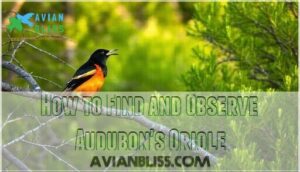
You’ll need patience and persistence when searching for Audubon’s Orioles, as these secretive birds prefer staying hidden in dense mesquite thickets and brushy woodlands throughout South Texas.
Start by checking recent eBird reports to identify active locations, then listen carefully for their distinctive slow, hesitant whistles that often provide the first clue to their presence.
Using EBird Records to Track Sightings
EBird Data Analysis breaks down your hunt for this yellow-and-black phantom. Checking eBird records to find where others have seen the species can help.
These Bird Tracker Tools offer Sightings Mapping that reveals hotspots and Migration Patterns, while Conservation Insights show Population Trends compared to Altamira Oriole distributions. Understanding oriole birds in California can provide valuable insights into their behavior and habitat preferences.
| Location | Recent Sightings | Best Months |
|---|---|---|
| Salineño, TX | 15+ reports | Mar-Aug |
| Bentsen State Park | 8 reports | Apr-Jul |
| Santa Ana NWR | 12 reports | May-Sep |
| Falcon State Park | 6 reports | Mar-Jun |
| Roma Bluffs | 4 reports | Apr-Aug |
Focusing on Dense, Brushy Habitat
Target thick mesquite forests and thorn-scrub areas where Audubon’s Orioles thrive. These birds prefer dense brushland ecology with intact wildlife corridors that support biodiversity conservation. Habitat fragmentation threatens their nesting behavior, making larger forest patches essential for bird species conservation.
Look for areas with minimal forest habitat destruction, as these provide essential ecosystem services. Unlike Orchard Orioles, Audubon’s Orioles stick to the densest cover available. The creation of essential brush habitats is indispensable for preserving their natural environments.
Visiting Feeding Stations and Backyards
Audubon’s Orioles occasionally visit backyard feeding stations, especially during breeding season when food demands increase. Their feeding habits include seeking fruit, nectar, and insects at yard attractions.
- Sweet treats: Offer orange halves, grape jelly, or sugar water to attract these yellow beauties.
- Native plants: Plant fruiting shrubs like elderberry to create natural food sources year-round.
- Patience pays: Unlike Baltimore Orioles or Orchard Orioles, station visits remain unpredictable but rewarding.
To increase the chances of attracting Audubon’s Orioles, consider using bird feeder options that cater to their specific dietary needs.
Listening for Distinctive Songs
You’ll recognize Audubon’s Oriole’s song patterns before seeing the bird itself. Listen for slow, hesitant whistles rising and falling from dense thickets during breeding season.
Both males and females share vocal learning, creating melodic bird calls unlike Baltimore Oriole or Scotts Oriole songs. Audio recordings help with sound recognition training for field identification success.
Conservation Status and Ongoing Threats
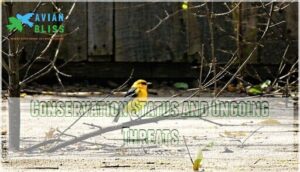
You’ll find that Audubon’s Orioles face mounting conservation challenges despite their "Least Concern" status globally.
Local populations in South Texas have declined over recent decades due to habitat loss, urban development, and increased cowbird parasitism of their nests.
Population Decline and Range Restrictions
Since the 1920s, you’ve witnessed significant population trends affecting this striking yellow-and-black species. Range contraction has pushed Audubon’s Orioles from historic strongholds, with southern Texas populations especially vulnerable to ongoing decline.
- Bird Population Decline accelerated through habitat fragmentation and cowbird parasitism
- National Audubon Society placed the species on their Wildlife Watchlist due to concerning trends
- Ornithological Research reveals fewer than 5,000 breeding pairs remain in U.S. territories
Conservation Efforts now focus on protecting remaining habitat corridors while addressing Climate Threats that may further restrict this species’ already limited range.
Habitat Loss and Urbanization
Urban sprawl across southern Texas fragments critical habitat for Audubon’s Orioles, breaking apart their woodland sanctuaries into isolated patches. Development pressure destroys native brush and mesquite forests, while ecosystem degradation eliminates essential wildlife corridors.
The National Audubon Society documents how environmental policy gaps accelerate bird population decline, placing this species on ornithological research watchlists as urbanization continues fragmenting their remaining strongholds.
Understanding habitat loss factors is vital to addressing the decline of Audubon’s Orioles and other species facing similar threats.
Impacts of Climate Change
Beyond typical seasonal shifts, Climate Shift is reshaping southern Texas ecosystems where Audubon’s Orioles struggle. Rising Temperatures and Weather Extremes disrupt nesting cycles along the Rio Grande, while Ecosystem Disruption forces competition with more adaptable species like American Robin and Bronzed Cowbird.
Avian Research Studies indicate Sea Level Rise threatens coastal habitats, pushing these rare birds further inland.
Efforts in Habitat Protection and Research
While Habitat Restoration efforts along the Rio Grande remain critical for this Passeriformes species, Wildlife Conservation groups are actively partnering on Research Initiatives.
Ecosystem Management programs now monitor Bronzed Cowbird parasitism impacts, and Environmental Monitoring tracks population trends in southern Texas.
Avian Research Studies continue documenting these secretive orioles’ needs.
Frequently Asked Questions (FAQs)
What is the nest of the Audubon oriole?
You’ll find nests that resemble shallow hanging pouches, crafted from long grass stems while still green. These basket-like structures feature firmly woven rims attached to supporting twigs with a constricted entrance.
What bird looks like a Baltimore Oriole but isn t?
You might confuse an American Robin with a Baltimore Oriole, but robins have shorter bills, rounder heads, and more subdued orange breast coloring than orioles’ vibrant plumage.
How can you tell the difference between an oriole and a Baltimore Oriole?
You’ll notice Baltimore Orioles have bright orange plumage with black wings, while other orioles display different color patterns—yellow bodies, varied wing markings, or distinct head colorations that separate species.
Are there two different kinds of orioles?
Nature’s orchestra plays across North America, where you’ll discover not just "two" but actually eight or nine different oriole species painting the skies with vibrant orange, yellow, and black plumage.
How long do Audubons Orioles live?
Specific lifespan data for these secretive birds isn’t well-documented, but you’ll likely see similar orioles living 6-10 years in the wild based on closely related species’ lifespans.
What predators threaten Audubons Oriole nests?
You’ll find Bronzed and Brown-headed Cowbirds are the main nest threats. These brood parasites sneak their eggs into over half of oriole nests.
Despite aggressive defense, you’ll see many nests fail due to this parasitism strategy.
How do Audubons Orioles communicate beyond their song?
You’ll observe subtle body postures, wing movements, and tail positioning when pairs forage together. These secretive birds rely heavily on close-proximity visual cues rather than elaborate displays, staying hidden in dense vegetation while communicating through quiet movements.
Do Audubons Orioles form flocks or live solitarily?
You’ll usually find these birds in pairs rather than flocks. Mates stay together year-round, foraging side by side through dense woodlands more consistently than most bird species exhibit.
How can I attract Audubons Orioles to my backyard?
Plant native fruiting shrubs and maintain dense vegetation cover. Offer sugar water feeders and keep quiet spaces undisturbed. These secretive birds prefer thick mesquite and brushy habitats over open areas.
How long do Audubons Orioles typically live?
While there’s limited specific data on Audubon’s Oriole longevity, most oriole species live 6-10 years.
You’ll find they’re closely related to Baltimore Orioles, which reach 11+ years in ideal conditions.
Your secretive backyard visitors likely enjoy similar lifespans.
Conclusion
Research reveals that fewer than 1,000 breeding pairs of Audubon’s oriole remain in Texas, making every encounter precious. Finding this elusive species requires patience and persistence in South Texas’s remaining mesquite forests.
You’ll increase your success by listening carefully for their distinctive whistles and checking dense brushy areas near the Rio Grande.
**While habitat loss continues threatening local populations, conservation efforts offer hope.
Your field notes and eBird reports contribute valuable data** for protecting these exceptional birds and their specialized border ecosystem.