This site is supported by our readers. We may earn a commission, at no cost to you, if you purchase through links.
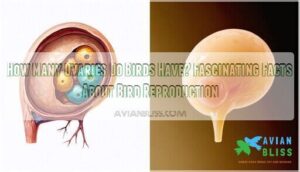 Curious about how many ovaries birds have? Here’s the scoop: you’d expect birds to come equipped with two, but most female birds keep things uncomplicated with just a single ovary on their left side.
This one-ovary design is nature’s way of helping them stay lightweight for flight—less baggage, more lift. The right ovary is usually all but missing, a holdover from evolution’s obsession with efficiency.
That single ovary takes care of all the egg business, from follicle development to hormone production. Want to know what happens during egg formation and why birds stand apart from mammals? Let’s just say, the story only gets more fascinating.
Table Of Contents
- Key Takeaways
- How Many Ovaries Do Birds Have?
- Female Bird Reproductive Anatomy
- Evolutionary Reasons for a Single Ovary
- Egg Formation Process in Birds
- Comparison of Ovaries in Vertebrates
- Research and Discoveries in Avian Reproduction
- Frequently Asked Questions (FAQs)
- How many ovaries are present in birds?
- How many ovaries does a female chicken have?
- Why do chickens have one ovary?
- How many ovaries do animals have?
- Why did birds evolve to have only one ovary?
- How does having one ovary affect bird flight capabilities?
- Are there any modern birds with two functional ovaries?
- How do bird ovaries differ from dinosaur ovaries?
- Can birds with one ovary produce as many eggs?
- Can birds regenerate lost or damaged ovaries?
- Conclusion
Key Takeaways
- You’ll find that nearly all female birds have only one working ovary, usually on the left side, which keeps them lighter and more agile for flight. – Having just a single ovary doesn’t limit a bird’s ability to lay eggs—in fact, the left ovary efficiently handles all egg production. – Evolution favored this one-ovary setup in birds to reduce body weight, helping them conserve energy and stay swift in the air. – While most birds follow this rule, a handful of raptor species sometimes retain both ovaries, proving nature isn’t always predictable.
How Many Ovaries Do Birds Have?
You might be surprised to learn most birds have just one functional ovary, usually located on the left side, which helps make their bodies more aerodynamic for flight. While this single ovary efficiently produces eggs, a few species, such as some raptors, hold onto both, showing nature’s flexibility in reproductive strategies.
Typical Number of Ovaries in Birds
Bird anatomy might surprise you: most birds, thanks to evolutionary pressures, rock just one ovary—the left one. This “ovary dominance” lets them travel light for agile flight. But why settle for one? Well, nature’s blueprint favors it.
Let’s break down why birds’ reproductive systems are set up the way they are:
- Ovary location matters
- Right ovary regression is typical
- Few functional exceptions
- Embryonic development shapes anatomy
Functional Vs. Nonfunctional Ovaries
Birds have a quirky setup when it comes to their reproductive system—only the left ovary does the heavy lifting, while the right one fades away early on.
As the embryo develops, hormones step in to shrink the right ovary, so it never gets a chance to function.
This process shapes female bird anatomy, optimizing reproductive physiology in birds. It’s Mother Nature’s odd but efficient take on the female reproductive system!
Exceptions in Some Bird Species
Sometimes, nature breaks its own rules. In some species, you’ll see Raptor dual ovaries or even right ovary function popping up, a twist in typical avian anatomy. Heads up for these exceptions:
- Atypical ovary development in kiwis and some raptors
- Genetic influences in raptors and waterfowl
- Fertility implications for species health
- Impacts on the avian reproductive system
The avian ovary contains hundreds of white follicles that vary in diameter.
Female Bird Reproductive Anatomy
You’ll notice that female birds have a single functional ovary on the left side, structured to efficiently produce ova for egg development.
Understanding the ovary’s location and how the oviduct forms and protects each egg helps you monitor avian reproductive health more effectively.
Location and Structure of The Ovary
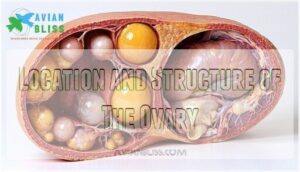
If you’ve ever wondered about Ovary Location in a female chicken, you’ll find it tucked on the left side near the kidney, right under the adrenal gland. The Ovary Structure is a powerhouse, packed with growing follicles.
While the right ovary usually fades away, the left ovary handles Follicle Development and key Hormone Production in the avian reproductive system’s intricate reproductive anatomy.
Oviduct and Its Role in Egg Formation
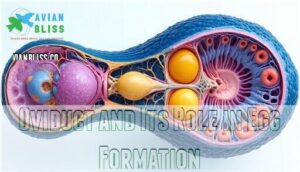
In birds, the oviduct does some impressive work. Each layer has its own specific job—from moving freshly released eggs along to building that tough outer shell.
Along the way, sperm storage boosts fertilization timing, and every segment impacts avian egg quality. Mastering oviduct structure and function means truly appreciating the innovation behind egg formation in birds.
Hormonal Control of Reproduction

You’ll notice every Ovary runs a tight ship regarding hormonal control of reproduction. As daylight lengthens, hormones get going—especially Estrogen Production and Progesterone Function.
These influence follicle growth and egg release, with Steroid Receptors fine-tuning the process.
Thanks to Photoperiod Influence and clever Sperm Storage, birds manage their reproductive biology, proving avian reproduction is anything but simple.
Evolutionary Reasons for a Single Ovary

When you look at a bird’s reproductive system, you’ll notice that most female birds have just one ovary, usually the left.
This evolutionary adaptation helps reduce body weight, supporting efficient flight and healthier egg production.
Early Birds and Ovary Pairing
During Embryonic Development, early birds actually started with paired ovaries. Here’s what you should know:
- Both ovaries begin developing in embryos.
- Hatching Asymmetry leads to a stronger left ovary.
- Postnatal Regression trims the right one away.
- MIH Influence helps guide this process.
- Raptor Exceptions sometimes buck the trend.
This evolutionary trend shapes modern avian reproduction traits.
Evolutionary Loss of The Right Ovary
Think of avian evolution as a practical engineer. As birds fine-tuned their flight adaptation, they ditched the right ovary, maximizing mass reduction for airborne efficiency.
This isn’t just random—under the MIH influence during embryonic development, most species lose the right ovary. A few raptors buck tradition, but this reproductive trait shapes the broader evolution of birds and avian reproduction.
Weight-Saving Adaptation for Flight
Only one ovary? It’s not just a quirky quirk of Bird Physiology—this organ reduction is all about Flight Efficiency. By having just one ovary, birds drop unnecessary weight, reduce metabolic cost, and keep their Bird Reproductive Systems well-organized.
That’s why birds don’t just settle for strong wings and hollow bones—their whole reproductive setup is streamlined for life in the air.
Egg Formation Process in Birds
You’ll see that egg formation in birds is a detailed, well-coordinated process that begins in the ovary and continues as the egg travels through the oviduct.
Understanding these stages helps you recognize how a single ovary does all the work, ensuring successful reproduction and healthy chicks.
Ova Development and Release

As birds evolved a single functional ovary for efficiency, the ovary runs the show by maturing oocytes in a precise follicle hierarchy.
Here’s how egg production lines up:
- Oocyte maturation kickstarts.
- Yolk deposition builds up layers.
- Ovulation triggers release.
- Egg polarity is set.
Careful reproductive biology ensures each egg forms with structure and strength for species survival.
Stages of Egg Formation in The Oviduct
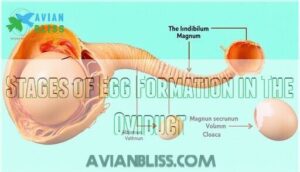
Every stage in the oviduct has a specific job—starting as the infundibulum grabs the egg, and the magnum pours on albumen secretion. Roll through the isthmus for membrane deposition, swing by the uterus for shell gland hardening, and wave at cuticle formation and pigmentation process.
Here’s a cheat sheet:
| Stage | Function |
|---|---|
| Infundibulum | Captures egg |
| Magnum | Albumen secretion |
| Isthmus | Membrane deposition |
| Uterus | Shell gland, pigmentation |
| Vagina | Cuticle formation |
Common Irregularities in Egg Formation

Shell imperfections, double yolks, or even yolkless eggs can all show up during egg production and formation, each with its own root in the reproductive biology of birds. If you spot soft shells, or signs of egg binding, take action quickly—these aren’t just oddities, but clear signals something might be amiss in a hen’s ovary or wider egg-laying process.
Comparison of Ovaries in Vertebrates
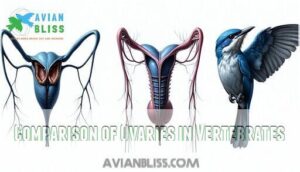
When you look at vertebrates, you’ll find that reproductive anatomy isn’t a one-size-fits-all arrangement. Mammals, reptiles, amphibians, and fish usually have paired ovaries, but birds break the pattern.
Noticing these differences lets you see what sets birds apart—and helps you take better care of their unique needs.
Mammals and Their Paired Ovaries
After exploring how eggs form in a female chicken’s oviduct, let’s look at you—well, mammals. Unlike birds, you’ve got two working ovaries. Mammalian reproduction relies on paired ovaries for continual egg release, steady ovarian hormones, and placental development. The dual ovary design helps with gestation periods and lactation.
Let’s lay it out side by side:
| Feature | Mammals | Birds |
|---|---|---|
| Number of Ovaries | Two | One |
| Ovarian Hormones | Estrogen/Prog. | Estrogen/Prog. |
| Placenta Present | Yes | No |
Reptile, Amphibian, and Fish Ovarian Anatomy
While mammals double up on ovaries, reptiles, amphibians, and fish share a different approach in reproductive anatomy. Reptile Oogenesis generally features paired ovaries, amphibian follicles show variety, and fish egg-laying ranges widely—talk about Ovarian Diversity! Take a look:
| Group | Ovary Traits |
|---|---|
| Reptiles | Usually paired |
| Amphibians | Highly variable |
| Fish | Often paired |
Each system is suited to unique reproductive needs.
Unique Features of Avian Reproduction
Bird biology’s big twist? Your feathered friends often break the mold, with just one ovary, unique clutch size, and even wild sperm storage tricks. Some species flip gender roles—think reversed sex roles—while hormones drive egg variability. Ornithology reveals that avian anatomy and reproductive systems set birds apart. Here’s a quick glance:
| Unique Feature | Real-World Impact |
|---|---|
| Sperm storage | Boosts reproductive odds |
| Reversed sex roles | Males incubate eggs |
| Egg variability | Survival flexibility |
Research and Discoveries in Avian Reproduction
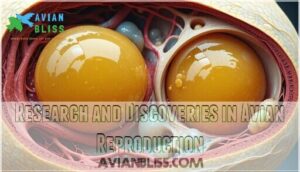
You’ll find that research into avian reproduction helps you understand why birds almost always have just one functional ovary and how this trait offers survival advantages.
Recent scientific discoveries clarify how these adaptations influence everything from egg development to the overall health of modern bird populations.
Fossil Evidence of Bird Reproductive Evolution
Dig into avian ancestry, and you’ll find paleontology offers clues about reproductive biology few textbooks cover. Fossilized Eggs and Ancient Ovaries turn up in Early Cretaceous fossils, spotlighting the one-ovary setup long before modern birds.
These reproductive fossils, echoing egg-laying habits of their dinosaur relatives, help us trace eggshell evolution and ovary adaptation through millions of years of evolutionary fine-tuning. Fossil discoveries reveal preserved avian eggs inside bird bodies.
Studies on Modern Bird Reproductive Systems
You might think fossils tell the whole story, but modern science sheds real light on how birds handle their reproductive business. Researchers peek under the feathers, using Hormone Receptor Studies and Sperm Storage Research to uncover how Avian Pair Bonds and Reproductive Strategies are shaped by Genetic Influences.
Learning about ovary function in chickens helps fine-tune Avian Reproductive Health and Reproductive Biology.
Advances in Understanding Egg Formation
Every now and then, research brings fresh insight into egg formation and structure. Here’s what’s new and interesting:
- Carefully tuned Oviduct secretions foster key albumen synthesis. – Advances in shell mineralization explain stronger, safer eggs.
- Studies pinpoint cuticle formation’s role in microbial defense. – Yolk deposition now better understood for healthier offspring.
- Exploring Ovary and oviduct teamwork boosts reproductive biology knowledge.
Frequently Asked Questions (FAQs)
How many ovaries are present in birds?
Around 95% of female birds have just one working ovary on their left side—think of it as Mother Nature’s way of lightening the load for flight.
It’s efficient, though a few raptors retain two.
How many ovaries does a female chicken have?
A female chicken’s got just one working ovary, usually on her left side. The right one’s pretty much sidelined, doing nothing.
It’s nature’s way of keeping hens light for flight, even if they rarely take off.
Why do chickens have one ovary?
Did you know over 95% of bird species rock just one working ovary? You get this nifty design because it lightens your load for better flight.
Less weight means safer escapes from hungry predators mid-air!
How many ovaries do animals have?
Most animals are equipped with two ovaries, one on each side, working as nature’s factory for eggs.
Of course, there are quirky exceptions in the animal kingdom, but the two-ovary setup is the usual blueprint.
Why did birds evolve to have only one ovary?
Carrying just one ovary helps birds cut weight for flight—a bit like ditching excess baggage before takeoff.
With less mass, birds are more agile and energy efficient, which gives them a survival edge.
How does having one ovary affect bird flight capabilities?
Imagine flying fast and soaring for miles, while dodging branches along the way. Having only one ovary means you’ve got less weight to carry.
This evolutionary shortcut reduces drag and helps you conserve energy, making every flight smoother.
Are there any modern birds with two functional ovaries?
If you’re curious, almost all modern birds get by with just one working ovary. However, a few raptor species can surprise you, sometimes keeping both ovaries active—a rare exception to the usual avian rule.
How do bird ovaries differ from dinosaur ovaries?
If you ever wondered if bird ovaries run Windows 95, here’s the scoop: birds usually have one active ovary for lighter flight, while dinosaurs had two, making birds more aerodynamic and ready for takeoff.
Can birds with one ovary produce as many eggs?
You’d think one ovary would hold birds back, but nope—they can still lay just as many eggs as those with two.
It’s all about efficiency: with enough nutrients and hormones, the left ovary steps up.
Can birds regenerate lost or damaged ovaries?
Just like a car can’t regrow a flat tire, birds can’t regenerate a lost or damaged ovary. Once it’s gone, the remaining ovary does all the heavy lifting, so avian reproductive potential stays limited.
Conclusion
Regarding birds, there’s more than meets the eye. You might be surprised to learn that the answer to "how many ovaries do birds have" is usually just one—and that’s no accident. Evolution made their design simpler so they could take flight efficiently, leaving only the left ovary functional in most species.
This adaptation highlights how birds stand apart from mammals, making their unique biology both fascinating and essential for understanding avian health.