This site is supported by our readers. We may earn a commission, at no cost to you, if you purchase through links.

Watch a flock of green-winged teal drop into a marsh at dawn and you’ll understand why veteran birders stop mid-stride. These are North America’s smallest dabbling ducks, yet they move with a speed and precision that outpaces birds twice their size—banking in tight spirals, wings nearly touching, before settling onto the water like a single coordinated unit.
That compact 31–39 cm frame hides a surprising amount of biological efficiency. From the iridescent emerald stripe on the drake’s chestnut head to foraging strategies refined across thousands of migration miles, the green-winged teal rewards closer attention at every level.
Table Of Contents
- Key Takeaways
- Green-winged Teal Identification and Features
- Habitat and Geographic Distribution
- Diet and Foraging Behavior
- Breeding and Life Cycle
- Conservation Status and Notable Facts
- Frequently Asked Questions (FAQs)
- What is the difference between a teal and a green-winged teal?
- Where do green winged teals live?
- Are green wing teal puddle ducks?
- What is the difference between green-winged teal and common teal?
- Where can I find green-winged teal?
- How fast do green-winged teals fly?
- What type of nest does a green-winged teal have?
- Can Green Winged Teals be kept as pets safely?
- How do Green Winged Teals adapt to changing weather?
- Can Green Winged Teals interbreed with other duck species?
- Conclusion
Key Takeaways
- green-winged teal is North America’s smallest dabbling duck, yet it flies at up to 60 mph and navigates all four major flyways—making it one of the continent’s most agile and wide-ranging waterfowl.
- Its diet is roughly 80–90% plant-based seeds, but it shifts strategically to invertebrates during breeding season to fuel egg production and duckling growth.
- Despite a 15% short-term dip in 2024, its global population sits around 6.7 million and holds an IUCN “Least Concern” rating—though wetland loss from climate change threatens to shrink viable habitat by up to 90%.
- female handles nesting, incubation, and brood-rearing entirely alone, with ducklings swimming and foraging within hours of hatching and reaching full fledged in just 34 days.
Green-winged Teal Identification and Features
Getting to know the Green-winged Teal starts with knowing what to look for. It’s a small duck, but it’s packed with surprisingly sharp details that make it easy to spot once you know them.
Once you know what to look for, resources like this Green-winged Teal field identification guide make spotting those crisp markings even faster in the field.
Here’s a closer look at the key features that’ll help you identify one in the field.
Size, Shape, and Measurements

- Length: Body length range of 31–39 cm
- Wingspan: Wing span variability from 52–59 cm
- Weight: Weight distribution of 140–500 g
- Bill: Narrow bill proportions with a distinctive tail light indicator
The species is recognized by its dark green wing speculum, which is visible when the wings are extended.
Male and Female Plumage Differences

Once you’ve clocked the size, plumage tells the rest of the story.
Males are hard to miss — a cinnamon-red head with iridescent Head Stripe Iridescence running green from eye to nape, buff breast with fine Breast Spotting Contrast, and crisp Tail Light Patterns flanking the rump.
Females stay muted brown, with softer Tertial Edge Color, a cleaner Wing Speculum Edge, and no bold markings.
The accompanying illustration is a public domain image.
Distinctive Markings and Coloration
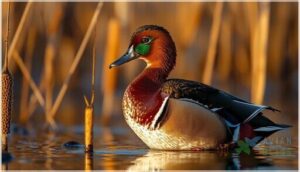
Beyond size and plumage, the details really reward a closer look.
That bright green eye patch on the male — showing Head Patch Iridescence that shifts metallic blue in certain light — sits bold against chestnut.
A vertical white stripe marks the breast, while Tail Light Patterns flank the rump. The green wing patch and speculum border colors, plus bare part pigmentation, finish the picture.
Comparison to Similar Duck Species

Once you’ve got the markings down, putting the American Teal next to similar species really sharpens your eye for duck species identification.
- Bill Shape Differences: Green-winged teal have shorter, narrower bills than blue-winged or cinnamon teals
- Wing Morphology Variation: Eurasian teal shows a white speculum border; American birds show buff
- Flight Formation Patterns: Green-winged flocks twist tightly — mallards fly slower, more loosely
- Vocalization Contrasts: Males whistle thinly, unlike the deeper quacks of mallards
- Winter Flock Sizes: They can number thousands at rich feeding sites
Habitat and Geographic Distribution

Green-winged Teal aren’t picky travelers, but they do have clear preferences for where they settle, breed, and wait out the winter. Knowing spotting them makes spotting them a lot easier in the field.
Once you know their favorite haunts—shallow wetlands, prairie potholes, and marshy edges—these tips on identifying birds during migration season can sharpen your eye even further.
Here’s a closer look at the key habitats and regions that define their range.
Preferred Wetland and Aquatic Habitats
Shallow Water Depths tell you everything about where these birds feel at home. Green-winged teal thrive in shallow freshwater wetlands, favoring water just 4–12 inches deep — perfect for their tip-up dabbling style.
| Habitat Type | Key Feature |
|---|---|
| Emergent Vegetation Cover | Cattails, bulrushes for shelter |
| Winter Aquatic Zones | Coastal salt marshes, playa lakes |
| Migration Stopover Wetlands | Mudflat Foraging Areas with exposed seeds |
These wetland ecosystem specialists won’t waste energy on deep open water.
Regional Range in North America
From Alaska’s tundra deltas to Gulf Coast marshes, the Green-winged Teal covers an impressive sweep of North America. Alaska Breeding Deltas and Prairie Pothole Hotspots in Saskatchewan drive the highest Population Density Gradients.
Come winter, Southern Winter Refuges stretch from the Pacific Coast to the Caribbean.
All four Flyway Convergence Zones funnel these birds across the Rocky Mountains and beyond.
Breeding and Nesting Locations
Regarding nesting, Green-winged Teal are surprisingly selective. They tuck ground nests beneath dense sedge cover, brush thicket sites, or low shrubs—always within about 200 feet of water.
Pothole marshes and restored prairie basins are prime breeding habitat, while agricultural field edges work too, provided grassy buffers stay intact.
Their nesting behavior favors dry, hidden spots that predators simply won’t bother checking.
Migration Patterns and Wintering Areas
Green-winged teal doesn’t pick just one flyway—they use all four across North America.
Fall migration starts as early as September, with birds covering several thousand kilometers southward to Gulf Coast and Pacific marshes.
Spring arrival peaks in late March through May.
Molt stopovers add interesting detours mid-journey.
Vagrant records even show up in Europe and northern South America, proving these compact travelers go surprisingly far.
Diet and Foraging Behavior
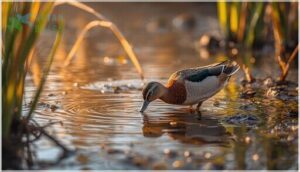
What a green-winged teal eats — and how it finds food — tells you a lot about why it thrives in the wetlands it calls home. These small ducks are surprisingly strategic foragers, and their diet shifts with the seasons in ways worth understanding.
Here’s a closer look at what fuels them throughout the year.
Primary Food Sources
What’s on the menu for one of North America’s smallest dabbling ducks? Mostly seeds — plant material makes up 80 to 90 percent of their diet.
Their Wetland Seed Preferences lean toward sedges, pondweeds, and smartweeds, while Crop Field Grains like waste rice and corn supplement the diet seasonally.
Invertebrate Protein Sources, Spring Invertebrate Surge nutrients, and Vegetative Plant Parts round things out:
- Seeds of sedges and pondweeds dominate aquatic diet
- Agricultural grains fuel long migrations efficiently
- Aquatic insects and invertebrates supply critical protein
Feeding Techniques and Habits
These ducks don’t just eat — they work for every bite. Their feeding behavior blends dabbling, upending, surface pecking, and mud filtering into an efficient daily rhythm.
They tip forward in shallow water, skim floating plant material and aquatic insects, and sieve wet mud with specialized bill lamellae.
Social foraging adds another layer — group foraging techniques let some birds watch for predators while others feed.
Seasonal Dietary Changes
Their diet shifts with the calendar. Spring Seed Reliance defines migration stopovers, where sedges and smartweeds fuel the journey north.
Come summer, a Breeding Invertebrate Surge kicks in — insects and crustaceans power egg production and duckling growth.
Autumn Fat Accumulation draws teal to flooded fields and dense seed beds.
Winter Grain Utilization takes over, with waste rice sustaining flocks through cold months.
Ecological Role in Wetland Ecosystems
Beyond just fueling their seasonal migration, what teal eat shapes entire wetland ecosystems. Through Seed Dispersal, they carry aquatic plant seeds between ponds, stitching isolated marshes into a network of Wetland Connectivity.
Their droppings drive Nutrient Cycling, fertilizing shorelines and algae. By grazing aquatic plants and invertebrates, they manage Vegetation and anchor Food Web Links across the habitat.
Breeding and Life Cycle
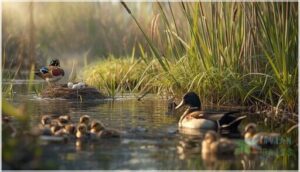
The breeding season is one of the most active and fascinating stretches in a Green-winged Teal’s year. From courtship rituals to raising ducklings, each stage follows a tight, well-paced timeline that shapes the future offspring.
Here’s what that process actually looks like, step by step.
Courtship Displays and Pair Formation
Regarding breeding behavior, Green-winged Teals put on quite a show.
Males perform Head Pumping and Bill Shaking rituals on open water, with up to 25 rivals competing for one female simultaneously.
Breast Slapping signals serious mating intent, while Courtship Flights send green wing patches flashing overhead.
Throughout, courtship vocalizations, bird communication, and mating rituals seal pair bonds, with Mate Guarding keeping rivals at bay.
Nest Construction and Egg Laying
Once paired, the female takes full charge of Nest Site Selection, choosing dry upland ground tucked into dense grass — prioritizing Predator Avoidance over convenience. She scratches a shallow Nest Bowl Architecture into the soil, weaving in grasses and sedges, then adds a Feather Down Lining after the last egg drops.
Egg Clutch Size usually runs 6–9 creamy white eggs, laid one daily.
Incubation and Duckling Development
Once the last egg drops, the female begins full incubation — holding steady at 99 to 100°F for about three weeks to hatch the clutch.
Egg Synchrony means all ducklings emerge together despite staggered laying.
She manages Female Nest Defense alone, rarely leaving the nest.
Precocial Duckling Behavior kicks in fast: hatchlings swim and forage within hours.
Rapid Growth Milestones follow, with fledging around 34 days.
Parental Care and Fledging Process
From the moment her ducklings hatch, the female green-winged teal shifts into full protective mode. Nighttime Brooding keeps chicks warm during cold snaps for the first two weeks.
Duckling Mobility is impressive — they swim and forage within hours. Her Maternal Guidance leads them to water within a day.
Predator Defense includes distraction displays and vocal alarms. The Fledging Timeline wraps up around 34 days.
Conservation Status and Notable Facts
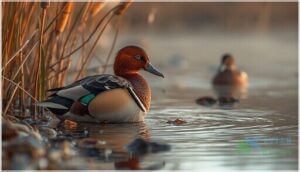
The green-winged teal is doing surprisingly well for a wild bird in a changing world—but that doesn’t mean there’s nothing worth paying attention to. Understanding where it stands conservation-wise, and what makes it genuinely fascinating, gives you a fuller picture of this small duck.
Here’s what you should know.
Population Trends and IUCN Listing
The green-winged teal’s conservation story is genuinely encouraging. Its IUCN Status sits at Least Concern, backed by Global Population Estimates of roughly 6.7 million breeding birds worldwide. Long-Term Growth since 1966 confirms this isn’t luck — it’s a species holding its ground.
- Continental Conservation Scores rate it just 8/20, signaling low concern
- Short-Term Fluctuations showed a 15% dip in 2024, yet numbers remain 16% above the long-term average
- Regional IUCN Assessments across North America and Europe reflect consistent Population Stability
Conservation Efforts and Habitat Protection
Protecting the green-winged teal takes a whole team effort.
Wetland Restoration Projects, led by Ducks Unlimited, rebuild prairie potholes and coastal marshes critical for nesting and wintering birds.
Protected Area Management along major flyways keeps shallow wetlands intact, while Policy Coordination through the North American Waterfowl Management Plan aligns Canada, the U.S., and Mexico.
Working Lands Partnerships and Monitoring Adaptive Management guarantee these Avian Conservation Efforts stay effective long-term.
Impacts of Environmental Change
Climate change is quietly reshaping life for the green-winged teal in ways that compound fast. Wetland Loss in prairie regions shrinks suitable habitat by up to 90%, while Breeding Timing Shifts push nesting earlier — exposing ducklings to deadly cold snaps. Migration Phenology Change and Microplastic Ingestion add further pressure.
Climate change is silently shrinking green-winged teal habitat by up to 90%, while earlier nesting exposes ducklings to deadly cold
- Extreme Weather Risk concentrates birds in just 10% of remaining wetlands
- Warmer springs create dangerous mismatches with insect hatches and food availability
- Artificial wetlands expose teal to twice the microplastic contamination of natural sites
Interesting Facts About Green-winged Teal
Few ducks pack so much into such a small frame. As the smallest North American duck, the green-winged teal displays striking sexual dimorphism, with males cycling through dramatic molt timing shifts each fall.
Their high-pitched Call Patterns help flocks coordinate tight aerial maneuvers — key predator avoidance tactics. Hybridization Events and population genetics studies keep revealing surprises about this species’ impressive adaptability.
Frequently Asked Questions (FAQs)
What is the difference between a teal and a green-winged teal?
Teal” covers several dabbling duck species worldwide.
The green-winged teal is North America’s smallest, identified by its chestnut head, green ear patch, and distinctive vertical white breast bar — traits no other teal shares.
Where do green winged teals live?
You’ll find these small ducks across North America—from Aleutian Breeding Islands to Texas Playa Lakes.
They favor shallow ponds, Great Lakes Marshes, and Prairie Pothole Stopovers, thriving wherever wetland bird habitats offer dense vegetation and Coastal Brackish Ponds nearby.
Are green wing teal puddle ducks?
Yes, absolutely. Green-winged teal are classic puddle ducks. They dabble in shallow ponds and flooded ground, tip-up feeding in water under 12 inches, and launch skyward instantly — textbook Puddle Duck Criteria.
What is the difference between green-winged teal and common teal?
The main differences lie in stripe patterns, head iridescence variation, and vocalization differences.
Males show distinct plumage contrasts, while wintering range overlap and rare hybridization zones make careful field observation essential for accurate identification.
Where can I find green-winged teal?
You’ll spot them in wetlands, coastal marshes, and flooded fields across North America — from Alaskan coastal flats and prairie marsh hotspots to wintering Gulf Coast bayous and Mexican mangrove refuges during migration.
How fast do green-winged teals fly?
Green-winged teals hit maximum flight speeds of 60 mph, cruising comfortably around 50 mph. Their rapid takeoff acceleration and high wingbeat frequency make them remarkably agile fliers among North American dabbling ducks.
What type of nest does a green-winged teal have?
The female scrapes a shallow depression into the ground, creating a ground bowl lined with grasses and down. Camouflaged grass and vegetation cover hide it, always within close water proximity.
Can Green Winged Teals be kept as pets safely?
No, you can’t keep them safely. The Migratory Bird Treaty Act bans private ownership without legal permits.
Captivity causes serious stress, nutritional deficiencies, and health risks — these birds belong in the wild.
How do Green Winged Teals adapt to changing weather?
Their thermal plumage and heat exchange system lock in warmth, while flock huddling, storm sheltering, and sharp migration timing help them ride seasonal variations and climate change impacts with surprising ease.
Can Green Winged Teals interbreed with other duck species?
Yes, dabbling ducks can hybridize across species. Overlapping Ranges and Size Barriers shape Hybridization Cases, affecting Genetic Compatibility and Hybrid Identification.
Duck subspecies and hybridization—including Eurasian Green-winged Teal populations—offer fascinating challenges for species identification.
Conclusion
You could spend a lifetime watching wetlands and still catch the green-winged teal doing something that stops you cold. That’s not an exaggeration—it’s what this bird does.
Compact in size but enormous in ecological impact, it seeds wetlands, filters water, and signals habitat health with every migration cycle.
Once you learn to recognize its markings and rhythms, you won’t scan a marsh the same way again.
Some birds teach you patience. This one rewards it.
- https://www.buckeyehunterhub.com/post/understanding-the-green-winged-teal-habitat
- https://swibirds.org/fff/2019/7/5/green-winged-teal
- https://www.audubon.org/field-guide/bird/green-winged-teal
- https://www.sibleyguides.com/2011/03/distinguishing-green-winged-and-common-teal/
- https://www.iucnredlist.org/species/pdf/181562690