This site is supported by our readers. We may earn a commission, at no cost to you, if you purchase through links.
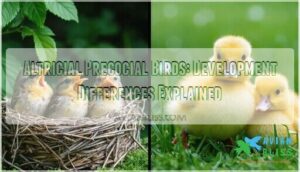 When you’re observing altricial precocial birds, you’ll spot two completely different survival strategies. Altricial birds like robins hatch helpless, blind, and naked, requiring weeks of intensive parental feeding and care. They’re basically feathered potatoes that can’t do much except open their mouths and beg.
Precocial birds like ducks and chickens emerge ready to rock—eyes open, fluffy down feathers intact, walking and pecking at food within hours. It’s like comparing a newborn human to a baby deer that’s up and running immediately.
Why such different strategies? It comes down to brain development timing versus immediate survival needs. This split creates wildly different parenting styles and ways of dodging predators.
Table Of Contents
- Key Takeaways
- What Are Altricial and Precocial Birds?
- Physical Development and Hatching Differences
- Parental Care and Behavioral Patterns
- Brain Development and Cognitive Abilities
- Examples and Evolutionary Advantages
- Frequently Asked Questions (FAQs)
- What is altricial or precocial bird?
- Are humans altricial or precocial?
- Are all songbirds altricial?
- What are the key differences between altricial and precocial birds?
- Why do some bird species hatch helpless, while others are independent?
- What are the evolutionary advantages of each strategy?
- How do climate changes affect development patterns?
- Conclusion
Key Takeaways
- You’ll spot two completely different hatching strategies – altricial birds emerge helpless and naked, requiring weeks of intensive parental care, while precocial birds hatch ready to walk, swim, and forage within hours.
- Brain development timing creates opposite approaches – altricial species invest in rapid post-hatching neural growth for enhanced learning capacity, whereas precocial birds complete most brain development before hatching for immediate survival skills.
- Parental investment varies dramatically between types – you’ll notice altricial birds like robins need constant feeding and protection in nests, while precocial species like ducks require mainly guidance as chicks find their own food.
- Each strategy offers distinct evolutionary advantages – altricial development enables complex behaviors and intelligence through extended care, while precocial birds prioritize early mobility and independence to reduce predation vulnerability.
What Are Altricial and Precocial Birds?
When you observe baby birds in the field, you’ll notice they fall into two distinct development categories: altricial and precocial species.
Some baby birds hatch completely helpless—eyes shut tight, barely any feathers to speak of—and need their parents for everything.
Others pop out of the shell already walking around with bright eyes and fluffy down, ready to start finding their own food almost immediately.
Defining Altricial Development in Birds
Finding baby birds can be tricky. Altricial development is key to figuring out what they need. These birds hatch completely helpless and depend on their parents for everything during the nestling stage. They show complete altricial dependence – they can’t survive without mom and dad.
Here’s what makes altricial birds different:
- They’re born blind with barely any feathers
- Parents must feed them constantly and keep them warm
- They stay in the nest for weeks while developing
This altricial pattern is just one side of the precocial and altricial differences you’ll see in bird species.
Understanding Precocial Bird Characteristics
Precocial birds enter the world ready for action. These nidifugous species hatch with open eyes, dense down coverage, and immediate mobility. Within hours, they’re walking, swimming, and following parents through their chosen habitat.
| Characteristic | Precocial Development | Early Capabilities |
|---|---|---|
| Eyes & Vision | Open at hatching | Full visual awareness |
| Down Coverage | Dense, insulating | Thermoregulation ready |
| Mobility | Walk/swim immediately | Predator avoidance active |
| Social Behavior | Follow parents closely | Imprinting begins quickly |
You can spot the divide between altricial and precocial birds by watching how they tackle habitat choices and staying alive.
Those ready-to-go precocial chicks? They’re already pecking at seeds and nabbing insects on their own, which perfectly matches their hit-the-ground-running approach to life.
Semi-Altricial and Semi-Precocial Categories
Between strict classifications, you’ll find semiprecocial and semialtricial birds that blur the lines. These hybrid development patterns showcase intermediate strategies where chicks exhibit mixed traits.
Seagulls and raptors demonstrate semiprecocial characteristics—hatching with open eyes and down but remaining nest-bound.
Take herons as a prime example of semialtricial species. They’ve figured out how to get the best of both worlds, which explains why scientists sometimes struggle to pin down exactly where they fit. This flexibility actually makes perfect sense when you consider the different survival challenges birds have faced over millions of years.
Physical Development and Hatching Differences
When you observe newly hatched birds, you’ll notice striking physical differences that reveal their developmental strategies. Altricial chicks emerge naked with closed eyes and minimal down feathers, while precocial hatchlings appear fully covered in dense down with open eyes and functional mobility.
Feather Development and Down Coverage
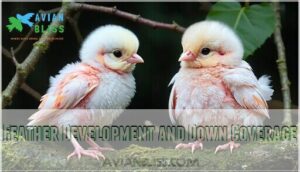
You’ll notice striking differences when comparing down density between altricial and precocial birds at hatching. Altricial birds emerge with sparse down cover, requiring extensive parental thermoregulation for survival. Precocial birds hatch with dense, well-developed down providing enhanced insulation properties.
Pin feathers appear as juvenile plumage development begins, marking distinct plumage stages in both bird types.
Eye Opening and Sensory Capabilities
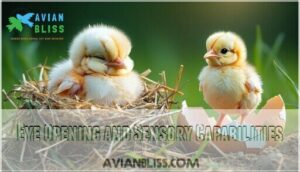
When altricial birds hatch, their eyes remain sealed shut for days or weeks, limiting vision development initially. In contrast, precocial birds emerge with eyes open, enabling immediate environmental adaptation through heightened auditory perception and sensory integration.
This stems from how different bird species develop. Precocial chicks come equipped with advanced smell-processing abilities right from day one, while altricial species take their time with sensory development and start life with more compact brains.
Body Size and Mobility at Hatching
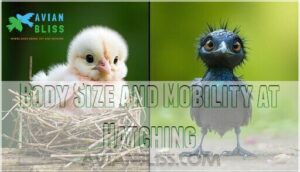
You’ll notice striking size differences between newly hatched birds. Precocial birds emerge larger and more sturdy, with well-developed leg muscles enabling immediate locomotion. Their skeletal maturity allows walking and swimming within hours.
Altricial birds hatch considerably smaller with underdeveloped limbs. Their wing development remains minimal, restricting movement to helpless shuffling.
Early locomotion depends entirely on developmental strategy—precocial hatchlings demonstrate considerable mobility while altricial species rely completely on parents.
Juvenile Plumage Formation Timeline
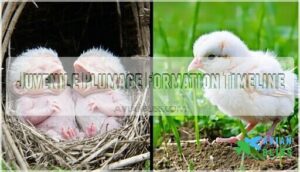
You’ll notice timing differences when juvenile plumage develops. Altricial birds start growing pin feathers around day six after hatching, while precocial birds begin this molting process immediately. Down cover gets replaced at different rates too.
Plumage growth rate varies by species, with environmental influence affecting feather composition. Seasonal variations also impact when birds develop their first true feathers.
Understanding molting strategies is essential for identifying bird species and determining their age.
Parental Care and Behavioral Patterns

When you compare altricial and precocial birds, you’ll notice striking differences in their parental care needs and behaviors. Altricial chicks require constant feeding, warmth, and protection from parents while staying in the nest.
Precocial youngsters, on the other hand, can walk, swim, and find food within hours of hatching, though they still follow parents for guidance and safety.
Feeding Dependencies and Strategies
Examining feeding strategies reveals stark differences between bird types. Altricial birds depend entirely on parental food provision, receiving frequent meals through intensive parental care. Their nutritional needs require constant attention as parents deliver specific diet compositions.
Meanwhile, precocial birds demonstrate early foraging skill development, finding food independently while parents guide their avian feeding habits and help hone their techniques.
Nest-Leaving Timeline and Independence
When you’re watching birds, you’ll notice timing separates altricial from precocial species dramatically. Altricial birds remain nidicolous, staying in nests for weeks developing survival skills before fledging. Precocial birds are nidifugous, departing within hours with developed mobility. This nest departure age reflects different weaning timeline strategies.
- Altricial birds: 10-35 days nest-bound before fledging begins
- Precocial birds: Leave within 1-2 days, following parents immediately
- Post-fledging care: Altricial species need weeks of continued feeding
- Fledgling independence: Precocial chicks forage sooner, requiring less parental investment
- Survival skills: Developed through extended nest time versus early field experience
Imprinting and Parent-Following Behaviors
Within hours of hatching, precocial chicks develop imprinting behaviors that bind them to their parents. This critical period creates species recognition and early socialization patterns.
Altricial precocial birds show different behavioral plasticity during these formative moments. Parental care guides chick behavior through cognitive mapping processes, while parental roles in birds determine how offspring learn essential survival skills.
Protection and Learning From Parents
Both altricial and precocial birds rely on parental defense mechanisms to survive their vulnerable early stages. You’ll observe different protective strategies as parents shield their young from predators and environmental threats.
- Parental defense – Adults use distraction displays, alarm calls, and aggressive behaviors to protect chicks
- Supervised learning – Parents demonstrate foraging skills and safe navigation techniques through direct modeling
- Socialization cues – Chicks learn species-specific behaviors through imprinting mechanisms and social interactions
- Parental care patterns vary between altricial birds requiring intensive feeding versus precocial birds needing guidance while self-feeding
Brain Development and Cognitive Abilities

You’ll discover that altricial and precocial birds show striking differences in how their brains develop and when they gain cognitive abilities.
While altricial species experience most brain growth after hatching, precocial birds develop sophisticated neural networks before they even break out of their shells.
Telencephalon Maturation Differences
Brain development patterns show striking differences between bird types. Altricial birds experience delayed telencephalon maturation, meaning their brain’s thinking center develops after hatching. Precocial birds, on the other hand, mature this region before hatching, giving them sophisticated cognitive abilities from birth.
| Development Aspect | Altricial Birds | Precocial Birds |
|---|---|---|
| Brain Plasticity | High post-hatch | Lower, pre-established |
| Environmental Influence | Shapes neural growth | Limited impact on structure |
| Evolutionary Significance | Flexible learning | Immediate survival skills |
When brain development happens at different times, it shapes how each group tackles survival in completely different ways.
Pre-Hatching Vs Post-Hatching Neurogenesis
You’ll notice a striking difference in neurogenesis timeline between these bird types. Precocial species complete most neuron maturation during egg development, while altricial birds rely heavily on post-hatching neurogenesis.
This timing creates different cognitive impacts – precocial chicks hatch with functional brains ready for immediate environmental challenges, whereas altricial species use extended post-hatching brain development for enhanced learning capacity and adaptability. This is reflected in the fact that retinal maturation differs between the two bird types.
Cognitive Development Timing Variations
Altricial birds show delayed cognitive plasticity, with neurogenesis timeline extending well past hatching. Their brain size increases dramatically during nest life.
Precocial birds complete sensory development before hatching, achieving cognitive milestones earlier. Early learning windows differ markedly between groups.
Evolutionary adaptations in birds reflect these timing variations, with altricial species investing energy in post-hatch brain growth while precocial birds prioritize immediate cognitive functionality for survival.
Learning Capacity at Different Stages
Young birds show different learning abilities depending on where they are in development. Precocial species pick up skills quickly and adapt to their environment through early social learning and variations in imprinting.
Altricial birds build cognitive flexibility over time, learning complex behaviors through extended guidance from their parents.
Both strategies make sense when you consider what each species needs to survive and how much time they have to develop.
Examples and Evolutionary Advantages
You’ll recognize altricial birds like robins and sparrows, which hatch helpless and rely entirely on parents, while precocial species such as ducks and chickens emerge ready to walk and feed themselves.
These contrasting strategies reflect different evolutionary approaches, where altricial birds invest energy in rapid brain growth after hatching, and precocial birds prioritize immediate survival skills that reduce parental care demands.
Common Altricial Bird Species
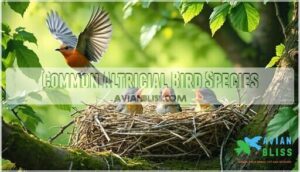
You’ll find altricial birds everywhere, from backyard robins to forest-dwelling woodpeckers. Passerine birds make up the largest group, including sparrows, cardinals, and finches. These nestlings depend entirely on parents for Songbird Diets consisting of insects and seeds.
Swallow Habitats span urban areas where these aerial hunters catch insects mid-flight. Woodpecker Care involves feeding larvae to young in tree cavities. Hummingbird Needs include nectar feeding every 10-20 minutes.
These avian offspring remain helpless fledglings until fully feathered.
Typical Precocial Bird Examples

Observing precocial birds reveals striking adaptations. Wood Ducks and mallards demonstrate classic Duckling Development, swimming within hours. Shorebird Behavior shows Piping Plovers running across beaches immediately after hatching. Quail Ecology includes Ruffed Grouse chicks foraging independently.
Chicken Breeds exhibit typical precocial traits, while megapodes represent superprecocial development, requiring no parental care.
These Precocial birds showcase nature’s efficiency through early mobility and self-sufficiency.
Habitat and Nesting Strategy Adaptations
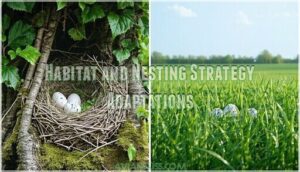
Where these birds set up shop reveals everything about their survival tactics. Altricial and precocial species have completely different approaches to nesting that match their chicks’ needs.
Altricial birds go for maximum security—think hidden tree cavities and thick shrubs where predators can’t easily spot their helpless young. Precocial species take the opposite approach, choosing open ground where their mobile chicks can make quick getaways if danger appears.
Clutch sizes tell another part of the story. Birds balance how many eggs they can realistically protect against how much energy they can invest in each offspring. Even nest coloring plays a role, with birds choosing spots that blend seamlessly into their surroundings.
All these choices add up to real differences in survival rates depending on where birds call home.
Survival Trade-offs and Evolutionary Benefits

Each evolutionary tradeoff shapes survival strategies. Altricial species invest heavily in parental care, reducing reproductive success but enhancing growth rate through focused resource allocation. Precocial birds face greater predation vulnerability yet achieve independence faster under environmental pressures.
| Development Type | Advantage | Cost |
|---|---|---|
| Altricial | Protected growth | Extended vulnerability |
| Precocial | Early mobility | High energy demands |
| Both strategies | Adapted survival | Food availability dependence |
Frequently Asked Questions (FAQs)
What is altricial or precocial bird?
You’ll encounter two distinct bird categories based on their development at hatching. Altricial birds hatch helpless, requiring parental care in nests. Precocial birds emerge ready to walk and forage immediately.
When baby birds hatch, they fall into two camps. Some arrive completely helpless – these altricial species can’t even lift their heads, let alone leave the nest. Their parents become round-the-clock caregivers.
Others hit the ground running as precocial birds, already equipped to walk around and find their own food within hours.
You’ll easily spot ducks waddling with their ducklings near ponds. These chicks hatch with open eyes, fluffy down feathers, and can swim within hours.
Chickens, geese, and quail are also classic examples.
Are humans altricial or precocial?
You’re definitely altricial. Humans are altricial and require extensive parental care for their development.
You can’t walk, talk, or feed yourself when you’re born—that’s classic altricial behavior requiring years of dependence on parents.
Are all songbirds altricial?
You’ll find that most songbirds are indeed altricial, hatching helpless with closed eyes and requiring extensive parental care. However, a few exceptions exist within certain songbird families.
What are the key differences between altricial and precocial birds?
You’ll notice something fascinating: altricial birds hatch helpless, naked, and blind, requiring extensive parental care in nests.
Precocial birds emerge ready-to-go, feathered, mobile, and capable of finding food independently within hours.
Why do some bird species hatch helpless, while others are independent?
You’ll observe different hatching strategies reflect evolutionary trade-offs. Some species invest energy in extended parental care, while others prioritize immediate independence for survival advantages in their specific environments.
Different species have found their own ways to balance the parenting equation. Some put everything into caring for their young, while others send their offspring into the world ready to fend for themselves from day one.
It’s all about what works best in their particular corner of the world.
Feather formation follows fundamentally different pathways. Altricial chicks hatch nearly naked, then grow downy patches before developing juvenile plumage in the nest.
Precocial birds emerge with dense, fluffy down covering their entire bodies, ready for immediate mobility and thermoregulation.
What are the evolutionary advantages of each strategy?
You’ll discover that altricial species invest energy in rapid post-hatching growth, enabling complex behaviors and intelligence. Precocial birds prioritize immediate survival through early mobility and self-sufficiency.
Altricial species take a different approach – they channel energy into rapid growth after hatching, which builds the foundation for complex behaviors and higher intelligence.
Precocial birds, on the other hand, focus on immediate survival by developing early mobility and the ability to fend for themselves right away.
You’ll find nature isn’t black and white. Semi-precocial and semi-altricial birds exist between these extremes. Hawks, owls, gulls, and terns display intermediate characteristics, combining traits from both developmental strategies.
How do climate changes affect development patterns?
Climate warming shifts your breeding schedule earlier, altering when you lay eggs and how long your season lasts. Temperature fluctuations affect food availability, migration timing, and even body sizes.
Conclusion
Like nature’s split personality disorder, altricial precocial birds showcase evolution’s contrasting blueprints for survival. You’ve seen how altricial species trade immediate independence for enhanced brain development, while precocial birds prioritize instant mobility over prolonged cognitive growth.
Evolution solved the same survival puzzle with two radically different blueprints: helpless altricial chicks that invest in brain power versus mobile precocial birds ready to run from day one
These developmental strategies represent millions of years of environmental fine-tuning. Whether you’re watching helpless songbird nestlings or day-old ducklings paddling confidently, you’re witnessing two striking solutions to the same fundamental challenge: surviving long enough to reproduce.
- https://pmc.ncbi.nlm.nih.gov/articles/PMC3037498/
- https://a-z-animals.com/blog/altricial-vs-precocial-key-differentiators/
- https://www.sciencedirect.com/science/article/pii/S0960982222011885
- https://portal.research.lu.se/en/publications/the-energetic-costs-of-incubation
- https://wildbirdstore.com/2021/05/19/altricial-vs-precocial-bird-young/