This site is supported by our readers. We may earn a commission, at no cost to you, if you purchase through links.
 You won’t see the American Dipper paddle gently along pond edges or peck at seeds in meadows. This slate-gray songbird walks along the bottoms of mountain streams, disappearing beneath whitewater rapids to hunt aquatic insects where oxygen levels exceed 8 mg/L and water temperatures drop below 10°C.
Unlike warblers or sparrows that avoid submersion, dippers evolved 4,200 densely packed feathers—40% more than similarly sized songbirds—creating waterproof insulation that lets them forage in conditions that would drown their relatives.
From northern Alaska to western Panama, these birds claim swift-running waterways as their hunting grounds, transforming what seems like hostile territory into a specialized niche where few competitors dare follow.
Table Of Contents
- Key Takeaways
- American Dipper Habitat
- Physical Characteristics
- Aquatic Adaptations
- Feeding Habits and Diet
- Breeding and Nesting Habits
- Conservation Status and Threats
- Conservation Efforts and Advocacy
- Frequently Asked Questions (FAQs)
- Where do American dippers live?
- What does a dipper look like?
- Why are American dippers called Dippers?
- Are American dippers waterproof?
- How big do American dippers get?
- Does the American dipper swim?
- What is the American Dippers unique communication style?
- How do American Dippers protect themselves from predators?
- Can American Dippers be found in urban areas?
- How long do American Dippers typically live in the wild?
- Conclusion
Key Takeaways
- The American Dipper survives in hostile whitewater environments through extreme physical adaptations—6,000 densely packed waterproof feathers (double that of comparable songbirds), 20% higher hemoglobin levels for extended underwater hunting, and a uropygial gland ten times larger than typical passerines that maintains waterproof insulation in freezing mountain streams.
- This slate-gray songbird occupies a specialized ecological niche by walking along stream bottoms and "flying" underwater with its wings to hunt aquatic insects in swift currents exceeding 0.5 meters per second, capturing 2.4 to 4.1 prey items per minute where oxygen levels exceed 8 mg/L and temperatures drop below 10°C.
- American Dipper populations face severe threats from habitat fragmentation, water pollution, and climate change—South Dakota’s Black Hills populations crashed from widespread distribution to just two drainages by 2012, while climate projections show only 12% of their summer range remaining viable under high-emission scenarios.
- Conservation success depends on protecting riparian corridors and maintaining water quality, as evidenced by the 2015 Gold King Mine spill that devastated Animas River dipper populations through heavy metal contamination and the destruction of 80% of aquatic food sources that these birds depend on for survival.
American Dipper Habitat
If you’re looking to spot an American Dipper, you’ll need to know where these exceptional songbirds call home. Their habitat requirements are surprisingly specific, shaped by their unique aquatic lifestyle.
Let’s explore the distinct environments where you can find these slate-gray divers thriving across western North America.
Swift-Running Mountain Streams
You’ll find American Dippers where swift mountain streams carve through rugged terrain, their whitewater habitat demanding stream velocity exceeding 0.5 meters per second. These aquatic songbirds rely on river dynamics that sustain aquatic ecosystems rich in oxygen—usually over 8 mg/L—and maintain water quality through cold temperatures below 10°C.
Mountain hydrology creates the perfect conditions: cascading riffles over cobbles and boulders where this exceptional species hunts beneath the surface. The American Dipper’s habitat is characterized by its preference for cold water streams that support a wide range of aquatic life.
Forest Areas and Mountain Lakes
Where streams meet forest canopy and riparian zones, you’ll discover American Dippers adapting to mountain lake ecosystems with surprising versatility. These aquatic ecosystems support dippers at elevations up to 3,000 meters, where forest cover exceeding 70% shields nest sites and stabilizes aquatic biodiversity.
Mountain hydrology around lakes provides seasonal refuges during ice-free periods, sustaining stream habitats when traditional rivers freeze, making wildlife conservation of these forested corridors essential for population persistence.
The American Dippers’ presence is often linked to high mountain lakes and their unique characteristics.
Geographic Distribution and Range
Spanning from northern Alaska through Western Canada and the Rocky Mountains to western Panama, you’ll track American Dippers across a range that follows North America’s major waterways.
Their distribution reveals striking migration patterns—most populations stay year-round, but northern birds shift downstream 10–30 kilometers when streams freeze, returning upstream by March.
This riverine ecology shapes geographic isolation, with subspecies evolving in distinct mountain systems from the Cascades to Costa Rica, while habitat fragmentation increasingly threatens range expansion across their 3,500-meter elevational gradient.
Habitat Loss and Fragmentation
While their range spans thousands of kilometers, you’ll find American Dipper populations increasingly isolated by stream degradation and habitat fragmentation. Timber harvest, mining, and overgrazing destroy riparian buffers—80% of Animas River fish died post-wildfire, decimating dipper food sources. Dams fragment connectivity, forcing northern populations into unnatural migrations.
Climate projections show only 12% of summer range remaining viable under high-emission scenarios.
Effective conservation strategies demand riparian restoration, water pollution controls, and protected corridor maintenance to counter this ecosystem disruption threatening wildlife habitats across western watersheds.
Physical Characteristics
When you spot an American Dipper perched on a streamside boulder, you’ll notice its compact build sets it apart from other songbirds that venture near water.
This chunky, slate-gray bird carries a suite of physical traits that reveal its aquatic lifestyle at first glance. Let’s break down the key features that make the American Dipper uniquely adapted to life in fast-moving mountain streams.
Plumage and Coloration
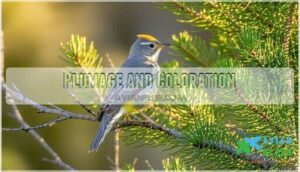
You’ll recognize the American Dipper by its uniform slate-gray plumage—a masterful camouflage against rocky streambeds. This bird species boasts roughly 4,200 densely packed feathers, 40% more than similarly sized songbirds, creating outstanding waterproof plumage through oil secreted by an enlarged uropygial gland.
Adults display darker wings and brownish heads during spring, while fall brings white margins to underparts. Juveniles show lighter, mottled feathering that conceals them effectively.
Watch for the striking white eyelid flash—visible during blinking—that distinguishes this outstanding avian species across its range.
Body Shape and Size
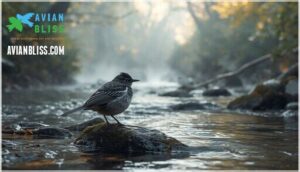
At first glance, you might mistake this chunky little powerhouse for just another streamside rock—until it moves. The American Dipper measures 14–20 cm in length and weighs 43–67 g, with a stocky build featuring long, sturdy legs and a short, squared tail. Its wingspan reaches about 23 cm.
Body Proportions reveal a low surface-to-volume ratio that minimizes heat loss. This bird species overview wouldn’t be complete without noting its striking Feather Density—approximately 6,000 waterproof feathers, double that of comparable songbirds, creating the waterproof plumage essential for underwater foraging.
Distinctive Features and Markings
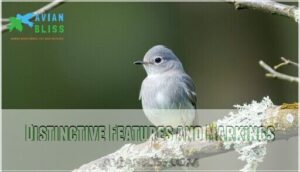
Watch for that telltale flash when you’re scanning streamsides—the American Dipper’s white eyelids blink rhythmically, functioning like signal flags against dark canyon rocks. This avian characteristics specialist recognizes four defining markers:
- Eyelid Features: White upper eyelid feathers flash with each blink, aiding visual communication in roaring whitewater habitats
- Plumage Patterns: Uniformly slate-gray bodies with brownish heads provide camouflage; seasonal white feather margins appear in fall and winter
- Tail Characteristics: Short, stubby, square-tipped tail cocks rhythmically during territorial displays and feeding sequences
- Leg Adaptations: Strong, elongated legs with contrasting yellow feet grip slippery riverbeds during underwater foraging
Juveniles lack pronounced white eyelids and display paler gray underparts with faint barring—features that develop fully after their first molt.
Adaptations for Aquatic Life
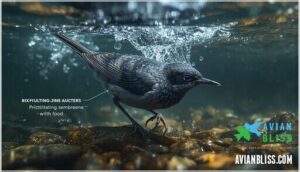
You’re witnessing evolutionary mastery when a dipper vanishes beneath roaring whitewater—this waterbird’s aquatic lifestyle demands extreme avian adaptations to cold water. Thermoregulation relies on over 6,000 waterproof feathers (double that of similar songbirds) and subcutaneous fat deposits that maintain function in subzero streams. Diving mechanics involve wing-propelled swimming powered by flight muscles exceeding 22% body mass, while a nictitating membrane—a translucent third eyelid—delivers aquatic vision by filtering refracted light underwater. Streamlining comes from compact morphology and specialized feather barbules reducing drag by 30%, while nasal flaps seal automatically during dives.
| Adaptation Category | Specific Feature | Functional Advantage |
|---|---|---|
| Thermoregulation | 6,000+ dense feathers, subcutaneous fat | Maintains body heat in water below 0°C |
| Waterproof Feathers | Uropygial gland 10× larger than other songbirds | Secretes oil maintaining >95% insulation after submersion |
| Aquatic Vision | Nictitating membrane, enlarged eye sphincter muscles | Protects eyes, facilitates focus shift between air and water |
| Diving Mechanics | Elevated hemoglobin, 15–20% higher red blood cell count | Permits dives exceeding 60 seconds at depths reaching 6 meters |
| Streamlining | Short rounded wings, compact body, strong curved claws | Generates underwater thrust, grips slippery rocks in swift currents |
Aquatic Adaptations
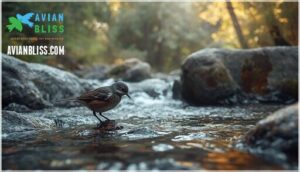
You can’t survive underwater without some serious biological backup. The American Dipper’s body is a masterclass in cold-water engineering, packed with adaptations that let it walk stream bottoms like it’s no big deal. Here’s what makes this bird an aquatic rebel.
Lower Metabolic Rate for Cold Water
The American Dipper thrives in frigid mountain streams thanks to metabolic adaptation—its basal metabolic rate runs 15–20% lower than expected for passerines its size. This energy conservation strategy allows cold water survival without constant feeding, even when stream temperatures hover around 4–10 °C. You’ll find this aquatic physiology striking: reduced thermal conductance paired with excellent insulation creates thermal efficiency that outperforms similar songbirds.
The American Dipper survives icy mountain streams through a metabolic rate 15–20% lower than similar songbirds, conserving energy without constant feeding in near-freezing water
- Vasoconstriction in peripheral blood vessels minimizes heat loss during underwater foraging
- Mitochondrial density in muscles aids efficient oxygen use and endurance in icy conditions
- Stable thermoregulation maintains body temperature down to −30 °C air temperatures
- Lowered daily energy demands allow survival when aquatic invertebrates become scarce in winter
Extra Oxygen-Carrying Capacity
Think of hemoglobin as a biological scuba tank—the American Dipper carries up to 20% more blood oxygen than typical songbirds, thanks to elevated hemoglobin levels and myoglobin function in muscle tissue.
This respiratory efficiency rivals diving ducks and penguins, letting you witness 30-second submersions while the bird hunts aquatic invertebrates.
Ornithology research confirms this oxygen-carrying capacity enables energy-intensive underwater locomotion against fierce currents, a convergent trait among avian species adapted to cold alpine streams.
Uropygial Gland and Waterproof Plumage
Boosted by extra oxygen, the dipper owes its underwater prowess to a second secret: the uropygial gland, positioned at the tail base, which produces nearly ten times more oil than typical songbirds. This preen gland drives the bird’s waterproof plumage through daily feather maintenance rituals.
Here’s how gland anatomy fuels avian adaptations:
- Oil secretion chemistry: Long-chain esters and fatty acids form a hydrophobic shield, blocking water penetration during 30-second dives.
- Preening behavior frequency: Dippers dab their bill into the gland multiple times daily, spreading oil across dense down feathers for continuous plumage maintenance.
- Antimicrobial defense: The secretion inhibits feather-degrading bacteria, preserving structural integrity in cold streams.
Without this biological raincoat, you’d witness waterlogged feathers and failed foraging—proof that feather waterproofing separates aquatic specialists from landlocked songbirds.
Nictitating Membranes for Eye Protection
Waterproof plumage shields the body, but you’ll need more than oiled feathers to forage in debris-filled torrents. That’s where nictitating membranes come in—translucent third eyelids that sweep horizontally across the cornea within milliseconds, offering eye shielding during underwater pursuits.
These membranes act like built-in underwater goggles, transmitting light while blocking suspended particles and sharp rocks. Membrane movement syncs with each dive, protecting your eyes for up to seven seconds as you track aquatic insects along stream bottoms, proving corneal protection drives aquatic vision in water birds.
Nostril Flap for Diving Protection
Beyond eye protection, you’ll need to seal your airways when submerging. The American Dipper’s nasal flap—a flexible, cornified membrane—closes reflexively within 0.1 seconds of immersion, blocking water entry during each plunge.
This nostril closure prevents aspiration in turbulent currents up to 3 m/s, coordinating with dense plumage and specialized hemoglobin for efficient aquatic respiration. It’s a rare submersion adaptation among water birds, evolved specifically for cold-stream foraging where avian adaptations to cold water separate true divers from surface feeders.
Feeding Habits and Diet
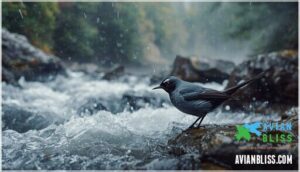
You’ll find the American Dipper hunting for food in ways that break every rule of typical songbird behavior. This slate-gray acrobat doesn’t just pick insects off leaves—it walks into rushing mountain streams and disappears beneath the surface to catch its prey.
Let’s look at what these exceptional birds eat and how they’ve mastered the art of underwater foraging.
Aquatic Insects and Larvae
You’ll find the American Dipper’s menu reads like a stream ecology textbook—aquatic insects and their larvae dominate up to 70% of winter intake. Mayfly larvae alone account for 60% during breeding season, while caddisflies, stoneflies, and chironomid midges round out this macroinvertebrate feast.
Water quality directly shapes prey diversity, making these birds living indicators of freshwater ecosystem health in their mountain stream habitat.
Small Fish, Fish Eggs, and Crayfish
While aquatic insects rule their diet, American Dippers (Cinclus mexicanus) aren’t afraid to diversify when opportunity strikes. Small fish under three inches, fish eggs during salmon runs, and occasional crayfish round out their stream ecology menu, with fish consumption spiking during spawning seasons.
- Small fish provide high-protein reserves during breeding, captured by diving up to six meters
- Egg predation peaks in spring when salmon-derived nutrients constitute up to 15% of intake
- Crayfish diet increases in summer as aquatic insects decline, contributing 2-4% annually
- Aquatic foraging varies geographically—Alaska populations consume more fish than inland mountain birds
- Stream ecology shifts determine prey availability, with salmon runs boosting success rates by 25%
These nutrient-dense foods support the intense energy demands of cold-water living.
Foraging Techniques and Strategies
Watch a dipper master underwater foraging by "flying" with partially spread wings through currents up to 1.5 meters per second, diving headfirst from boulders to probe streambed cobbles for hidden larvae. These aquatic bird adaptations deliver impressive prey capture efficiency—2.4 to 4.1 insects per minute during active hunting—with individuals performing 30 to 60 dives hourly in peak feeding strategies. You’ll notice prime foraging behavior in clear, moderate riffles where stream ecosystems support up to 250 larvae per square meter, though avian diet success drops 40% when flow exceeds 2 meters per second or turbidity clouds visual hunting cues.
| Foraging Technique | Key Details |
|---|---|
| Wing-Propelled Diving | Dippers use wings at 25°–40° angles to stabilize and navigate currents underwater |
| Rock Overturning | Birds flip pebbles up to 3 cm diameter to expose concealed stonefly and caddisfly larvae |
| Dive Duration | Average 6–9 seconds per dive; maximum submersion reaches 15 seconds in deeper pools |
| Foraging Depth | Usually under 0.5 m but can reach 6 m in unusual stream conditions |
| Peak Activity Windows | Early morning (05:00–09:00) and late afternoon (16:00–19:00) during breeding season |
Visual Signals and Communication
When white eyelids flash against charcoal plumage, you’re witnessing adaptive signaling refined by roaring mountain torrents—American Dipper communication that thrives where sound drowns. During courtship displays and territorial marking, these visual cues replace vocalizations when stream noise exceeds 70 decibels, with birdwatching and ornithological studies documenting this exceptional avian behavior shift.
- Rhythmic dipping motions occur 40–60 times per minute, intensifying during territorial encounters and synchronized between mating pairs as ecological research confirms.
- White eyelid flashes provide high-contrast signals detectable up to 30 meters, increasing 1.7-fold when ambient noise masks vocal communication.
- Amplified body bobbing rises 20–30% during pre-copulatory displays, with both sexes employing these visual cues for competitive territorial marking success.
Breeding and Nesting Habits
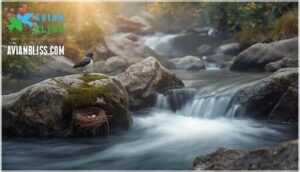
When you’re ready to explore how American Dippers bring the next cohort into the world, you’ll find their breeding strategies break free from conventional songbird patterns. These birds have carved out a unique niche that demands specialized nesting approaches and adaptive reproductive behaviors.
Here’s what sets their breeding and nesting habits apart from typical mountain-dwelling songbirds.
Territorial Behavior and Mating
You’ll notice American Dippers hold down their ground fiercely—males defend linear territories stretching 300 to 1,000 meters along clear streams. Territorial Displays intensify during breeding season, with dipping rates hitting 60 per minute during disputes. Territorial Defense involves aggressive pursuit of intruders, ensuring exclusive access to prime foraging waters for mating success.
During Courtship Rituals, males perform upright displays with drooping wings, sing from exposed rocks, and feed prospective mates. These monogamous songbirds form Pair Bonding through synchronized dipping and duet singing, with Mate Selection tied directly to territory quality and nest sites.
Monogamy and Polygamy
Most dippers lock into monogamous pair bonding with strong mate fidelity, but about 7-15% of males break the mold through polygamy—mating systems shaped by territory quality and age. Breeding strategies vary:
- Monogamous males dominate first-year breeders, forming exclusive bonds
- Polygynous males (older, experienced) defend territories with multiple nest sites
- Primary females in polygamous setups tend to be older than monogamous pairs
- Secondary females nest close by, laying eggs after the primary clutch
- Reproductive success stays similar across both social structure types
This flexibility in mating behavior reveals how American Dipper nesting habitats and resource availability drive different approaches to pairing and breeding.
Nesting Sites and Materials
American dipper nesting behavior reveals strategic adaptations shaped by stream bank erosion and waterfall placement. Their dome-shaped nests, constructed primarily from moss (95%+ of cases) with grass lining, average 20–25 cm in diameter. Key nesting habitats include:
- Cliff ledge usage and natural substrates – 62% of nests occupy rock crevices and boulders near cascades
- Bridge nesting and man-made structures – Over 50% in urbanized reaches use culverts and platforms
- Nest box design acceptance – Artificial boxes successfully hosted 9 documented cases between 2017–2018
- Waterfall placement strategy – 74% positioned within 2 meters of fast-moving water, entrance facing stream for predator avoidance
Nesting Behind Waterfalls
You might think bridges are prime nesting real estate, but waterfalls outshine them. Behind thundering cascades, over 75% of American dipper nests survive predators—terrestrial threats can’t breach the water curtain.
These aquatic bird adaptations include flying straight through falls, entering moss domes 15–20 times hourly while feeding chicks. Microhabitat selection focuses on vertical rock faces where constant spray nourishes verdant moss for nest construction, creating humid, temperature-stable hideaways.
Stream ecology favors these sites: acoustic masking from roaring water conceals chick calls, and 60–65% of pairs return annually, proving waterfall nesting works brilliantly.
Conservation Status and Threats

The American Dipper isn’t quite out of the woods yet—while it’s listed as Least Concern, this aquatic songbird faces real threats that chip away at its mountain stream strongholds.
You’ll find these pressures come from multiple directions, hitting both the bird’s habitat and its food sources. Let’s break down the main threats putting pressure on dipper populations across their range.
Declining Population Trends
Recently, populations have crashed in regions like South Dakota’s Black Hills—from widespread breeding across permanent streams to just two drainages by 2012. You’re witnessing a bird on the brink, and here’s what’s driving the American Dipper’s population decline:
- Climate impact: droughts and extreme temperatures reduce stream flows and prey availability
- Habitat loss from sedimentation and poor water quality forces abandonment of former territories
- Low reproductive success—only 1.8 fledglings per nest—threatens long-term survival
- Geographic isolation limits genetic diversity and recovery potential
- Conservation efforts remain critical as current productivity may not support population replacement
Habitat Loss and Degradation
Stream pollution and habitat fragmentation are breaking apart the dipper’s world—quite literally. Timber harvesting, overgrazing, and mining operations degrade riparian zones and destroy nesting sites. The 2015 Gold King Mine spill contaminated the Animas River with heavy metals, crushing reproductive success.
Ecosystem disruption from deforestation narrows channels and reduces aquatic biodiversity.
Conservation strategies must prioritize habitat preservation, or you’ll watch these birds vanish from watersheds where they once thrived.
Water Pollution and Siltation
Beyond habitat fragmentation, you’re seeing another killer: water pollution and siltation. Runoff from poor land management raises stream temperatures and destroys aquatic food sources—the caddisflies, mayflies, and stoneflies dippers need. Heavy metals like lead, copper, and mercury from mining operations accumulate in river sediments, slashing reproductive success.
Siltation smothers benthic zones and drops oxygen levels. A 2024 study showed 33% of aquatic insect species face extinction from warming waters and pollution. Clean rivers aren’t optional—they’re survival.
Riverbank Erosion and Nesting Habitat Loss
When streams lose their banks, you’re watching nesting habitat vanish. Erosion from logging, grazing, and road construction destabilizes cliffs and boulders where American Dippers build—Spearfish Canyon lost breeding pairs to bank collapse. Sediment reduction through habitat restoration works: reforested riparian zones cut erosion rates over 50%, and bank stabilization using rootwads protects rocky unpolluted streams.
Here’s what erosion destroys:
- Nest platforms: Collapsing ledges eliminate sites within 1–10 m of water where dippers anchor nests above swift currents.
- Food webs: Siltation smothers invertebrate habitat, dropping prey abundance and chick survival in rivers and streams.
- Territory stability: Widening channels from poor river management force dippers into marginal habitat or total abandonment.
Conservation Efforts and Advocacy
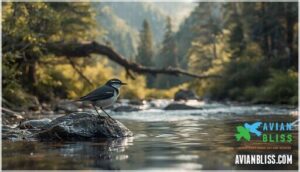
You can’t save the American Dipper just by hoping things get better—it takes real action from organizations and people who refuse to let these birds vanish. Several conservation groups have stepped up to protect dippers and their mountain stream habitats.
Here’s what’s being done to keep these exceptional birds thriving in the wild.
American Bird Conservancy (ABC) Initiatives
You’re backing more than a bird when you support American Bird Conservancy initiatives—you’re investing in wild freedom. ABC’s habitat restoration programs protect over 400,000 hectares across Latin America, directly benefiting species like the American Dipper.
Through conservation funding partnerships and bird-friendly policies, ABC confronts threats from water pollution to habitat loss. Their community outreach trains local stewards in avian ecology, weaving environmental conservation into everyday lives.
| ABC Initiative | Impact on American Dipper |
|---|---|
| Habitat Restoration Projects | Protects fast-flowing mountain streams and nesting sites from degradation |
| Water Quality Advocacy | Reduces pollution and siltation that destroy aquatic food sources |
| Species Protection Programs | Monitors population trends and confronts threats to wildlife habitat |
Public Land Protections and Policies
Across 640 million acres of Federal Land Policies, your voice matters in shaping Wildlife Management that keeps streams wild and free. The Bureau of Land Management oversees 155,000 miles of waterways, while Forest Service programs have restored 2.9 million acres—core wildlife habitat for species like the American Dipper.
Here’s how Riparian Conservation and Habitat Restoration protect Aquatic Ecosystems:
- Enforce water quality standards under the Federal Land Policy and Management Act to preserve ecological protection for aquatic insects and invertebrates.
- Support the Northwest Forest Plan’s 24 million acres of forestland, maintaining waterway integrity for bird conservation.
- Advocate for Conservation Reserve Programs that reduce siltation and establish riparian buffers, directly benefiting environmental conservation goals.
- Demand active forest management that balances recreation with wildlife ecology, ensuring sustainable habitats for generations ahead.
Migratory Bird Treaty Act
Think of the Migratory Bird Treaty Act as a lifeline thrown across borders—since 1918, it’s been the law that makes harming the American Dipper and over 1,000 other bird species a federal offense. You’re protected under Treaty Enforcement that bans unauthorized hunting, capturing, or nest destruction.
Here’s the catch: Incidental Take—accidental bird deaths from oil pits, power lines, or industrial operations—has sparked fierce Environmental Policy debates. While the Biden administration reinstated Bird Protections in 2021, recent shifts threaten Wildlife Conservation gains.
Ornithological research shows species like the Dipper need clean streams, and avian conservation efforts hinge on enforcing this act to prevent habitat degradation and pollution-driven declines.
Community Engagement and Education
You’re standing at the edge of conservation history when you join volunteer programs like the American Dipper Project. Over 100 citizen scientists through Weminuche Audubon Society have tracked nest success since Colorado’s 2016 mine spill.
Educational outreach brings ornithology alive: Basalt Elementary’s students created "Dee Dee the Dipper," blending birdwatching tips with stream ecology.
Public engagement through field surveys and community literacy workshops transforms you into an advocate for avian conservation efforts, proving the Audubon Field Guide principle that bird species conservation starts locally.
Frequently Asked Questions (FAQs)
Where do American dippers live?
You might assume they stick to one region, but these birds roam widely across western mountains.
American Dippers inhabit swift mountain streams from Panama to Alaska, favoring cold, unpolluted whitewater streams with rocky substrates throughout their geographic range.
What does a dipper look like?
You’ll spot this compact songbird by its dense slate-gray plumage covering its rounded body, stocky build, and distinctive white eyelids that flash when it blinks.
The American Dipper measures 5-7 inches long with a short, sturdy dark beak, long legs, and a characteristically short tail often held upright.
Why are American dippers called Dippers?
You’ll spot this bird constantly bobbing up and down—a rhythmic motion called "dipping" performed up to 60 times per minute.
This distinctive behavior, involving leg flexions that make the entire body rise and fall, gave the American Dipper its name.
Are American dippers waterproof?
Yes, American dippers are waterproof. Their enlarged uropygial gland produces a hydrophobic coating rich in unsaturated fatty acids.
Combined with specialized feather microstructure and frequent preening, these aquatic adaptations create water-repellent plumage that keeps them dry while swimming in cold mountain streams.
How big do American dippers get?
You’ll spot these compact songbirds measuring 5 to 9 inches in body length, with a wingspan around 9 inches and weighing 5 to 4 ounces—roughly robin-sized but stockier for their aquatic lifestyle.
Does the American dipper swim?
This dipper doesn’t just wade—it actively swims and walks underwater using its wings like flippers.
You’ll see it dive up to 20 feet below the surface, staying submerged for 15 seconds while chasing aquatic insects through swift currents.
What is the American Dippers unique communication style?
You’ll notice this North American songbird uses both auditory cues and visual signals to communicate. Vocalization patterns include territorial calls and courtship songs, while the characteristic dipping motion and white eyelid flashes serve as visual markers during interactions.
How do American Dippers protect themselves from predators?
Regarding staying off the menu, habitat barriers are your first line of defense. You’ll find these birds nesting behind waterfalls or under cliff ledges—spots where snakes and raccoons can’t reach.
Their aquatic escapes are impressive too: they dive 20 feet deep, walk underwater gripping rocks, and use rapid wing strokes to vanish beneath the surface when threatened.
Can American Dippers be found in urban areas?
You won’t often spot these birds along city rivers, but they can adapt to urban areas with clean, fast-flowing water.
Urban stream quality determines whether they’ll stay—pollution drives them away, while well-maintained riverine ecology attracts them.
How long do American Dippers typically live in the wild?
You’ll find these aquatic songbirds generally survive 7-8 years in the wild, with maximum age records reaching just over 8 years. However, survival rates vary widely—adult mortality rates fluctuate between 33-63% annually, while juveniles face even steeper odds, with only 40-50% reaching their first year due to predation and environmental pressures.
Conclusion
Still waters run deep" might describe contemplative souls, but the American Dipper proves the opposite—turbulent currents run deeper still. You’ve seen how this songbird transforms whitewater chaos into opportunity, wielding specialized feathers, oxygen-rich blood, and waterproof oil as survival tools.
Yet pollution, habitat fragmentation, and warming streams threaten these adaptations. Protecting mountain watersheds isn’t just conservation—it’s preserving evolutionary ingenuity that refuses to compromise, a living rebellion against the limits others accept.
- https://animaldiversity.org/accounts/Cinclus_mexicanus/
- https://www.birdconservancy.org/wp-content/uploads/2025/01/BlackHills-AmDippers_finalRpt_2019.pdf
- https://www.audubon.org/magazine/meet-dipper-north-americas-only-aquatic-songbird
- https://www.allaboutbirds.org/guide/American_Dipper/lifehistory
- http://roaringfork.org/media/1289/2014-american-dipper-rfc-final-report.pdf