This site is supported by our readers. We may earn a commission, at no cost to you, if you purchase through links.
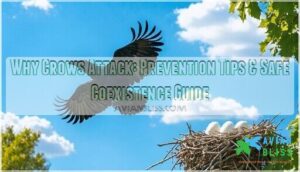 Crow attacking behavior stems from their fierce protective instincts, especially during nesting season when they’ll dive-bomb anyone who wanders too close to their eggs or chicks. These intelligent birds don’t attack out of malice—they’re simply following nature’s playbook to keep their families safe.
It’s like living next to someone who never forgets a face and takes home security very seriously. Once you learn to spot their warning signs—the sharp cawing that means "back off"—and time your walks around their busy season, you can coexist peacefully with these remarkable birds while they do what they do best: protecting their young.
Table Of Contents
- Key Takeaways
- Why Do Crows Attack People?
- When Are Crow Attacks Most Common?
- How Intelligent Are Crows?
- What Triggers Crow Aggression?
- How to Prevent Crow Attacks
- Can Humans and Crows Coexist Safely?
- Frequently Asked Questions (FAQs)
- Why is a crow attacking me?
- What to do when crows attack?
- Are American crows aggressive?
- Why are crows attacking my lawn?
- What to do if a crow attacks while walking outside?
- How to prevent crow attacks when approaching their nests?
- What are the signs of a crow preparing to attack?
- Can crows transmit diseases through their attacks on humans?
- How to safely and humanely deter crows from attacking people?
- Do crows attack pets or small animals?
- Conclusion
Key Takeaways
- Crows attack primarily to protect their nests and young during breeding season (March-July), not from malice—they’re defensive parents following natural instincts to guard vulnerable offspring from perceived threats.
- These intelligent birds remember human faces for up to 17 years and share this information with their communities, so respectful behavior during encounters prevents long-term targeting by entire crow populations.
- Most "attacks" are actually warning displays—loud cawing, wing spreading, and dive-bombing without contact are their way of telling you to back off before escalating to actual physical contact.
- You can safely coexist by avoiding nesting areas during breeding season, walking calmly without sudden movements, and using simple deterrents like umbrellas or walking sticks when necessary.
Why Do Crows Attack People?
Crows attack people primarily to protect their nests, eggs, and young during breeding season when they perceive humans as threats to their territory.
What seems like aggression is actually defensive behavior – crows are warning you to back away from their vulnerable offspring rather than launching unprovoked attacks.
Protective Nesting Behavior

When you’re walking near crow nesting areas during spring, you’re entering a parent’s protective zone. Crow Parenting involves intense Nest Defense Strategies where Protective Parents use Aggressive Warning Signs like swooping and loud calls to guard Baby Crows.
Their Nesting Site Selection in tall trees creates ideal Territorial Marking Behaviors. Understanding Crow Behavior and Nesting patterns helps you recognize when the Crow Nesting Season makes these intelligent birds most defensive of their vulnerable offspring.
By learning about crow nest construction, you can better appreciate the complexity of their nesting habits.
Territorial Defense and Aggression

Crows don’t just defend their nests—they claim entire neighborhoods as their kingdom, and trespassers aren’t welcome. These intelligent birds establish clear boundaries through aggressive posturing and defensive strategies. When you enter their territory, expect:
- Loud warning calls that alert the entire crow community
- Dive-bombing flights that come increasingly close to your head
- Persistent following as they escort you out of their domain
Urban bird behavior shows crows patrol their territories daily, making crow attacks more likely in familiar areas.
Misinterpretation of Warning Signs

What looks like an attack might actually be nature’s version of a flashing neon sign saying "back off." Crows use specific warning signs before escalating to physical contact. Understanding crow body language helps you recognize defensive posturing versus true aggressive behavior.
| Warning Sign | What It Means |
|---|---|
| Loud cawing calls | Territory announcement |
| Wing spreading | Threat display |
| Head bobbing | Agitation signal |
| Flying close overhead | Final warning |
| Diving without contact | Last chance alert |
Most perceived crow attacks are actually defensive posturing – the bird’s way of communicating threat perception without actual harm.
When Are Crow Attacks Most Common?

Crow attacks spike dramatically during nesting season, usually from March through July when parents fiercely protect their eggs and young.
You’re most at risk walking near trees with active nests, especially if you’ve previously disturbed the area since crows remember faces and target repeat offenders.
Nesting Season Peaks
Spring brings more than just blooming flowers—it unleashes crow parents who’ll turn your morning jog into a battlefield if you wander too close to their nest.
From March through June, protective parents guard their eggs during the 18-day incubation period, then fiercely defend baby crows through the fledgling stage.
You’re most likely to experience divebombing during this intense breeding season when crow nesting behavior peaks.
Seasonal Changes in Aggression
Like a switch flipping in nature’s control room, crow behavior transforms dramatically as seasons shift from spring’s protective fury to autumn’s cautious calm.
What drives these wild mood swings? It all comes down to their breeding calendar and family priorities:
- Spring surge – Peak territorial defense during egg-laying
- Summer intensity – Peak protection while chicks develop
- Late summer decline – Reduced aggression as young fledge
- Winter retreat – Minimal territorial behavior, focus on survival
Knowing these seasonal patterns helps you predict when wildlife conflicts might heat up.
Identifying High-Risk Areas
Across urban environments, crow attack maps reveal dangerous hotspots concentrated around tall trees and high foot traffic areas. Downtown Vancouver and the West End report over 8,000 incidents since 2017, with 97% occurring within 50 meters of active nests.
These High-Risk Zones include parks, schools, and garbage collection sites where American Crow populations cluster densely during breeding season. Crows often exhibit mobbing behavior toward ravens, particularly during breeding season.
How Intelligent Are Crows?

Crows possess exceptional intelligence that rivals many primates, with the ability to remember human faces for years and pass this knowledge to their offspring.
Their intricate problem-solving skills include using tools to obtain food and communicating complex information through their social networks.
Crow Memory and Facial Recognition
How impressive is crow intelligence regarding face recognition? American crows possess exceptional neural mechanisms that allow them to remember human faces for up to 17 years after a single encounter. Their brain activity shows patterns similar to mammalian fear processing when viewing threatening faces.
American crows can remember and recognize individual human faces for up to 17 years after just one encounter
Through social learning, entire crow communities share knowledge about dangerous individuals, teaching younger generations which humans to avoid. This memory retention creates lasting behavioral changes across crow populations, demonstrating refined avian intelligence rarely seen in wildlife.
Problem-Solving and Tool Use
Crows don’t just remember your face—they can actually craft and use tools with the precision of a skilled craftsman. These corvids bend wires into hooks, strip leaves from twigs, and even create compound tools to extract food from tight spaces. Their cognitive abilities rival those of young children in terms of adaptive learning and intelligent behavior.
- Tool Innovation: Crows modify objects on the fly, creating custom solutions for unique problem-solving challenges
- Sequential Planning: They use multiple tools in order, showing sophisticated cognitive abilities beyond simple trial-and-error
- Teaching Skills: Adult crows demonstrate proper tool use techniques to younger birds through observation
- Memory Integration: They remember which tools work best in specific situations and return to successful strategies
- Creative Adaptation: Crows repurpose human-made objects as tools, showing impressive intelligent behavior flexibility
Social Communication and Learning
If you think crows are just noisy neighbors, you’re missing the biggest story—these birds run complex social networks that would make any community organizer jealous.
Crow vocalizations carry specific meanings across their flock dynamics, with different calls signaling danger, food, or territory boundaries.
Through social learning, young corvids pick up communication strategies and cooperative behavior patterns from their elders, creating intricate avian behavior systems that demonstrate impressive bird intelligence.
What Triggers Crow Aggression?

These smart birds turn aggressive for three key reasons that activate their protective instincts.
When you threaten their eggs, disturb their territory repeatedly, or compete for food in urban spaces, crows won’t hesitate to launch protective strikes against perceived dangers.
Threats to Eggs and Chicks
Nothing triggers a parent’s protective instincts quite like someone getting too close to their babies—and crows are no exception.
During crow nesting season, these protective parents become hypervigilant against nest predators and potential egg theft. Their aggressive behavior intensifies when humans approach nesting areas, as they instinctively defend against threats that could cause chick mortality or nesting failure, prioritizing brood survival above all else.
Repeated Human Disturbance
Once you’ve crossed a crow’s path during nesting season, you’ve basically signed up for their personal watch list—and they don’t forget a face. These birds develop crow habituation to specific humans who repeatedly approach nesting proximity areas.
Each human approach reinforces their territorial invasion response, making repeated exposure increasingly dangerous. This repeated human disturbance triggers escalating bird aggression as urban wildlife adapts their animal defense mechanisms to persistent threats.
Resource Competition in Urban Areas
When urban environments create dense populations, crows face heightened competition for both food sources and prime nesting locations. Cities with crow populations up to 12 times higher than rural areas intensify these pressures markedly.
Urban foraging becomes more challenging as multiple families compete for the same garbage sites and anthropogenic food sources. This resource scarcity triggers increased bird aggression, with studies documenting aggressive encounters in 40% of urban crow interactions during peak competition periods.
How to Prevent Crow Attacks
Most crow attacks happen during nesting season, so timing matters. Stay aware of your surroundings and take a few basic steps to avoid trouble.
Watch for warning signs and use simple tactics to steer clear of conflicts. These birds are smart—respect that, and you’ll both be fine.
Avoiding Nesting Sites

The secret to staying safe around crows isn’t outrunning them—it’s outsmarting them by knowing where they call home. During nesting season, these protective parents guard territories within 100 feet of their nests.
Look for stick platforms in tree forks and avoid walking directly beneath active nesting sites where crow behavior patterns show heightened aggression.
Using Deterrents and Distractions

When crows start dive-bombing your morning walk, you don’t have to wave a white flag in surrender—simple deterrents can turn the tables in your favor.
Carry an umbrella or stick as visual distractions—these urban barriers create a buffer zone that changes crow behavior patterns.
Noise devices like keys or coins can interrupt their aggressive focus, while reflective surfaces confuse their targeting systems.
Safe Behavior Around Crows

Think of crow encounters like moving through a busy street—knowing the unspoken rules keeps everyone safe. Walk calmly without sudden movements near nesting sites.
Keep your head up to spot Crow Warning Signs like dive-bombing or loud cawing. These Urban Crow Safety practices help prevent escalation, turning potential conflicts into peaceful coexistence through respectful Crow Behavior awareness.
Can Humans and Crows Coexist Safely?

Despite their reputation for aggression, crows and humans can absolutely share the same spaces peacefully.
The key lies in understanding their behavior and respecting their boundaries, especially during nesting season when they’re simply protecting their families.
Crow Conservation Status and Protections
Understanding Crow Conservation Status helps you appreciate why coexistence matters more than elimination. Most crow species enjoy stable populations, but Wildlife Management requires balanced Environmental Policies that protect both birds and people.
- American crows classified as "Least Concern" with thriving populations across North America
- Hawaiian crows critically endangered with only 120 individuals remaining in captivity
- Migratory Bird Treaty Act protects all native crow species with penalties up to $50,000
- Conservation Efforts focus on Habitat Preservation and Species Legislation for threatened populations
Positive Human-Crow Interactions
Building trust with crows isn’t just possible—it’s surprisingly rewarding when you approach these intelligent birds with patience and respect. Many people successfully develop crow friendships through consistent bird feeding routines. These intelligent birds remember your kindness and often bring small gifts like shiny objects.
Urban coexistence thrives when you respect their crow behavior patterns and maintain mutual respect during their parenting seasons.
Urban Wildlife Management Solutions
More cities are figuring out that crows aren’t going anywhere—so instead of fighting them, they’re learning to live alongside them.
Smart urban wildlife management isn’t rocket science, but it does take the right mix of strategies:
- Green spaces design that provides natural foraging areas away from high-traffic zones
- Wildlife corridors connecting urban parks to reduce human-crow conflicts
- Community engagement programs educating residents about crow behavior and diet
- Conflict resolution protocols for addressing aggressive encounters during nesting seasons
- Urban planning policies that consider animal defense mechanisms in development projects
When cities adopt this approach, both people and crows benefit.
Frequently Asked Questions (FAQs)
Why is a crow attacking me?
Something’s got that crow fired up, and you’re caught in the crossfire. Most likely, you’ve wandered too close to their nest during breeding season when these intelligent birds become fierce protectors of their eggs and chicks.
What to do when crows attack?
Back away slowly while maintaining eye contact, then seek shelter behind trees or buildings until the aggressive behavior subsides completely.
| Immediate Actions | Protective Measures |
|---|---|
| Move away slowly | Raise arms above head |
| Find solid cover | Use umbrella as shield |
| Avoid sudden movements | Carry a walking stick |
| Don’t run frantically | Wear protective hat |
| Stay calm and quiet | Travel in groups |
These Defensive Measures help you respond to Crow Attack Response situations effectively.
Urban Safety Tips include recognizing Aggression Triggers during nesting season. Understanding Bird Behavior promotes Wildlife Protection through proper Animal Defense Mechanisms. Smart Coexistence Strategies reduce future Attacks while respecting these intelligent birds’ natural instincts.
Are American crows aggressive?
Boldly brooding birds, American Crows display selective aggression primarily during nesting seasons.
Their Aggression Triggers center on protecting vulnerable eggs and chicks. Crow Intelligence allows them to remember threats and respond defensively.
These Bird Behavior patterns reflect natural Nesting Behavior rather than inherent hostility toward humans.
Why are crows attacking my lawn?
Your lawn likely attracts crows because it offers food sources like grubs, insects, or earthworms beneath the surface. Understanding their habits helps you protect your property effectively:
- Remove food sources – Treat grub infestations and avoid leaving pet food or garbage accessible
- Install crow deterrents – Use reflective tape, scarecrows, or motion-activated sprinklers around your property
- Modify crow habitat – Trim tall trees where they roost and eliminate standing water sources
Dealing with urban wildlife means finding the right balance between protecting your property and respecting the animals that share our neighborhoods.
What to do if a crow attacks while walking outside?
When crows dive toward you during Outdoor Safety Tips walks, stay calm and protect your head with arms or objects. Back away slowly without running.
These Aggressive Crow Behavior episodes stem from Wildlife Protection instincts during nesting season, not true attacks.
How to prevent crow attacks when approaching their nests?
Nest Approach Strategies require maintaining safe distance guidelines of at least 50 feet during crow nesting season.
Recognizing warning sign behaviors like aggressive cawing helps you identify protective parents defending against perceived nest predators before escalation occurs.
What are the signs of a crow preparing to attack?
Ironically, crows telegraph their intentions before striking, making their "surprise" attacks quite predictable. You’ll notice these warning signs during Crow Nesting Season when Bird Behavior shifts toward Animal Defense Mechanisms:
- Aggressive Posturing – Wings spread wide, head lowered, body positioned for launch
- Warning Calls – Harsh cawing escalates in frequency and intensity
- Direct Staring – Unwavering eye contact with Feather Ruffling around the neck
These Territorial Marking behaviors signal imminent Attacks from defensive Crows protecting their young.
Can crows transmit diseases through their attacks on humans?
Crow saliva does contain bacteria, just like you’d find with most wild birds.
But here’s the thing – getting sick from a crow bite or scratch is pretty unlikely. Sure, crows can carry Campylobacter jejuni , but actually catching it from an attack? That’s really rare.
Clean the wound well and you’ll be fine in most cases.
How to safely and humanely deter crows from attacking people?
Several effective Crow Deterrent Methods help establish Safe Crow Interactions without harm. Carry umbrellas or walking sticks for visual deterrence. Avoid known nesting areas during the breeding season.
Feed crows regularly to build positive relationships and reduce territorial aggression through Crow Behavior Modification techniques.
Do crows attack pets or small animals?
Two disturbing incidents show how urban wildlife conflicts escalate when Pet Attack Patterns involve vulnerable animals. Crows don’t usually target pets, but small animals face greater risks during nesting season when avian behavior intensifies around territorial defense.
- Crow Prey Selection focuses on insects, carrion, and eggs rather than live pets
- Small Animal Defense becomes critical when cats or small dogs venture near active nests
- Animal Protection Strategies include supervised outdoor time and wildlife protection awareness during breeding seasons
Conclusion
Understanding crow attacking behavior isn’t just about avoiding a feathered foe—it’s about respecting nature’s boundaries. These intelligent birds attack primarily to protect their young, not out of malice.
By recognizing warning signs, avoiding nesting areas during breeding season, and maintaining a respectful distance, you can safely coexist with these extraordinary creatures.
Remember, crows have excellent memories, so building positive relationships through patience and understanding benefits everyone in your shared urban ecosystem.