This site is supported by our readers. We may earn a commission, at no cost to you, if you purchase through links.
 Baby owls, called owlets, are fluffy bundles of charm with thick white or grey down feathers that keep them warm.
You’ll recognize them by their oversized black button eyes and distinctive heart-shaped heads, especially in barn owls.
These tiny hunters start life weighing just 4-60 grams but grow incredibly fast—some species multiply their birth weight by 20 times within a month.
Baby owls go through three main stages: the helpless owlet phase, the juvenile stage where they develop adult feathers, and finally the fledgling stage when they practice flying.
Unlike many birds, owlets are surprisingly independent early on, developing their hunting instincts naturally.
They’re strictly carnivorous, relying on parents to regurgitate fresh meat until they can hunt solo.
Most achieve basic survival skills and independence within 6-10 weeks, transforming from vulnerable fluffballs into skilled nocturnal predators with remarkable speed and precision.
Table Of Contents
- Key Takeaways
- Baby Owl Physical Traits
- Baby Owl Size and Weight
- Baby Owl Development Stages
- Baby Owl Behavior Patterns
- Baby Owl Diet and Nutrition
- Baby Owl Nesting Habits
- Baby Owl Growth and Fledging
- Baby Owl Parenting and Care
- Baby Owl Identification and Naming
- Baby Owl Reproduction and Breeding
- Frequently Asked Questions (FAQs)
- What is the story of Owl Babies by Martin Waddell about?
- Where can I buy Owl Babies?
- Is Owl Babies a good book?
- What were the owl babies called?
- What is the owl baby?
- What is the name and sound of a baby owl?
- What is Owlet called?
- What are little owls called?
- What do you do if you find a baby owl?
- Are owlets baby owls?
- Conclusion
Key Takeaways
- You’ll recognize baby owls by their fluffy white or gray down feathers and oversized black button eyes – these adorable features aren’t just cute but serve as insulation and sophisticated survival tools for navigation and hunting.
- Baby owls grow incredibly fast, multiplying their birth weight by up to 20 times within a month – they start at just 4-60 grams but develop from helpless hatchlings to capable hunters in 6-10 weeks through three distinct stages.
- Unlike many birds, owlets are surprisingly independent and naturally solitary – they develop hunting instincts without extensive parental coaching and achieve basic survival skills much faster than other species.
- You shouldn’t intervene if you find a baby owl on the ground – they’re naturally good climbers who can scramble back to safety, and parent owls are likely nearby hunting even if you can’t see them.
Baby Owl Physical Traits
When you first spot a baby owl, you’ll notice their incredibly fluffy appearance that makes them look like living cotton balls.
Their most striking features include thick white or grey down feathers, jet-black button eyes, distinctive heart-shaped heads, and sharp hook-shaped beaks with a temporary egg tooth used for breaking out of their shells, which is a notable characteristic of these young birds, making them instantly recognizable with their heart-shaped heads.
Thick White or Grey Down

Baby owlets look like tiny snowballs wrapped in nature’s coziest blanket.
Their thick down provides critical insulation properties during vulnerable early weeks when they can’t regulate body temperature.
This fluffy plumage varies from pure white to soft gray, offering perfect camouflage in tree cavities.
As down development progresses, adult feathers gradually emerge underneath, marking the beginning of feather transformation into their mature coat.
Black Button-Like Eyes
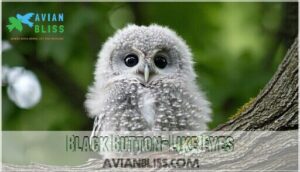
Those enchanting black button-like eyes aren’t just adorable—they’re sophisticated survival tools.
These perfectly round orbs develop rapidly to help your young owl navigate its world.
Here’s how Owlet Vision works:
- Eye Development starts immediately, allowing baby owls to detect movement within days
- Nocturnal Adaptation gives owlets superior night vision compared to most animals
- Depth Perception helps them judge distances when exploring branches
- Hunting Sight begins forming early, preparing them for independent feeding
These cute owl features make adorable animals even more enchanting while serving essential survival purposes.
Heart-Shaped Head
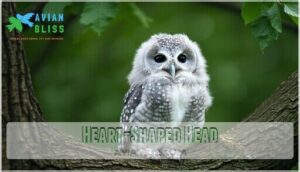
Those striking black eyes sit within a distinctive heart-shaped head that makes baby owls instantly recognizable among owl eggs hatchers.
This unique facial disk isn’t just adorable—it’s perfectly designed for hunting success.
The heart shape evolution differs dramatically between species, with barn owl chicks showing the most pronounced shape variations.
| Species | Head Feathering | Species Differences |
|---|---|---|
| Barn owl | Pronounced heart | White feather arrangement |
| Great Horned | Rounded heart | Tufted ear formations |
| Snowy owlet | Compact heart | Dense white plumage |
| Screech owl chick | Small heart | Mottled feather patterns |
This shape variation helps young baby owl specimens focus sound waves effectively, making them nature’s cutest radar systems.
Hook-Shaped Beak With Pronounced Egg Tooth
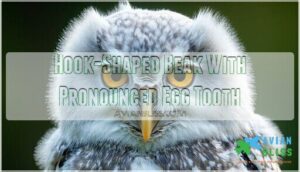
Despite their fluffy appearance, baby owls possess hook-shaped beaks that appear disproportionately large for their tiny heads.
The most remarkable feature is the prominent egg tooth—a sharp, pointed projection that aids in hatching adaptation by helping owl chicks break through their shells.
Here are four key facts about owlet beaks:
- Egg tooth function: This temporary tool helps baby owls crack open tough eggshells during hatching
- Beak disappearance: The egg tooth vanishes within one week after the owlet emerges
- Beak development: The hook shape becomes more pronounced as the owl chick matures
- Species variations: Different owl species show slight differences in beak size and egg tooth prominence
Baby Owl Size and Weight
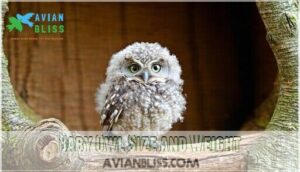
You’ll be amazed at how tiny baby owls start compared to their impressive adult size.
Most owlets weigh just 4-60 grams at birth but can double their weight in just two weeks through rapid development.
Small Size Compared to Adults
You’ll be amazed by the tiny newborn dimensions of owl chicks compared to their imposing parents.
Baby owls start impossibly tiny but transform into mighty predators through nature’s most dramatic size makeover.
This growth disparity creates one of nature’s most dramatic size transformations as these vulnerable babies develop into powerful hunters.
Here’s the adult comparison that showcases this remarkable size advantage:
- Snowy owlets start at just 2.5 inches tall but grow into 2.5-foot adults
- Great Horned owl chicks begin around 3 inches versus their 25-inch parents
- Even massive species produce relatively small babies that fit easily in cramped nests
- This vulnerability factor makes young owls appear almost toy-like next to adults
- Small owl chicks use their compact size to hide effectively from predators
Weight Range at Birth
Baby owls weigh surprisingly little at birth, showing dramatic Species Variation across different types.
Great Horned owl chicks start at just 35 grams, while tiny Elf Owl babies weigh only 4 grams.
Larger species like Eurasian Eagle-Owls can reach 55 grams at hatching.
This baby owl weight directly impacts survival chances and Growth Rate potential.
| Species | Birth Weight |
|---|---|
| Elf Owl | 4g (0.14oz) |
| Barn Owl | 18-22g (0.6-0.8oz) |
| Great Horned | 35g (1.2oz) |
| Little Owl | 11g (0.4oz) |
| Eurasian Eagle-Owl | 55g (1.9oz) |
Most owlet births fall between 15-55 grams.
Recently, a chick hatched weighing approximately 55 grams at the National Aviary.
Owls possess acute hearing ability that aids them in hunting, even from a young age.
Weight Doubling happens quickly once feeding begins, with heavier chicks showing better resilience against early developmental challenges.
Rapid Growth Rate
The owlet’s weight doubling between days 14-28 showcases nature’s incredible efficiency.
Great Horned owlets grow from 1.2 ounces to 28 ounces in just one month, while feather development replaces fluffy down.
- Growth accelerates dramatically during weeks 2-4 of development
- Weight increases support essential muscle and bone strengthening
- Size changes prepare owlets for their fledgling timeline milestones
- Dietary needs expand as larger bodies require more nutrition
This rapid transformation supports independence timeline success.
Baby Owl Development Stages
Baby owls pass through three key development stages that transform them from helpless hatchlings into independent hunters.
You’ll witness remarkable changes as owlets grow from fluffy down-covered nestlings to fully-fledged juveniles ready to leave their parents within just a few months, which is a remarkable transformation that occurs in a short period, involving fully-fledged juveniles.
Owlet Stage

During the early owlet stage, you’ll witness remarkable transformations as these down feathers-covered nestlings navigate their most vulnerable weeks.
Your baby owl depends entirely on parents for survival, making constant begging calls to secure meals and warmth.
This nest dependence period features incredible growth spurts that prepare them for eventual independence.
The owlets’ diet includes insects and small mammals, reflecting their opportunistic hunting habits.
Three critical developments shape this stage:
- Sensory Awakening – Eyes open gradually while hearing becomes razor-sharp for detecting danger
- Physical Strengthening – Tiny muscles develop through constant stretching and movement exercises
- Fledging Prep – Wing-flapping practice builds the strength needed for their first flight attempts
This downy plumage stage transforms helpless hatchlings into capable owl fledgling candidates.
Juvenile Stage

During the juvenile stage, your baby owl starts developing adult plumage changes while mastering independent hunting skills.
The owlet sheds its fluffy down feathers and practices social interactions with siblings.
As territorial development begins, the young owl fledgling explores beyond the nest but still begs parents for food.
This maturity onset phase prepares them for complete independence within weeks.
Fledgling Stage

When fledging begins around 8-9 weeks, your owlet starts its first clumsy flights while parents continue feeding and protecting it.
These young owls practice flight development through "branching" – hopping between branches near the nest to build muscle strength.
Parental independence gradually develops as hunting instincts emerge, though post-fledging survival depends on mastering essential skills before territory establishment and complete independence.
Baby Owl Behavior Patterns

You’ll discover that baby owls display fascinating behavior patterns that differ substantially from many other young birds.
While most owl species are naturally solitary creatures, owlets show surprising independence early in their development, though some species break this rule with interesting social behaviors.
Solitary Nature of Owls
Unlike many birds that prefer company, baby owls naturally embrace solitary lifestyles from day one.
You’ll find independent owlets practicing solitary hunting techniques without parental coaching, relying on pure instinct.
These young owl chicks show limited interaction with siblings, displaying remarkable independence that prepares them for adult life.
Minimal flocking occurs since avoiding competition becomes essential for survival in their territorial world.
Owlets’ Independence
Baby owls don’t follow the same playbook as other bird species in terms of gaining independence. These remarkable owlets demonstrate self-sufficiency that’ll surprise you with its rapid timeline.
Hunting Instincts kick in naturally without extensive parental coaching. Within weeks of hatching, fledgling owls begin developing the predatory skills they’ll need for Post-Fledging Survival.
Here’s how Owl Independence unfolds:
- Branching behavior – Moving between branches before mastering flight
- Instinctive hunting – Developing predatory techniques through trial and error
- Territorial exploration – Venturing beyond the nest while parents monitor nearby
- Gradual weaning – Reducing dependence on parental food delivery systems
This Self-Sufficiency Timeline varies by species, but most owlets achieve basic Owl Survival skills within 6-10 weeks. Parental Influence remains minimal compared to other birds, as Owl Development relies heavily on innate behaviors rather than learned techniques.
Exceptions to Solitary Behavior
Most owlets follow their independent nature, but some species surprise you with their social side.
Flocking owlets like Burrowing Owls practice cooperative hunting together, while others form sibling bonds that last weeks beyond fledging.
You’ll spot communal roosting behavior in Short-eared Owls during winter months.
Social learning happens when young owls watch their parents hunt as a team, picking up essential survival skills through observation rather than solo practice.
Social Behavior Species Examples
Baby Owl Diet and Nutrition

You’ll find that baby owls are strict carnivores from the moment they hatch, relying entirely on their parents to hunt and deliver fresh meat.
Their diet consists of small mammals like mice and voles, insects, birds, and occasionally amphibians that parents tear into manageable pieces before feeding.
Carnivorous Diet
From the moment they hatch, owls are built for one thing: hunting. These tiny predators can’t survive on seeds or berries like songbirds. Their carnivorous diet drives every aspect of their development, from razor-sharp talons to powerful digestive systems designed for processing raw meat.
Hunting instincts kick in immediately, even before baby owl eyes open. Their nutritional needs demand constant food provision from dedicated parents who understand this carnivorous lifestyle perfectly.
Here’s what makes their diet so specialized:
- Sharp beaks tear flesh into bite-sized pieces for easy swallowing
- Powerful stomach acid breaks down bones, fur, and feathers efficiently
- Regurgitation pellets expel indigestible materials like tiny fur balls
Feeding frequency increases rapidly as owlets grow, with parents delivering prey types around the clock to fuel their incredible growth spurts. Parental owl diets determine preferred owl prey for their young.
Food Sources
Through diverse prey types, baby owls receive complete nutrition from their parents’ skilled hunting.
Small mammals like mice and voles dominate their diet, while insects, birds, and amphibians provide variety during food scarcity periods.
They also need nutrients from owl prey to grow properly.
| Prey Category | Primary Species | Nutritional Value |
|---|---|---|
| Small Mammals | Mice, voles, shrews | High protein, calcium |
| Birds | Songbirds, chicks | Essential fats, protein |
| Amphibians | Frogs, salamanders | Moisture, vitamins |
| Insects | Beetles, moths | Quick energy source |
This varied owl diet guarantees owlets develop proper hunting instincts while meeting their nutritional needs through regurgitation pellets and fresh prey delivered at ideal feeding frequency.
Feeding by Parents
Parent owls demonstrate regurgitation methods by bringing whole prey back to nestlings.
They tear mice, insects, and small birds into manageable chunks for easy swallowing.
Feeding frequency increases as baby owl appetites grow – you’ll see parents delivering food provision every few hours.
For consistent feeding, consider owl prey delivery options.
Both parental roles involve continuous nourishment, though hunting guidance comes naturally through instinct rather than teaching.
Baby Owl Nesting Habits

You’ll discover that baby owls don’t build their own nests but instead take advantage of abandoned structures or natural cavities.
Unlike many birds, owlets leave their nests surprisingly early and require only brief parental care before becoming independent hunters.
Opportunistic Nesting
Unlike most birds that construct elaborate homes, owls are opportunistic nesters who steal ready-made real estate from hawks, crows, and squirrels.
Nest site selection depends on safety over craftsmanship. You’ll discover owlet families in tree cavities, abandoned nests, barn lofts, and even urban structures.
Nest box adoption has become increasingly popular as cavity nesting habits adapt to modern landscapes.
These unusual nest locations showcase remarkable flexibility in owl nests construction.
Quick Exit From Nest
Unlike many birds that take their time leaving home, owl fledgling face premature fledging when nest disturbance occurs.
This forced departure from the nest happens before their flight skills fully develop, creating injury risk.
Young owls must quickly adapt to independence despite being unprepared for survival outside their protective nest environment.
- Nest disturbance triggers early departure before owlets master flight skills
- Forced departure occurs 1-2 weeks earlier than natural fledging timeline
- Injury risk increases substantially when owlets leave nest prematurely
- Fledgling survival depends on finding safe ground cover near parents
Short Parental Care Period
After six weeks, owl parents drastically reduce their involvement with fledgling baby owl care.
Most owl offspring must master hunting skills within days of leaving the nest, unlike songbirds that receive weeks of guidance.
This abbreviated independence timeline creates higher survival challenges but produces remarkably self-sufficient young owls.
| Parental Roles | Duration |
|---|---|
| Intensive feeding | 6-8 weeks |
| Post-fledging care | 2-4 weeks |
| Hunting instruction | Minimal/none |
| Territory protection | 1-2 weeks |
| Complete independence | 10-12 weeks |
Survival rates improve when nest sites offer abundant prey nearby, giving newly independent owlets better hunting opportunities during this critical period of development.
Baby Owl Growth and Fledging
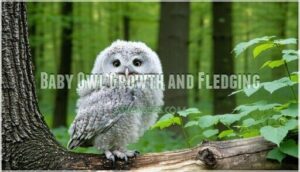
During their first few months of life, young owls experience incredible physical changes that transform them from helpless nestlings into capable hunters.
The growth timeline for most owl species follows a predictable pattern, though timing varies between different types.
Feather development begins around 3-4 weeks when flight feathers start replacing fluffy down. Your baby owl won’t look like an adult until 2-3 months old, but these changes happen quickly.
By 10 weeks, most owlets have developed competent flying skills and adult-like appearance.
The fledging process involves several key stages:
- Branching behavior – Young owls leave the nest to explore nearby branches while still flightless
- Wing strengthening – Fledglings practice flapping and build flight muscles through repetitive movements
- Instinctive learning – Baby owls develop hunting skills with minimal parental guidance.
Independence age varies by species, but most fledglings become self-sufficient within 1-3 months.
During this period, parental influence gradually decreases as the nestling gains confidence.
Don’t worry if you see a fledgling on the ground – they’re surprisingly good climbers who can scramble back to safety.
Fledging success depends on this natural learning process.
Notably, fledglings need supervision while they learn to fly.
Baby Owl Parenting and Care

You’ll discover that owl parents provide dedicated care for their babies during the first few critical months of life.
While owlets depend entirely on their parents for food and protection initially, they develop independence remarkably quickly compared to many other bird species.
Parental Care Period
Parent owls dedicate themselves like devoted teachers for independence timeline spanning 2-3 months after hatching.
Feeding frequency drops gradually as owlets mature from helpless nest dwellers to confident hunters.
During post-fledging support, parents balance protection duration with encouraging self-reliance.
Though hunting instruction happens through observation rather than formal lessons, parents remain nearby guardians until their young master survival skills completely.
Feeding and Protection by Parents
When you observe owl parents with their chicks, you’ll witness fierce guardians in action.
Males hunt tirelessly while females handle parental regurgitation, tearing prey into manageable pieces for hungry owlets.
Begging calls from the nest trigger immediate responses from protective parents who maintain strict territory protection.
These dedicated caregivers provide round-the-clock predator defense, positioning themselves between threats and their vulnerable young.
Hunting instruction begins early as parents demonstrate proper techniques near the nest, preparing owlets for eventual independence.
Abandonment and Independence
Baby owl abandonment rarely means true desertion.
Most owlets naturally gain independence as parental involvement decreases over weeks. You’ll witness owl development following predictable patterns that guarantee fledgling survival.
Understanding normal post-fledging behavior helps you recognize when intervention isn’t needed:
- Gradual weaning – Owl parental support slowly decreases as instinctual hunting skills develop
- Self-sufficiency timeline – Most owl nestlings achieve independence within 10-14 weeks after hatching
- Natural dispersal – Healthy owl fledglings eventually leave parental territory to establish their own ranges
Human interference often disrupts this essential learning process unnecessarily.
Baby Owl Identification and Naming

You’ll recognize baby owls by their distinctive fluffy white or gray down feathers and oversized black button eyes that make them look like adorable cotton balls with attitude.
These owlets, as they’re properly called, start tiny but grow incredibly fast—some species can multiply their birth weight by 20 times in just one month, which is a remarkable growth rate.
Owlet as a Term for Baby Owls
Now that you’ve seen how parent owls care for their young, you’ll want to know what these fluffy babies are actually called.
The owlet definition is simple: it’s the proper term for baby owls. The etymology owlet comes from combining "owl" with "-let," meaning "little one." This follows the same pattern as piglet or eaglet in owl terminology.
Regional variations are minimal—scientists worldwide use "owlet" as standard owl names. Some owlet misconceptions exist, like calling them "baby owls" instead of the correct term.
| Term | Usage Context |
|---|---|
| Owlet | Scientific and formal writing |
| Baby owl | Casual everyday conversation |
| Young owl |
Wildlife documentation.
Usage examples include "The owlet called for food" or "Three owlets hatched yesterday.
Other Names for Baby Owls
You’ll encounter various owl terminology beyond the common owlet.
Hatchling definition refers to newly emerged baby owl chicks, while nestling stage describes those still nest-bound.
Fledgling description covers young owl birds learning flight skills.
Scientists use juvenile owls for older specimens developing adult features.
Regional terms include "owllings" in casual conversation, creating diverse owl names across different communities and bird-watching groups.
Identification by Size, Weight, and Plumage
Identifying owlets gets easier when you know what to look for. Species Size varies dramatically – tiny pygmy owlets weigh just 4 grams while great horned baby owl chicks tip scales at 60 grams.
Here’s your identification checklist:
- Weight Gain – Owlets double their mass within two weeks
- Down Variations – White or gray fluffy feathers indicate younger birds
- Plumage Development – Adult feathers emerging means older owlet
- Fledgling Appearance – Mixed down and proper feathers signal flight readiness
Baby Owl Reproduction and Breeding
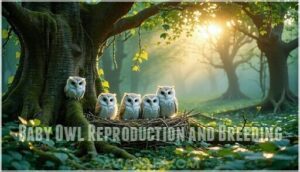
Understanding owl reproduction helps you recognize when and where you might encounter baby owlets in the wild.
The breeding cycle determines everything from nest timing to clutch sizes, directly affecting owlet survival rates.
Egg-Laying
When you discover owl nests in spring, you’ll find female owls laying 4-6 glossy white owl eggs per clutch.
These smooth, calcium-rich shells vary in texture by species.
Clutch size depends on food availability and territory quality.
Egg color remains consistently white across most species, helping with nest location camouflage in tree cavities.
Some species utilize abandoned nests of other birds.
Incubation Period
After the owl eggs are laid, the incubation period begins immediately.
This critical phase determines whether those precious owl eggs will successfully hatch into fluffy owlets.
Here’s what happens during the incubation process:
- Hatching Time averages 30-35 days across most owl species
- Temperature Effects require constant warmth, even in freezing winter conditions
- Parental Roles divide as females incubate while males hunt
- Asynchronous Hatching means eggs don’t all hatch simultaneously
Parents work tirelessly maintaining proper temperature for successful egg development throughout this month-long journey.
Clutch Size and Food Supply
Food supply drives everything regarding owl eggs and egg number.
Food supply is crucial as prey availability directly determines clutch size – abundant resources mean 4-6 eggs, while scarce food results in smaller clutches.
This smart strategy prevents resource competition among siblings during incubation and hatching.
When food runs short, brood reduction occurs naturally, with younger chicks facing higher mortality rates.
Parents can’t stretch their owl diet thin, so they match reproductive effort to what they can realistically provide.
This adaptation maximizes chick survival by ensuring adequate care for fewer offspring rather than failing to support larger broods.
Frequently Asked Questions (FAQs)
What is the story of Owl Babies by Martin Waddell about?
You find yourself reading a bedtime story.
You worry about missing pieces.
You wonder what comes next.
Martin Waddell’s tale follows three owlets who wake to find their mother gone from their nest one night.
Where can I buy Owl Babies?
You can buy "Owl Babies" at major bookstores like Barnes & Noble, online retailers such as Amazon, local independent bookshops, or through your library’s book sales and ordering services.
Is Owl Babies a good book?
Owl Babies" by Martin Waddell is widely considered an excellent children’s book.
You’ll find it perfectly captures young anxieties about separation while offering comfort through beautiful illustrations and relatable owl characters waiting for their mother’s return.
What were the owl babies called?
Back in Victorian times, naturalists would’ve called them "owlets" – that’s what you’d call baby owls today too.
Scientists use this term for young owls still covered in fluffy down feathers before they develop adult plumage.
What is the owl baby?
You’ll discover that owlet is the proper term for a baby owl.
These fluffy creatures hatch covered in white or gray down feathers, sporting oversized black button eyes and heart-shaped heads that’ll melt your heart instantly.
What is the name and sound of a baby owl?
Young owls weigh just 35 grams at birth but grow rapidly. A baby owl’s called an "owlet" and makes high-pitched begging calls, soft peeps, or sharp screeches to communicate with parents.
What is Owlet called?
An owlet is what you’d call a baby owl during its fluffy down stage. The term describes young owls from hatching until they develop adult feathers, typically lasting several weeks.
What are little owls called?
Little owls, owlets, and hatchlings share your world with fluffy charm.
You’ll find these downy babies called owlets during their early weeks.
They’re also termed hatchlings when newly emerged from eggs, then nestlings while nest-bound before becoming independent fledglings.
What do you do if you find a baby owl?
First, assess if the owlet needs help by checking for injuries or if it’s truly abandoned.
Don’t approach immediately – parent owls are likely nearby hunting.
If the baby appears injured or has been alone for several hours, contact a licensed wildlife rehabilitator for guidance.
Are owlets baby owls?
Yes, owlets are baby owls. The term "owlet" specifically refers to young owls covered in fluffy down feathers before they develop their adult plumage and become independent hunters.
Conclusion
Knowledge is power, but understanding baby owls gives you something special.
You’ve now learned everything from their adorable fluffy down to their lightning-fast development. These remarkable baby owl creatures transform from helpless 4-gram newborns into skilled hunters within weeks.
Remember that owlets are naturally independent and surprisingly resilient. Whether you’re a wildlife enthusiast or simply curious about nature, understanding these fascinating birds enriches your appreciation for wildlife’s incredible adaptability and survival instincts.