This site is supported by our readers. We may earn a commission, at no cost to you, if you purchase through links.
 A bird that’s vanishing faster than desert rain, Bendire’s thrasher has lost 90% of its population in just four decades. This mousy-brown songbird, with its distinctively straight bill and preference for thorny desert scrub, once thrived across the American Southwest’s most unforgiving landscapes.
Now, with fewer than 83,000 individuals remaining worldwide, spotting one requires both luck and knowledge of their increasingly rare haunts. Arizona holds half the world’s remaining population, making every sighting precious for birders and conservationists alike.
Understanding this elusive thrasher’s habits, habitat needs, and identification features becomes vital as we race against time to protect what remains of their desert kingdom.
Table Of Contents
- Key Takeaways
- Bendire’s Thrasher Description and Identification
- Habitat and Geographic Range
- Feeding Habits and Diet
- Breeding and Nesting Behavior
- Conservation Status and Threats
- Frequently Asked Questions (FAQs)
- What are the unique characteristics of Bendires Thrasher nests?
- How do Bendires Thrashers adapt to desert environments?
- What is the average lifespan of a Bendires Thrasher?
- How do Bendires Thrashers interact with other bird species?
- What are the primary threats to Bendires Thrasher populations?
- How long do Bendires Thrashers typically live?
- What predators threaten Bendires Thrasher populations?
- Do Bendires Thrashers migrate or stay year-round?
- How do climate changes affect desert thrashers?
- What diseases commonly impact Bendires Thrasher health?
- Conclusion
Key Takeaways
- Bendire’s Thrasher has lost 90% of its population in forty years, with less than 83,000 left and Arizona now holding half of the remaining birds.
- This bird is easiest to spot by its straight, short bill, bright yellow eyes, and preference for open desert scrub with tall shrubs.
- The thrasher’s diet relies heavily on insects, especially ants and beetles, and its ground-foraging and heat-avoidance behaviors help it survive harsh desert conditions.
- Urban expansion, habitat loss, and fragmented desert landscapes are pushing the species toward possible extinction, but conservation efforts and community science offer hope for recovery.
Bendire’s Thrasher Description and Identification
When you’re out in the desert trying to spot a Bendire’s Thrasher, you’ll want to know exactly what sets this bird apart from its look-alike cousins.
Getting a positive identification comes down to recognizing a few key features that separate it from other thrashers in the Southwest.
Let’s break down the essential field marks that’ll help you confidently identify this elusive desert dweller.
Physical Characteristics and Plumage
Bendire’s Thrasher identification starts with recognizing its medium-sized frame and distinctive plumage variation. You’ll notice these key physical characteristics when observing this desert specialist:
- Thrasher size: 23-25 cm length with 33-38 cm wingspan
- Plumage: Uniform mousy brown upperparts, paler buffy underparts
- Juvenile markings: Cinnamon-buff wingbars, finer breast streaking
- Seasonal molt: Fresh plumage highlights distinctive features October-February
Compared to similar species, bill shape is straighter.
Bill Shape and Eye Color
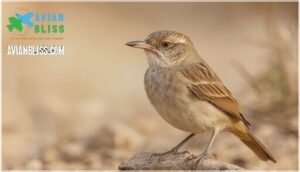
When you’re looking at Bendire’s Thrasher identification features, the bill morphology and iris coloration become your best friends. That straighter, thinner bill measures just 21mm—noticeably shorter than its curve-billed cousin. You’ll spot the pale base on the lower mandible, while those bright yellow eyes practically glow against the dusty plumage. As a Vulnerable species, habitat preservation is essential for their survival. These field identification markers work together like a fingerprint.
| Feature | Adult Bendire’s | Seasonal Changes |
|---|---|---|
| Bill Shape | Straighter, 21mm length | Wear lightens coloration |
| Eye Color | Bright yellow iris | More pronounced in breeding |
| Foraging Adaptation | Precision probing sandy soil | Enhanced during nesting season |
Distinguishing From Similar Species
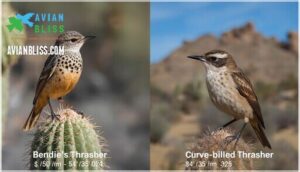
Field identification becomes tricky when you encounter Curve-billed Thrashers in habitat overlap zones across southern Arizona. Key morphometrics reveal Bendire’s smaller frame (23-28cm versus 26-29cm) and triangular breast spots forming a distinct “necklace” pattern. Plumage nuances include lighter grayish-brown upperparts and buffy-orange flanks.
Behavioral differences show Bendire’s upright stance with raised tail, while seasonal challenges peak during March-August molting periods when species identification features blur.
Vocalizations and Song Patterns

Beyond visual cues, acoustic features provide reliable identification tools. Male Bendire’s Thrashers produce distinctive song structures with continuous warbles lasting up to 41 seconds, each motif repeated 2-4 times. Unlike extensive mimicry patterns in mockingbirds, these vocalizations remain original compositions.
Key call functions include:
- “Suuuweeep” – territorial defense whistles
- “Chulup” – rapid trilled alarm chirps near nests
- “Tirup” – quick contact calls during movement
- Predawn choruses – overlapping bird song bouts during the breeding season
Seasonal variation shows peak vocal activity from March to June, with minimal winter singing.
Habitat and Geographic Range

Finding Bendire’s Thrasher isn’t just about knowing what it looks like—you need to know where to look. This desert specialist has carved out a specific niche in some of North America’s most challenging environments, from scorching Arizona scrublands to the thorny landscapes of northern Mexico.
Let’s explore the key habitat features and geographic patterns that’ll help you track down this elusive bird.
Preferred Desert and Scrubland Environments
Think of Bendire’s Thrasher habitat as a carefully balanced recipe—you’ll find these birds in arid environments where vegetation structure creates the perfect mix of open ground and scattered shrubs.
They prefer edge habitats with moderate bare ground coverage, avoiding dense vegetation while selecting territories with taller shrubs exceeding 1.5 meters for nesting and perching in deserts and scrublands.
Geographic Distribution in The U.S. And Mexico
Across the southwestern United States and northern Mexico, Bendire’s Thrasher occupies a surprisingly fragmented range that tells the story of desert connectivity and climate impacts. You’ll encounter these birds in specific pockets where border ecosystems create essential population connectivity despite ongoing habitat fragmentation.
Their geographic distribution spans:
- Southern Arizona and New Mexico’s year-round populations
- California’s Mojave Desert breeding territories
- Northwestern Mexico’s Sonoran Desert wintering grounds
- Utah and Nevada’s expanding northern range boundaries
Recent range expansion into eastern Nevada suggests these thrashers are adapting to changing conditions, though 79% of the global population remains concentrated in core Sonoran and Mojave Desert regions.
Adaptations to Arid Climates
Within the harshest arid environments, you’ll witness striking bird adaptations that showcase nature’s ingenuity. Bendire’s Thrasher maintains water balance through metabolic water production from its insect-heavy diet, while heat avoidance strategies include crepuscular foraging patterns and seeking shade under desert shrubs.
These morphological traits and dietary adaptations enable survival where temperatures exceed 40°C, demonstrating specialized reproductive adjustments to extreme conditions.
Association With Other Southwestern Birds
You’ll discover Bendire’s Thrasher sharing desert real estate with fascinating southwestern specialists, creating a vibrant neighborhood of adapted birds. Nesting site overlap and competitive interactions with the Curve-billed Thrasher shape habitat selection, while conservation synergy benefits multiple species:
- Costa’s Hummingbird – shares cholla nesting sites
- Elf Owl – utilizes similar saguaro habitats
- Lucy’s Warbler – overlaps in mesquite thickets
- Black-throated Sparrow – competes for shrubland niches
- Varied Bunting – coexists in semi-open scrub
Their ecological role connects insectivores and granivores within these specialized habitat niches.
Feeding Habits and Diet

Bendire’s Thrashers are opportunistic feeders that have adapted remarkably well to the harsh realities of desert life. You’ll find these birds employing a fascinating mix of hunting strategies to secure their next meal, from ground-scratching techniques to seasonal fruit foraging.
Understanding their dietary preferences and feeding behaviors reveals how these notable birds have carved out their niche in one of North America’s most challenging environments.
Insectivorous Diet and Common Prey
Insects dominate the Bendire’s Thrasher diet, comprising 70-80% of annual consumption. Their insectivorous diet reflects refined dietary adaptations, with seasonal consumption peaking at 85% insects during breeding when nutritional needs intensify for egg production and chick development.
You’ll find these birds targeting ants (62% of stomach samples), beetles (18-25%), termites (10-15%), and grasshoppers (15%).
Foraging Techniques and Ground Behavior
Picture a feathered archaeologist methodically excavating the desert floor—that’s your Bendire’s Thrasher at work. Their ground foraging behavior involves rapid lateral bill sweeps and precise prey extraction techniques, overturning stones up to 3.5 centimeters to access hidden insects.
You’ll observe their substrate preferences favor areas with 38% shrub cover, creating ideal territory utilization for their insect diet.
Seasonal Variation in Food Sources
Your thrasher’s diet follows nature’s calendar like clockwork. Insect abundance peaks during breeding season (March-June), comprising 80% of their diet. Precipitation influence drives these foraging behavior shifts:
- Spring-Summer: Grasshoppers, beetles, and caterpillars dominate feeding behavior
- Fall: Fruit consumption patterns emerge with Lycium berries and cactus fruits
- Winter: Seed feeding dynamics increase, utilizing agricultural edges
Role in Desert Ecosystems
Beyond their varied diet, Bendire’s Thrasher functions as a cornerstone species in desert ecosystem health.
You’ll find they provide vital insect population control, reducing ground-dwelling beetle densities by measurable margins. Their seed dispersal activities boost cactus regeneration rates by 15%, while soil structure improvements from foraging improve nutrient cycling.
This food web integration makes them essential ecosystem health indicators for desert birds conservation.
Breeding and Nesting Behavior
Bendire’s Thrashers follow fascinating reproductive patterns that reflect their adaptation to harsh desert environments. Their breeding behavior differs markedly from other thrasher species, with unique timing and nesting strategies that help them survive in arid conditions.
Let’s examine the key aspects of their reproductive cycle, from nest building through raising their young.
Nest Construction and Location
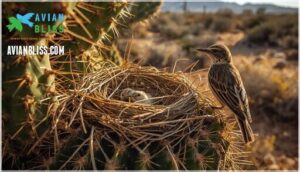
Within dense shrub canopies, you’ll find these thrashers weaving bowl-shaped nests from twigs and grass, usually 0.8 meters high in cholla, mesquite, or yucca. Nest construction takes 2-7 days, with both sexes cooperating on building.
Urban nests occasionally incorporate synthetic materials, while microhabitat features like increased canopy cover improve nest success rates markedly compared to exposed nesting sites.
Egg Characteristics and Incubation
Once nest construction finishes, you’ll observe clutch sizes usually ranging from 3 to 4 eggs, occasionally reaching 5. These avian eggs display pale green to whitish-gray coloration with brown speckling concentrated at the larger end. The incubation period spans 12 to 14 days, with both sexes sharing brooding duties, though females contribute approximately 65% of the total incubation time.
Key factors affecting nest success include:
- Seasonal Variability – Earlier clutches show 20% higher hatching success
- Vegetation Density – Shrubs over 1.5 meters greatly improve survival rates
- Egg Coloration – Semi-glossy shells reduce predator detection through minimal reflectivity
Peak nesting activity occurs during cooler morning and late afternoon periods, helping maintain optimal nest temperatures of 36 to 38°C despite harsh desert conditions.
Parental Care and Fledgling Development
After hatching, both parents diligently feed nestlings for approximately 12 days until fledgling occurs. Young birds can’t fly initially, making predation risks extremely high during their first week outside the nest.
Territory use becomes important as parents guide fledglings through dense vegetation for protection. This extended parental care strategy, lasting up to 38 days, greatly improves ecological adaptations and survival rates in harsh desert environments.
Breeding Season and Brood Frequency
From mid-March through July, you’ll find Bendire’s Thrashers actively breeding across their desert range. These birds usually produce two broods per season, with each clutch containing 3-4 eggs.
Nesting chronology varies regionally—California populations start later than Arizona birds, while environmental influence from spring precipitation directly affects brood productivity and the likelihood of successful double-brooding attempts.
Conservation Status and Threats

The Bendire’s Thrasher faces a conservation crisis that’s hitting harder than most desert birds can handle. This once-common species has crashed by 90 percent over four decades, earning it a spot on multiple watch lists and pushing conservationists into overdrive.
Bendire’s Thrasher has suffered a staggering 90% population crash in forty years, becoming one of the desert’s most urgent conservation crises
Understanding what’s driving this decline—and what’s being done about it—reveals both the challenges and hope for this special desert dweller.
Population Trends and Decline
Bendire’s Thrasher faces one of the steepest population declines among North American desert birds, with numbers plummeting nearly 90% over the past four decades. This dramatic species decline reflects broader challenges facing arid-adapted wildlife as their conservation status deteriorates rapidly.
Key decline causes and monitoring challenges include:
- Annual population decline of 2.7% recorded since 1968, totaling 78% reduction
- Current global population estimated at just 83,000 individuals
- Arizona holds half the world’s remaining Bendire’s Thrasher population
- Detection frequency dropped over 75% between 1970s and 2020s surveys
- Continental Concern Score of 16/20 places species among most critically monitored
Regional variations show Arizona experiencing the steepest losses, while conservation projections indicate potential extinction within the century without immediate recovery strategies to address this alarming habitat loss trajectory.
Habitat Loss and Urban Development
Picture Arizona’s sprawling metro areas as a concrete tide washing over desert landscapes—that’s the reality threatening Bendire’s Thrasher survival. Urban sprawl across Maricopa, Pima, and Pinal counties eliminates critical nesting grounds, while infrastructure threats like the proposed Interstate 11 corridor intensify habitat fragmentation. You’re witnessing how development impacts transform once-continuous arid habitat into isolated patches, accelerating species decline through urbanization pressures that demand immediate conservation strategies.
| Threat Type | Impact on Bendire’s Thrasher |
|---|---|
| Urban Expansion | 90% population loss in 50 years |
| Highway Projects | 60% reduction in nesting territories |
| Agricultural Conversion | Altered shrubland structure |
| Industrial Development | Displaced vegetation cover |
| Habitat Fragmentation | Reduced genetic diversity |
Conservation Initiatives and Legal Protections
Regarding bird conservation efforts, legal muscle makes all the difference. The Center for Biological Diversity’s 2025 ESA listing petition represents a turning point for Bendire’s Thrasher protection, while California’s state-level initiatives strengthen habitat preservation strategies.
Key conservation initiatives driving population recovery include:
- Federal ESA protection – May 2025 petition for threatened/endangered status
- Critical habitat designation – Securing 56,000 U.S. individuals through development restrictions
- Desert Thrasher Conservation Strategy – December 2024 framework for habitat restoration
- Research collaboration – Multi-agency Desert Thrasher Working Group coordination
- Policy advocacy – “Red Alert Tipping Point Species” designation demanding immediate action
These conservation status improvements through research collaboration and policy advocacy create hope for reversing decades of habitat loss across southwestern desert ecosystems.
Community Science and Monitoring Efforts
Ever wondered how everyday birders become conservation heroes? You can join the fight through citizen engagement programs that transform casual observations into powerful species tracking data. The Arizona Important Bird Areas program trains volunteers in standardized monitoring protocols, while the Desert Thrasher Working Group coordinates multi-state conservation collaboration efforts.
| Program | Focus | Impact |
|---|---|---|
| AZIBA Surveys | Point count training | Multi-county coverage |
| DTWG Protocols | Standardized methods | Cross-state comparisons |
| Borderlands Data Center | Technology integration | Real-time tracking |
These bird conservation efforts demonstrate how volunteer training and community education create meaningful conservation initiatives, proving that collective action drives species recovery.
Frequently Asked Questions (FAQs)
What are the unique characteristics of Bendires Thrasher nests?
Like tiny desert fortresses, these striking bowl-shaped nests showcase impressive desert adaptations. You’ll find intricate nest architecture woven from sticks, lined with soft materials, strategically placed in thorny vegetation for maximum nest insulation and predator protection.
How do Bendires Thrashers adapt to desert environments?
Desert camouflage through dusty brown plumage, water conservation via moisture-rich prey consumption, thermal regulation using behavioral cooling strategies, and adaptive foraging techniques enable exceptional arid survival in challenging desert ecosystems.
What is the average lifespan of a Bendires Thrasher?
You’ll find these outstanding desert dwellers usually live 2-6 years in the wild, with outstanding individuals reaching nearly 10 years.
However, survival rates face mounting pressure from habitat loss and predation challenges.
How do Bendires Thrashers interact with other bird species?
Territorial behavior dominates avian interactions during the breeding season, with aggressive chasing of wrens and competing thrashers.
Resource competition occurs with LeConte’s and Curve-billed species, while predator avoidance strategies promote species coexistence in shared desert habitats.
What are the primary threats to Bendires Thrasher populations?
While some assume desert birds face only natural challenges, Bendire’s Thrashers confront multiple human-driven threats.
Habitat fragmentation from urban sprawl, climate impacts, pesticide exposure, invasive species, and recreational disturbance collectively drive their alarming population decline.
How long do Bendires Thrashers typically live?
Maximum lifespan reaches approximately 10 years in wild populations, though most individuals live 4-6 years. Juvenile survival rates around 38-40% greatly impact longevity, with predation representing the primary mortality cause affecting these desert-dwelling bird species.
What predators threaten Bendires Thrasher populations?
Avian predators like Chihuahuan Ravens cause 34% of nest failures, while mammalian threats including coyotes account for 28%. Reptilian predation from snakes reaches 20%.
Habitat fragmentation increases overall predation rates by 32% across desert territories.
Do Bendires Thrashers migrate or stay year-round?
Migration patterns vary by location—northern populations migrate south for winter, while southern resident populations stay year-round.
Partial migration means some birds move seasonally while others remain in suitable desert habitats permanently.
How do climate changes affect desert thrashers?
Rising temperatures and prolonged droughts are reshaping desert landscapes, forcing these specialized birds to adapt their foraging strategies.
While facing dramatic habitat degradation, their reproductive success is threatened, which accelerates population decline.
What diseases commonly impact Bendires Thrasher health?
West Nile Virus, increased parasite prevalence like mites and lice, and pesticide exposure all impact avian health, especially in bird species like Bendire’s Thrasher.
Climate impacts and habitat degradation worsen disease risk, threatening population resilience and survival.
Conclusion
Even as footprints fade from the desert dust, new questions about resilience and adaptation linger in view. Each encounter with Bendire’s thrasher reveals more than a checklist tick; it grants a glimpse into a fragile web where survival is never promised.
As arid landscapes shift, your awareness—and your voice—could make a vital difference. The fate of this unobtrusive, steadfast bird depends on keen observation, persistent stewardship, and a willingness to listen closely to what the silence hides.
- https://www.biologicaldiversity.org/species/birds/Bendires-thrasher/pdfs/Bendires-thrasher-ESA-listing-petition-5-20-25.pdf
- https://borderlandsbirds.org/wp-content/uploads/2025/01/Desert-Thrasher-Conservation-Strategy_v1.0Dec2024.pdf
- https://biologicaldiversity.org/w/news/press-releases/california-endangered-species-status-sought-for-declining-desert-thrashers-2025-09-16/
- https://www.allaboutbirds.org/guide/Bendires_Thrasher/lifehistory
- https://nrm.dfg.ca.gov/FileHandler.ashx?DocumentID=10420