This site is supported by our readers. We may earn a commission, at no cost to you, if you purchase through links.

Few birds split opinion like the black-billed magpie. Ranchers once hunted them by the thousands, convinced they were pests. Scientists now study them as one of the most cognitively advanced birds in North America—capable of recognizing their own reflection, a trick only a handful of species on Earth can pull off.
That tension between misunderstood nuisance and behavioral marvel says everything about how little most people actually know this bird. Spread across western North America from Alaska down through the Rockies, the magpie thrives in places most wildlife struggles to tolerate. What follows breaks down exactly what makes this species tick.
Table Of Contents
- Key Takeaways
- Black-billed Magpie Identification Guide
- Habitat and Distribution
- Behavior and Social Structure
- Diet and Feeding Habits
- Breeding and Conservation
- Frequently Asked Questions (FAQs)
- What does seeing a black-billed magpie mean?
- Do black-billed magpies swoop?
- Are black-billed magpies rare?
- Are black-billed magpies aggressive?
- Where do black-billed magpies live?
- How long do black-billed magpies typically live?
- What predators prey on black-billed magpies?
- Do black-billed magpies have any unique vocalizations?
- Can black-billed magpies mimic human speech?
- What role do magpies play in their ecosystem?
- Conclusion
Key Takeaways
- The black-billed magpie can recognize itself in a mirror—one of the only birds on Earth that can pull that off, which tells you its brain is running at a level most people never give it credit for.
- It doesn’t pick one habitat and settle; from Alaskan scrublands to suburban backyards, it reads the landscape and adapts faster than most wildlife ever could.
- Its social life runs deeper than you’d expect—family groups, winter roosts, vocal dialects, and even grief rituals around dead members of the flock.
- Despite holding a “least concern” status, regional declines of up to 74% in places like Nebraska show that stable on paper doesn’t always mean safe on the ground.
Black-billed Magpie Identification Guide
Spotting a Black-billed Magpie in the field isn’t hard once you know what to look for. These birds wear their identity boldly — no blending in, no hiding.
That bold black-and-white contrast is hard to miss, and if you’re learning your birds, brushing up on how to identify birds by their facial markings makes the whole process click faster.
Here’s what to check when one crosses your path.
Size, Shape, and Measurements
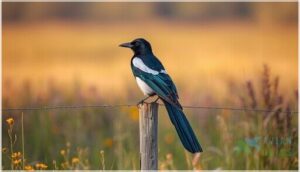
The black-billed magpie is a jay-like bird that punches above its weight in presence. Here’s what defines its frame:
- Body Proportions: Adults run 45–60 cm long, weighing 145–210 grams.
- Tail Length: The long tail makes up nearly half that total length.
- Wing Span: Broad wings spread 56–61 cm, built for agile flight.
- Beak Size: The heavy bill is built for serious work.
For a thorough overview of its, further reading is available.
Distinctive Tail and Bill Features
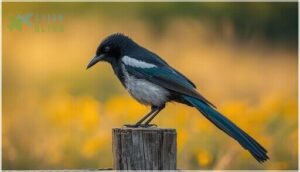
That heavy bill isn’t just for show — it digs, pries, and picks with real precision. The beak structure manages everything from ticks on cattle to buried beetles.
Then there’s that long tail, graduated to a sharp diamond tip, flicking and steering with every move. In good light, the blue-green iridescence across tail and wings shifts like oil on water.
For more details about their conspicuous appearance and behaviors, see the bright, flashy white wing patches on these extraordinary birds.
Plumage Coloration and Patterns
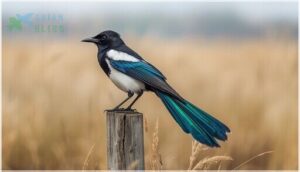
From that shimmering tail, look closer — the magpie’s distinctive plumage tells a bold story.
Sharp black hood, white belly, white primaries flashing like signals across open fields.
That bluegreen iridescence isn’t pigment — it’s pure feather structure bending light.
Like a jaylike bird dressed for rebellion, the color patterns shift with every angle, turning visual signaling into something almost alive.
Sexual Dimorphism and Age Differences
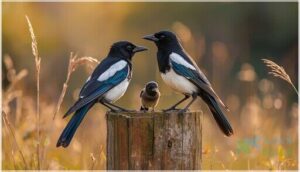
That bold plumage looks the same on every bird — but look closer, and the Sexual Size Difference tells another story.
Males run 6–9% longer and up to 24% heavier than females. Age Based Traits sharpen the picture further:
- Juveniles show duller iridescence and buffy underparts
- First-year birds have rounded tail feathers vs. adult squared tips
- Full Maturity Stages complete after the first molt
Dimorphic Features here are structural, not colorful.
Comparison With Similar Magpie Species
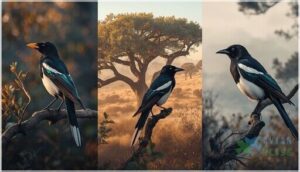
Three cousins, one confusing family portrait. In the Corvidae family — home to Crows, Magpies, and Jays — the Black-billed Magpie stands apart once you know what to clock.
Each of these birds has carved out its own corner of the world, and their geographic ranges and habitat preferences make the family’s diversity even more striking.
Yellow-billed Magpies share the same Plumage Gloss and body plan but stay locked inside California. Eurasian birds look nearly identical, yet their Geographic Range never crosses into North America.
Bill Color, Tail Length, and Vocalization seal the ID every time.
Habitat and Distribution
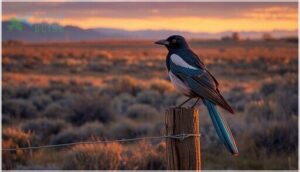
The black-billed magpie doesn’t stick to one kind of place — it roams a wide stretch of western North America with surprising ease.
Whether you’re in open farmland, a suburban backyard, or mountain shrubland, there’s a good chance this bird has already figured out how to live there. Here’s a closer look at where it actually shows up and why.
Geographic Range in North America
The Black-billed Magpie — a standout of the Corvidae family — claims the western landscapes of North America as its own. You’ll find it ranging from coastal southern Alaska down through western Canada and into the Rocky Mountain states.
Range expansion has nudged it eastward into the Great Plains, though Climate Shift and Habitat Fragmentation keep reshaping where this bird species calls home.
Preferred Habitats and Environments
In terms of habitat selection, this bird doesn’t settle — it thrives. Black-billed magpies favor semi-open country: fields, meadows, grasslands, sagebrush steppe, and shrublands savanna thickets where edge habitats connect tree cover to open ground.
Landscape ecology shapes their range — riparian corridors, scattered woodlands, and agricultural mosaics support ecosystem dynamics and biodiversity conservation. They don’t chase dense forest or barren desert and arid habitats.
Adaptations to Urban and Rural Areas
Few birds own both worlds the way this one does. Its adaptations to urban and suburban habitats — and wild rural landscapes — reflect a rare behavioral range in avian ecology.
- Urban Nesting in tall street trees reduces human disturbance
- Human Food sources like trash and scraps fill winter gaps
- Disturbance Tolerance keeps them foraging near busy roads
- Landscape foraging shifts between farms, parks, and roadsides
- Wildlife habitats from ranchlands to city parks are all fair game
Population Size and Trends
About 5.4 to 6.1 million adults range across North America — but that number tells only part of the story. Global Trends show stability, yet Regional Fluctuations reveal sharp Population Shifts beneath the surface.
Nebraska lost roughly 74% of occupied survey blocks since the 1980s. The West Nile virus accelerated Demographic Changes after 2003. Conservation Impacts remain uneven across the range.
| Region | Trend |
|---|---|
| Nebraska | ~7% annual decline |
| Minnesota | Notable increase |
| Montana/Wyoming | Stable or rising |
| Great Plains | Significant declines |
Behavior and Social Structure

Black-billed magpies don’t just live alongside each other — they build real social lives.
From tight family groups to noisy roost gatherings, their behavior runs deeper than most people expect.
Here’s what shapes how they communicate, forage, and connect.
Family Groups and Communal Roosting
These magpies don’t fly solo. Family groups of 5 to 10 birds stay tight year-round, sharing food, space, and a clear social order.
Come winter, those family bonds stretch further — communal roosting pulls hundreds of individuals into dense shelterbelts, a smart play for Predator Evasion and warmth. Roost Dynamics peak in February, with Winter Gatherings reinforcing the social behaviors that define Corvidae family avian behavior patterns.
Vocalizations and Communication
Their vocal life is just as layered as their social one. The Black-billed Magpie runs a wide range of Call Patterns — harsh chatters, coos, purrs, and Alarm Signals that shift in syllable length depending on threat level.
Longer syllables draw birds in; shorter ones push them away. Geographic Dialects exist too, with measurable pitch differences across populations — a quiet nod to Vocal Learning and regional identity.
Magpie calls shift with intent — longer syllables to gather, shorter ones to scatter
Foraging Techniques and Ground Behavior
On the ground is where the Black-billed Magpie really earns its reputation. Ground Foraging defines its daily rhythm — walk, pause, probe, repeat. Bill Usage is precise: jabbing soil, flipping dung, tearing carrion.
- Insect Hunting peaks in summer, targeting grasshoppers and beetles
- Scavenging Tactics include following coyotes to fresh kills
- Cache Management means burying scraps across wide areas for later
Notable Social Behaviors
Beyond foraging, the Black-billed Magpie runs a tight social order. Dominance Hierarchy shapes who eats first — males generally rank above females, and dominant birds displace subordinates without much drama.
Social Learning kicks in early, with juveniles joining mob events to identify predators. Funeral Behavior draws small groups around a dead magpie, calling briefly, then moving on.
Playful Interactions among young birds hone flight skills.
Diet and Feeding Habits
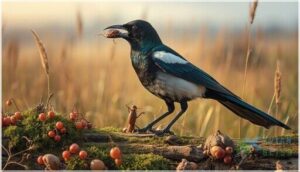
The black-billed magpie doesn’t play by the rules in terms of eating. It’s an opportunist through and through, willing to eat almost anything the landscape offers.
Here’s a closer look at what fuels this adaptable bird.
Omnivorous Diet Overview
The Black-billed Magpie doesn’t pick sides — it eats what’s there. This omnivorous bird covers roughly two-thirds animal matter and one-third plant material across the year. That flexibility is the whole game.
- Foraging Strategies shift with the seasons — insects in summer, seeds and carrion in winter
- Scavenging Behavior ties it directly into Food Web Dynamics and Nutrient Cycling
- Ecosystem Services include pest control, seed dispersal, and carcass cleanup
- Its bird species characteristics make it one of the most diet-adaptable corvids around
Insect and Carrion Foraging
In the context of Insect Hunting and Carrion Feeding, the Blackbilled Magpie doesn’t wait around. It walks open ground, flips debris with its bill, and digs into dung or disturbed soil to find beetles and grasshoppers.
Scavenging Behavior kicks in around carcasses and roadkill, where it follows predators like coyotes for leftovers. Its Foraging Strategies also include Food Caching — stashing excess food in soil or snow.
Plant Material and Seasonal Diet Shifts
When insects disappear under snow, the magpie pivots — no hesitation. Its Winter Diet leans hard on Berry Foraging, Grain Preferences, and Seed Consumption.
You’ll spot them raiding farm fields for corn or wheat, picking ornamental fruits from yard trees, or hitting bird feeders. This Food Adaptation is core to their diet and nutrition strategy, keeping them fed when the wild world goes quiet.
Food Caching and Stealing
Magpie Foraging doesn’t stop at finding food — it’s about outsmarting everyone else for it. This bird species masters Scatter Caching, hiding food in dozens of small spots across its territory.
- Each cache holds just one or two items
- False caches throw off would-be thieves
- Cache Recovery happens within days
- Food Theft between birds is constant
Hoarding Strategies and avian behavior don’t get wilder than this.
Dietary Needs of Adults Vs. Chicks
Adults and chicks don’t follow the same playbook. A grown black-billed magpie thrives on dietary flexibility — shifting between insects, seeds, and carrion as seasons change.
Chicks need something different: high protein intake, tight nutrient balance, and relentless feeding frequency from both parents. Wildlife biology calls this divergence essential. Their nesting habits and energy requirements shape every meal delivered to the nest.
Breeding and Conservation
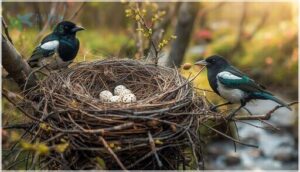
Breeding season is when you really see how purposeful these birds are. From the moment they start building their nests to the day their young take flight, every step follows a clear pattern.
Here’s what that process looks like, and why it matters for the species’ future.
Nest Construction and Site Selection
Black-billed magpie nests aren’t built overnight — construction follows four Building Stages and takes 40 to 50 days. Their nesting habits reflect serious Nesting Effort.
Their nests are constructed in the following manner:
- A stick framework anchors the Dome Structure
- A Mud Bowl lines the interior
- Soft grasses and fur insulate the cup
They often select posts and small trees, weaving Thorn branches into the roof to block predators.
Egg Laying and Parental Care
Once the nest is ready, the female lays 6 to 7 eggs — sometimes up to 9 — over roughly a week. Her brooding behavior is steadfast; she undertakes all egg incubation for 16 to 21 days while the male delivers food.
These parental roles reflect complex avian biology and mating and breeding strategies shaped by survival, not sentiment.
Fledging and Juvenile Development
Once those eggs hatch, the real work begins. Chicks leave the nest 24–30 days after hatching, but nest departure doesn’t mean freedom — not yet.
Here’s what juvenile development looks like in the black-billed magpie:
- Fledging success averages 3–4 chicks per nest
- Parental investment continues 6–8 weeks post-fledging
- Social learning happens by shadowing adults
- Juvenile mortality drops as flight improves
- Full independence arrives around 70 days
Conservation Status and Threats
Once juveniles strike out on their own, a bigger picture comes into focus. The black-billed magpie holds Least Concern status globally, but that doesn’t mean all’s well.
Population decline continues at roughly 0.5% yearly. Pesticide exposure, habitat fragmentation, habitat loss, and human persecution all chip away at numbers. Climate change adds pressure too — and ignoring these threats isn’t an option for serious bird conservation.
Conservation Efforts and Strategies
Real conservation efforts are already in motion. Wildlife management agencies focus on three key actions:
- Enforcing species protection under the Migratory Bird Treaty Act
- Supporting habitat preservation across declining Great Plains populations
- Monitoring trends through Breeding Bird Surveys and Christmas Bird Counts.
Ecosystem restoration and biodiversity conservation depend on early action. You can help by securing food sources, supporting covered coops, and spreading the word.
Frequently Asked Questions (FAQs)
What does seeing a black-billed magpie mean?
Seeing a magpie carries deep Magpie Symbolism across cultures.
In folklore interpretations, one bird signals sorrow, while two bring joy.
Its spiritual meaning blends omen beliefs with cultural significance, making every sighting worth a second look.
Do black-billed magpies swoop?
Yes, black-billed magpies swoop — especially in spring.
Swooping triggers include nesting threats, and individual variation means some birds dive boldly while others just call.
Wear a hat and give nests space.
Are black-billed magpies rare?
Not rare at all. The black-billed magpie holds a Least Concern Rarity Status, with roughly 6 million individuals across its Geographic Distribution.
Population Trends remain stable, making species conservation a low-urgency, long-term watch.
Are black-billed magpies aggressive?
Black-billed magpies can get bold — but are they truly aggressive? Mostly during nesting season.
Expect nest defense swoops, predator mobbing, and territorial disputes near the nest, but serious attacks on people stay rare.
Where do black-billed magpies live?
These bold birds call western North America home, stretching from Alaska south through the Rocky Mountains and Great Plains.
Their geographic range spans open fields, meadows, grasslands, shrublands, and suburban edges with equal ease.
How long do black-billed magpies typically live?
Most wild magpies live four to six years, though lifespan factors like harsh winters and predators cut many lives short.
Mortality rates run highest in juveniles. Captive birds push longevity trends past twenty years.
What predators prey on black-billed magpies?
Great horned owls, red-tailed hawks, coyotes, and ravens all prey on magpies.
Fledgling survival drops sharply after leaving the nest, making raptor attacks and nest defense critical to magpie mortality rates.
Do black-billed magpies have any unique vocalizations?
Yes — their call patterns are surprisingly varied. From harsh alarm signals to soft whisper songs, their song structure and imitation ability set them apart, making vocal learning a standout trait among corvids.
Can black-billed magpies mimic human speech?
They can. Through vocal learning, black-billed magpies mimic short human words like “hi” when hand-raised.
This speech imitation reflects genuine cognitive ability and intelligent behavior, rooted in social interaction rather than instinct.
What role do magpies play in their ecosystem?
Ecosystem engineers rarely announce themselves.
Magpies recycle nutrients through scavenging, control insect populations, enable seed dispersal, and support biodiversity.
Their role in ecological balance makes them quiet but critical players in ecosystem management and wildlife conservation.
Conclusion
The black-billed magpie is hunted and studied, dismissed and admired—a bird that thrives precisely because people keep underestimating it.
It doesn’t need your approval to cache food through winter, outwit predators, or recognize its own face in a reflection.
Once you stop seeing it as a nuisance and start watching how it actually moves through the world, something shifts. You don’t just notice a bird anymore. You notice how much you’d missed.