This site is supported by our readers. We may earn a commission, at no cost to you, if you purchase through links.
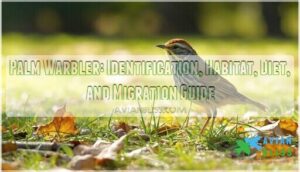 Watch a Palm Warbler for just a few seconds, and you’ll notice something unusual—its tail never stops moving. This constant bobbing, paired with rusty cap feathers and a preference for walking on the ground rather than flitting through branches, sets this warbler apart from its woodland cousins.
While most warblers hide in dense canopy foliage, Palm Warblers forage openly in fields, beaches, and even parking lots during migration, making them one of the easiest warblers to observe.
Whether you’re scanning Florida’s winter coastlines or watching spring migrants pass through your local park, learning to identify this distinctive bird opens up reliable year-round warbler watching opportunities.
Table Of Contents
- Key Takeaways
- Distinguishing Features of The Palm Warbler
- Palm Warbler Habitat and Range
- Palm Warbler Diet and Foraging Habits
- Nesting and Breeding Behavior of Palm Warblers
- Conservation and Migration Challenges
- Frequently Asked Questions (FAQs)
- How to identify a Palm Warbler?
- Are Palm Warblers rare?
- Are Palm Warblers native to Florida?
- What is the difference between a yellow rumped warbler and a Palm Warbler?
- How long do Palm Warblers live?
- What predators do Palm Warblers face?
- How do Palm Warblers raise their young?
- Are Palm Warblers solitary or social birds?
- Do Palm Warblers interact with humans?
- How long do Palm Warblers typically live?
- Conclusion
Key Takeaways
- Palm Warblers stand out among North American warblers through their constant tail-bobbing behavior, longer legs, and preference for ground foraging in open habitats like fields and beaches rather than dense forest canopy, making them one of the easiest warbler species to observe during migration and winter months.
- The species splits into two distinct plumage forms at James Bay—the "Yellow" variety with entirely yellow underparts and the "Western" type with whitish belly—both maintaining a distinctive rufous breeding cap and bright yellow undertail coverts that aid in reliable field identification.
- These adaptable warblers breed almost exclusively (98% of global population) in Canada’s remote boreal peatlands and bogs, then migrate to concentrate heavily in the southeastern United States (particularly Florida, which hosts up to 75% of wintering birds) and Caribbean, demonstrating remarkable habitat flexibility from pristine wetlands to suburban parks and golf courses.
- Despite stable populations of roughly 13 million individuals, Palm Warblers face emerging conservation challenges including peat extraction threatening breeding grounds, collision mortality during nocturnal migration past lit structures, and climate models suggesting up to 83% of their current breeding range could shift due to warming temperatures affecting bog hydrology and insect abundance timing.
Distinguishing Features of The Palm Warbler
Recognizing a Palm Warbler in the field requires attention to several distinctive traits that set this species apart from other warblers. You’ll want to focus on plumage variations, behavioral quirks, and subtle physical features that make identification more reliable.
These key markers will help you confidently distinguish Palm Warblers from look-alike species during your observations.
Physical Characteristics and Size
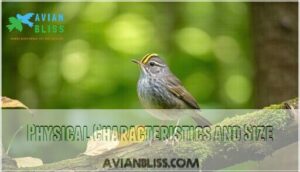
You’ll find the Palm Warbler standing a bit taller than most warblers, its longer legs and tail giving it an upright, pipit-like silhouette that makes it easy to spot when it’s foraging near the ground.
These sparrow-sized birds measure between 4.7 and 5.5 inches in length, with key body proportions including:
- Weight ranging from 0.3 to 0.5 ounces
- Wingspan stretching 7.9 to 8.3 inches across
- Leg length noticeably longer than typical warbler species
- Wing structure and tail proportions creating their distinctive posture
Their grayish-brown plumage shows subtle feather patterns with a yellow eyebrow that helps with Palm Warbler identification year-round.
Plumage Differences: Yellow Vs. Western Types

The Palm Warbler’s plumage splits into two distinct forms at James Bay, with the "Yellow" variety flashing entirely yellow underparts while the "Western" type sports a whitish belly that contrasts sharply with its bright yellow undertail. These plumage variations hold steady through molt cycles, making subspecies identification reliable year-round.
The Western Palm Warbler’s color patterns show more subdued tones compared to its eastern cousin’s vibrant yellow wash, though both share that distinctive chestnut cap and yellow undertail coverts that set warbler plumage characteristics apart.
Unique Tail-Bobbing Behavior
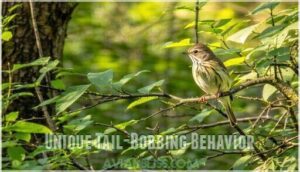
Watch for that signature bob—once you spot a Palm Warbler pumping its tail up and down with metronomic precision, you’ve found one of the few warbler species that simply can’t hold still.
Once you spot a Palm Warbler pumping its tail with metronomic precision, you’ve found one of the few warblers that simply can’t hold still
This tail movement occurs continuously during ground behavior, maintaining a steady bobbing speed whether you’re observing foraging styles or watching the bird’s posture analysis in action.
The avian behavior acts as your most reliable field mark, especially during warbler migration patterns when other identification features may appear less distinct.
Key Identification Markers Compared to Similar Species
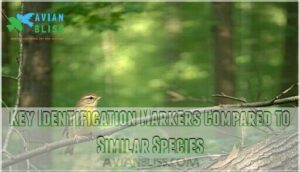
Beyond that tail bobbing, you’ll want to note several plumage patterns and structural features for confident bird identification. The Palm Warbler shows a bright yellow undertail, rufous breeding cap, and pale eyebrow—coloration differences that separate it from Prairie and Cape May warbler species.
Tail length exceeds most warblers’, while faint wing bars and brown upperparts help in warbler species comparison with other bird species identification challenges you’ll encounter.
Understanding the boreal forest habitat is essential for identifying the Palm Warbler’s breeding grounds and migration patterns.
Palm Warbler Habitat and Range
Understanding where you’ll find Palm Warblers throughout the year helps you know when and where to look for these distinctive tail-bobbing songbirds. Their range shifts dramatically with the seasons, taking them from remote northern bogs to sunny southern coasts and through a variety of landscapes in between.
Let’s explore the three main chapters of their annual journey across North America.
Breeding Grounds in Boreal Forests
You’ll find Palm Warblers breeding across Canada’s vast boreal forest, where roughly 98% of the global population nests in remote peatlands and bogs. These ground-nesting specialists favor open habitats with black spruce, tamarack, and sphagnum moss—ecosystems that define boreal forest ecology.
While breeding habitat remains largely intact, climate models suggest up to 83% of this range could shift, making peatland conservation increasingly essential for the species’ climate resilience and warbler migration patterns. Understanding the birds’ breeding ground habits is essential for effective conservation efforts.
Wintering Sites in The Southeastern USA and Caribbean
During the cooler months, you’ll encounter the majority of Palm Warblers across Florida’s open fields and coastal areas, where up to 75% of the wintering population gathers. Their winter habitat stretches from southern Delaware through the Gulf Coast to Texas, with smaller numbers reaching the Caribbean islands.
These seasonal movements bring Palm Warblers to weedy fields, forest edges, and urban parks, where their ground-based foraging strategies help them thrive until spring migration begins.
Preferred Habitats During Migration
As Palm Warblers journey between their northern breeding grounds and southern wintering territories, you’ll spot them in surprisingly diverse stopover sites—from manicured golf courses and suburban parks to scrubby fields and coastal thickets.
These open shrubby habitats and forest edges provide critical resources during migration patterns, while coastal wetlands and agricultural areas offer abundant insects. Unlike many warblers preferring dense boreal forest habitats, migrating Palm Warblers readily adapt to urban landscapes along their migration routes.
Palm Warbler Diet and Foraging Habits
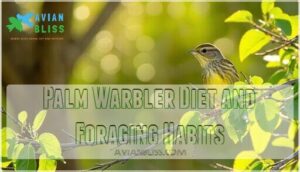
Palm Warblers aren’t picky eaters, and their foraging strategy reflects a bird that’s adapted to find food wherever it lands.
You’ll notice they shift what they eat and how they hunt depending on the season and habitat. Let’s break down their diet, foraging techniques, and how these change throughout the year.
Insect and Berry Diet
You’ll find Palm Warblers dining on a surprisingly diverse menu that shifts with the seasons, from tiny beetles and flies to sweet bayberries and raspberries. Their insect diet includes small beetles, mosquitoes, leafhoppers, grasshoppers, and ants, supporting essential nutrient intake during breeding.
You’ll also spot them eating spiders and bees, while berry consumption—especially raspberries and bayberries—fuels migration, demonstrating notable dietary adaptation across their range.
Ground-Based and Aerial Foraging Techniques
Unlike most warblers that cling to branches and hunt above your head, this species hunts like a sparrow—walking boldly across open ground while pumping its tail, then launching into the air to snatch insects mid-flight.
You’ll observe this Palm Warbler demonstrating dual foraging strategies: ground foraging through methodical hopping and gleaning, paired with aerial pursuit when food sources demand it.
This warbler feeding habit reflects exceptional behavioral flexibility, allowing efficient insect capture across varied habitats while optimizing its avian diet as an adaptable insectivore.
Seasonal Changes in Diet
When breeding season arrives, Palm Warbler diet shifts from protein-rich insects to mixed food sources as availability changes throughout the year. These dietary adaptation patterns reflect seasonal shifts in nutrient intake and foraging strategies:
- Summer breeding: Gleaning small beetles, flies, leafhoppers, and mosquitoes from foliage facilitates reproduction
- Fall migration: Consuming berries like raspberries and bayberries supplements insect intake during transit
- Winter months: Ground-based foraging for seeds, spiders, and various insects sustains survival in warmer regions
This warbler feeding habit demonstrates exceptional avian diet flexibility for bird identification purposes.
Nesting and Breeding Behavior of Palm Warblers
Palm Warblers show exceptional nesting behavior, building hidden ground nests in remote boreal bogs where few birders venture.
Their breeding strategies include clever defenses against nest parasites and coordinated parental care that ensures fledgling success.
Here’s what you need to know about their nest construction, egg-laying patterns, parental duties, and protective behaviors.
Nest Construction and Concealment
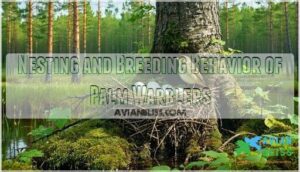
Hidden deep in the sphagnum-rich wetlands of Canada’s boreal zone, the Palm Warbler constructs one of the most secretive nests among North American warblers, carefully tucking it at the base of a small conifer or shrub where detection by predators becomes nearly impossible.
You’ll find the nest-building process employs intricate camouflage techniques, with the female weaving rootlets, soft bark strips, sedge, grasses, and other bog vegetation into a small, cup-shaped structure that blends seamlessly with the surrounding ground cover, making Palm Warbler nesting behavior remarkably adapted to ground nesting challenges.
Clutch Size, Egg Description, and Incubation
Once the nest is complete, the female usually lays four to five creamy white eggs marked with brown speckles, beginning an incubation period of roughly twelve days that both parents likely share.
This brood size remains consistent across the Palm Warbler’s range, and you’ll notice the eggs are incubated with keen attentiveness.
A nesting habit that greatly improves fledging success by maintaining ideal temperature throughout the developmental period, essential for successful bird identification studies tracking reproductive outcomes.
Parental Roles and Fledging Period
After the eggs hatch, both parents work together to feed the nestlings. You’ll see the young birds leave their well-hidden nest at around twelve days old, though they can’t fly strongly yet.
Within one to two days of fledging, these young Palm Warblers manage short flights, gradually building strength. Both parents continue their parental investment, providing food and protection until the juveniles reach independence—a critical phase in the Palm Warbler life cycle that demonstrates exceptional warbler reproduction strategies and bird behavior patterns.
Defense Against Nest Parasitism
Palm Warblers have developed an exceptional defensive strategy against Brown-headed Cowbirds, which try to sneak their eggs into warbler nests. You’ll rarely find cowbird eggs successfully parasitizing these vigilant parents.
When they detect foreign eggs, these insectivores actively remove the cowbird eggs or cover them with nesting material, ensuring brood survival. This nest defense behavior—recognizing intruder eggs through keen observation—demonstrates effective parasite removal and nest sanitation that protects their own offspring from competition.
Conservation and Migration Challenges
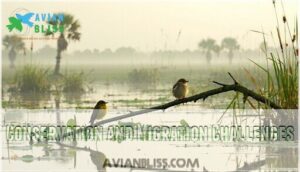
Palm Warblers remain common across their range, but you’ll find they face real challenges that could shape their future. Habitat loss from peat extraction and deforestation threatens their breeding grounds, while migration brings deadly encounters with towers and lit structures.
Climate change is shifting the landscapes these birds depend on, making conservation efforts more urgent than ever.
Current Population Status and Threats
You’ll find the Palm Warbler population thriving, with roughly 13 million individuals globally and a Least Concern conservation status. Population trends show consistent growth since 1970, though mortality rates from tower collisions during migration remain concerning.
Habitat loss through peat extraction in Quebec threatens breeding grounds locally, yet wildlife conservation efforts across Canada’s boreal regions help maintain stable numbers.
Palm Warbler conservation benefits from legal protections under migratory bird legislation, supporting ongoing ecological conservation.
Effects of Habitat Loss and Climate Change
Across boreal Canada, habitat fragmentation from peat extraction and logging reduces Palm Warbler breeding territory, while climate shift alters bog hydrology and insect abundance timing.
Ecosystem disruption from warming temperatures affects species vulnerability during migration, though environmental resilience remains evident in stable populations.
Your support for habitat conservation and avian habitat preservation strengthens ecological conservation, ensuring wildlife conservation efforts protect Palm Warbler habitat against future environmental pressures.
Migration Routes and Hazards
During spring and fall, you’ll witness Palm Warbler migration across eastern North America, where migratory patterns reveal predictable regional timings—early April northbound, September-October southward.
Migration routes traverse perilous landscapes, including urban areas with lit towers, creating significant flight hazards during nocturnal travel.
Quantifiable trends from survey data show population stability despite collision mortality, though warbler migration patterns demonstrate vulnerability to anthropogenic structures along traditional bird migration corridors.
Ongoing Conservation Efforts and Research
Why does conservation matter when populations seem stable? You’ll find that conservation initiatives like Canada’s Bird Conservation Region Strategy and Audubon’s climate modeling protect Palm Warblers proactively.
Research collaboration through eBird and banding programs advances species monitoring, while habitat restoration in Honduras and bog preservation counter development threats.
Ornithological research using radar tracking and genomic studies informs wildlife conservation efforts, ensuring these avian research priorities address collision mortality and ecological conservation needs through adaptive climate modeling strategies.
Frequently Asked Questions (FAQs)
How to identify a Palm Warbler?
You’ll recognize this small songbird by its constant tail-bobbing habit and subtly patterned brown-and-yellow plumage.
During breeding season, look for the distinctive rufous cap, yellow eyebrow, and streaked underparts with bright yellow undertail coverts.
Are Palm Warblers rare?
You won’t need to journey far to spot this warbler species. Palm Warblers are common across their range, not rare or vulnerable, with stable population trends supporting healthy conservation efforts for this adaptable avian species and its subspecies.
Are Palm Warblers native to Florida?
While you might see these birds throughout Florida, they aren’t native there. Palm Warblers use Florida as critical wintering grounds after breeding in Canada’s boreal forests, making the state a seasonal home rather than their year-round geographic range.
What is the difference between a yellow rumped warbler and a Palm Warbler?
Yellow-rumped Warblers show bold yellow patches on their sides and rump, plus white throat patches—think of them as the flashier cousin.
Palm Warblers, by contrast, display chestnut caps during breeding season, constant tail-bobbing behavior, and yellow undertail coverts with subtler streaking across their underparts.
How long do Palm Warblers live?
You’ll find that most Palm Warblers live around two to three years in the wild, though some individuals have been documented reaching six or seven years when survival strategies align favorably with habitat conditions and predation avoidance.
What predators do Palm Warblers face?
Predators like hawks, snakes, and mammals such as feral cats threaten these small songbirds throughout their life cycle, while nest raiders including crows and squirrels target eggs and nestlings in their well-concealed ground nests.
How do Palm Warblers raise their young?
Both parents share feeding duties after the young hatch, bringing insects to the nestlings for roughly 12 days.
Once fledged, the chicks can fly short distances within a day or two, though parents continue feeding them until independence arrives.
Are Palm Warblers solitary or social birds?
Think of them as birds who keep their options open—Palm Warblers shift between solitary habits and social interactions depending on the season.
During fall migration, you’ll spot them joining flocks with other warbler species, but they mostly forage alone year-round.
Do Palm Warblers interact with humans?
Palm Warblers tolerate human presence well, often visiting backyard bird feeders and urban parks during migration. You’ll spot them foraging on lawns and golf courses, though window collisions pose risks in developed areas.
How long do Palm Warblers typically live?
Most avian longevity studies show small songbirds face high mortality rates, but you’ll be surprised—Palm Warblers can survive several years in the wild, with banding age records documenting individuals reaching 5-6 years, though survival strategies vary by environmental pressures.
Conclusion
Like a compass needle pointing steadily south, the palm warbler’s tail-bobbing guides you through seasons and landscapes where other warblers vanish. From boreal bogs to Florida beaches, this adaptable species proves that warbler watching doesn’t require dense forests or fleeting glimpses.
Watch for that constant tail motion, rusty cap, and ground-foraging habit—you’ll find palm warblers thriving in open spaces year-round, offering consistent opportunities to sharpen your identification skills and deepen your connection with migratory rhythms.
- https://macaulaylibrary.org/photo/43731651
- https://en.wikipedia.org/wiki/Johann_Friedrich_Gmelin
- https://www.allaboutbirds.org/news/where-the-birds-come-from-the-push-to-protect-the-boreal-forest/
- https://wildlife-species.canada.ca/bird-status/oiseau-bird-eng.aspx?sY=2019&sL=e&sM=a&sB=PAWA
- https://www.birdatlas.mb.ca/accounts/speciesaccount.jsp?sp=PAWA&lang=en