This site is supported by our readers. We may earn a commission, at no cost to you, if you purchase through links.
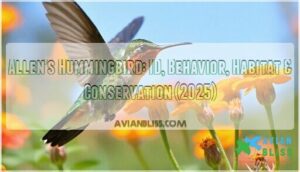 A tiny warrior guards his territory with the ferocity of a creature ten times his size. The male Allen’s Hummingbird defends his patch of coastal scrub like it’s the last refuge on Earth—and for this species, that instinct might be prescient.
These orange-throated jewels have lost 83% of their population since 1970, making every sighting more precious than the last. You’ll find them tracing an ancient elliptical route between coastal California and northern Mexico, though some rebels have abandoned migration altogether, staking permanent claims in Southern California suburbs.
Their rust-colored flanks flash through native gardens where monkey-flowers bloom, each bird burning through twice its body weight in fuel daily to power wings that beat fifty times per second.
Table Of Contents
- Key Takeaways
- Allen’s Hummingbird Identification
- Allen’s Hummingbird Behavior
- Allen’s Hummingbird Habitat and Migration
- Allen’s Hummingbird Diet and Feeding
- Allen’s Hummingbird Conservation Status
- Frequently Asked Questions (FAQs)
- What are Allen’s hummingbirds?
- Where do Allen’s hummingbirds live?
- Are Allen’s hummingbirds rufous?
- How do you identify an Allen’s hummingbird?
- How big do Allen’s hummingbirds get?
- Are Allen’s hummingbirds migrating?
- What is the difference between Anna’s hummingbird and Allen’s hummingbird?
- What is the Allen’s hummingbird behavior?
- Are Allen’s hummingbirds endangered?
- Are Allen’s hummingbirds territorial?
- Conclusion
Key Takeaways
- Allen’s Hummingbirds have crashed 83% since 1970 and face critical habitat loss from coastal development, making them one of North America’s fastest-declining species despite not yet being officially endangered.
- Males defend territories with aggressive aerial displays and J-shaped courtship dives, while some populations have abandoned migration entirely to breed year-round in Southern California suburbs.
- These birds burn through twice their body weight daily in fuel, requiring nectar from red tubular flowers plus insects for protein, making native plant gardens and clean feeders essential survival tools.
- Distinguishing Allen’s from Rufous Hummingbirds requires examining tail feather shape and courtship patterns since up to 30% of male Rufous also show green backs, making visual identification unreliable.
Allen’s Hummingbird Identification
Spotting an Allen’s Hummingbird takes a sharp eye and a bit of know-how. These tiny birds share many traits with their close cousins, the Rufous Hummingbirds, making field identification a real puzzle.
Here’s what you need to look for to tell them apart and understand where they show up.
Physical Description and Characteristics
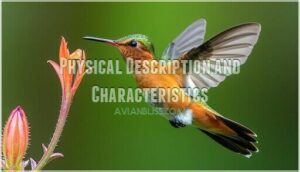
You’ll know an Allen’s Hummingbird the moment you spot one—these tiny acrobats stretch just 3 to 3½ inches from beak to tail, making them barely longer than your thumb. Males wear a show-stopping costume: a green back that catches the light, rust-orange flanks and tail, and an iridescent orange-red gorget that blazes like fire. Their straight beak matches the head’s length, while the tail extends past folded wings.
Females and juveniles trade flashiness for subtlety, sporting duller plumage that makes identification trickier.
Distinction From Similar Species
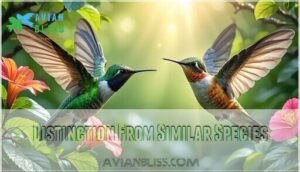
Telling an Allen’s Hummingbird from a Rufous Hummingbird is like spotting twins with different tattoos—you need sharp eyes. Here’s your field guide for bird species identification:
- Tail Structure: Allen’s shows narrower, more pointed outer tail feathers, while Rufous displays a notched R2 feather and squarer tail tips—this is your most reliable visual cue.
- Feather Color: Adult male Allen’s Hummingbirds sport solid green backs, but up to 30% of male Rufous Hummingbirds also show partial green, so back color alone won’t seal the deal.
- Courtship Displays: Allen’s males plunge in J-shaped arcs, while Rufous perform U-shaped aerial loops—behavior reveals identity when plumage fails.
Females and juveniles of both species often hybridize, making identification nearly impossible without examining spread tail feathers in hand. Unlike the smaller Calliope Hummingbird or larger Anna’s Hummingbird, these two remain frustratingly similar. Understanding the color variation patterns is vital for accurate identification.
Migratory Patterns and Range

Once you’ve cracked the look-alike puzzle, the next mystery is where these birds actually go—and Allen’s Hummingbirds follow one of the most compressed migration schedules of any North American hummingbird. Males push north along coastal habitat corridors as early as January, claiming territories before females arrive weeks later. By summer’s end, migratory populations retreat to wintering sites in central Mexico.
But here’s the twist: sedentary populations along Southern California’s coast don’t migrate at all—they’ve broken free from the ancient rhythm, breeding year-round in suburban gardens while their cousins chase seasons.
Habitat Preferences
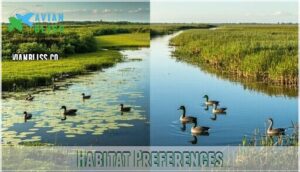
Knowing where they travel only tells half the story—where they choose to stop and settle reveals everything about what makes them tick. Allen’s Hummingbirds stake claims in five distinct landscape types:
- Coastal Habitats with salt-tolerant scrub and fog-drip moisture
- Shrubland Management areas featuring native chaparral and sagebrush
- Urban Landscapes offering nectar corridors through deliberate Garden Design
- Forest Ecology zones at woodland edges with open oak canopies
- Wildlife Habitat preserves supporting Avian Habitat Preservation initiatives
Their Conservation Status hinges on protecting these Hummingbird Habitat mosaics—especially where coastal development fragments remaining pockets of suitable territory.
Allen’s Hummingbird Behavior
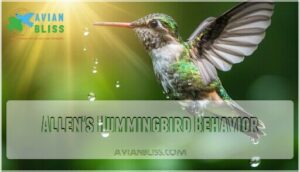
Allen’s Hummingbirds aren’t shy about defending what’s theirs. You’ll notice their bold personalities through territorial battles, dramatic courtship flights, and clever feeding strategies.
Let’s break down the key behaviors that make this species worth watching.
Territoriality and Social Interactions
You might think these jewel-toned birds would get along, but Allen’s Hummingbirds are scrappy loners who guard their feeding zones like tiny, feathered bouncers. Males stake claim to flower patches with aggressive aerial displays. They chase off rivals in fierce dive-bomb attacks. This agonistic behavior establishes a clear dominance hierarchy around prime nectar sources. During breeding season, territorial displays intensify as males defend both food and potential mates.
- Fierce midair battles over prime feeding territories
- Bold dive-bomb attacks that send intruders packing
- Relentless mate guarding during breeding season
- Social learning from observing rival hummingbird behavior
- Adaptation strategies as wild spaces vanish
Mating and Courtship Displays
When a male Allen’s Hummingbird spots a potential mate, he launches into an aerial acrobatics show that would make any stunt pilot jealous. He rockets skyward, then plummets in a dramatic J-shaped arc while his tail feathers whistle sharply. At the bottom of each dive, he flashes his iridescent orange-red gorget like a neon sign. These courtship displays can last several minutes as he repeats the pattern to prove his fitness. Females watch from nearby perches, evaluating each performance before deciding whether he’s worthy of pair bonding.
| Courtship Element | Function |
|---|---|
| High-altitude climbs | Demonstrate stamina and territorial control |
| J-shaped dive patterns | Create audible tail whistles that signal breeding readiness |
| Gorget flashing | Showcase genetic quality through vibrant plumage |
| Repetitive display loops | Prove persistence and mating commitment |
Foraging and Feeding Habits
Allen’s Hummingbird treats every flower like a strategic fuel stop, darting between blooms with precision that borders on obsessive. You’ll spot them hovering at red tubular flowers—penstemon and red monkey-flower top their list of nectar sources.
But flower preferences tell only half the story. These birds catch insects mid-flight or pluck them from spider webs for protein during the hummingbird life cycle.
Position hummingbird feeders near natural cover to watch their foraging strategies unfold—they’ll defend prime feeding spots with fierce territorial displays.
Communication and Vocalizations
These birds don’t rely on fancy songs to stake their claim—instead, they broadcast their presence through sharp wing trills and rapid-fire chip notes that cut through the garden air like tiny alarm bells.
During courtship dances, males add buzzing dive sounds to their repertoire—a sonic signature that announces territorial calls and mating rituals.
You’ll hear these vocalization patterns shift between aggression and attraction, revealing hummingbird behavior that’s all instinct and zero pretense in their avian world.
Allen’s Hummingbird Habitat and Migration
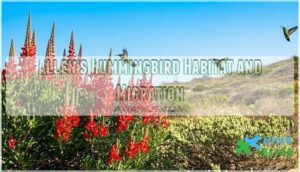
Allen’s hummingbirds aren’t homebodies—they travel between distinct landscapes throughout the year. Understanding where they nest, where they winter, and how they’ve adapted to changing environments reveals the flexibility these tiny birds need to survive.
Let’s break down the key places you’ll find them and what makes each habitat work.
Breeding Grounds and Nesting Sites
Picture a nest so small it could fit snugly in a teaspoon—that’s the architectural marvel Allen’s Hummingbirds call home. During nesting season, females select sheltered spots in coastal scrub and chaparral. They weave plant fibers and spider silk into cup-shaped structures on tree branches or shrubs. Site selection matters—protection from predators boosts fledging success. Conservation of these habitats ensures Allen’s Hummingbird populations can continue their breeding rituals.
5 Key Nesting Facts:
- Nest architecture uses soft plant down and stretchy spider silk for flexibility
- Breeding seasons align with California’s wet months for flower abundance
- Nesting materials include moss, lichen, and feathers for camouflage
- Typical nest sites sit 3-30 feet high in protected vegetation
- Females alone manage all construction and raise young without male help
Wintering Grounds and Migration Patterns
Around 81% of Allen’s Hummingbirds follow migration patterns that trace an elliptical route between coastal California and oak-pine forests in northern Mexico. Avian migration begins surprisingly early—some northbound birds depart wintering grounds in December, making Allen’s among the earliest migratory land birds. Migration routes shift with age and sex; adult males usually head south before females and juveniles.
Winter habitats in Mexico provide essential food availability, while cold tolerance allows some individuals to survive subfreezing weather for up to 72 hours. Population dynamics reveal that migratory individuals face lower survival rates (0.06) compared to year-round residents (0.73), showing how bird migration patterns directly impact conservation outcomes. The conservation of hummingbird species is essential for maintaining ecological balance.
Coastal Scrub and Chaparral Habitats
You’ll find these hummingbirds darting through California’s coastal scrub and chaparral—habitats shaped by fire, salt air, and the stubborn beauty of drought-tolerant plants.
These chaparral ecosystems depend on native plants like manzanita and sage, which provide nectar and shelter for Allen’s Hummingbird populations.
Habitat restoration efforts support wildlife conservation by protecting coastal scrub from invasive species, ensuring ecosystem services remain intact for generations of birdwatchers to come.
Adaptation to Suburban Environments
While wild chaparral feels a world away from backyard birdbaths, Allen’s Hummingbirds have learned to thrive in the concrete sprawl of suburban California with surprising ease. Garden design matters more than you’d think—plant native flowers and these birds will claim your yard as territory.
Urban planning that includes habitat preservation fosters wildlife conservation and hummingbird characteristics like territorial defense. Your feeder becomes part of their survival strategy, proving environmental adaptation trumps wild landscapes when conservation initiatives meet thoughtful suburban ecology.
Allen’s Hummingbird Diet and Feeding
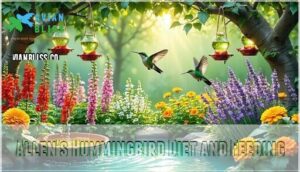
Allen’s hummingbirds fuel their high-energy lifestyle with a mix of sweet nectar and protein-packed insects.
Understanding what they eat helps you create spaces that support their survival.
Here’s what powers these tiny acrobats through their demanding days.
Nectar Sources and Flower Preferences
When you’re chasing nectar like your life depends on it, not just any flower will do. Allen’s Hummingbirds zero in on red tubular blooms that pack serious nectar quality. Here’s what draws them in:
- Penstemon and monkey-flower – classic favorites with deep tubes perfect for pollination
- Blooms with extended bloom periods – ensuring steady nectar through breeding season
- Native California wildflowers – evolved alongside hummingbird feeding patterns
Plant these flower choices near bird feeders, and you’ll watch these little rebels work the garden like they own it. They’re not just collecting pollen; they’re rewriting the rules of survival.
Insect Consumption and Protein Sources
Nectar might steal the spotlight, but insects are what keep Allen’s Hummingbirds firing on all cylinders when it counts most. You’ll spot them snatching gnats and aphids midair or plucking spiders from webs—protein intake that fuels flight muscles and breeding demands.
Their feeding strategies shift with seasonal needs, weaving insect capture into daily routines. This avian behavior highlights why wildlife conservation efforts matter: protecting habitat means safeguarding nutrient sources that ornithology research shows are essential for hummingbird survival during bird watching season.
Hummingbird Feeders and Sugar Ratios
A simple feeder with the right sugar mix can turn your backyard into a hummingbird haven—no fancy setup required. Mix one part sugar to four parts water for the perfect nectar recipe that mimics natural flowers. Skip the red dye—Allen’s Hummingbirds don’t need it, and it might harm them during bird-watching season.
Smart feeder placement and consistent feeder maintenance create safe refueling stations for these tireless travelers.
- Swap sugar water every 2-3 days to prevent deadly mold growth.
- Scrub hummingbird feeders weekly with hot water—no soap residue allowed.
- Add ant moats to block crawling invaders from stealing nectar.
- Position feeders in partial shade to keep sugar ratios stable and support wildlife conservation efforts.
Planting Flowers to Attract Allen’s Hummingbirds
Red tubular blooms act like neon signs in the wild, pulling Allen’s Hummingbirds straight to your yard with their irresistible nectar promise. Plant native pollinator plants like California fuchsia and red monkey-flower for bird-friendly habitats that support hummingbird migration and wildlife preservation.
Mix flower selection across different heights—penstemon towers while columbine sprawls low. This garden design creates nectar sources from spring through fall, giving these territorial jewels reasons to stake their claim in your conservation corner.
Allen’s Hummingbird Conservation Status

Allen’s Hummingbird populations are sliding downhill fast, and you need to know why. The numbers tell a stark story—an 83 percent crash between 1970 and 2014 within their narrow California range.
Allen’s Hummingbird numbers have plummeted 83 percent since 1970, revealing one of North America’s starkest avian collapses
Here’s what’s threatening these birds and what’s being done to turn the tide.
Population Decline and Threats
Allen’s Hummingbird populations have crashed nearly 88% since 1970, earning this species a spot on the "Red Alert Tipping Point" list in the 2025 State of the Birds report. You’re witnessing one of North America’s most dramatic avian declines, with threat analysis revealing urgent environmental impact:
- Habitat fragmentation from urban sprawl destroys breeding territories
- Pesticide risks eliminate insects that comprise 20% of their diet
- Invasive species outcompete native nectar-producing plants
- Light pollution and glass collisions disorient migrating birds
The conservation status demands immediate action. Despite not being listed as endangered species yet, conservation efforts must address habitat loss before this coastal specialist vanishes from its already restricted range.
Habitat Loss and Climate Change
Climate shift hits hard when your breeding grounds shrink. Habitat fragmentation from coastal development slices nesting zones into isolated patches, triggering ecosystem disruption. Rising temperatures push nectar-producing plants out of sync with migration timing.
Biodiversity loss accelerates as environmental degradation replaces native chaparral with pavement. Habitat loss compounds 88% population crashes. Wildlife ecology research warns: without habitat restoration and environmental conservation efforts, these coastal specialists face extinction within decades. Biodiversity preservation can’t wait.
Conservation Efforts and Partnerships
Grassroots groups and wildlife agencies are teaming up to reverse the damage before it’s too late. Habitat preservation and community engagement drive these environmental partnerships forward:
- Partners in Flight coordinates bird conservation strategies across North America
- Native plant restoration programs rebuild nectar corridors
- Citizen science monitors track population trends through banding
- Local land trusts protect critical breeding grounds from development
- Educational outreach teaches suburban residents hummingbird-friendly gardening
Species protection demands action now—your backyard choices matter for wildlife conservation.
Research and Climate Modeling for Future Projections
Scientists aren’t just watching Allen’s Hummingbirds disappear—they’re mapping exactly where and why it’s happening. Climate projections and species modeling reveal a brutal truth: this bird could lose 90% of its breeding range by 2080. Ornithological research tracks the evidence through:
- Range shifts pushing birds northward into unfamiliar territory
- Population dynamics showing 83% decline since the 1970s
- Emissions scenarios forecasting habitat collapse even under moderate warming
- Wildlife ecology studies exposing phenological mismatches between flowers and migration timing
Hummingbird conservation depends on these climate models—they’re your roadmap for environmental conservation action.
Frequently Asked Questions (FAQs)
What are Allen’s hummingbirds?
Good things come in small packages, and few birds prove this better than these jewel-toned flyers. Introduction to Allen’s Hummingbird reveals a tiny avian species in the Trochilidae family. Classification places them in Animalia kingdom, Chordata phylum, and Aves class.
Physical traits include iridescent orange-red gorgets in males and rust-colored flanks. Hummingbird identification requires noting their green backs and compact size.
Life cycle studies show nesting along California’s coast. Taxonomy confirms their close relationship with Rufous Hummingbirds. Allen’s Hummingbird characteristics make them garden favorites throughout their limited range.
Where do Allen’s hummingbirds live?
You’ll find these jewels along California’s coast and nearby foothills. Their natural range hugs the West Coast, stretching through coastal regions and forest ecosystems where they’ve carved out territories in both wild spaces and urban habitats.
Are Allen’s hummingbirds rufous?
No, they’re not the same species, but you’ll have a tough time telling them apart. Both show similar rufous coloring in their plumage. Males of both species sport that fiery orange-red gorget and rusty flanks.
The key species distinction lies in the back feathers—Allen’s males have green backs.
How do you identify an Allen’s hummingbird?
You’ll notice this bird’s green back and forehead first, paired with a rust-colored rump and tail. Males flash an iridescent orange-red gorget.
Check the tail length—it extends past the wings when perched, with narrower outer feathers.
How big do Allen’s hummingbirds get?
You’ll find these tiny jewels measure just 3 to 5 inches in length. That’s comparable to a sparrow in relative size.
Their compact body proportions and narrow tail feathers give this avian species its distinctive shape, making size comparison with other hummingbirds straightforward in the field.
Are Allen’s hummingbirds migrating?
Yes, you’ll catch them on the wing—these birds follow migratory routes like clockwork. Allen’s Hummingbird exhibits seasonal movements between breeding grounds in California and wintering habitats in Mexico.
Their hummingbird migration patterns show distinct flight routes and habitat shifts tied to flower availability.
What is the difference between Anna’s hummingbird and Allen’s hummingbird?
You’ll notice Anna’s hummingbirds are bulkier with rose-pink gorgets, while Allen’s sport orange-red throats and rust-colored flanks. Beak shape stays similar, but tail length and feather color patterns differ.
Anna’s hummingbirds tolerate neighbors better than territorial Allen’s.
What is the Allen’s hummingbird behavior?
You’ll see territorial defense in action as males patrol their feeding zones with sharp dives and aggressive displays. Males perform courtship rituals in J-shaped aerial patterns, while females manage nesting behavior alone, weaving spider webs into cup-shaped nests.
Are Allen’s hummingbirds endangered?
While they’re not officially on the endangered species list, these birds aren’t out of the woods yet. Their conservation status remains Least Concern under IUCN guidelines, but population trends tell a sobering story—an 83% decline since 1970 due to habitat loss within their limited range.
Are Allen’s hummingbirds territorial?
Male Allen’s hummingbirds are fierce defenders of their feeding grounds. You’ll see them chase off rivals with aggressive aerial displays, especially during breeding season.
They patrol their territories relentlessly, protecting flowers and feeders from intruders with extraordinary intensity for such tiny birds.
Conclusion
Picture a flash of rust disappearing into a salvia bloom—you’ve just witnessed survival in motion. The Allen’s hummingbird exists at the edge of disappearance, where every defended flower patch becomes a referendum on adaptation.
Your native garden isn’t decoration; it’s sanctuary. Plant monkey-flower and sage. Skip the pesticides. Leave the feeders filled through winter.
These orange-throated migrants are rewriting their own rulebook, ditching ancient flight paths for suburban stability. Whether they’ll outrun habitat loss remains uncertain, but your yard might tip the balance between extinction and endurance.
- https://app.mybirdbuddy.com/compare/allens-hummingbird-vs-rufous-hummingbird
- https://www.texasbirdrecordscommittee.org/review-information/list-of-statements/allen-s-hummingbird
- https://digitalcommons.usf.edu/cgi/viewcontent.cgi?article=3203&context=bird_observer
- https://pmc.ncbi.nlm.nih.gov/articles/PMC7469328/
- https://underclearskies.com/2020/07/25/green-backed-rufous-hummingbirds/