This site is supported by our readers. We may earn a commission, at no cost to you, if you purchase through links.
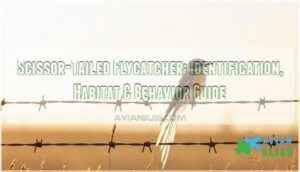 A male Scissor-tailed Flycatcher perched on a wire looks like it’s trailing twin streamers—tail feathers so improbably long they seem borrowed from another species entirely. Those elegant rectrices can stretch 25 centimeters, dwarfing the bird’s actual body and creating a silhouette that stops birders cold.
You’ll find these aerial acrobats patrolling the Great Plains and Texas grasslands each spring, their tails scissoring through the air as they snatch insects mid-flight.
But populations have crashed 31% since 1966, pushed by habitat loss and pesticide drift across their breeding grounds. Recognizing their forked tail, peach-washed flanks, and sharp territorial calls helps you spot these flycatchers before they vanish from open country altogether.
Table Of Contents
- Key Takeaways
- Scissor-Tailed Flycatcher Identification Guide
- Habitat and Geographic Range
- Behavior and Ecology
- Nesting, Eggs, and Breeding
- Conservation Status and Viewing Tips
- Frequently Asked Questions (FAQs)
- In what states can you find a scissor tail flycatcher?
- Is the scissor-tailed flycatcher rare?
- What are the interesting facts about the scissor-tailed flycatcher?
- Where can I see a scissor-tailed flycatcher?
- How does climate change impact their migration patterns?
- What role does the scissor-tailed flycatcher play in the ecosystem?
- Are scissor-tailed flycatchers featured in any cultural symbols?
- What are the distinguishing features of juvenile flycatchers?
- How does the scissor-tailed flycatcher contribute to pest control?
- What is the average lifespan in the wild?
- Conclusion
Key Takeaways
- Scissor-tailed Flycatchers face a 31% population decline since 1966 driven by habitat loss, pesticide use, and agricultural expansion across Great Plains grasslands where they depend on open country with scattered trees for breeding and hunting.
- Males possess tail feathers up to 25 centimeters long—often twice their body length—which they use in aerial courtship displays and mid-flight insect captures, making them instantly recognizable among North American flycatchers.
- These birds migrate thousands of miles between southern Great Plains breeding grounds (Texas, Oklahoma, Kansas) and Central American wintering sites, serving as natural pest control by consuming grasshoppers, beetles, and crop-damaging insects.
- Conservation efforts focus on preserving semi-open grassland habitats, reducing pesticide applications, and maintaining fence lines and utility poles that substitute for natural perches in increasingly treeless landscapes.
Scissor-Tailed Flycatcher Identification Guide
You won’t mistake this bird once you’ve seen it—that absurdly long, scissor-shaped tail gives it away every time.
But there’s more to identification than just the tail, from subtle color washes to differences between males, females, and young birds.
Here’s what to look for when you’re out in the field.
Distinctive Long, Forked Tail

You’ll spot a Scissor-tailed Flycatcher from a mile away—that dramatically elongated, forked tail can stretch up to 25 centimeters and makes up more than half the bird’s total body length. Males flaunt the longest tail feathers, giving them an unmistakable silhouette when perched on fence posts or executing sharp aerial maneuvers. This forked shape isn’t just for show—it’s a precision tool for catching insects mid-flight.
- Sexual dimorphism matters: Males carry longer rectrices than females, making field identification of sex possible even at a distance.
- Flight patterns reveal identity: Watch for the characteristic scissoring motion as these tyrant flycatchers twist through the air.
- Taxonomy distinction: Among flycatchers and bird species identification guides, tail length separates this species instantly from lookalikes.
Plumage Colors and Patterns

Beyond that striking tail, the Scissor-tailed Flycatcher wears a subtle palette that’s anything but boring—silvery gray feathers fade into salmon-pink flanks and underwings, creating a color combination that catches light like no other tyrant flycatcher in North America.
When these birds take flight, you’ll catch vivid scarlet wing patches in the axillaries—a hidden flash that reveals itself during aerial pursuits. Their blackish wings contrast sharply against pale gray bodies, while the stout black beak completes this elegant design crafted for ornithology enthusiasts and bird species identification alike.
Sex Differences in Tail Length and Plumage

Male Scissor-tailed Flycatchers carry noticeably longer tail streamers than females—sometimes reaching twice their body length—giving you a reliable field mark for separating the sexes at a glance. Females and juveniles show shorter tails and less intense salmon-pink coloration on their flanks.
This sex dimorphism in tail length variance and plumage coloration acts as a mating signal in Tyrannus forficatus, making bird identification easier once you understand these feather structure differences in avian ecology.
Similar Species and Lookalikes
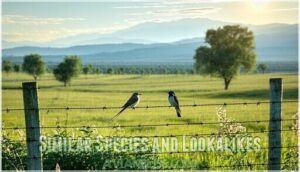
When you spot a pale gray flycatcher with a long tail perched on a wire, don’t assume it’s always a Scissor-tailed—Western Kingbirds can fool you in a heartbeat, especially when you’re watching juveniles with shorter streamers. Here’s your field checklist for flycatcher lookalikes:
- Western Kingbird: Yellow belly, square tail without fork—key species comparison trait
- Eastern Kingbird: White terminal tail band, darker plumage, stockier beak shapes
- Great Crested Flycatcher: Rufous tail, yellow belly, prefers woodlands over open country
- Juvenile Scissor-tails: Shorter tails mimic kingbirds until feather patterns fully develop
- Couch’s Kingbird: Tropical range overlap requires careful study of bird mimicry details
Habitat and Geographic Range

You’ll find Scissor-tailed Flycatchers across a surprisingly specific slice of North America, from the Great Plains down through Texas and into Mexico. Their range shifts dramatically with the seasons, pulling them thousands of miles between breeding and wintering grounds.
Here’s where to look for these elegant flycatchers throughout the year.
Breeding Grounds in The US and Mexico
You’ll find Scissor-tailed Flycatchers nesting across the southern Great Plains, from southeastern Colorado through Nebraska and Missouri, sweeping down through Oklahoma and Arkansas into Texas and northeastern Mexico. These breeding habitats favor open grasslands with scattered trees, farm fields, and ranches where territorial behavior is easily observed.
Breeding seasons run from spring through summer, with males establishing territories around fence lines and utility poles—artificial nesting sites that have expanded their range into treeless areas.
| Region | Primary Breeding States | Habitat Type |
|---|---|---|
| Northern Range | Nebraska, Missouri, Colorado | Grasslands with shelterbelts |
| Core Range | Oklahoma, Arkansas, Kansas | Open prairies with scattered trees |
| Southern Range | Texas, northeastern Mexico | Ranches, farms, mesquite country |
| Expanding Areas | Portions of Louisiana | Semi-open agricultural land |
Wintering Grounds in Central America and Florida
As breeding season ends, these elegant flycatchers abandon the Great Plains for tropical wintering grounds stretching from southern Mexico through Central America, with smaller populations reaching southern Florida. You’ll witness impressive avian migration as they move through established wildlife migration patterns, seeking tropical roosting sites where food sources remain abundant.
Winter habitat preferences include:
- Semi-open tropical countryside with scattered trees and groves
- Agricultural areas near Gumbo Limbo (Jiñocuabo) trees providing winter fruits
- Open lowlands supporting climate adaptation through milder temperatures
The Scissortailed Flycatcher’s migration and movement patterns demonstrate exceptional navigational precision across thousands of miles.
Preferred Open Areas With Scattered Trees
Throughout their range, Scissor-tailed Flycatchers stake their claim in landscapes where grasslands meet the occasional tree—a habitat mosaic that offers both hunting perches and nesting opportunities without the constraints of dense forest. Semiopen habitats provide ideal conditions—treeless landscapes don’t offer nesting sites, while dense forest limits aerial hunting. You’ll find these birds thriving in rural farmland, open grasslands, and scattered woodland edges where fence posts and utility lines substitute for natural perches.
| Habitat Type | Value to Scissortailed Flycatcher |
|---|---|
| Fields & Meadows | Prime insect-hunting zones with clear flight paths |
| Scattered Trees | Essential nesting sites and territorial perches |
| Ranch Land | Combines grasslands with artificial perching structures |
Migration Patterns and Stopover Sites
Twice-yearly seasonal movements illustrate textbook Flyway Ecology—these flycatchers trace migration routes between southern Great Plains breeding grounds and Central American wintering sites. Stopover habitats remain poorly documented, though wandering patterns suggest flexible use of semi-open landscapes during transit.
Key Migration Characteristics:
- Spring northbound movement begins March-April
- Fall southbound passage peaks August-October
- Bird tracking data shows coastal Texas as critical corridor
- Flycatcher species exhibit direct flight paths with opportunistic stops
Understanding avian migration patterns aids wildlife migration research and strengthens bird conservation strategies. The scissor-tailed flycatcher’s population is impacted by coastal prairie conservation efforts.
Behavior and Ecology

You’ll notice Scissor-tailed Flycatchers don’t sit still for long—they’re aerial hunters, fierce defenders of territory, and surprisingly social outside the breeding season. Their behavior reflects both the demands of catching insects on the wing and the challenges of claiming space in open country.
Here’s what shapes their daily routines and seasonal rhythms.
Courtship Displays and Mating Habits
When a male Scissor-tailed Flycatcher sets out to win a mate, he launches into one of the most theatrical performances you’ll witness in grassland skies. His courtship displays involve sharp calls paired with breathtaking aerial maneuvers—climbing high, then plummeting in zigzag dives while his elongated tail feathers slice through air like twin blades.
These mating rituals establish pair bonding and reinforce territorial behavior, showcasing breeding strategies refined through generations of avian behavior.
Foraging Techniques and Insect Prey
You’ll spot a Scissor-tailed Flycatcher hunting long before you identify it by plumage—these acrobatic predators command the air like fighter pilots, twisting sharply mid-flight to snatch grasshoppers, beetles, and dragonflies right out of the sky.
Their aerial foraging strategies include hovering to glean prey from vegetation or dropping groundward to pounce on insects below.
This diet makes them essential to ecological conservation, controlling crop-damaging species while showcasing exceptional avian biology through precise insect catching and adaptive feeding habits.
Perching, Roosting, and Social Structure
Between hunts, these flycatchers turn fence posts and power lines into personal observation decks—perching conspicuously in the open where their silhouettes become as recognizable as the landscapes they inhabit. But their social structure shifts dramatically with the seasons:
- Breeding season isolation – Territorial defense intensifies as each Scissortailed Flycatcher claims prime perching bird territory
- Migration flocking patterns – Hundreds gather in noisy communal roosts before southward journeys
- Perch selection hierarchy – Dominant individuals claim highest vantage points in shared habitat and distribution zones
- Winter social tolerance – This bird species loosens aggressive behavior and ecology while roosting together
Songs, Calls, and Territorial Defense
Sharp calls pierce the air when intruders test their luck—these birds don’t just defend territory, they broadcast ownership with a voice that matches their showy tail. Vocalization patterns include sharp "pup" notes and twittering territorial songs during aerial displays.
Call variations intensify as defense strategies escalate—the Scissortailed Flycatcher’s sonic communications turn bird watching moments into acoustic performances that reflect their conservation status as bold grassland guardians.
Nesting, Eggs, and Breeding

When the breeding season arrives, Scissor-tailed Flycatchers transform from nomadic wanderers into fiercely territorial architects of the open grasslands. Their nesting behavior reveals a surprising adaptability—building in trees when available, but claiming utility poles and fence posts when the prairie stretches treeless.
Here’s what you need to know about their nesting sites, eggs, and how they raise their young.
Nesting Sites and Materials
Scissor-tailed Flycatchers build their nests in isolated trees, shrubs, or on utility poles, choosing exposed perches that offer clear sightlines across open grasslands. Tree selection favors thorny species when available, offering natural protection from predators.
The birds construct cup-shaped nests using twigs, grasses, and rootlets, often incorporating human materials like string, paper, or cotton. Material composition varies by site, but weaving creates a sturdy platform that withstands prairie winds while supporting nesting and breeding activities in these open bird habitats.
Egg Characteristics and Incubation Period
Once the nest is secure, the female lays a clutch of three to six creamy-white eggs marked with reddish-brown or purple spots concentrated at the broader end. Egg size variation reflects maternal condition and habitat quality.
Incubation duration spans 13-15 days, during which the female manages primary brooding behavior. This consistent incubation period bolsters nesting success across breeding populations, contributing valuable data to ornithological research on bird breeding and migration patterns in grassland ecosystems.
Nestling Care and Fledging Behavior
After hatching, both parents shoulder the demanding work of feeding their altricial young—helpless, featherless chicks that depend entirely on constant deliveries of protein-rich insects. Nestling development accelerates over 14-16 days as parental care intensity peaks. Fledglings then take their first flights, testing survival skills while adults continue provisioning.
Fledging success hinges on:
- Relentless foraging runs that turn parents into aerial acrobats hunting grasshoppers dawn to dusk
- Nestling mortality risks from predators, storms, and starvation that make every sunrise a small victory
- Wildlife conservation efforts protecting open grasslands where these determined families can thrive
Conservation Status and Viewing Tips

The Scissor-tailed Flycatcher isn’t facing extinction, but it’s not bulletproof either. Climate shifts, habitat loss, and agricultural changes all chip away at populations in ways worth understanding.
Here’s what you need to know about protecting these birds and finding them in the wild.
Population Trends and Conservation Efforts
Over five decades, the population has stumbled—a 31% decline between 1966 and 2014 tells a sobering story. You’ll find the species rates an 11 out of 20 on the Continental Concern Score, though it dodged the 2014 State of the Birds Watch List.
Conservation strategies now pivot toward habitat preservation: keeping grasslands intact, retaining brush patches, and slashing pesticide use.
Wildlife conservation efforts through Partners in Flight and regional agencies monitor population trends across 300+ survey routes, tracking climate impact and breeding success to safeguard this species’ future. Understanding the Neotropical migrants is vital for developing effective conservation plans.
Habitat Loss, Climate Change, and Threats
With grasslands gutted by agriculture and brush removal, you’re witnessing habitat fragmentation that cuts nesting success and isolates staging flocks. Climate shifts threaten to intensify extreme weather—tornadoes and frosts—while pesticide impact decimates insect prey and poisons nestlings.
Nest predation and human disturbance from roads and fires push adult survivorship to just 45%, demanding urgent habitat preservation and wildlife conservation to sustain biodiversity preservation and environmental sustainability for this embattled species.
Where to See and Photograph Scissor-Tailed Flycatchers
You’ll find your best birdwatching and photography opportunities along fence lines and utility wires in the open ranch country of Oklahoma, Texas, and Kansas, where these showbirds perch like banners against the sky.
Hit wildlife refuges and scissor-tailed habitats across the southcentral United States during May breeding season—birding tours there offer close encounters.
Fast shutter speeds (1/1000+) freeze those acrobatic insect chases; telephoto glass captures the scissortailed flycatcher’s salmon blush and streaming tail in sharp detail.
Supporting Bird Conservation Initiatives
If you’ve ever watched a scissor-tail carve the sky and thought someone should protect this, good news—you already can. Wildlife preservation starts with small, direct actions:
- Plant native grasses and shrubs for habitat restoration in your yard
- Contact legislators to support bird-friendly policies and conservation funding
- Donate to organizations driving conservation efforts and eco-tourism management
- Reduce pesticide use to protect insect populations these flycatchers depend on
Your voice and dollars fuel nature conservation efforts that keep scissor-tails streaming across open skies.
Frequently Asked Questions (FAQs)
In what states can you find a scissor tail flycatcher?
Imagine—a bird with a tail so outrageously long it defies proportion, slicing through prairie skies like a living pennant.
A bird with a tail so outrageously long it defies proportion, slicing through prairie skies like a living pennant
You’ll spot Scissortailed Flycatcher across Texas Habitats, Oklahoma Sightings dominate breeding zones, Kansas Distribution follows open grasslands, with Arkansas Breeding populations and Nebraska Migration routes documented on eBird Occurrence Map. Montana records exist but remain rare.
Is the scissor-tailed flycatcher rare?
No, you won’t find this bird on endangered lists. The Scissor-tailed Flycatcher holds a Least Concern conservation status and a stable Global Rank, with populations hovering near 5 million individuals despite some regional declines from habitat loss.
What are the interesting facts about the scissor-tailed flycatcher?
Feather-flaunting flycatchers flaunt fascinating features—their tails can stretch twice their body length. Males showcase vivid scarlet wing patches and perform aerial acrobatics during courtship.
These Tyrannidae family members are valued for controlling crop-damaging insects across their migration routes.
Where can I see a scissor-tailed flycatcher?
Head to the southern Great Plains—Texas, Oklahoma, Arkansas—during breeding season. Open ranches, roadsides with scattered trees, and utility lines mark prime Flycatcher Hotspots.
Migration Routes bring wanderers across the Western Hemisphere Range, offering surprise sightings far beyond core Breeding Areas.
How does climate change impact their migration patterns?
Climate shift alters weather patterns and temperature effects across migration routes, forcing birds to adjust timing and pathways. Habitat disruption threatens stopover sites critical for refueling.
These changes affect scissortailed flycatcher distribution and breeding success, complicating conservation status assessments.
What role does the scissor-tailed flycatcher play in the ecosystem?
These birds keep ecosystem balance by controlling grasshoppers, beetles, and other insects that damage crops.
Their foraging maintains biodiversity across wildlife habitats, supporting ecological preservation.
They occupy a key ecological niche as aerial insect predators in open prairies.
Are scissor-tailed flycatchers featured in any cultural symbols?
Since its vintage designation as Oklahoma’s state bird in 1951, the scissor-tailed flycatcher carries deep cultural significance across the southern Great Plains.
You’ll spot artistic depictions in regional murals and festivals celebrating this elegant Passeriformes member, known locally as "tijereta" or "tijerillo."
What are the distinguishing features of juvenile flycatchers?
Juvenile Plumage appears pale gray overall, lacking the salmon-pink flanks and underwings adult flycatchers display. Their tails are noticeably shorter than adults’, resembling Western Kingbirds but paler—an immature trait that distinguishes young tijereta from their elegant, long-tailed parents.
How does the scissor-tailed flycatcher contribute to pest control?
Think of these birds as nature’s pest control squadron—they’re aerial acrobats that snatch up grasshoppers, beetles, and crop-damaging insects mid-flight.
Their diet protects agricultural fields, making flycatchers valuable allies in ecosystem balance and wildlife management without chemical intervention.
What is the average lifespan in the wild?
Wildlife longevity data for flycatchers remains limited in avian ecology. Research on survival rates and mortality factors in wild population trends hasn’t established definitive average lifespan figures for this species.
Conclusion
Imagine if your local park required a thirty-one percent admission fee hike every decade—you’d rebel, petition, raise hell. Yet the scissor-tailed flycatcher has lost exactly that proportion of its population since 1966, and most of us shrugged.
These fork-tailed marvels don’t lobby or protest; they simply disappear from fencelines and prairies while we debate whose problem it is.
Spotting one now means you’ve glimpsed something rarer than you realize—a sky dancer that needs your fence posts, your pesticide restraint, and your willingness to care before the streamers vanish entirely.
- https://www.allaboutbirds.org/guide/Scissor-tailed_Flycatcher/lifehistory
- https://www.coastalprairieconservancy.org/blog/state-of-the-species-scissor-tailed-flycatcher
- https://en.wikipedia.org/wiki/Scissor-tailed_flycatcher
- https://abcbirds.org/bird/scissor-tailed-flycatcher/
- https://landpotential.org/habitat-hub/scissor-tailed-flycatcher/