This site is supported by our readers. We may earn a commission, at no cost to you, if you purchase through links.
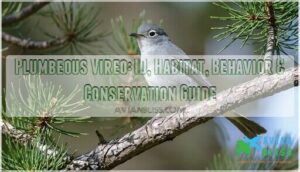 A gray bird perched quietly in a ponderosa pine might blend into the shadows, but look for the bold white eye-ring and crisp supraloral stripe—you’ve spotted a plumbeous vireo.
This compact songbird, measuring just under five inches, makes its home in warm, dry montane forests from Montana to Mexico, where it methodically hunts insects among the canopy branches. Unlike many vireos, it lacks wingbars, and its preference for open pine woodlands sets it apart from its forest-dwelling relatives.
Despite its unassuming appearance, this species faces steady population declines, with surveys showing a troubling 70% drop over recent decades due to habitat loss and shifting climate patterns.
Table Of Contents
- Key Takeaways
- Plumbeous Vireo Identification Guide
- Habitat, Range, and Migration
- Behavior and Social Patterns
- Breeding and Nesting Details
- Conservation Status and Threats
- Frequently Asked Questions (FAQs)
- What is the difference between Cassin’s and Plumbeous Vireo?
- How does the Plumbeous Vireos habitat differ across its range?
- What are the key physical differences between Plumbeous and Cassins Vireos?
- How does the Plumbeous Vireos song compare to other vireo species?
- What are the main threats to the Plumbeous Vireos population?
- How do Plumbeous Vireos interact with other bird species?
- What predators threaten Plumbeous Vireo populations?
- How long do Plumbeous Vireos typically live?
- Can Plumbeous Vireos be kept as pets?
- What trees do they prefer besides ponderosa pine?
- Conclusion
Key Takeaways
- The Plumbeous Vireo is a small gray-and-white songbird (under 5 inches) distinguished by its bold white eye-ring, supraloral stripe, and lack of wingbars, inhabiting warm, dry montane forests with ponderosa pines from Montana to Mexico.
- This species faces a severe 70% population decline over recent decades due to habitat loss, climate change pushing its range northward, and high nest parasitism rates from Brown-headed Cowbirds that can exceed 50% in some areas.
- Identification requires attention to its monochrome gray upperparts and white underparts, slower burry song compared to similar vireos, and preference for open pine woodlands rather than dense forests.
- Conservation efforts including habitat restoration through prescribed burns, population monitoring since 2015, and genetic analysis of breeding populations show some stabilization in key regions like New Mexico, which holds 21.6% of the global population.
Plumbeous Vireo Identification Guide
Spotting a Plumbeous Vireo in the field starts with knowing what to look for, from its compact build to its understated gray-and-white pattern.
You’ll need to focus on key features like size, markings, and behavior to separate it from similar species.
Here’s what you should watch for to confirm your identification.
Physical Characteristics and Size

The Plumbeous Vireo is a small, sturdy songbird measuring 4.7 to 5.5 inches in length and weighing between 0.4 and 0.7 ounces, making it slightly larger than a Red-breasted Nuthatch. You’ll notice its compact body proportions, with a fairly thick, short bill that’s slightly hooked at the tip.
Size variation and weight fluctuation occur throughout the year, with measurements reaching up to 138 mm in total length. The plumbeous vireo’s shape is typical of vireos, combining strength with agility for active foraging.
Distinctive Features and Markings
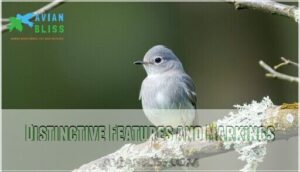
What really sets this bird apart is its monochrome plumage—smooth neutral gray across the upperparts and near-white below, creating the most subdued color pattern you’ll find among North American vireos.
Look for these diagnostic characteristics:
- Broad white supraloral stripe extending from the bill over the eye
- Prominent white eye-ring that stands out against gray plumage
- Lack of wingbars compared to other vireo species
Juvenile markings show similar patterns with slightly duller tones, while molting patterns maintain consistent gray-white contrast year-round with minimal plumage variations or color aberrations across regional differences.
Comparison With Similar Vireo Species
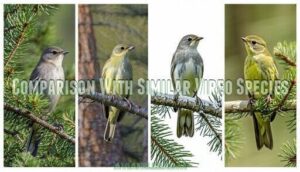
Separating Plumbeous Vireo from similar species requires careful attention to plumage differences and habitat preferences. Cassin’s Vireo shows greener upperparts and yellowish flanks, while Blue-headed Vireo displays vibrant yellow sides and a blue-gray crown. Warbling Vireo lacks bold wingbars entirely. Red-eyed Vireo appears larger with olive-green plumage.
Song analysis reveals subtle frequency variations, though observer error reaches 75% in hybridization zones where range overlap occurs between Plumbeous and Cassin’s Vireos, making bird species comparison challenging without molecular confirmation.
The blue-headed vireo favors coniferous forests.
Tips for Field Identification
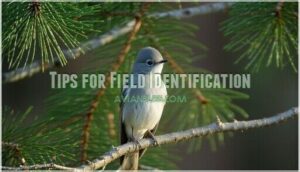
Once you know what to look for, spotting a Plumbeous Vireo in the field becomes much easier with a few practical techniques. Focus on dry ponderosa pine forests during spring mornings when males sing their slow, burry phrases. Watch for gray and white plumage variations with white eye-rings. Note behavioral patterns like steady foraging through mid-canopy branches.
Bird identification resources confirm seasonal changes affect vocalization nuances and flocking tendencies.
Habitat, Range, and Migration

If you’re looking to spot a Plumbeous Vireo in the wild, you’ll need to know where these gray songbirds call home. Their range stretches across specific regions of North America, and understanding their seasonal movements can make all the difference in your birding success.
Let’s explore where you’ll find them throughout the year and how different populations vary across their territory.
Preferred Woodland and Forest Habitats
You’ll find Plumbeous Vireos in warm, dry montane forests where ponderosa pines dominate the landscape, creating an open canopy that’s perfect for these gray songbirds to forage and nest. These pine forests generally occur at moderate elevation gradients, where fire ecology has historically maintained the open woodland habitat structure they prefer.
The forest composition matters—they avoid dense, closed-canopy stands. Habitat fragmentation can limit their presence, so look for larger, intact patches of this specialized Plumbeous Vireo habitat.
Geographic Distribution in North America
Across the interior West and Great Basin, the Plumbeous Vireo’s geographic distribution spans pine-dominated mountains from eastern Montana southward through the Rockies into Mexico. Subspecies variation is notable—the migratory plumbeus subspecies breeds across the United States range, while other nonmigratory forms maintain fixed territories farther south.
Range expansion remains limited due to habitat fragmentation and climate impacts on montane forests throughout North America.
They’re known to forage deliberately in the upper part of trees, searching for insects.
Migration Patterns and Wintering Areas
When autumn chill sweeps through the ponderosa pines, the migratory plumbeus subspecies begins its southward journey toward Mexico and other wintering grounds. Migration triggers include decreasing daylight and food availability, while route variations follow stream corridors and canyons.
Key migration patterns you’ll observe:
- Timing: Southward movement peaks September through October
- Stopover ecology: Brief rest periods in mixed-species flocks
- Wintering habitats: Pine-oak woodlands in Mexico
- Climate impacts: Shifting arrival dates in recent decades
Regional Variations Among Subspecies
The Plumbeous Vireo isn’t one uniform species—its subspecies (plumbeus, gravis, notius, montanus) show fascinating regional splits. Genetic divergence between northwestern and southwestern groups happened roughly 150,000–200,000 years ago, yet morphological differences remain subtle.
Northern subspecies favor dry pinyon-juniper at 1,200–3,000 m, while southern populations occupy humid broadleaf highlands. Song dialects vary slightly in phrase length and tempo.
These habitat adaptation patterns carry conservation implications, especially as climate shifts fragment already-isolated populations.
Behavior and Social Patterns

Understanding the Plumbeous Vireo means watching how it moves through its world. These birds show distinct patterns in how they find food, communicate, and interact with others.
Let’s break down the key behaviors that define this species.
Foraging Habits and Diet
Like a detective combing through evidence, the Plumbeous Vireo searches methodically for its meals in the forest canopy.
Here’s what shapes its feeding behavior:
- Insect prey selection: Over 80% of its diet consists of moths, butterflies, caterpillars, beetles, flies, leafhoppers, and cicadas gleaned from foliage.
- Seasonal diet shifts: Arthropods dominate spring through fall, while fruit becomes more important during winter months in Central American wintering grounds.
- Foraging flock benefits: Joining mixed-species flocks during migration increases prey detection efficiency and reduces predation risk.
- Prey manipulation methods: Small insects are swallowed whole; larger beetles and caterpillars are beaten against branches before consumption.
- Dietary study insights: Up to 12% of prey items require prolonged processing, demonstrating adaptation to varied food habits.
Song, Call, and Vocalization Patterns
If you’ve heard its song drifting through ponderosa pines, you’ll recognize the Plumbeous Vireo’s slow, deliberate phrases—they sound like a tired robin taking its time. Males sing steadily during spring mornings, delivering burry, pleasing vocalizations that establish breeding territories.
The songs lack complex mimicry skills or vocal dialects, but their call functions include sharp, scolding notes for alarm. Unlike some species, they don’t engage in duet singing, keeping their bird song characteristics straightforward and functional.
Social Behavior and Flocking
Outside the breeding season, you’ll often spot these vireos tagging along with mixed-species flocks, though they’re generally solitary travelers during migration. Their flock dynamics reflect practical foraging advantages rather than strong social bonds. Watch for these bird behavior patterns:
- They forage alongside warblers and nuthatches, benefiting from group vigilance
- Mixed flocks reduce predation risk during Plumbeous Vireo foraging
- Social signals remain minimal—no complex interactions or hierarchies
This solitary behavior shifts only when mixed-species flocks offer clear survival benefits.
Breeding Territories and Nesting Behavior
Once males claim their breeding grounds, they shift from flock participants to fierce defenders of their territory. Territory defense doesn’t depend on population density—males hold their space regardless.
During nest building, both sexes weave plant fibers and spider silk into a cup suspended from twigs. The breeding habitat in ponderosa pines sustains a typical clutch size of three to four eggs, followed by a two-week incubation period, with fledgling success varying by nest parasitism rates.
Breeding and Nesting Details

When raising offspring, Plumbeous Vireos follow a fascinating pattern that’s worth understanding if you’re trying to spot these birds during breeding season.
Their nesting approach involves specific construction techniques, careful timing, and some real challenges along the way. Here’s what you need to know about how these gray songbirds build their homes and raise their young.
Nest Construction and Placement
You’ll find the Plumbeous Vireo’s nest suspended gracefully from a forked twig, held by its upper rim like a tiny woven cup dangling in mid-air. Males and females work together on nest construction, weaving plant fibers, spider silk, and bark strips into a compact basket.
They usually choose sites 10 to 30 feet up in ponderosa pines or similar trees, positioning the nest for concealment among dense foliage.
Egg Laying and Incubation
After the nest is ready, the female usually lays three to four eggs, each one glossy white with reddish-brown speckles clustered near the broader end. Clutch size remains fairly consistent across the range.
Incubation lasts about 14 days, with the female doing most of the work, though males occasionally help. During this incubation period, you’ll notice the female rarely leaving the nest, ensuring steady warmth for successful hatching.
Parental Care and Nestling Development
When the chicks break free from their shells, both parents kick into high gear, trading off feeding duties every 15 to 20 minutes from dawn until dusk. You’ll see the nestlings grow rapidly through distinct development stages:
- Days 1–3: Eyes closed, nearly featherless
- Days 4–7: Pin feathers emerge, eyes open
- Days 8–10: Body feathers fill in
- Days 11–12: Wing and tail feathers develop
- Days 13–14: Ready to fledge
Feeding frequency remains intense throughout, with both parental roles equally critical for fledgling success.
Nest Parasitism Challenges
Despite the parents’ constant vigilance, Brown-headed Cowbirds slip into unguarded nests and lay eggs that hatch earlier and grow faster than the vireo chicks, often dooming the entire brood.
Parasitism rates can exceed 50% in some breeding habitat patches, though vireo defenses like nest abandonment offer limited protection.
This evolutionary arms race drives the need for mitigation strategies—restoring larger nesting territories and managing cowbird populations help reduce the cowbird impact on eggs and overall reproductive success.
Conservation Status and Threats

The Plumbeous Vireo is still widespread across its range, but it’s facing real challenges that deserve your attention.
Population surveys show steady declines, driven by habitat loss and climate shifts that are reshaping the bird’s mountain home. Here’s what’s happening and what’s being done to help this gray songster hold its ground.
Current Population Trends
Long-term Breeding Bird Survey data paint a sobering picture: Plumbeous Vireo populations dropped roughly 2.4% annually between 1968 and 2015, amounting to a 70% cumulative decline. However, regional trend variation complicates this story.
Long-term surveys reveal Plumbeous Vireo populations have plummeted 70% since 1968, though regional variations complicate the decline
While BBS data analysis reveals rangewide population declines, New Mexico holds stable numbers—580,000 birds representing 21.6% of global population estimates of 3.5 million.
Despite these losses, the species’ conservation concern level remains low, with monitoring tool efficacy through eBird and BBS continuing to track Plumbeous Vireo status.
Impact of Climate Change and Habitat Loss
Climate warming pushes the Plumbeous Vireo’s range northward at 0.007° latitude annually, shrinking southern habitats while disrupting insect availability during breeding.
Habitat loss from development and overgrazing intensifies cowbird parasitism and food scarcity.
Migration disruption from extreme weather increases mortality, while phenological mismatches between insect emergence and nesting threaten reproductive success.
These combined ecosystem impacts accelerate population declines despite the species’ current conservation status.
Conservation Efforts and Management
Targeted habitat restoration is helping stabilize populations where Plumbeous Vireo conservation status faces threats from climate change and population declines. Since 2015, wildlife conservation strategies in Texas have shown measurable success through collaborative initiatives and policy protections.
- Habitat restoration: Prescribed burns manage juniper encroachment; reforestation increased nesting success 30% by 2022
- Population monitoring: Annual counts since 2015 show stabilizing trends in key regions
- Threat mitigation: Invasive species control and conservation easements protect breeding sites
- Collaborative initiatives: Texas Parks and Wildlife, Audubon Society, and landowners coordinate corridor improvements
- Policy protections: State wildlife acts and environmental impact assessments safeguard critical habitats
Research and Monitoring Initiatives
Scientists track Plumbeous Vireo conservation status using multiple tools to understand population trends and breeding success. Acoustic monitoring with devices like BirdNET-Analyzer improves detection accuracy across wide areas. Genetic analysis of over 2,000 feather samples reveals breeding origins and population connectivity.
Breeding Bird Survey data documents regional declines exceeding 50% in some locations. Research priorities now focus on nest success rates, climate change threats, and habitat correlates of parasitism to guide future conservation decisions.
Frequently Asked Questions (FAQs)
What is the difference between Cassin’s and Plumbeous Vireo?
Two monochrome silhouettes drift through pine forests, testing even seasoned observers. Plumbeous Vireo shows cleaner gray upperparts and whiter underparts than Cassin’s Vireo, whose plumage appears softer with greenish-tinged flanks.
Their songs differ subtly—Plumbeous delivers slower, burrier phrases while Cassin’s sings faster, sweeter notes, though habitat overlap complicates identification.
How does the Plumbeous Vireos habitat differ across its range?
The Plumbeous Vireo habitat shifts from dry ponderosa pine forests at higher elevations in the interior West to mixed woodland types across the Great Basin.
Subspecies adapt to regional climate differences and varying forest composition throughout their geographic distribution.
What are the key physical differences between Plumbeous and Cassins Vireos?
You’ll notice Cassin’s has brighter plumage—yellow-washed flanks and more vibrant contrast—while Plumbeous stays monochrome gray-and-white.
Cassin’s also sports a slightly thicker bill and bolder white wingbars compared to Plumbeous’s subtler appearance.
How does the Plumbeous Vireos song compare to other vireo species?
Vireo songs share a similar pattern—short, repetitive phrases delivered methodically—but the Plumbeous Vireo’s burry song stands out.
You’ll notice its slower tempo and rougher quality compared to the sweeter, more melodic tones of Cassin’s or Blue-headed Vireos.
What are the main threats to the Plumbeous Vireos population?
Like a slow drip eroding stone, habitat fragmentation chips away at Plumbeous Vireo populations. Climate change threats alter forest composition, while cowbird parasitism destroys nests.
Pesticide exposure reduces food sources, and poor forest management degrades breeding habitat quality.
How do Plumbeous Vireos interact with other bird species?
During migration and winter, you’ll find these vireos joining mixed-species flocks with warblers, chickadees, and nuthatches.
This behavior helps with predator avoidance and resource sharing while reducing interspecies competition for food.
What predators threaten Plumbeous Vireo populations?
Hawks, owls, and snakes rank among the top nest predator impacts threatening eggs and young. Adult vireo predation from sharp-shinned hawks and Cooper’s hawks affects population trend.
Effective wildlife conservation requires reducing habitat predator density through predator population control while supporting vireo defense strategies against nest parasitism threats.
How long do Plumbeous Vireos typically live?
Unfortunately, specific lifespan data for Plumbeous Vireos isn’t well-documented in current research.
Most small songbirds in this family live 3-5 years in the wild, though some individuals reach 7-10 years if they avoid predators and habitat threats.
Can Plumbeous Vireos be kept as pets?
Ironically, these free-spirited forest wanderers can’t legally be caged. Federal law protects all native songbirds, including the Plumbeous Vireo, making pet ownership illegal.
Ethical considerations and conservation efforts prioritize keeping wildlife in their natural habitat where their behavior thrives.
What trees do they prefer besides ponderosa pine?
You’ll find them in open pine forests beyond ponderosa, including mixed stands with Douglas-fir, oak woodland habitats with juniper tree usage scattered throughout, and riparian tree choices like cottonwoods along stream corridors where forest composition effects create ideal bird habitat.
Conclusion
While others chase bright warblers and flashy tanagers, the plumbeous vireo thrives in the understated art of survival—its gray plumage a masterclass in camouflage. But that subtlety won’t save it from vanishing forests and warming mountains.
You’ve learned to spot its white eye-ring, decipher its burry song, and understand the montane woodlands it calls home. Now comes the harder part: ensuring those pine-clad slopes remain intact so future birders can hear that patient, deliberate call echoing through the canopy.