This site is supported by our readers. We may earn a commission, at no cost to you, if you purchase through links.

Most gulls blur together in the mind—white, gray, loud, and perpetually after your sandwich. Heermann’s Gull breaks that mold entirely. Its smoky charcoal body and vivid red bill make it one of the most visually distinct seabirds on the Pacific Coast, yet many birders walk right past it.
Nearly the entire global population—roughly 350,000 breeding adults—nests on a single island in Mexico’s Gulf of California before migrating north, sometimes reaching British Columbia by summer. Understanding this species means following it across two countries, into kelp beds, and through a life shaped by fish, theft, and shifting seas.
Table Of Contents
- Key Takeaways
- Heermann’s Gull Identification and Features
- Natural Habitat and Distribution
- Feeding Behavior and Diet
- Breeding Biology and Life Cycle
- Conservation Status and Challenges
- Frequently Asked Questions (FAQs)
- What is the rarest gull in the world?
- What do Heermann’s gulls eat?
- Are there Herring Gulls in America?
- Why are Herring Gulls so aggressive?
- What is an immature heermanns gull?
- What do Heermann’s gull eat?
- What is the average lifespan of Heermanns Gulls?
- How do Heermanns Gulls communicate with each other?
- Are Heermanns Gulls known for any unique behaviors?
- Do Heermanns Gulls have any natural predators?
- Conclusion
Key Takeaways
- Heermann’s Gull stands apart from every other Pacific Coast gull thanks to its smoky gray body, white head, and vivid red-tipped bill, making it one of the easiest seabirds to identify once you know what to look for.
- Nearly the entire global population of around 350,000 breeding adults nests on Isla Rasa, a quarter-square-mile island in Mexico’s Gulf of California, making the species uniquely vulnerable to a single ecological disruption.
- This gull’s survival is tightly tied to anchovy and sardine stocks, and when those fish disappear during El Niño events, breeding can fail almost completely across the entire species in a single season.
- Conservation efforts—including Mexico’s 1964 sanctuary designation, invasive rat removal, and cross-border marine protections—have helped stabilize the population, but climate-driven shifts in ocean temperatures remain a serious and growing threat.
Heermann’s Gull Identification and Features
Heermann’s Gull has one of the more striking looks you’ll find on the Pacific Coast, and once you know what to watch for, it’s hard to mistake for anything else.
A few key features set it apart at every life stage, from the sharp bill color to the way it carries itself in the air. Here’s what to look for.
Adult Plumage and Coloration
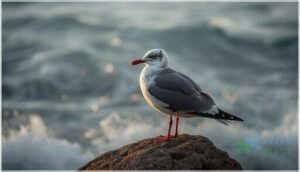
If you’ve ever spotted a gull along the Pacific Coast with a striking red bill and a smoky gray body, you’ve almost certainly crossed paths with a breeding adult Heermann’s Gull.
If you want to sharpen your eye for Pacific gulls, brushing up on closely related species like the California Gull identification features and markings makes spotting that vivid red bill even more satisfying.
In breeding plumage, Larus heermanni displays deep storm-cloud gray across the body, a pearly white head, and a vivid red bill tipped in black — breeding colors that make this species genuinely unmistakable among Pacific gulls.
Immature Gull Appearance

Young Heermann’s Gulls tell a completely different story. Where adults turn heads with bold contrast and color, immatures wear a uniform dark sooty brown that’s easy to overlook if you don’t know what you’re looking for.
These juvenile markings on Larus heermanni show minimal mottling effects and almost no streaking, setting them apart from other gull-like birds. Feather development gradually shifts the plumage patterns toward adult coloration over several years.
Bill, Legs, and Size Details
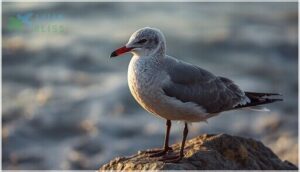
Beyond plumage, the bill and legs are where Heermann’s Gull really gives itself away. Adults carry a vivid red bill tipped in black — unmistakable in the field. Immatures show a pinkish bill base with black legs. For gull identification, size, shape, and measurements matter too:
- Length: 18–21 inches
- Bill coloration shifts from pink to red with age
- Leg structure stays dark throughout life
- Beak shape is medium, slightly drooped at the tip
That combination of relative size, feather length, and bold beak shape makes Heermann’s Gull reliably distinct.
Distinctive Flight Silhouette

Once you’ve nailed the bill and leg details, watch how Heermann’s Gull moves through the air — its broad, pointed wings and short, rounded tail create a silhouette that’s surprisingly easy to pick out against the sky.
| Flight Feature | What to Look For |
|---|---|
| Wing Shape | Broad, pointed tips |
| Tail Form | Short, rounded |
| Flight Patterns | Direct, steady beats |
| Aerodynamic Forms | Compact, low-profile body |
| Silhouette Analysis | Dark outline, smooth glide |
That distinct avian morphology makes gull identification straightforward, even at a distance.
Once you know what to look for, a guide like Gulls Simplified Bird Identification helps you nail the finer details that separate similar species.
Natural Habitat and Distribution

Heermann’s Gull doesn’t stay in one place for long — its range stretches from a tiny breeding island in Mexico to coastlines as far north as British Columbia. Where you find this bird, and when, depends entirely on the season.
Here’s a closer look at the key places and patterns that shape its world.
Breeding Sites in The Gulf of California
Almost the entire world population of Heermann’s Gull funnels down each spring to a single island you could walk across in under ten minutes. That island is Isla Rasa, a nesting island barely a quarter square mile in size, tucked inside the Gulf of California in Mexico.
Nearly every Heermann’s Gull on Earth converges each spring on Isla Rasa, a Mexican island barely a quarter square mile in size
This concentrated breeding population makes Gulf conservation and marine protected status critical — colony dynamics here determine the fate of the entire species.
Preferred Coastal and Marine Environments
Outside of breeding season, you’ll find Heermann’s Gull right where the land runs out — scanning rocky shorelines, riding swells above kelp beds, and working the surf zone with the kind of restless focus that defines a true coastal specialist.
These birds are shaped by shoreline dynamics and ocean currents, favoring marine habitats where upwelling pushes fish close to the surface. Coastal ecosystems built on productive seabed geology — estuaries, kelp forests, rocky headlands — are where seabird behavior and ecology like theirs truly thrives.
Seasonal Migration Along The Pacific Coast
Each spring, Heermann’s Gulls pull off one of the Pacific Coast’s most counterintuitive migrations — heading north after breeding, not south. Their seasonal movements along the Pacific Flyway take them from Mexico’s Gulf of California all the way to British Columbia.
Watch for them at these coastal stops:
- Rocky headlands and kelp-rich nearshore zones
- Estuaries with high fish density
- Sandy beaches near active fishing areas
- Offshore feeding grounds above productive upwellings
Population Hotspots in North America
From Monterey Bay to British Columbia, Heermann’s Gull migration patterns concentrate birds across a handful of reliable Pacific Coast hotspots. Central California beaches hold dense flocks from late May through early February, while British Columbia draws 1,500–3,000 birds each July and August.
Pacific Northwest shores track closely with sardine abundance. These coastal habitats and foraging strategies are shaped by the same breeding colonies and conservation efforts rooted in Mexico.
Feeding Behavior and Diet

Heermann’s Gull is, without question, one of the more resourceful feeders you’ll find along the Pacific Coast. It doesn’t just hunt — it schemes, adapts, and sometimes outright steals its next meal.
Here’s a closer look at what it eats, how it hunts, and how it interacts with the birds around it.
Primary Food Sources and Prey
Heermann’s Gull isn’t picky, but it does have a clear preference. When anchovies and sardines are running, you’ll find this gull right in the middle of the action. These pelagic fish drive the species’ marine foraging behavior, especially during breeding season.
Its prey list includes:
- Pacific sardines
- Northern anchovies
- Crustaceans
- Mollusks
- Insects and carrion
This diet keeps the marine ecosystem balance intact.
Foraging Techniques and Kleptoparasitism
If you’ve ever watched a Brown Pelican dive headfirst into the surf, you’ve probably also seen what happens next—a bold gray gull swooping in to steal the catch before the pelican even surfaces. That’s kleptoparasitism in action.
This food piracy is central to Heermann’s Gull’s foraging strategies, and it’s surprisingly effective. Beyond stealing, they also dip and plunge independently, showcasing flexible feeding adaptations that make seabird interactions with this species endlessly fascinating to observe.
Seasonal Dietary Shifts
What a gull eats isn’t fixed—it shifts with the seasons. During breeding in the Gulf of California, Heermann’s Gull relies heavily on sardines and anchovies, sometimes over 87% anchovy when sardine stocks drop.
Come fall, coastal bird migration patterns push them north, where fish availability changes and diet flexibility kicks in—crustaceans, mollusks, and beach scavenging fill the gaps. Prey switching is simply smart avian behavior.
Their distinct appearance, including a storm-cloud gray plumage, makes them easy to spot along the Pacific Coast.
Interactions With Other Seabirds
Beyond what it eats, how it eats tells an even more revealing story—and for this species, that often means showing up where the action is and letting larger birds do the hard work first. Heermann’s Gull is a master of avian piracy, targeting Brown Pelicans mid-catch through kleptoparasitism tactics.
Feeding frenzies draw large mixed flocks, where seabird aggression spikes and colony interactions become intense, chaotic, and worth watching closely.
Breeding Biology and Life Cycle

Breeding season is when Heermann’s Gull truly comes into its own, with every behavior sharpening around one goal: raising the future offspring. Most of the world’s population converges on Isla Rasa, a tiny island in Mexico’s Gulf of California, making this one of the most concentrated seabird breeding events on the Pacific Coast.
Here’s a closer look at how these gulls find mates, build nests, and bring their chicks into the world.
Mating and Pair Bonding Behaviors
When breeding season arrives, Heermann’s Gulls throw themselves into courtship with a focused intensity that’s hard to miss. Mate selection involves ritualized displays — head tossing, calling, and food offerings between prospective partners.
These courtship rituals reinforce pair bonding and establish monogamy patterns that often persist across multiple seasons. For a seabird species already facing conservation pressure, strong pair bonds directly support breeding strategies that improve chick survival rates.
Nesting Site Selection and Construction
Once those pair bonds are sealed, the real work begins — finding and building the right spot to raise a family. For Heermann’s Gull, that means returning to established breeding grounds, most memorably Isla Rasa in the Gulf of California, where colony formation happens on a massive scale.
Nesting habitat inclines to be open and rocky. Pairs scrape shallow depressions into the ground, sometimes adding pebbles or plant material for basic nest construction.
Egg-Laying, Incubation, and Chick Care
With the nest scraped and ready, both parents shift their focus to the next critical stage: bringing new life into one of the Pacific Coast’s most densely packed breeding colonies.
Heermann’s Gull usually lays two to three eggs, and incubation periods last around 28 days, with both parents sharing duties.
Chick development moves quickly — parents provide constant parental care, brooding and feeding young until they’re strong enough to fend for themselves.
Fledgling Development and Survival Rates
Young Heermanns Gull chicks grow fast — gaining most of their body mass in the first three weeks before shifting energy toward wing development. Fledging periods run 35–40 days, and survival rates vary sharply by year:
- Strong anchovy years produce one to two fledglings per nest
- Warm El Niño events can cause near-total Nesting Success failure
- Fledgling Mortality spikes when parents abandon nests due to food scarcity
Chick Growth directly mirrors ocean health, making bird species conservation critical. Long-term studies on provide essential insights into their survival challenges.
Conservation Status and Challenges

Heermann’s Gull faces a precarious future, with nearly all of its global population tied to a single small island in Mexico’s Gulf of California. That kind of concentration makes the species especially sensitive to shifting ocean conditions, human pressures, and ecological disruption.
Here’s a closer look at where things stand and what’s being done about it.
Current Population Trends
The global Heermann’s Gull population sits around 350,000 breeding adults, but don’t let that number fool you into thinking the species is secure. Population fluctuations tied to El Niño events can trigger near-total breeding failure in a single season, sharply cutting breeding success and disrupting migration patterns.
Colony dynamics remain highly unstable year to year, and the IUCN Status of Near Threatened reflects just how fragile global estimates really are.
Major Threats and Human Impacts
Several forces are quietly stacking against Heermann’s Gull. Overfishing effects on Pacific sardine and anchovy stocks have triggered near-total nesting failures on Isla Rasa. Introduced black rats destroy eggs and chicks each season.
Climate change disrupts ocean temperatures, cutting food availability at critical times.
Human disturbance at breeding colonies, pesticide contamination, and habitat destruction further threaten the species. The ecological balance and biodiversity this species depends on grows increasingly fragile.
Conservation Efforts and Protected Areas
Protecting Heermann’s Gull has taken real, coordinated work across borders. Mexico designated Isla Rasa a protected sanctuary in 1964, ending mass egg harvesting and anchoring long-term habitat preservation and island restoration efforts there.
Today, three key actions drive species protection forward:
- Invasive mammal removal from nesting islands
- Marine reserves limiting fishing and coastal disturbance
- California floating nest platforms expanding breeding sites
This layered wildlife conservation approach maintains ecological balance and biodiversity.
Future Outlook and Research Needs
The fate of Heermann’s Gulls hinges on how quickly climate modeling and coordinated research can catch up to real-world change. Rising sea temperatures are already disrupting sardine and anchovy stocks, threatening breeding success at Isla Rasa.
Conservation strategies must prioritize population projections, cross-border data sharing, and clear fish-stock thresholds. These research priorities aren’t optional — they’re the backbone of lasting seabird conservation efforts and species preservation and management.
Frequently Asked Questions (FAQs)
What is the rarest gull in the world?
The Relict Gull tops most Endangered Species Lists as one of the rarest seabirds globally, with a shrinking population that highlights urgent needs in Global Conservation and tracking Bird Migration Patterns across Central Asia.
What do Heermann’s gulls eat?
Heermann’s Gulls eat small fish like anchovies and sardines, plus crustaceans and mollusks. Their feeding habits include kleptoparasitism — stealing fish straight from pelicans mid-catch.
Are there Herring Gulls in America?
Yes, Herring Gulls are common across North America. They’re one of the most recognized gull species, spotted along coasts, lakes, and inland areas — a staple of American Gull Populations and Coastal Bird Diversity.
Why are Herring Gulls so aggressive?
Herring Gulls are aggressive because food scarcity, territorial disputes, and social hierarchy drive their behavior. Predator avoidance sharpens their instincts, making these gull-like birds fiercely competitive — especially when nesting or feeding alongside rival seabirds.
What is an immature heermanns gull?
An immature bird shows dark sooty brown plumage, with little streaking or mottling — quite different from adults.
Bill coloration starts pinkish at the base, and molt patterns gradually shift as the bird matures.
What do Heermann’s gull eat?
Like skilled thieves of the sea, these birds rely on fish piracy and kleptoparasitism. Their diet composition centers on anchovies and sardines, but they’ll steal catches from seabirds without hesitation.
What is the average lifespan of Heermanns Gulls?
Most seabirds in this family live roughly 10–15 years in the wild.
Longevity studies on Heermann’s Gulls suggest similar lifespans, with survival strategies, mortality rates, and wildlife conservation efforts all influencing age distribution across the population.
How do Heermanns Gulls communicate with each other?
Much like many coastal birds, these gulls rely on vocalization patterns, visual displays, and call recognition to coordinate flock dynamics, reinforce pair bonds, and support social learning — core aspects of avian biology and bird species identification.
Are Heermanns Gulls known for any unique behaviors?
These birds are bold, opportunistic feeders. Their kleptoparasitism — stealing catches mid-air from pelicans — defines their aggressive foraging style.
Flocking patterns, adaptive migration, and social interactions with gull-like birds make them a standout avian species.
Do Heermanns Gulls have any natural predators?
Even medieval sailors feared the coastal hunters of the sea.
Heermann’s Gulls face predators like falcons, ravens, and gulls, while black rats and mice threaten nesting sites, driving gull mortality and raising wildlife conservation efforts.
Conclusion
No other gull carries the Pacific’s entire story on its feathers quite like Heermann’s Gull—a species whose fate rests on a single island, a single fish, and decisions made across two countries.
Once you recognize that smoky silhouette diving into a kelp bed, you can’t unsee it. What you choose to notice changes what you choose to protect. This bird doesn’t need mythology; it just needs people paying attention.
- https://www.allaboutbirds.org/guide/Heermanns_Gull/overview
- https://nrm.dfg.ca.gov/FileHandler.ashx?DocumentID=1787
- https://pubs.acs.org/doi/abs/10.1021/acs.est.5b02053
- https://besjournals.onlinelibrary.wiley.com/doi/full/10.1002/2688-8319.12274
- https://terrapeninsular.org/en/isla-rasa-40-years-learning-from-the-nesting-seabirds/