This site is supported by our readers. We may earn a commission, at no cost to you, if you purchase through links.
 You might think telling a blackbird from a crow is simple, but add a raven to the mix and things get tricky fast. These dark-feathered birds share similar habitats and often cross paths, yet they belong to different families with distinct traits.
Ravens dwarf crows by nearly double the size, while blackbirds sport rusty shoulder patches that set them apart immediately. Size, beak shape, tail structure, and even social habits reveal clear differences once you know what to look for. Mastering these identification markers turns confusing sightings into confident species recognition every time you step outside.
Table Of Contents
- Key Takeaways
- Blackbirds, Crows, and Ravens: an Overview
- Size Comparison: Blackbird Vs Crow Vs Raven
- Physical Characteristics: Plumage, Beaks, and Tails
- Behavioral Differences: Social Structures and Interactions
- Vocalizations: Calls, Songs, and Communication Patterns
- Feeding Habits and Dietary Preferences
- Nesting Behaviors and Reproduction Strategies
- Intelligence and Problem-Solving Abilities
- Conservation Status and Human Interactions
- Identification Tips for Birdwatchers
- Frequently Asked Questions (FAQs)
- What is the difference between a crow and a raven and a blackbird?
- How can you tell a raven from a crow?
- Why is a crow called a raven?
- What is the difference between crow and black crow?
- How do ravens adapt to urban environments?
- What role do crows play in ecosystems?
- Are blackbirds migratory, and do they travel long distances?
- How do ravens communicate during mating season?
- What cultural significance do these birds hold worldwide?
- What predators naturally hunt blackbirds, crows, and ravens?
- Conclusion
Key Takeaways
- Ravens are nearly twice the size of crows and three times larger than blackbirds, with ravens reaching 27 inches in length compared to crows at 16-20 inches and blackbirds at just 9-11.5 inches, making size your most reliable identification marker.
- Tail shape provides instant identification in flight: ravens display distinctive wedge-shaped tails and soar like hawks, crows show fan-shaped or squared tails with steady flapping, and blackbirds have shorter tails suited for quick directional changes.
- Crows live in large social flocks called "murders" with complex hierarchies and cooperative behaviors, while ravens prefer solitary lives or mate pairs, and blackbirds fall somewhere between with seasonal flock formations.
- Both crows and ravens demonstrate remarkable intelligence through tool use, facial recognition lasting years, and cultural transmission of learned behaviors across generations, setting them apart from blackbirds and most other bird species.
Blackbirds, Crows, and Ravens: an Overview
When you’re trying to tell these large black birds apart, knowing where to start makes all the difference. You’ll need to understand their family connections, spot the features that set them apart, and recognize where each species calls home.
Let’s look at how these intelligent birds compare across classification, physical traits, distribution, and their fascinating evolutionary journey.
Classification Within The Corvidae Family
When you’re trying to tell these sharp-eyed birds apart, understanding their place in the taxonomic tree is your first solid foothold. Crows and ravens belong to the Corvidae family, making them true corvids. Blackbirds, however, aren’t corvids at all—they’re from different families entirely.
Here’s what you need to know about these birds’ classification:
- Corvus Genus: Both crows and ravens share the genus Corvus, highlighting their close evolutionary relationships
- Blackbird Separation: Blackbirds belong to Icteridae or Turdidae families, not Corvidae, despite superficial similarities
- Subspecies Variations: Multiple raven and crow species exist across North America, each with distinct characteristics
- Taxonomic Debates: Ongoing research continues to improve our understanding of corvid classification and hybridization events
Key Distinguishing Features
Once you’ve got the family tree down, spotting these birds in the field comes down to a few reliable features you can check off pretty quickly. Here’s what’ll help you nail the identification:
- Size discrepancies: Ravens measure 22–27 inches, crows 16–20 inches, and blackbirds just 9–11.5 inches—a clear progression you can see from a distance.
- Plumage comparison: Crows and ravens wear glossy black feathers, while blackbirds often show rusty patches or colorful markings.
- Beak morphology: Ravens carry thick, heavy beaks; crows have slimmer ones; blackbirds sport pointed bills.
- Tail characteristics: Ravens display wedge-shaped tails, crows show rounded or squared tips, and blackbirds have shorter, fan-like tails.
Geographical Distribution and Habitats
If you know which birds hang out where, you’ll save yourself a lot of guesswork when you’re trying to pin down an identification. American Crows adapt to nearly any habitat—from forests to urban areas—with minimal seasonal migrations. Common Ravens prefer secluded mountain ranges and boreal zones, rarely venturing into cities. Fish Crows stick to eastern wetlands, while Chihuahuan Ravens claim southwestern deserts. Blackbirds favor marshes and semi-aquatic environments.
Habitat loss and climate impact continue shifting these regional variations.
Evolutionary History and Adaptations
Around 10 million years ago, the genus Corvus began spreading from Central Asia across continents, building bigger bodies, longer wings, and larger brains along the way. You’ll notice crows and ravens thriving in habitats from deserts to cities, thanks to behavioral adaptations like tool use and sophisticated problem-solving that evolved from nest-building instincts.
Genetic divergence created distinct species, yet hybridization patterns still blur boundaries between raven lineages. Common ravens, for example, exhibit signs of reticulate evolution, where lineages merge.
Blackbirds took a different path, shifting from forests to marshes and evolving plumage changes tied to new breeding behaviors.
Size Comparison: Blackbird Vs Crow Vs Raven
Size matters when you’re trying to tell these birds apart. Ravens tower over crows, and both dwarf the smaller blackbird—but knowing the exact measurements helps you identify them quickly in the field.
Let’s break down the numbers so you can spot the differences at a glance.
Average Lengths and Wingspans
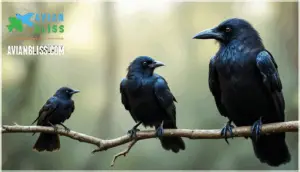
Ravens tower over crows at nearly 27 inches in length, while blackbirds barely reach 11 inches, making size your most reliable clue when you spot these birds from a distance. Wingspans follow this pattern too, creating clear physical characteristics that separate these species.
| Species | Length | Wingspan |
|---|---|---|
| Blackbird | 9–11.5 inches | 13–17 inches |
| Crow | 16–20 inches | 33–39 inches |
| Raven | 22–27 inches | 45–59 inches |
Regional variations and sexual dimorphism can shift these measurements slightly, but size overlap between species remains minimal, giving you reliable differences between blackbirds, crows, and ravens for comparing bird characteristics in the field.
Body Mass and Proportions
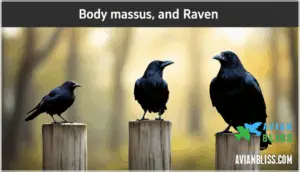
Weight differences tell you even more than length when you’re watching these birds swoop overhead or perch in your backyard. Ravens pack over three pounds of muscle, while crows average just one pound, and blackbirds weigh barely three ounces—giving you clear size ratios that simplify comparing bird species in the field.
| Species | Body Mass | Body Shape |
|---|---|---|
| Blackbird | 0.2 pounds | Slender, compact |
| Crow | 0.7–1.4 pounds | Sturdy, balanced |
| Raven | 1.5–4.4 pounds | Thick-bodied, powerful |
Sexual dimorphism affects juvenile size slightly, but these physical characteristics of birds remain your most reliable markers for identification.
Visual Size Comparison in Flight
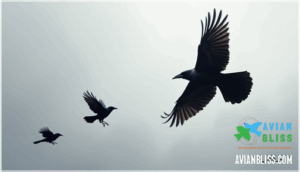
Watching these birds cut across the sky reveals size differences that field guides can’t quite capture—the way a raven dwarfs a crow becomes obvious when both glide through your line of sight. You’ll notice ravens use broad, deliberate wingbeats and soar like hawks, while crows flap steadily with minimal gliding. Blackbirds dart and weave with rapid wing motion.
| Flight Feature | Blackbird | Crow | Raven |
|---|---|---|---|
| Wingspan | 9–15 inches | 33–39 inches | 45–59 inches |
| Speed | Fast, erratic | Moderate, steady | Slow, powerful |
| Flight Pattern | Quick bursts | Consistent flapping | Soaring glides |
| Silhouette | Slender profile | Compact body | Wedge-shaped tail |
Size Variations Among Different Species
Within each species, you’ll find surprising size differences shaped by geography and genetics. Regional variations mean a Common Raven in Alaska might outweigh its Arizona counterpart by several ounces, while subspecies differences create distinct size classes across ranges. Sexual dimorphism appears subtly in crows—males usually measure slightly larger—though juvenile sizes complicate field identification since young ravens can resemble adult crows. Ravens also possess remarkably sharp eyesight, aiding them in foraging and spotting carrion. Measurement techniques confirm these patterns through systematic species comparison.
| Feature | Blackbird | Crow | Raven |
|---|---|---|---|
| Regional size range | 9–11.5 inches | 15–21 inches | 21–27 inches |
| Sexual dimorphism | Moderate (males larger) | Slight (males heavier) | Minimal visible |
| Juvenile vs. adult | Smaller, spotted plumage | 80% adult size at fledging | Larger than adult crows |
Physical Characteristics: Plumage, Beaks, and Tails
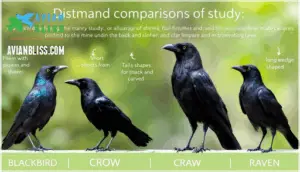
Once you’ve nailed down the size differences, you’ll want to zoom in on the physical details that really set these birds apart. Feathers, beaks, tails, and even eye color tell you a lot about what you’re looking at.
Here’s what to watch for when you’re trying to tell a blackbird from a crow or raven.
Feather Coloration and Iridescence
You’ll spot the most striking difference between these birds when sunlight hits their feathers just right, turning what looks like plain black into a dazzling display of blues, purples, and greens. Ravens show the most intense iridescence with rich purples across their black plumage, while crows display subtler blue-green structural colors.
Blackbirds often lack this shiny black finish entirely, with many species showing brown or mottled feather coloration instead.
Beak Shape, Size, and Functionality
When you compare these three birds side by side, their beaks tell you exactly what they’re built to do. Blackbirds sport slender beaks perfect for plucking insects and probing soft ground. Crows have stouter beaks with impressive bill strength for cracking seeds and tearing into diverse foods. Ravens possess the most powerful beaks with strong curved tips, built for ripping carrion and manipulating tough materials.
These specialized beaks reflect evolutionary pressures that shaped each species’ feeding adaptations and survival strategies.
Tail Shapes and Their Aerodynamic Purposes
If you watch these birds wheel overhead, you’ll notice the tail does more than just steer—it practically defines how each species masters the sky.
Ravens use their wedge-shaped tails for soaring and acrobatic maneuvers in flight. Crows rely on fan-shaped or squared tails that provide stability during steady flapping. Blackbirds sport shorter, efficient tails optimized for quick directional changes and efficient flight patterns through dense vegetation.
Eye Color and Visual Adaptations
Beyond flight mechanics, the eyes of these birds reveal another layer of distinction—ravens and crows have dark brown or black eyes adapted for sharp contrast detection, while many blackbird species display pale yellow or amber irises that improve their ability to spot insects and threats in varied light conditions. Eye pigmentation affects light sensitivity and visual acuity differently across species:
- Depth perception: Corvids excel at judging distances for precise landings
- Contrast enhancement: Dark eyes improve detection against bright backgrounds
- UV sensitivity: Pale eyes in blackbirds filter wavelengths differently
- Nocturnal vision: Ravens maintain better low-light performance than smaller species
- Visual acuity: All three groups show sharp focus for foraging and predator detection
These physical characteristics of birds directly influence how each species hunts, navigates, and survives in its preferred habitat.
Behavioral Differences: Social Structures and Interactions
The way these birds interact with each other tells you a lot about who they’re. Ravens prefer solitude or stick with their mate, while crows live in bustling flocks with clear pecking orders.
Here’s how their social lives compare across four key areas.
Flock Sizes and Social Hierarchies
Crows are social butterflies of the bird world, forming massive groups called "murders" that can number in the hundreds or even thousands, while ravens prefer the quiet life as loners or devoted pairs. Within crow flocks, you’ll find hierarchical structures where dominant birds claim the best feeding spots and roosting sites. Their social nature allows for impressive social learning—younger crows pick up foraging tricks from experienced family groups.
Ravens, in contrast, embrace solitude outside breeding season, occasionally forming loose groups around abundant food sources.
Blackbird flocks show intermediate behavior, gathering in mixed-species groups during migration but maintaining smaller family units during nesting.
Mating Behaviors and Pair Bonding
Ravens take romance to the next level with aerial acrobatics and synchronized flying, while crows stick with more practical displays of devotion—and blackbirds fall somewhere in between with melodious serenades and short courtship flights. All three species form strong pair bonds, but their approaches to mate selection and breeding behavior differ:
- Ravens maintain lifelong partnerships, performing elaborate avian mating displays including barrel rolls and wing-touching mid-flight.
- Crows show cooperative breeding, with offspring helping parents raise new broods.
- Blackbirds rely on territorial songs for courtship rituals and attracting mates.
- Nest building involves both partners in ravens and crows, strengthening their bonds.
Territorial Behaviors and Nest Defense
Once a nest is built, these birds transform into fierce defenders, with each species employing distinct strategies to protect their territory and young. Ravens defend vast territories aggressively, diving at intruders while emitting harsh croaks. Crows, on the other hand, engage in cooperative mobbing, using alarm calls to summon nearby flock members. Blackbirds rely on territorial songs and swift strikes near their nests.
| Species | Territory Size | Defense Tactics |
|---|---|---|
| Ravens | 15-44 acres | Aerial attacks, deep vocalizations, pair coordination |
| Crows | 1-5 acres | Group mobbing, persistent harassment, alarm calls |
| Blackbirds | 0.25-1 acre | Song displays, rapid flights, individual strikes |
Their nesting behavior reflects breeding priorities: ravens prioritize predator avoidance by nesting in remote locations, crows utilize cooperative nest guarding, and blackbirds balance territoriality with resource competition. Interspecies aggression peaks during the breeding season, intensifying these defense tactics.
Interspecies Interactions and Competition
Through shared habitat and feeding habits, these three species clash more often than you’d expect. Crow aggression toward ravens peaks from March to May, when crows gang up in groups to chase off the larger birds—accounting for 97% of hostile encounters. Resource competition flares at food sites, especially carcasses, where raven dominance usually wins despite crow harassment. Culling effects reveal hidden dynamics: removing crows allowed ravens to expand their range dramatically. Niche overlap stays minimal between blackbirds and corvids, reducing direct conflict.
Key interaction patterns you’ll observe:
- Breeding season battles – Crows mob ravens near nests, with 81% of attacks involving numerical advantage
- Food site standoffs – Ravens dominate at carcasses, but crows persistently displace them through group tactics
- Winter skirmishes – Competition intensifies over scarce resources when predators and ecological roles shift
- Blackbird separation – Different feeding habits and habitat preferences keep blackbirds out of corvid conflicts
Vocalizations: Calls, Songs, and Communication Patterns

You can actually tell these birds apart just by listening to them talk. Each species has its own signature sound, and if you know what to listen for, you’ll never mix them up again.
Let’s break down how blackbirds, crows, and ravens communicate, from their basic calls to the surprising ways they "speak" without making a sound.
Typical Calls of Blackbirds, Crows, and Ravens
You don’t need perfect pitch to tell these birds apart—their voices alone give them away. Ravens produce deep, guttural croaks that echo across canyons. Crows deliver the classic "caw"—sharp, nasal, and repetitive. Blackbirds surprise you with melodious, flute-like songs rather than harsh corvid vocalizations.
These acoustic adaptations serve different call functions:
- Ravens: Low-frequency croaks carry over long distances in remote terrain.
- Crows: High-pitched caws alert flockmates and defend territories.
- Blackbirds: Musical phrases attract mates and mark breeding areas.
Listen closely—dialect variations exist even within species.
Vocal Mimicry Capabilities
Some birds don’t just make noise—they steal it, copying everything from car alarms to human laughter with surprising accuracy. Ravens excel at mimicry, imitating human voices and mechanical sounds with striking vocal accuracy. Crows also demonstrate mimicry capabilities, though less complex than ravens.
Species imitation develops through social learning, with younger birds refining vocalization patterns by listening to their surroundings. Mimicry purpose remains debated—researchers suggest it aids territorial defense or social bonding within complex corvid societies.
Non-vocal Communication Methods
While calls and croaks steal the spotlight, these clever birds speak volumes without making a sound—their bodies do the talking through a surprising vocabulary of gestures and movements. You’ll notice ravens puffing throat feathers to establish dominance, while crows use specific posture signals during territorial disputes.
Flight patterns reveal behavioral traits too—watch for wing-flashing displays or tail-spreading that signal aggression or courtship.
Tactile communication matters in avian behavior, especially when adults guide fledglings during foraging strategies, gently nudging them toward food sources within their complex behavior and social structure.
Regional Dialects and Variations
Notably, dialect origins trace back to vocal learning during early development, when juvenile birds absorb the songs and calls of their local population. Geographic isolation creates distinct vocalizations—American Crows in New England produce slightly different "caw" patterns than their Pacific Northwest cousins.
Social dialects emerge within tight-knit flocks, where birds hone their communication through repeated interactions. Even hybridization effects between closely related species can blur traditional boundaries in bird sounds, making identification trickier where ranges overlap.
These differences between blackbirds, crows, and ravens reveal how environmental pressures shape their complex vocal repertoires over generations.
Feeding Habits and Dietary Preferences

What these three birds eat tells you a lot about where you’ll find them and how they behave. Their diets shape their daily routines, from where they search for food to how they interact with humans.
Let’s look at what each species prefers to eat and how they go about finding it.
Common Food Sources for Each Species
All three birds are opportunistic feeders, but their diets shift with the seasons and their surroundings. Ravens and crows, both omnivores, consume carrion, insects, small mammals, eggs, and grains. Blackbirds favor insects during breeding season and switch to fruits and seeds in fall.
Dietary adaptations reflect their habitats—crows thrive near human settlements, ravens in remote areas, and blackbirds in wetlands and fields, reducing food competition.
Foraging Techniques and Adaptations
Each species has honed distinct foraging strategies that make the most of their physical tools and environment. Crows use their strong beaks to crack nuts and probe garbage, while ravens flip rocks and cache food for leaner times. Blackbirds probe soil for insects with their slender bills during breeding season, then switch to picking fruits and seeds in fall.
These dietary adaptations reflect their omnivore flexibility and foraging intelligence, shaped by habitat influence and seasonal changes in available food.
Scavenging Behaviors and Carrion Consumption
When carrion appears on the landscape, it’s the crows and ravens that show up first—not by chance, but by design. Their sharp eyesight and keen sense of smell help with corpse detection from impressive distances. Ravens dominate larger carcasses in wild areas, while crows excel at urban scavenging, raiding roadkill and dumpsters.
Both omnivores navigate scavenging competition and disease transmission risks with specialized gut bacteria that break down decaying flesh.
Blackbirds rarely participate in these carrion food webs, sticking to their insect-based avian diet instead.
Impact on Agricultural and Urban Environments
Crows and ravens thrive in cities and farms, while blackbirds prefer fields and wetlands. Ravens and crows cause crop damage to corn and fruit orchards, yet they provide ecosystem services by eating insects and rodents.
Their urban scavenging behavior creates public health concerns near trash bins. Farmers use bird control methods like scarecrows, but these omnivores quickly adapt.
Their habitat flexibility and opportunistic behavior make them both helpful pest controllers and agricultural challenges, depending on their avian diet choices.
Nesting Behaviors and Reproduction Strategies

Understanding how these three birds build their homes and raise their young reveals another layer of distinction. Each species has evolved unique strategies for nesting, breeding, and caring for their offspring.
Let’s examine how blackbirds, crows, and ravens approach the critical task of reproduction.
Nest Construction and Placement
Ravens make a fortress while crows tuck their nests into branches like secrets, but blackbirds build their homes with the precision of craftsmen who know the neighbors won’t be friendly. Ravens often reuse nest locations year after year, adding layers until the structure becomes massive.
Crows prefer dense foliage for concealment, weaving sticks and mud into sturdy platforms.
Blackbirds select low shrubs or marsh vegetation, incorporating grasses and rootlets with considerable skill—their nesting behavior reflects their habitat preferences and breeding habits perfectly.
Breeding Seasons and Clutch Sizes
Timing can be everything, and these three birds don’t all wait for spring to roll around before they start their families. Ravens begin breeding habits in February or March, laying 3-6 eggs with incubation around 20 days. Crows follow similar mating rituals starting in late March, producing 4-5 eggs.
Blackbirds show clutch variation, nesting from April through July with multiple broods of 3-5 eggs, their nesting behavior reflecting their adaptable breeding success.
Parental Care and Fledgling Development
Once the eggs hatch, you’ll witness an extraordinary shift as both parents throw themselves into feeding duties, often making hundreds of trips daily to keep their hungry brood alive. Ravens and crows show intense parental investment, with incubation periods followed by 3-4 weeks of nestling feeding before fledgling survival becomes critical.
Post-fledging care extends another month as young birds master flight and foraging, though family groups may stay together longer in crows.
Cooperative Breeding in Some Species
In the American Crow world, you’ll find an unexpected twist—offspring from previous years often stick around to help raise their younger siblings, turning the nuclear family into a multi-generational support system. These Family Helpers demonstrate clever behavior through:
- Nest Defense: Extra guardians protect against predators.
- Resource Sharing: Helpers bring food to nestlings.
- Kin Selection: Related helpers boost their own genes’ survival.
- Breeding Success: More helpers mean healthier fledglings.
This cooperative breeding strengthens family groups and showcases one of the most interesting behaviors in corvid nesting habits.
Intelligence and Problem-Solving Abilities

You might think all black birds are pretty much the same, but crows and ravens are actually cognitive champions. These birds don’t just survive—they solve problems that would stump many animals.
Let’s look at the specific ways their intelligence shows up in everyday life.
Tool Use and Manipulation
If you’ve ever watched a crow drop a walnut onto pavement or seen one poke a twig into bark crevices to fish out insects, you’ve witnessed intelligence that rivals some primates. These cognitive abilities showcase striking problem-solving skills that go beyond instinct. Crows bend wire into hooks, while ravens manipulate sticks to reach hidden food—tool innovation that demonstrates developed learning behavior.
Their tool complexity increases with age, revealing interesting behaviors shaped by experience and observation of other birds.
| Tool-Use Behavior | Example |
|---|---|
| Stick manipulation | Probing bark crevices for larvae |
| Stone anvil use | Dropping shellfish to crack open |
| Hook-making | Bending wire to retrieve unreachable food |
Memory and Recognition Capabilities
Think of a crow as a feathered detective who never forgets a face—these birds can recognize individual humans years after a single encounter, and they’ll even teach their offspring who to trust or avoid.
Crows remember human faces for years and pass that knowledge to their young, teaching them exactly who to trust or avoid
Their spatial memory rivals GPS systems, letting them recall thousands of food cache locations months later. These cognitive abilities demonstrate avian intelligence through:
- Facial recognition lasting over five years
- Episodic memory of specific events and locations
- Object permanence understanding that hidden items still exist
Social Learning and Cultural Transmission
You’ve seen how crows remember faces—but that’s just the start. Through social learning, these birds watch each other’s problem-solving skills and copy what works, creating cultural innovations that spread through flocks like wildfire. Young ravens learn foraging techniques by observing older birds, while crows develop regional traditions for cracking nuts or using tools. This cultural transmission strengthens social hierarchies and shapes behavior across generations.
| Species | Cultural Innovation | Tradition Stability |
|---|---|---|
| Ravens | Tool manipulation techniques | Multi-generational teaching |
| Crows | Nut-cracking methods | Dialect variations across regions |
| Blackbirds | Mimicry evolution patterns | Song learning from parents |
| All Three | Learned foraging strategies | Cultural significance in flocks |
Their cognitive abilities rival primates in some tasks, demonstrating intelligence that’s both inherited and taught.
Adaptability to Human-altered Environments
While these birds master social learning, their most impressive skill might be turning our parking lots and dumpsters into five-star dining spots.
Urban colonization comes naturally to crows and ravens, who’ve adjusted their dietary shifts to include fast food scraps and garbage. Their nesting adaptations let them build homes on cell towers and billboards, while striking noise tolerance helps them thrive despite traffic roar.
Human proximity doesn’t phase them—they’ve decoded our patterns and schedules perfectly.
Conservation Status and Human Interactions
Understanding how these birds interact with humans helps you appreciate their role in our world. All three species hold stable populations, but their relationships with people vary widely.
From ancient myths to modern pest control debates, blackbirds, crows, and ravens each tell a different story about coexistence.
Population Trends and Threats
Despite their adaptability, these birds face real challenges. Habitat loss remains the biggest threat, especially for species with specific habitat preferences, such as wetland-dependent blackbirds. Climate change shifts food availability and breeding windows, while pesticide exposure affects their diet and feeding habits.
Human impact through persecution still occurs, though common misconceptions about birds as mere pests ignore their ecological value. Conservation efforts now focus on population monitoring to track trends—most crow and raven species maintain stable numbers, but localized declines warrant attention.
Natural predators and varying lifespans complicate recovery efforts where populations struggle.
Cultural Significance and Folklore
Beyond their ecological roles, these birds weave through human folklore with striking depth. Ravens carry raven mythology across cultures—Native American tales paint them as shape-shifters, while Greek myths linked them to weather prophecy. Crow omens vary wildly: Norwegian folklore sends them to hell annually, while the Yatagarasu in Japanese tradition symbolizes divine guidance. Blackbird symbolism spans from Druid legends of otherworldly transport to Sweden’s national bird status. Artistic depictions flourish—Messiaen’s compositions capture their songs, and postage stamps honor their presence.
- Counting Crows assigns fortune to numbers seen—one crow means bad luck, six signals doom
- The red-winged blackbird traditionally signals abundant harvests and plentiful catches to farmers and fishermen
- French rural folklore traditions give families "guardian crows" that predict major life events through their presence
These shared stories reveal humanity’s fascination with corvid wisdom and mystery.
Pest Management and Control Measures
Agricultural operations and urban developments often clash with these birds, so you’ll need smart strategies that balance effectiveness with ecological responsibility.
Crop protection relies on scare tactics—like predator decoys mimicking hawks—and reflective tape that disrupts their foraging patterns. Repellents using capsaicin affect bird behavior without harming habitats or nesting sites.
Trapping methods exist but raise ethical considerations, as these species control insect populations and disperse seeds. You’ll find success modifying bird habitats through timing adjustments rather than lethal measures.
Positive Ecological Roles and Benefits
These black-feathered birds aren’t just scavengers at your local park—they’re essential workers keeping entire ecosystems running smoothly. You’ll find them performing critical services that directly benefit you and your environment:
- Pest control: Crows consume thousands of insects, reducing crop damage and disease transmission
- Seed dispersal: Ravens spread fruits and seeds across vast distances, regenerating forests naturally
- Nutrient cycling: Scavenging benefits include breaking down carrion, returning nutrients to soil ecosystems
- Ecosystem engineers: These avian predators control rodent populations while maintaining predator-prey balance
Identification Tips for Birdwatchers
Spotting the differences between blackbirds, crows, and ravens in the field takes practice, but you can master it quickly with the right approach.
Focus on a few key features—size, shape, voice, and behavior—to sort out these look-alikes with confidence.
Here’s what to watch for when you’re out birdwatching.
Field Marks and Visual Cues
You’ll notice these field marks most clearly when you stop trying to see the whole bird at once and focus on one feature at a time. Start with beak morphology—ravens sport thick, curved beaks while crows have slimmer ones. Then check tail shape: ravens show wedge-shaped tails, crows display fans, and blackbirds vary by species.
Look for these key differences:
- Plumage iridescence: Ravens shine purple, crows gleam blue-green, blackbirds often show less gloss
- Eye color: Adults have dark eyes across species, though juveniles may differ
- Bird size and appearance: Ravens match hawks, crows resemble doves, blackbirds stay robin-sized
- Throat feathers: Ravens have shaggy throat hackles, unlike smooth-throated crows
- Flight silhouette: Ravens show longer necks and pointed wings in flight
Bird characteristics like these separate species faster than any single trait alone.
Flight Patterns and Silhouettes
Watch how a bird moves through the air, and you’ll decode its identity before it even lands. Ravens soar like raptors, using thermal currents with minimal flapping frequency and showing broad wing span. Crows maintain steady, methodical flight patterns with consistent wing beats. Blackbirds dart and weave with agile flight acrobatics.
In silhouette ID, notice ravens’ wedge-shaped tail shape and longer necks, while crows show fan tails and compact flight behavior.
Habitat Preferences and Range Maps
Each species stakes its claim in distinct corners of the continent, and mapping their ranges reveals surprising patterns that simplify identification. Ravens favor remote wilderness, from mountainous terrain to northern forests, while crows thrive in urban adaptation zones and agricultural landscapes. Blackbirds prefer semi-aquatic habitats like wetlands and marshes.
Habitat overlap occurs in transitional zones, but climate impact and range expansion continue reshaping avian habitats, making distribution maps essential tools for accurate identification.
Common Misidentifications and Look-alikes
Misidentifying these three species happens more often than you’d think, especially when juvenile plumage wears confusing plumage or lighting conditions play tricks on your eyes. Regional variations complicate matters further, as size perception shifts with distance and similar species like grackles mimic corvid features.
Understanding key differences between ravens and crows prevents common misconceptions:
- Juvenile crows resemble smaller ravens in poor light
- Grackles’ iridescent feathers mimic crow coloration
- Distance distorts actual size differences
- Wedge-shaped versus fan-shaped tail profiles
- Solo ravens versus social crow flocks
Frequently Asked Questions (FAQs)
What is the difference between a crow and a raven and a blackbird?
When large black birds gather on power lines or circle overhead, you’ll often wonder which species you’re watching. Crows are medium-sized corvids with rounded tails and high-pitched caws, ravens are larger with wedge-shaped tails and deep croaks, while blackbirds belong to different families entirely and show varied coloration beyond just black plumage.
How can you tell a raven from a crow?
Ravens stand out with their hawk-like size and wedge-shaped tails in flight. Their deep, guttural croaks differ from the crow’s sharp caw. Ravens glide and soar effortlessly, while crows flap steadily.
You’ll also notice a raven’s thicker beak and shaggier throat feathers up close.
Why is a crow called a raven?
Crows and ravens aren’t the same species, though folk taxonomy and historical naming confusion often blur the lines. Cultural perceptions and bird misidentification contribute to this mix-up, but differences between crows and ravens are clear: ravens are larger with wedge-shaped tails and deeper croaks, while crows are smaller with fan-shaped tails and sharper caws.
What is the difference between crow and black crow?
Black crow" isn’t a separate species—it’s just a casual way of saying crow. All crows are black, so the term doesn’t distinguish anything. What you’re really identifying is likely an American Crow, known for sharp problem-solving skills and traveling in groups called murders.
How do ravens adapt to urban environments?
Talk about a bird-brained success story—ravens have cracked the code to city living. You’ll spot these clever Corvidae family members thriving on urban food sources like dumpsters and fast-food scraps, nesting on skyscrapers and bridges, and boldly engaging in human interaction despite noise pollution and light pollution.
What role do crows play in ecosystems?
Crows maintain ecosystem health through their diverse ecological roles. They control insect populations by consuming beetles, caterpillars, and grasshoppers that damage crops. As opportunistic feeders, crows perform essential carrion cleanup, removing dead animals and reducing disease spread.
Through seed dispersal, they scatter fruits and nuts across landscapes, supporting forest regeneration. Their intelligence helps them adapt to changing habitats, making them valuable indicator species for environmental health.
Ravens and blackbirds share similar ecological functions, though crows excel in agricultural settings where their pest control and scavenging behaviors benefit human communities while maintaining natural balance.
Are blackbirds migratory, and do they travel long distances?
Migration patterns vary widely among blackbird species. Some populations migrate hundreds or even thousands of miles southward to escape winter, seeking warmer climates and reliable food sources.
Others remain year-round residents in their breeding territories, showing little to no migratory behavior depending on local climate impacts and habitat conditions.
How do ravens communicate during mating season?
During courtship, ravens become nature’s aerial acrobats, performing gravity-defying stunts you won’t believe until you see them.
These intelligent birds use deep, resonant croaks and synchronized flight displays to attract mates, combining vocalizations with breathtaking dives and rolls that demonstrate their fitness and strengthen pair bonding for territory defense and nesting.
What cultural significance do these birds hold worldwide?
Across dozens of cultures, crows and ravens embody death, prophecy, and transformation in mythology—from Odin’s ravens to Native American trickster tales. Their intelligence sparked reverence, while blackbirds often symbolize seasonal change and renewal in European folklore, appearing frequently in art and literature as messengers between worlds.
What predators naturally hunt blackbirds, crows, and ravens?
Hawks, owls, and eagles target all three species from above, while foxes, raccoons, and snakes raid their nests for eggs and young.
Adult ravens and crows face fewer mammalian predators due to their size and intelligence, but blackbirds remain vulnerable throughout their lifespan.
Conclusion
Before telegraphs or smartphones, spotting the differences between a blackbird vs crow vs raven required sharp eyes and patience—and that hasn’t changed. You now recognize size gaps, beak shapes, tail structures, and vocalizations that separate these species.
Ravens dominate with massive builds, crows gather in social flocks, and blackbirds flash rusty shoulder patches. Apply these markers during your next outdoor walk, and you’ll identify each bird with confidence instead of guesswork.
- https://macaulaylibrary.org/asset/135405
- https://www.bbcearth.com/news/are-ravens-as-smart-or-smarter-than-us
- https://nhpbs.org/wild/Corvidae.asp
- https://www.encyclopedia.com/environment/encyclopedias-almanacs-transcripts-and-maps/new-world-blackbirds-and-orioles-icteridae
- https://www.birdfamiliesoftheworld.com/passeriformes-family-groups/