This site is supported by our readers. We may earn a commission, at no cost to you, if you purchase through links.

A hummingbird hovers at your window for a moment, locks eyes with you, then vanishes. Something about it stops you cold. Cultures across six continents have felt that same pause—and decided it meant something.
The symbolism for hummingbird runs deeper than most people expect, woven through Aztec warrior myths, Native American healing ceremonies, and quiet personal moments where grief suddenly lifts. These tiny birds carry enormous spiritual weight.
Whether you’ve spotted one during a hard season or you’re simply drawn to what they represent, their meaning speaks directly to resilience, joy, and the kind of freedom that comes from trusting your own path.
Table Of Contents
- Key Takeaways
- What Does a Hummingbird Symbolize?
- Hummingbird Symbolism Across Cultures
- Spiritual Significance of Hummingbirds
- Hummingbird as a Spirit Animal
- Interpreting Hummingbird Encounters
- Symbolism of Hummingbird Colors
- Life Lessons From Hummingbirds
- Hummingbirds in Art and Folklore
- Hummingbird Symbolism in Relationships and Home
- Frequently Asked Questions (FAQs)
- What is the metaphor of a hummingbird?
- What is the meaning of a hummingbird spiritually?
- What is the hummingbird trying to tell me?
- Are hummingbirds messengers from heaven?
- Do hummingbirds carry messages?
- What is the significance of hummingbird colors?
- How do hummingbirds symbolize resilience in challenges?
- Are there specific dreams involving hummingbirds?
- Can hummingbird behavior predict upcoming events?
- What are common myths surrounding hummingbird sightings?
- Conclusion
Key Takeaways
- Across dozens of cultures — from Aztec warriors to Native healers — the hummingbird has long been seen as a messenger carrying divine guidance, ancestral love, and spiritual renewal.
- Its behaviors (hovering mid-air, reversing direction, migrating thousands of miles on tiny wings) aren’t just impressive — they’re a living blueprint for resilience, adaptability, and trusting your own path.
- When a hummingbird shows up near your home, in a dream, or at a hard moment in life, many traditions read it as a direct sign that change, hope, or a loved one’s presence is near.
- The hummingbird’s deepest lesson is simple: joy isn’t found in big moments — it’s in the small ones you’re brave enough to stop and actually feel.
What Does a Hummingbird Symbolize?
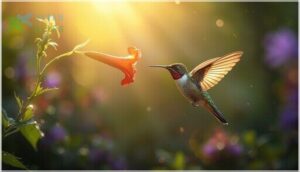
A hummingbird isn’t just a tiny bird darting through your garden — it carries meaning that people have felt in their bones for centuries. Whether you spotted one outside your window or just can’t stop thinking about them, there’s usually something deeper going on.
If you want to sit with that feeling a little longer, these hummingbird quotes about presence and wonder put words to something most of us struggle to explain.
Here’s what a hummingbird actually symbolizes across three key areas.
Key Spiritual and Emotional Meanings
There’s something quietly powerful about a hummingbird — the way it shows up out of nowhere, hovers for just a moment, and leaves you feeling like you were meant to see it. That’s not coincidence. That’s a spiritual connection talking. The hummingbird spiritual meaning runs deep, touching emotional healing, transformation, and joy all at once.
Here’s what it’s really speaking to you:
- High Vibrations — it reminds you to rise above the noise
- Inner Faith — trust what you feel, even when logic says otherwise
- Life Vigor — you’ve got more strength than you think
- Spiritual Renewal — something personal in you is ready to be reborn
- Joy — the small moments are the whole point
Symbolic Traits and Behaviors
What the hummingbird does — not just what it means — is where things get really interesting. Its hovering flight alone defies what seems possible.
That kind of agility — stopping mid-air, reversing direction, pushing forward with speed — mirrors what you’re capable of too.
Its elusive nature, high vibration, and fast metabolism give it a vibrancy and perseverance that feels almost defiant. Like freedom in motion.
Common Interpretations in Modern Life
Today, people carry that same ancient symbolism into their everyday lives — spotting a hummingbird at the feeder and feeling, almost instantly, like it means something.
And honestly? It does. Modern hummingbird symbolism hits three deep notes:
- Daily Joy — a nudge toward Present Living and noticing what’s good right now
- Modern Resilience — your spirit animal pushing you through hard seasons
- Adaptability Lessons — a positive omen that change is your strength, not your enemy
Hummingbird Symbolism Across Cultures
The hummingbird doesn’t belong to just one culture — it’s shown up in stories and traditions all over the world. Each one saw something different in those tiny, fearless wings.
Here’s how a few of them made the hummingbird their own.
Native American Traditions
For Indigenous peoples across Turtle Island, the hummingbird isn’t just a bird — it’s a living message. In Native American traditions, this tiny creature carries enormous spiritual weight.
Pueblo Rain ceremonies honored it as a rainbringer. Native Healers called on its energy for restoration. The Taino Love story of rival lovers transformed into hummingbird and flower still echoes today.
| Tradition | Hummingbird Role | Core Meaning |
|---|---|---|
| Pueblo Peoples | Rain spirit messenger | Renewal and fertility |
| Pacific Northwest | Guardian spirit | Love and healing |
| Taino (Caribbean) | Sacred pollinator | Enduring love |
| Navajo | Protector | Emotional safety |
| Hopi/Zuni | Divine courier | Abundance and balance |
Many First Nations honor the hummingbird for embodying joyful messengers and healers, connecting people to positivity and renewal.
Aztec and Mayan Mythology
Few mythologies cut as deep as Aztec and Mayan ancient beliefs around the hummingbird.
Huitzilopochtli’s symbol — the god of war himself — was this tiny bird. Fallen warriors became hummingbirds after death, Warrior Souls reborn in feathered form.
Mayan mythology adds the Jade Arrow legend: gods carved the first hummingbird to serve as messenger of the gods.
Key cultural interpretations to know:
- Hummingbird symbolism = divine warrior energy
- Fallen soldiers reborn as sacred birds
- Jade Arrow origin story reveals purpose and mission
- Hummingbird feathers carry miracle-making power
The role of the hummingbird as a messenger between worlds remains a powerful theme in Mesoamerican beliefs.
Japanese and Other Global Views
Japan never shared its land with hummingbirds, yet Japanese culture embraced their symbolism wholeheartedly — calling it Japanese Elegance in motion. Across the globe, hummingbird symbolism across cultures speaks a shared language.
Haitian Vodou ties them to Vodou Passion through the love goddess Erzulie. Christian Hope finds renewal in their quick, vibrant presence.
This Global Resilience woven through art and belief is hummingbird spiritual significance at its most universal.
Spiritual Significance of Hummingbirds
There’s something almost otherworldly about spotting a hummingbird — like it showed up for a reason. Across many traditions, people believe these tiny creatures carry meaning far beyond what we can see.
Here’s a look at the spiritual significance that’s followed them for centuries.
Messengers From The Spirit Realm
There’s something almost impossible to ignore about the moment a hummingbird appears out of nowhere, hovering just long enough to feel like it came with a purpose. Many believe these tiny birds are Spirit Guides carrying Divine Messages straight from spiritual domains.
Think of them as Gatekeepers — bridges offering Domain Connection and Unseen Wisdom. When you need it most, they show up as divine messengers, delivering messages from the spirit world like living proof that spiritual guidance is always near.
Connection to Angels and Ancestors
If a hummingbird has ever hovered right in front of you and held your gaze, you might’ve felt — even if just for a second — like someone who loves you was trying to say hello.
Many traditions believe that’s exactly what’s happening. These birds carry angelic messages and ancestral connection, acting as Spirit Gatekeepers between you and your passed loved ones. That flutter? It could be divine guidance wrapped in wings.
Signs of Hope and Inspiration
When life feels heavy and you’re running low on faith, the universe has a funny way of sending you exactly what you need. Sometimes, this comes in the form of a hummingbird, with wings no bigger than your thumb.
A hummingbird showing up isn’t random. It carries divine messages, vibrant hope, and a nudge toward new beginnings. Its high vibrations spark inner joy and remind you that positive change is already in motion.
Hummingbird as a Spirit Animal
The hummingbird as a spirit animal carries a lot more weight than most people expect from something so small.
It speaks to who you are and how you move through the world.
Here’s what this spirit animal reflects about your inner traits, your growth, and when to lean into its energy.
Traits and Qualities Embodied
Think about what it really takes to live fully — and you’ll find that a tiny, wing-blurring bird has been showing us how all along. The hummingbird carries Vibrant Energy and Joyful Spirit in every flicker of its wings.
It moves with Swift Adaptability and pure agility, yet its resilience and endurance are fierce. Delicate but never fragile, it embodies positivity and transformation — proof that real strength doesn’t always look the way you expect.
Guidance for Personal Growth
All that energy, all that joy — it turns out the hummingbird isn’t just showing off; it’s quietly teaching you how to grow. As your spiritual guide, it nudges you toward self-discovery through life lessons you can actually feel.
Embrace Adaptability when everything shifts. Cultivate Joy even on hard days. Trust your path. Inner Resilience lives in you — transformation starts the moment you believe that.
When to Call on Hummingbird Energy
Some moments just call for a little extra magic, and that’s exactly when you invite hummingbird energy in.
- Seeking Adaptability — when life pivots fast and you need to pivot faster
- Needing Joy — when living in the moment feels impossible and your spirit feels heavy
- Facing Adversity — when overcoming hardship demands healing energy you didn’t know you’d
- Spiritual Guidance — when personal growth quietly calls you forward
Interpreting Hummingbird Encounters
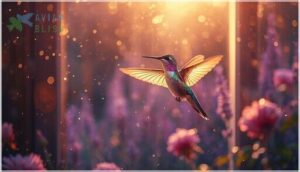
When a hummingbird crosses your path, it rarely feels like coincidence. These tiny visitors carry meaning — whether you spot one at your window, sense a shift after seeing one, or find one fluttering through your dreams.
Here’s what different kinds of hummingbird encounters might be telling you.
Meaning of Hummingbird Visits
A tiny flash of wings at your window isn’t just a pretty sight — it just might be the universe tapping you on the shoulder.
These visits carry real spiritual significance. When a hummingbird lingers near you, its presence is often considered one of the clearest messages from the spiritual domain — a joyful reminder to slow down and feel alive again.
| Visitor’s Purpose | Messages Received | Joyful Reminders |
|---|---|---|
| Spiritual check-in | You’re on the right path | Embrace the present |
| Ancestral connection | Love surrounds you | Life is beautiful now |
| Personal awakening | Change is coming | Trust your journey |
Hummingbird Omens and Signs
Beyond the simple joy of a visit, these little birds have long been read as omens — signs that something meaningful is unfolding in your life. Spot one hovering near you? That’s often linked to Good Luck Signs and Future Blessings heading your way. Some even see them as Angelic Messages, quiet nudges urging you to trust what’s coming.
Understanding hummingbird omens means staying open to what life’s quietly trying to tell you.
Seeing Hummingbirds in Dreams
Dreams have a quiet way of delivering messages your waking mind is too busy to hear — and when a hummingbird shows up in yours, it’s worth paying attention.
These dream omens carry real inner messages. Think of them as subconscious guidance nudging you toward joy. A positive dream like this often signals good changes ahead — bright symbolic interpretations pointing you toward hope, freedom, and messages from the spiritual sphere.
Symbolism of Hummingbird Colors
A hummingbird’s colors aren’t just pretty — they actually carry meaning. Each shade and shimmer tells its own story, from the way iridescence shifts in the light to what different color variations might be trying to tell you.
Here’s what those colors are really saying.
Spiritual Meaning of Iridescence
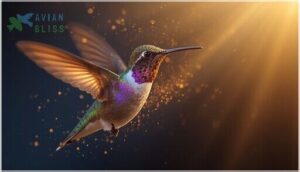
There’s something almost magical about the way a hummingbird’s feathers shift from green to gold to purple depending on how the light hits them — and that’s no accident. That iridescence carries deep spiritual meanings.
It reflects shifting perspectives and divine radiance, a reminder that your truth changes with how you look at it. Those energetic vibrations of light signal a living divine connection, pulling you closer to spiritual realms through vibrant energy you can actually feel.
Color Variations and Their Messages
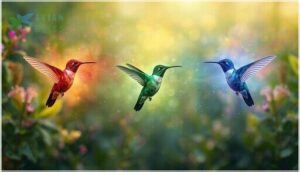
Each hummingbird color carries its own quiet message, like nature’s way of speaking directly to you in a language you’re only just learning to hear.
- Red Meanings — passion, courage, and bold action calling you forward.
- Green Symbolism — growth, healing, and a green hummingbird urging renewal.
- Blue Messages — calm truth; purple significance points toward spiritual depth.
Trust what you feel when one appears.
Life Lessons From Hummingbirds
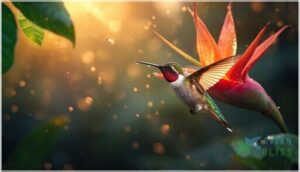
Hummingbirds don’t just look beautiful — they live in a way that can teach you something real. Every flutter, pivot, and flower stop carries a quiet lesson worth paying attention to.
Here’s what they’ve been showing us all along.
Finding Joy in Small Moments
When did you last stop — really stop — to notice something small and realize it was actually everything?
That’s what the hummingbird teaches. It doesn’t chase big moments. It finds the sweetness of life in one tiny flower, one fleeting second. Present moment awareness isn’t passive — it’s bold. It’s choosing to cherish pleasures hiding in plain sight.
| Simple Habit | Daily Blessing | Joy It Unlocks |
|---|---|---|
| Morning stillness | Quiet before noise | Lighthearted attitude |
| Noticing beauty | Present living | Deep gratitude |
| Savoring slowly | Fleeting moments | Lasting peace |
Resilience and Overcoming Adversity
What carries a body the size of your thumb across hundreds of miles of open sky without a single complaint? Pure, unshakeable resilience. That’s the hummingbird’s quiet rebellion.
The hummingbird crosses hundreds of miles on wings the size of a thumb — pure, unshakeable resilience in motion
Its Persistent Spirit and Courageous Flight make overcoming obstacles look easy — but it’s earned through real endurance.
Your own Endurance Journey works the same way. Keep going. The Renewal Cycle always rewards perseverance.
Embracing Change and Flexibility
Change doesn’t wait for you to feel ready — and the hummingbird never does either. It shifts mid-air without hesitation, trusting its Adaptable Mindset to carry it forward. That’s your invitation to stop bracing for change and start moving with it.
Your Fluid Life Path gets easier when you lean into flexibility:
- Release control — Handling Transitions starts with letting go
- Stay curious — an open mind fuels personal transformation
- Move small — one Incremental Adjust at a time builds real momentum
- Trust the detour — resilience grows in unexpected directions
- Embrace becoming — life transitions are where your truest self emerges
Hummingbirds in Art and Folklore
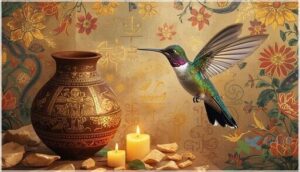
Hummingbirds haven’t just inspired spiritual beliefs — they’ve made their way into art, stories, and myths across centuries and cultures. From hand-painted pottery to ancient legends, their presence carries real weight.
Here’s a look at how they show up in creative and folkloric traditions around the world.
Symbolic Representation in Art
Artists have long been drawn to the hummingbird like a moth to flame — its blur of wings and jewel-bright colors almost daring you to capture something that refuses to stand still.
You’ll find its symbolic representation woven into tattoo symbolism, jewelry designs, and home décor across cultures. These art motifs carry real cultural significance — resilience, joy, freedom.
In craft interpretations and visual art alike, the hummingbird reminds you to keep moving forward.
Hummingbirds in Literature and Myth
Myths carry what history sometimes forgets. In Greek Messengers tradition, hummingbirds linked mortals to the divine — tied to Iris and Eros, love and fate intertwined.
Taino Warriors called themselves Colibri, honoring the bird’s fierce spirit. Aztec Guidance led an entire people to a new homeland. Inca Rituals used feathers as sacred offerings.
Native American legends made hummingbirds healers and fire-bringers. That’s Hummingbird in mythology and folklore — raw, cross-cultural significance you can’t ignore.
Hummingbird Symbolism in Relationships and Home

Hummingbirds don’t just carry meaning in myths and paintings — they show up in the spaces closest to your heart, too. Whether one hovers near your window or you keep finding them in your relationships, that’s worth paying attention to.
Here’s what hummingbird symbolism looks like when it hits closer to home.
Significance Near Your House
Spotting a hummingbird near your home isn’t just a lucky moment — it’s often seen as a gentle nudge from the universe that something good is on its way. Many spiritual interpretations treat it as a sign from heaven, a quiet message landing right at your Personal Sanctuary. Here’s what those Garden Messages might mean for you:
- Your home is receiving Home Blessings — protection and warmth are surrounding your space.
- It’s a call to embrace the Present Moment and stop rushing through your days.
- The visit carries hummingbird meaning tied to renewal — something in your life is shifting.
- It acts as Daily Inspiration, reminding you that beauty lives close to home.
- When interpreting hummingbird encounters near your door, trust that unseen forces are sending you messages of hope.
Love, Positivity, and Harmony in The Home
And once that little visitor has graced your doorstep, you might start to notice something softer settle into the air around you — a kind of warmth that feels a lot like love finding its way home.
Hummingbird symbolism in relationships and home runs deep that way. It nudges you toward Peaceful Living, stirs up Home Joy, and strengthens Family Bonds — quietly turning your Nurturing Spaces into places where positivity and harmony actually breathe.
Hummingbirds as Symbols in Personal Connections
Some connections in your life carry a quiet magic that’s hard to explain but impossible to ignore — and the hummingbird, in its restless, radiant way, has long been a symbol of exactly that kind of bond.
As a spirit animal, it speaks directly to your heart about the relationships that shape your life’s path:
- It sparks Personal Inspiration, pushing love deeper.
- It builds Inner Resilience when relationships get hard.
- It brings Daily Joy into how you show up for others.
- It weaves personal growth and life lessons into every bond you carry.
Frequently Asked Questions (FAQs)
What is the metaphor of a hummingbird?
A hummingbird is life’s dance made visible — pure vibrational energy moving without hesitation.
It carries messages from unseen realms, reminding you that personal transformation doesn’t always roar.
Sometimes it hovers, iridescent and quiet, then disappears.
What is the meaning of a hummingbird spiritually?
Spiritually, a hummingbird carries High Vibrations and a unique Time Perception that opens a Gate to Unseen Spheres.
It’s a spirit animal rooted in Faith Symbolism, delivering messages from the spiritual sphere with quiet, breathtaking purpose.
What is the hummingbird trying to tell me?
Think of it as a gentle tap on the shoulder — a Personal Guidance nudge from your spirit animal, awakening Inner Wisdom.
Hummingbird symbolism is Life Affirmation in motion, an Emotional Nudge to embrace joy now.
Are hummingbirds messengers from heaven?
Many believe these tiny birds carry messages of comfort from departed loved ones — a sign from heaven, offering divine guidance, angelic communication, and spiritual blessings.
Their presence often feels like messages from the spiritual plane.
Do hummingbirds carry messages?
Yes, many traditions believe they do. These tiny birds are seen as carriers of messages from the spiritual world — signs of divine blessings, angel guidance, or gentle words from departed loved ones.
What is the significance of hummingbird colors?
Each hummingbird color carries vibrant energy and meaning. Red hummingbirds signal passion, green ones ground you in growth, and their light reflection does something simple but powerful — it keeps attracting joy wherever they fly.
How do hummingbirds symbolize resilience in challenges?
Tiny but Mighty, the hummingbird’s Spirit of Persistence proves resilience is real. Its Enduring Migrations show hopeful endurance.
You carry that same adaptability — healing and overcoming adversity, a living symbol of perseverance.
Are there specific dreams involving hummingbirds?
Dreaming of a hummingbird often signals Good Luck Dreams and Positive Change Dreams ahead. These dream interpretations suggest it’s time to release worry, embrace joy, and trust that life is already moving in a beautiful direction.
Can hummingbird behavior predict upcoming events?
Folklore says an unexpected hummingbird visit carries omens. Trust that instinctive pull — nature’s cues and behavioral anomalies often echo messages from the spiritual sphere, weaving cultural interpretations of hummingbirds into the symbolism of hummingbird encounters and omens.
What are common myths surrounding hummingbird sightings?
Not every hummingbird myth is true. People tie them to bad omens, good luck, ancestor spirits, or healing power — but most are just old stories passed down through native American cultures and personal belief.
Conclusion
Small, swift, and surprisingly strong—the hummingbird has always carried more than its tiny wings suggest. The symbolism for hummingbird isn’t just ancient lore or quiet folklore. It’s a living reminder meant for you, right now.
When one appears, it’s asking whether you’re really tasting your life or just rushing through it. You don’t need to have everything figured out. You just need to keep moving, stay open, and trust what your heart already knows.
- https://blog.kachinahouse.com/understanding-the-symbolism-of-hummingbirds-in-native-american-culture/
- https://artinas.com/collections/hummingbird/sun
- https://www.oreateai.com/blog/the-symbolism-of-hummingbirds-natures-messengers-of-joy-and-resilience/6b9504fa47eba32ae0c18f57c550ba9a
- https://www.birdfy.com/blogs/blogs/hummingbirds-spiritual-meaning-a-simple-guide-to-their-special-symbolism
- https://www.thegrandhacienda.com/post/hummingbirds