This site is supported by our readers. We may earn a commission, at no cost to you, if you purchase through links.

Most birdwatchers remember their first chestnut-sided warbler—not because it’s rare, but because it defies the rules. While most warblers skulk in shadowy canopies, this species hunts at eye level in scrubby tangles where you can actually see it.
Its breeding plumage reads like a field guide illustration come to life: clean white underparts with bold chestnut racing down the flanks, topped by a yellow cap that catches the light. But here’s the twist—come fall, those same birds transform into lime-green phantoms that stump even experienced observers.
You’ll find them wherever forests have been knocked back to early successional growth, thriving in the disturbed edges and regenerating clearcuts that other woodland birds avoid. Understanding their seasonal looks, habitat preferences, and behavior patterns turns confusion into confident identification.
Table Of Contents
- Key Takeaways
- Chestnut-Sided Warbler Description
- Habitat and Distribution
- Identifying Chestnut-Sided Warblers
- Chestnut-Sided Warbler Behavior
- Breeding and Nesting
- Chestnut-Sided Warbler Diet
- Conservation Status
- Warbler Migration Patterns
- Chestnut-Sided Warbler Song and Call
- Attracting Chestnut-Sided Warblers
- Frequently Asked Questions (FAQs)
- What color are chestnut sided warblers in the fall?
- How long do Chestnut-sided Warblers live?
- What are predators of the Chestnut-sided Warbler?
- Is the Chestnut-sided Warbler affected by pesticides?
- Are Chestnut-sided Warblers solitary or social?
- Can Chestnut-sided Warblers recognize human presence?
- How long do chestnut-sided warblers typically live?
- What predators threaten chestnut-sided warbler populations?
- Do chestnut-sided warblers mate for life?
- Can chestnut-sided warblers hybridize with other species?
- Conclusion
Key Takeaways
- Chestnut-sided Warblers undergo a dramatic plumage transformation between breeding and fall seasons—spring birds display bold chestnut flanks and yellow caps, while fall birds shift to lime-green backs with white eye-rings, making seasonal identification challenging even for experienced observers.
- These warblers thrive exclusively in early successional habitats like clearcuts and regenerating forests (peak density at 7-8 years post-disturbance), making them dependent on landscape disturbance that other woodland species avoid—a vulnerability as fire suppression and forest maturation eliminate their preferred scrubby edges.
- Despite a global population of 18 million, the species has declined 45% since 1966 due to habitat loss, with conservation efforts now prioritizing prescribed burns and selective logging to recreate the young, dense understory these warblers need for successful breeding (nest survival rates of 82.6% in quality habitat).
- Males employ two distinct song types—an accented-ending version for territorial defense and an unaccented version for mate attraction—with the unaccented songs showing hyper-local dialects (86% of elements unique to territory clusters) while accented songs remain 97% identical across North America.
Chestnut-Sided Warbler Description
If you’re trying to pick out a Chestnut-sided Warbler in the field, you’ll need to know what separates breeding adults from fall birds and juveniles. Plumage changes dramatically through the year, and what works for identifying a male in May won’t help you in September.
Here’s what to look for across different ages and seasons.
Adult Male Appearance
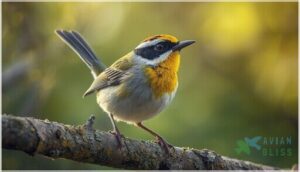
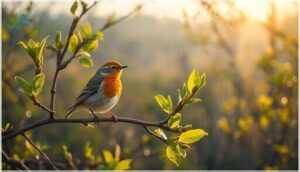
If you catch a breeding male Chestnut-sided Warbler in good light, you’ll see one of the most boldly patterned small birds in eastern forests. His yellow cap practically glows against a crisp white face, framed by that distinctive black mustache stripe. But it’s those chestnut flanks—sharp, rusty streaks running down his sides—that give this avian species its name.
The combination is unforgettable, making bird species identification straightforward when these plumage characteristics align. His underparts stay brilliantly white, while his wings show subtle wingbars that complete the look.
Adult Female Appearance
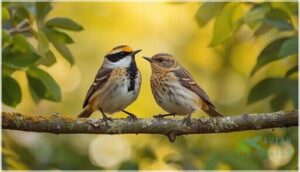
Adult females wear a more understated version of the male’s breeding outfit, trading boldness for subtlety while keeping the family resemblance intact. Their plumage patterns show:
- Pale yellow cap, less intense than males
- Fainter chestnut streaking on flanks—sometimes barely visible
- Gray-green upperparts with noticeable wing bars
- Softer facial markings that frame a whitish throat
You’ll still recognize the chestnut-sided warbler shape and posture, but these plumage characteristics demand sharper eyes for bird species identification.
Non-Breeding Plumage
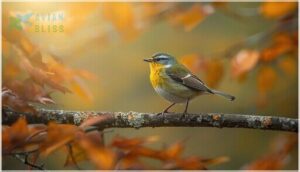
Come fall, breeding males and females shed their striking summer wardrobe for something you might walk right past—a lime-green back, clean white underparts, and a pale gray face punctuated by a white eye-ring. This fall plumage transformation is your warbler’s ticket to winter camouflage, blending into tropical undergrowth where flashy breeding colors would just attract trouble. Molt patterns erase the chestnut streaks entirely, leaving plumage characteristics that challenge even sharp-eyed birders during fall coloration shifts.
Come fall, these warblers trade their bold chestnut and yellow for lime-green camouflage that lets them vanish into tropical undergrowth unnoticed
| Feature | Breeding | Non-Breeding |
|---|---|---|
| Back | Yellow-green streaked | Solid lime-green |
| Flanks | Bold chestnut stripes | Plain white |
| Face | Black/yellow pattern | Pale gray, white eye-ring |
Juvenile Warblers
Young birds leave the nest wearing plumage so drab it’s barely recognizable as the same species—lime-green backs, faint wing bars, and zero trace of the namesake chestnut that’ll eventually mark their sides. This young plumage acts as camouflage during warbler development when fledgling care keeps parents busy shuttling insects.
Here’s what sets juvenile warblers apart:
- Olive-gray heads lack adult face patterns
- Pale buff wing bars replace crisp white
- Whitish underparts show no flank markings
- Eye-rings appear bolder than adults’
- Bills show pinkish base tones
These youngsters master bird identification challenges before juvenile migration south.
Habitat and Distribution
You’ll find Chestnut-sided Warblers in landscapes shaped by change and renewal. Their range spans distinct seasonal territories, from northern breeding forests to tropical wintering grounds.
Here’s where these warblers turn up throughout the year.
Breeding Grounds
If you want to find a chestnut-sided warbler raising its family, look for forests that have recently been disturbed—these birds thrive in the scrappy, regenerating woodlands that spring up after clear-cuts or natural disturbances. Their breeding grounds stretch across eastern North America, from Saskatchewan to the Maritimes, dipping south through the Appalachians to northern Georgia. They’re habitat selection specialists, choosing young deciduous forests—usually less than 20 years old—where dense shrubs and saplings create perfect nesting sites for territorial defense and mating rituals.
Prime breeding habitat features:
- Early successional forests with thick understory
- Clear-cut areas 7-8 years post-disturbance (peak density)
- Mixed shrubland with low canopy cover
- Second-growth deciduous woodlands
- Areas documented in Breeding Bird Survey data
Wintering Grounds
When autumn chill sends them south, chestnut-sided warblers swap their northern breeding forests for the lush edges and scrubby clearings of Central American and northern South American tropics. You’ll find them in second-growth habitats where forest meets field—prime winter feeding zones rich with insects. Their wintering range spans from southern Mexico through Panama, with flocking behavior patterns shifting based on habitat quality and conservation status concerns from ongoing habitat loss.
| Wintering Feature | Details |
|---|---|
| Primary tropical habitats | Forest edges, coffee plantations, shrubby clearings |
| Elevation range | Sea level to 2,000 meters |
| Flocking behavior | Mixed-species foraging groups |
| Diet shift | Insects, spiders, occasional berries |
| Migration routes | Trans-Gulf and Caribbean pathways |
Migration Patterns
Twice a year, chestnut-sided warblers funnel through eastern North America in migrations timed so precisely to food abundance and weather windows that missing the mark by even a week can mean the difference between survival and starvation. These nocturnal travelers navigate trans-Gulf and overland migration routes, peaking in May and September. You’ll spot them at stopover sites where they refuel before continuing their journey between breeding and wintering grounds.
- Spring migration: Northbound flight from Central America, April through May
- Fall migration: Southbound departure, August through October, with juveniles trailing adults
- Flight patterns: Nocturnal travel at varying altitude changes to avoid predators
- Stopover ecology: Critical refueling sites along migratory bird program monitoring stations
Rare Vagrant Sightings
You might think chestnut-sided warblers stick to eastern routes, but coastal records tell a different story. Over 1,000 vagrant patterns have been documented in California alone, driven by storm effects and migration errors. These geographic trends peak during autumn when Pacific weather systems sweep eastern migrants westward.
British Columbia logged 97 records by 2013, with June sightings showing territorial males far from home. Bird watching enthusiasts now track these warbler migration patterns annually, revealing how habitat shifts and meteorological forces reshape chestnut-sided warbler distribution across unexpected western landscapes.
The species’ long distance migrations play a key role in deciphering their behavior and distribution.
Identifying Chestnut-Sided Warblers
You won’t mistake a breeding male Chestnut-sided Warbler for anything else once you know what to look for.
The challenge comes with females, non-breeding birds, and those tricky fall juveniles that seem designed to test your field skills.
Here’s how to nail the ID every time, along with tips for separating similar species and aging birds in the field.
Key Identification Features
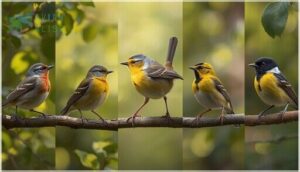
You don’t need a field guide degree to pick out a Chestnut-sided Warbler—just a sharp eye for a few telltale marks. Focus on these key plumage characteristics for solid avian identification:
- Yellow crown cap with bold black facial markings framing white cheeks
- Chestnut flanks running along the sides (breeding adults)
- Two white wing bars standing out against darker wings
- Lime-green back with white underparts and a distinctive eye-ring (fall plumage)
These plumage patterns make the Chestnut-sided Warbler unmistakable once you’ve locked onto them.
Similar Species
In the warbler world, Species Distinction isn’t always a walk in the park—several lookalikes can trip you up. Here’s the Warbler Comparison for Bird Identification:
- Bay-breasted Warbler: Rich bay (not chestnut) sides, buff undertail coverts
- Black-throated Green Warbler: Bold throat patch, lacks chestnut flanking entirely
- Yellow-rumped Warbler: Signature yellow rump patch, different face pattern
- Cape May Warbler: Chestnut cheek patch (not flank), tiger-striped breast
- American Redstart: Orange patches, entirely different structure
Focus on those distinctive chestnut flanks and yellow crown—they’re your ticket to confident Warbler Characteristics identification among Wood Warblers. Understanding the warbler breeding habits is essential for accurate identification.
Distinguishing Males From Females
Once you’ve narrowed down your warbler ID to chestnut-sided, the next puzzle is figuring out whether you’re looking at a male or female—and breeding plumage makes this surprisingly straightforward. Males flaunt bold chestnut flanks, sharp black facial markings, and bright yellow caps—unmistakable field marks for Bird Identification. Females wear softer tones with muted or absent chestnut striping and less defined Feather Patterns.
Understanding these Plumage Differences helps with Sexing Techniques across Warbler Species and aids Bird Species Conservation efforts through accurate population monitoring.
Ageing and Sexing Warblers
Beyond the basic male-female divide lies a deeper layer of warbler detective work: pinning down a bird’s age while confirming its sex, especially when fall and winter plumages blur those summer certainties. Juvenile development shows up in duller tones and incomplete Chestnut-sided Warbler markings, while molting patterns reveal fresh versus worn feathers vital for age determination in warbler species. Master these plumage variation clues:
- First-year birds: Greenish backs, faint chestnut traces, pale wing bars
- Adult molt timing: Complete prebasic molt before fall migration
- Song as sexing tool: Males deliver complex phrases year-round
These avian ecology insights sharpen your bird identification skills and support avian conservation through accurate sex ratio monitoring.
Chestnut-Sided Warbler Behavior
Watching a Chestnut-sided Warbler in action reveals a bird perfectly adapted to life in the understory. You’ll notice distinct patterns in how they move, communicate, and interact with their environment.
Understanding these behaviors helps you predict where to find them and what they’re up to throughout the breeding season.
Foraging Habits
Chestnut-Sided Warblers forage with a restless energy that’s easy to spot once you know what to look for. They hop through shrubs and saplings, gleaning insects from leaf undersides—caterpillars, flies, and small moths make up their insectivorous diet. You’ll see them flutter-hover to snatch prey mid-air, demonstrating specialized foraging strategies.
These dietary needs drive their feeding behavior: constant movement through dense vegetation, targeting food sources where competition stays low. Their avian ecology reflects adaptation to early successional habitat, where insect capture fuels survival.
Social Structure
Their social lives shift dramatically with the seasons. During breeding, males defend territories of 0.2 to 0.4 hectares—aggressive displays mark boundaries until pair bonds form. Females arrive days later, choosing mates and nesting sites within established territories. That’s when cooperation kicks in: both parents provision chicks, with males contributing 40–50% of food deliveries.
Winter flips the script entirely:
- Flock Dynamics: They abandon territorial behavior and join mixed-species flocks of 10–30 birds across tropical wintering grounds
- Group Cooperation: Foraging efficiency jumps 32% in flocks compared to solitary feeding during migration stopovers
- Nesting Independence: Post-fledging juveniles stick with parents for two weeks before dispersing—85% remain associated during that first critical week
Mate selection happens fast once females touch down on breeding habitat—usually within 3–6 days. These bonds last one season, with divorce rates below 5%.
Territorial Behavior
Males patrol their territories like sentries, dropping from perches to chase intruders with sharp chip calls and rapid wing-flicking displays that escalate into aerial pursuits when warning songs fail. These boundary defense tactics establish dominance hierarchies in dense breeding habitats. You’ll see males returning to the same singing posts hourly, marking territorial limits through agonistic behavior.
Successful mate selection hinges on holding quality territory: males defending prime shrubby edges attract females faster than those in marginal avian habitats.
Song and Call Patterns
You can pinpoint these warblers from afar by listening for their signature vocal patterns—males belt out two distinct song types that shift purpose depending on whether they’re courting a mate or defending their patch of shrubland. The accented song structure sounds like "pleased, pleased, pleased to MEET-cha," while the unaccented version drops that emphatic finish. Their call types include sharp chips during territorial disputes and high seets in flight.
Understanding these melodic patterns transforms bird identification from guesswork into precision ornithology, supporting warbler conservation initiatives through accurate population monitoring of this Chestnut-sided Warbler’s avian vocalizations and geographic variation across its breeding range.
Breeding and Nesting
Chestnut-sided Warblers build their nests in the dense, scrubby habitat they call home, crafting delicate structures that cradle the future offspring. Understanding their breeding cycle—from nest construction to fledging—reveals how these birds navigate the challenges of raising young in early successional forests.
Here’s what you need to know about their nesting timeline and parental strategies.
Nesting Sites and Materials
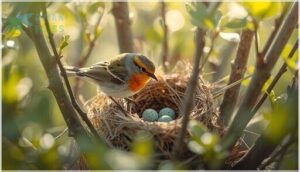
Female warblers take the lead here, selecting shrub tangles or low-hanging branches one to three feet off the ground and weaving an open cup from bark strips, grass stems, and plant down. They’ll often use cedar or grapevine bark, binding it with spider silk for flexibility.
The nest construction happens in breeding habitat where dense understory provides cover. It’s a loosely built structure, but functional—keeping nestlings secure while allowing quick exits if predators snoop around.
Egg Laying and Incubation
After the female settles into her nest, she lays 3-5 creamy white eggs speckled with brown or reddish markings—a clutch that appears over consecutive days, with one egg arriving each morning.
She shoulders the incubation period alone for 11-12 days, maintaining steady warmth while rarely leaving her post. This breeding behavior promotes ideal egg formation and hatching success, though predators and weather can disrupt even the most carefully tended nests.
Parental Care and Fledging
Both parents take turns delivering a steady stream of caterpillars and soft-bodied insects to their gaping, insistent chicks—sometimes flying back and forth hundreds of times each day. This intense parental investment fuels rapid chick development, with nestlings transforming from naked hatchlings to feathered fledglings in just 10-12 days.
You’ll notice the young warblers leaving the nest before they’re fully flight-capable, hopping through low branches while still depending on their parents for food and protection during this vulnerable fledgling stage.
Breeding Success and Failure
Breeding productivity hinges on a razor’s edge—nest survival rates averaged 82.6% across Massachusetts powerline habitats, yet nearly one in five nests failed entirely. Nest predation drove 89.2% of failures, with desertion trailing behind. Habitat quality matters deeply: early successional clearcuts and managed corridors functioned as population sources, pumping out 2.7 to 3.4 fledglings per attempt.
Here’s what determines nesting success on breeding grounds:
- Predation pressure varies wildly by site, with ground nests facing 15-55% loss depending on landscape configuration and natural disturbances.
- Timing advantages favor males with vibrant chestnut plumage, who initiate nests earlier and gain critical replacement opportunities after reproductive failure.
- Edge effects occasionally spike depredation rates near habitat boundaries, though most years show no significant pattern.
- Habitat loss threatens long-term conservation status as fire suppression reduces the young forest openings these warblers desperately need.
Understanding these dynamics helps you protect their fragile nest survival and reverse population declines.
Chestnut-Sided Warbler Diet
If you’re watching a Chestnut-sided Warbler flit through the branches, you’re witnessing one of nature’s most efficient insect hunters at work.
These warblers don’t mess around when it comes to feeding—they’ve got specific tastes and smart strategies for finding their next meal. Let’s break down what fuels these yellow-capped wanderers and how they go about getting it.
Insectivorous Diet
If you think warblers are picky eaters, you’ve never watched one demolish a smorgasbord of insects like it’s going out of style. The Chestnut-sided Warbler’s insectivorous diet revolves around caterpillars, flies, small moths, and grasshoppers—basically anything with six legs that moves.
These foraging tactics meet their dietary needs perfectly, fueling nonstop movement through shrubs.
Avian ecology shows these food sources drive bird conservation efforts, since healthy insect populations equal thriving warblers. Their feeding habits aren’t just survival—they’re pest control with wings.
Spider and Invertebrate Consumption
Beyond their insect feast, these warblers treat spiders and soft-bodied invertebrates like bonus protein snacks hidden throughout the canopy. You’ll spot them plucking arachnids straight from spider webs or gleaning aphids off leaf surfaces with surgical precision.
This insectivorous behavior targets:
- Caterpillars and beetle larvae tucked in bark crevices
- Spiders snatched mid-web or from foliage
- Leafhoppers and aphids clustered on fresh growth
- Soft-bodied invertebrates that round out their diet during breeding season
Their web foraging skills showcase exceptional invertebrate capture techniques essential for survival.
Fruit and Nectar Consumption
While insects dominate their menu, chestnut-sided warblers don’t turn down a juicy berry or a drop of nectar when the opportunity presents itself. This dietary flexibility reflects smart avian ecology—supplementing protein with quick sugars for fuel.
You’ll find them sampling small fruits during migration, especially in fall when berry crops ripen across their route. Their fruit intake and occasional pollen feeding support wildlife biology research on warbler adaptability, informing bird conservation strategies for maintaining diverse habitat patches across their range.
| Food Type | Primary Season |
|---|---|
| Berry eating | Fall migration |
| Nectar sources | Spring/summer |
| Seed consumption | Winter (rarely) |
| Pollen feeding | Breeding season |
Foraging Strategies
Watching these warblers hunt reveals a fascinating mix of acrobatics and patience—they’re part gymnast, part sniper. Their foraging techniques involve dietary adaptations that optimize insect capture from various food sources:
- Branch hopping: They work methodically through shrubs, checking leaf undersides for hidden prey.
- Hover-gleaning: Quick wing flutters let them snatch insects mid-air.
- Tail-cocking displays: This feeding habit helps flush out skittish prey.
These foraging strategies showcase avian behavior perfectly adapted to their insect diet and bird-friendly habitat needs.
Conservation Status
The Chestnut-sided Warbler faces real challenges despite its "Least Concern" status. Understanding population trends and threats helps you appreciate what this species needs to survive.
Let’s look at the numbers, risks, and conservation work shaping its future.
Global Population Trends
Partners in Flight estimates the Chestnut-sided Warbler’s global breeding population at roughly 18 million individuals, though this number masks a troubling reality. Since 1966, populations have declined at 1.2% annually—a cumulative 45% drop that earned the species a Continental Concern Score of 12 out of 20. Population decline stems primarily from habitat loss as young forests mature and early successional habitats vanish across eastern North America. Conservation efforts now prioritize prescribed fire and natural regeneration to counter decades of disturbance suppression.
| Region | Population Estimate | Trend Since 1970 |
|---|---|---|
| Canada | 5–50 million adults | Moderate decrease |
| United States | ~5.4 million adults | Declining regionally |
| Minnesota | 6.14 million breeders | Stable/increasing |
| New England | Variable densities | Significant decline |
| Pennsylvania | Local populations | Increasing locally |
Despite its conservation status as Least Concern, species migration and breeding dynamics face disruption as avian conservation experts track global trends in habitat availability, with migration patterns increasingly vulnerable to landscape-scale changes that could reshape this warbler’s future.
Threats to The Species
Habitat Loss stands as the primary threat, with 78% of essential early-successional forest vanishing across the Northeast since mid-century. Human Impact through development fragments nesting sites, elevating predation by raccoons, snakes, and jays.
Domestic cats kill over 2 billion birds annually, while collisions with buildings claim another billion during migration—risks intensified by light pollution.
Climate Change reshapes breeding ranges and dries Caribbean wintering grounds, compounding Population Decline.
Wildlife Conservation Efforts now target these intersecting Threats to warbler populations before cumulative pressures overwhelm this once-common species.
Habitat Preservation Efforts
Conservation groups across North America are rewriting the warbler’s future by turning logged clearcuts and abandoned farmland back into prime breeding habitat. These Wildlife Conservation Efforts blend Ecological Conservation with practical Forest Regeneration:
- Prescribed burns ignite new shrubland through Ecosystem Management
- Selective logging creates early-successional patches for Biodiversity Protection
- Natural regeneration zones let Habitat Restoration unfold without human interference
This Conservation Biology approach proves Habitat Preservation works—warbler populations rebound where disturbance mimics nature’s rhythm.
Climate Change Impacts
Rising temperatures aren’t just shifting thermometers—they’re rewriting the Chestnut-sided Warbler’s survival playbook. Climate Shift forces breeding ranges northward while Warmer Temps advance spring migration by over three weeks, creating mismatches with peak insect emergence. Here’s how Ecosystem Disruption threatens their Conservation Status:
- Caribbean wintering grounds face drying conditions that slash spring survival rates
- Breeding ranges projected to contract massively under 3.0°C warming scenarios
- Migration Patterns now collide with altered vegetation green-up timing
- Habitat Loss accelerates as early successional forests mature faster in warming climates
- Ecological Conservation efforts must now buffer populations against microclimatic extremes
Bird Migration timing grows increasingly unpredictable as Climate Change Impacts cascade through their annual cycle.
Warbler Migration Patterns
Chestnut-sided Warblers don’t stick around—they’re on the move twice a year, covering thousands of miles between their breeding and wintering grounds.
Understanding their migration timing helps you know when to look for them and where they’re headed. Here’s what drives their extraordinary twice-annual journey across the continent.
Spring Migration
Each spring, Chestnut-Sided Warblers launch a high-stakes race against the calendar, covering thousands of miles to reach their breeding grounds before the best territories are claimed. These neotropical migrants depart Central America in late April, following spring routes through the Gulf Coast and up the Mississippi flyway. Peak movement hits in May—you’ll spot waves of them refueling at stopover sites where forest edges meet open country. Their timing variations depend on weather fronts and food availability, making stopover ecology vital for survival.
| Migration Feature | Details | Key Locations |
|---|---|---|
| Departure Period | Late April–early May | Central America, Caribbean |
| Peak Movement | Mid-May | Eastern U.S., Great Lakes |
| Spring Routes | Gulf Coast, Mississippi flyway | Texas coast, Appalachians |
| Refueling Strategies | 3-7 day stopovers | Forest edges, young woodlands |
| Arrival at Breeding Grounds | Mid to late May | Canada south to Georgia |
Bird migration patterns reveal these warblers as precision navigators, timing their arrival when caterpillar populations explode—nature’s perfect synchrony.
Fall Migration
When autumn’s chill sends most songbirds packing, Chestnut-Sided Warblers trade their breeding territories for a southbound odyssey that tests every ounce of their half-ounce frames. Fall migration kicks off late August through October, when these warblers follow migration routes through the Appalachians and Atlantic coast.
Bird tracking reveals their seasonal patterns—they travel mostly at night, making habitat stopovers vital for refueling. Unlike spring’s urgency, fall flocking occurs in looser groups, and warbler migration patterns shift toward a more leisurely pace as juveniles navigate their first avian migration south.
Stopover Sites and Refueling
Between touchdown and takeoff, a warbler’s survival hinges on finding the right patch of forest to tank up on insects before the next leg of its transcontinental flight. Stopover ecology shapes everything—Chestnut-sided Warblers need dense shrubland where refueling behavior can rebuild energy reserves fast.
Consider what makes a site work:
- Fueling strategies refined through countless migration patterns
- Habitat quality that determines survival odds
- Insect abundance matching peak demand
- Wildlife conservation protecting these critical waypoints
Without proper stopover sites, even strong fliers won’t complete their journey south.
Migration Routes and Timing
After refueling, you’ll want to track where these warblers actually go. Chestnut-sided Warblers follow well-defined flight routes during their epic journey—up to 5,000 km between breeding and wintering grounds. Nocturnal migration keeps them safe from predators, with most movement happening after dark.
Here’s how their avian migration breaks down:
| Season | Route | Peak Timing | Distance | Key Corridor |
|---|---|---|---|---|
| Spring | Central America to Eastern North America | May | ~5,000 km | Gulf Coast, Ohio Valley |
| Fall | Eastern North America to Central America | Late August–Late September | ~5,000 km | Eastern Great Lakes, Gulf Coast |
| Wintering | Southern Mexico to Northern Colombia | November–March | N/A | Costa Rica (highest concentration) |
Males usually arrive at breeding grounds several days before females. Seasonal timing varies with wind patterns and stopover ecology quality. Species migration patterns stay remarkably consistent—east of the Rockies, following continental land routes through eastern Mexico into their Central American wintering range.
Chestnut-Sided Warbler Song and Call
The Chestnut-sided Warbler’s voice is as distinctive as its bold chestnut markings. Males deliver two song types that serve different purposes, while both sexes use specific calls to communicate throughout the year.
Understanding these vocalizations helps you track and identify these warblers in the field.
Song Structure and Function
Male Chestnut-sided Warblers don’t just sing—they compose two distinct melodies, each one serving a different purpose in their daily drama of survival and courtship. The accented-ending song claims territory, while the unaccented version woos potential mates.
These acoustic features reveal song complexity shaped by vocal learning and ornithology research:
- Melodic patterns advertise fitness
- Harmonic analysis aids bird identification
- Avian vocalizations support warbler conservation initiatives
The Chestnut-sided Warbler’s dual-song strategy breaks the mold of single-purpose singing.
Call Types and Usage
You don’t have to wait long to hear those chattering calls—Chestnut-sided Warblers use them constantly to stay in touch with their neighbors and sound the alarm when predators show up. Their vocalization patterns reveal rich bird communication strategies. The Chestnut-sided Warbler produces distinct acoustic signals that any Audubon Field Guide enthusiast can learn to recognize. This call frequency facilitates both bird identification and warbler conservation initiatives.
| Call Type | Context | Acoustic Feature |
|---|---|---|
| Chip note | Contact call | Sharp, high-pitched |
| Alarm call | Predator detection | Rapid, repeated |
| Flight call | Migration, movement | Thin, rising whistle |
| Aggression call | Territorial disputes | Harsh, buzzy |
| Begging call | Juveniles seeking food | Soft, insistent |
These avian vocalizations demonstrate how song variation extends beyond breeding displays into everyday survival.
Vocal Learning and Development
Young warblers don’t hatch with a perfect song—they absorb melodies from their fathers and neighbors during a critical window of development, gradually sculpting their own signature tune through trial and error. This Vocal Imitation process involves precise Auditory Development as Chestnutsided Warbler fledglings memorize Song Patterns through repeated listening.
Their Brain Structure facilitates this Learning Behavior, allowing them to perfect Avian Vocalizations essential for Bird Identification, territorial defense, and mate attraction—critical factors affecting their Conservation Status and overall Avian Behavior.
Geographic Variation in Song
Across their breeding range, Chestnut-sided Warblers speak different acoustic dialects—like regional accents shaped by local tutors. Males learn Unaccented-Ending songs from neighbors during their first breeding season, creating micro-dialect formation within territory clusters where 86% of song elements stay hyper-local.
Meanwhile, Accented-Ending songs remain remarkably uniform across North America, with 97% of these avian vocalizations identical from Massachusetts to Saskatchewan.
This split in vocal learning strategies—localized versus continent-wide—reflects ornithological research revealing how geographic distribution shapes song pattern analysis in this bird species through acoustic adaptation and cultural transmission.
Attracting Chestnut-Sided Warblers
You can’t exactly lure Chestnut-sided Warblers to a feeder like chickadees, but you can create the right conditions to make your property irresistible to them.
These birds are picky about their surroundings, favoring young, scrubby habitats over manicured lawns. Here’s how you can roll out the welcome mat for these charismatic warblers.
Habitat Creation and Management
If you want Chestnut-sided Warblers stopping by your patch of earth, start thinking less like a gardener and more like a forest architect. These warblers thrive in young deciduous forests and early successional habitat—basically, places that look a bit wild and unmanicured.
Your conservation planning should prioritize habitat creation through forest regeneration tactics: clear small patches, let native shrubs reclaim space, and establish wildlife corridors connecting fragmented areas.
Effective habitat management means maintaining dense thickets where caterpillars thrive, supporting critical ecosystem services. Forest management practices that encourage disturbance—not manicured lawns—deliver results. Habitat preservation alone won’t cut it; you need active habitat restoration that mimics natural forest cycles.
Food Sources and Provisioning
Chestnut-sided Warblers won’t show up for store-bought suet alone—they’re after the live, wriggling protein that fuels their frenetic lifestyle. Your yard becomes warbler territory when you prioritize insect foraging opportunities over artificial provisioning. Here’s how you shift the balance:
- Plant native caterpillar hosts like oak, cherry, and willow—critical for nestling diet during breeding season.
- Let leaf litter accumulate beneath shrubs where spiders and beetles thrive, supporting natural foraging strategies.
- Add berry-producing natives (elderberry, serviceberry) for fall berry consumption when insect populations crash.
Wildlife biology studies confirm warblers don’t cache food—they hunt constantly, making your landscape’s living invertebrate diversity the real draw for this bird species’ avian behavior.
Water Features and Ponds
A shallow basin with moving water draws more warblers than a deep pond ever will—these birds need safe, accessible spots to drink and bathe without risking predation. You’ll want edges no deeper than two inches where aquatic plants provide cover, creating avian habitat that mimics natural wetland conservation zones.
Keep water quality high through pond management basics—circulating pumps prevent mosquito breeding while maintaining the ecological balance this species adaptation demands in wildlife habitat.
Warbler-Friendly Gardens and Landscapes
Transform your backyard into a thriving warbler stopover by layering native shrubs, young saplings, and tangled understory—the very architecture these birds evolved to hunt through. Your garden layout should mimic semi-open habitat with wildlife corridors connecting patches of young deciduous forests.
Consider these bird-friendly practices:
- Native plantings like dogwood and viburnum provide insect-rich foraging zones
- Bird baths with shallow edges support warbler conservation initiatives
- Eco-friendly designs eliminate pesticides, preserving prey populations
- Strategic habitat preservation through controlled brushy growth
Frequently Asked Questions (FAQs)
What color are chestnut sided warblers in the fall?
Subtle shifts signal autumn’s arrival—those chestnut streaks fade, revealing a warbler’s quieter disguise.
In fall plumage, these birds sport lime-green backs, white bellies, and pale gray faces with crisp white eye-rings, trading boldness for camouflage as seasonal changes reshape their color patterns.
How long do Chestnut-sided Warblers live?
Most survive only a few years in the wild, though banding studies show they can reach nearly seven years. Mortality rates peak during migration and breeding seasons. Age determination through longevity studies reveals these survival strategies help some individuals beat the odds.
Bird conservation and avian ecology research continue tracking species migration patterns to better understand biodiversity conservation needs.
What are predators of the Chestnut-sided Warbler?
Hawks, snakes, and domestic cats pose the greatest threats to these warblers. Nest Raiders like jays and crows steal eggs, while Feline Threats and Hawk Attacks target adults during foraging—making Wildlife Management and Conservation critical for survival.
Is the Chestnut-sided Warbler affected by pesticides?
Pesticide exposure poses indirect threats through bird toxicity and environmental impact. Chemical effects reduce insect abundance—your warbler’s primary fuel—creating food scarcity during breeding and migration.
Habitat loss compounds these conservation challenges, making pesticides a significant wildlife conservation concern for chestnut-sided warblers.
Are Chestnut-sided Warblers solitary or social?
Ever wonder if these yellow-capped sprites prefer their own company? Solitary by nature, Chestnut-sided Warblers keep to themselves outside breeding season.
Males belt out territorial songs during spring mating habits, establishing social bonds briefly before returning to their independent ways—true solitary traits among warbler species.
Can Chestnut-sided Warblers recognize human presence?
Birds possess exceptional avian perception and awareness of their surroundings, including human presence. Through repeated exposure in bird watching scenarios, these warblers develop species interaction patterns, recognizing observers who remain calm.
Their bird intelligence allows them to distinguish threats from passive watchers, making warbler awareness of human activity quite intricate when you stay still.
How long do chestnut-sided warblers typically live?
Most small warblers live two to six years in the wild, though survival strategies and mortality rates vary widely. Banding studies help with age determination, revealing that habitat quality and nesting success strongly influence longevity in these species.
What predators threaten chestnut-sided warbler populations?
Nest raiders like snakes and chipmunks destroy eggs and nestlings regularly. Hawks attack adult warblers during migration, while feline threats from outdoor cats remain significant.
Collisions with communications towers and habitat loss compound natural predation pressures.
Do chestnut-sided warblers mate for life?
Most warblers don’t stick with one partner forever. These birds form social pairs during breeding seasons, showing strong pair bonding while raising young, but monogamy usually lasts just one season before they find new mates.
Can chestnut-sided warblers hybridize with other species?
Hybridization among warbler species remains rare but documented in field studies. Genetic mixing occurs when closely related species overlap during the breeding season, producing hybrid offspring through species interbreeding.
Avian genetics research shows hybridization risks are minimal for the Chestnut-sided Warbler, though species adaptation and evolution continue shaping avian habitat and behavior patterns across biodiversity and ecology landscapes.
Conclusion
Most birders stumble through their first fall warbler wave thinking they’ve missed the chestnut-sided warbler entirely—until they realize those lime-green ghosts flitting through the saplings are the same birds they confidently identified six months earlier. That seasonal shapeshifting separates casual observers from field-sharp identifiers.
Your advantage lies in recognizing what others overlook: that preference for scrubby edges, that tail-cocking habit, that white wing bar slicing through green plumage. Learn the full seasonal cycle, and you’ll spot chestnut-sided warblers when everyone else sees anonymous "confusing fall warblers.
- https://www.mass.gov/info-details/chestnut-sided-warbler
- https://mnbirdatlas.org/species/chestnut-sided-warbler/
- https://stateofthebirds.nhaudubon.org/bird_database/chestnut-sided-warbler/
- https://en.wikipedia.org/wiki/Chestnut-sided_warbler
- https://www.sdakotabirds.com/species/chestnut_sided_warbler_info.htm