This site is supported by our readers. We may earn a commission, at no cost to you, if you purchase through links.
 You probably wouldn’t glance twice at a small duck weaving through reeds at dawn—unless you caught sight of its sharply hooked bill. There’s nothing accidental about that curve; it springs from centuries of careful breeding and a touch of European wetland mystery.
Hook Bill ducks, with their distinctive profiles and understated elegance, quietly outlasted royal banquets and shifting landscapes, all while staying under the radar. If you know where to look, their hooked bills lead you into a world where adaptation and rarity intertwine, quietly demanding a closer look at what makes them so unusual.
Table Of Contents
- Key Takeaways
- Hook Bill Duck Origins
- Physical Characteristics of Hook Bills
- Hook Bill Duck Temperament
- Hook Bill Conservation Status
- Hook Bill Duck Breeding and Varieties
- Hook Bill Duck Care and Management
- Hook Bill Duck Health Issues
- Hook Bill Duck Preservation Efforts
- Getting Involved With Hook Bill Ducks
- Frequently Asked Questions (FAQs)
- Conclusion
Key Takeaways
- Hook Bill ducks stand out for their dramatically curved bills, a result of centuries of selective breeding in Europe.
- This rare duck breed is endangered, with only 250–400 breeding birds left worldwide and urgent conservation needs.
- Their unique bill shape helps them forage in shallow waters, and some lay blue eggs—a key ID marker tied to genetic purity.
- Hook Bill ducks are known for their quiet, gentle temperament, making them approachable for both enthusiasts and conservationists.
Hook Bill Duck Origins
Hook Bill ducks trace their roots back centuries to the wetlands of Europe, where their unusual curved beaks set them apart from other domesticated waterfowl. Charles Darwin himself mentioned these distinctive birds in his writings on variation, recognizing their unique bill structure as a curious example of selective breeding.
Despite this historical attention, the exact origins remain murky—though records confirm that Dutch keepers were raising Hook Bills by the 1600s, their true ancestry continues to puzzle ornithologists and breed historians alike.
History of Hook Bill Ducks in Europe
You’ll discover the Hook Bill duck has been part of European folklore for over 400 years, with the first published illustration appearing in Francis Willughby’s 1676 Ornithologiæ Libri Tres. Dutch duck traditions shaped this breed’s development in North Holland, where historical records show it became common across Europe by the early nineteenth century.
Large flocks thrived in Thuringia, Germany, prized for eggs and meat, while breed development continued along Dutch canals. Despite its rich European origins and documented presence in England by 1840, today’s conservation efforts face the challenge of preserving this rare breed. The Hook-billed Duck is considered a rare duck breed and is in need of protection.
Connection to Charles Darwin’s Writings
Charles Darwin kept Hook Bill ducks in the mid-19th century, documenting their dramatic downward-curving bills in "The Variation of Animals and Plants under Domestication" (1868). He traced this inherited trait back to 1676, using the breed as powerful evidence for artificial selection’s ability to fix unusual features through human preferences. Darwin’s crossbreeding experiments revealed something vital: when Hook Bills mated with common ducks, some offspring showed abnormal bill lengths with fatal consequences.
Darwin’s Hook Bill Legacy:
- Species variation proof – The breed challenged fixed-species theories, showing domestication history could rapidly transform duck morphology
- Artificial selection showcase – Breeders maintained the hooked bill for centuries without clear functional advantages
- Living laboratory – Hook Bill ducks demonstrated how selective breeding creates distinct varieties from wild ancestors
- Conservation cornerstone – Today’s rare breed status echoes Darwin’s warnings about population constraints under selective pressure
Modern conservation efforts now protect the very ducks that helped Darwin reveal evolution’s secrets. The Dutch Hookbill ducks are a prime example of a rare duck breed that requires careful conservation.
Uncertain Origins and Early Keeping in Holland
Though Dutch farmers kept Hook Bill ducks by the 1670s—appearing in Willughby’s 1676 "Ornithologiæ Libri Tres"—Genetic Research hasn’t pinpointed their true birthplace. Historical Records show this rare breed thrived across Dutch landscapes in North Holland’s polder ditches, yet speculation about Asian roots remains unproven.
By the 1700s, Dutch Farming practices let roughly 15 Hook Bills forage freely during daylight, returning nightly for grain.
Conservation Efforts today grapple with the same mystery Darwin faced: where did Hook Bill Duck Origins actually begin?
Physical Characteristics of Hook Bills
Hook Bill ducks stand out in the waterfowl world with features you won’t see in most other breeds. Their physical traits make them instantly recognizable, from the unique shape of their beaks to the surprising color of their eggs.
Let’s look at what sets these rare ducks apart in appearance and biology.
Distinctive Curved Bills
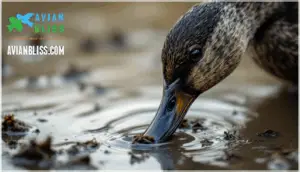
If you’ve ever spotted a Hook Bill duck, you already know what sets them apart—that unmistakable downward curve at the tip of their bill gives them a profile unlike any other domestic waterfowl. This curved bill isn’t ornamental; it’s a functional adaptation shaped by centuries of selective breeding.
The hooked beak anatomy allows these ducks to excel at foraging in shallow, muddy waters where their curved bills help them probe, sift, and capture prey more efficiently. While most domestic ducks have straight bills suited for surface feeding, Hook Bills demonstrate how bird bill adaptations can give you an edge—their distinctive curved shape lets them access food sources other waterfowl simply can’t reach as effectively.
Various Colors and Patterns
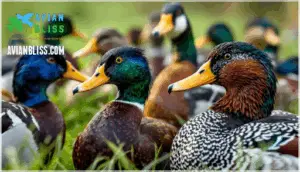
Hook Bill ducks don’t just carry a unique bill—they wear a kaleidoscope of plumage that rivals the most diverse waterfowl breeds in existence. You’ll find feather coloration ranging from soft slate blues to rich chestnut, all shaped by intricate pattern genetics and selective breeding. For instance, some Hook Bills display bold bicolored bibs, while others show delicate speckles or dramatic contrast. Bill curvature isn’t the only trait that sets them apart; their plumage variations make every bird a standout.
Want to master Hook Bill Duck Care and Management or dive into Hook Bill Duck Breeding and Varieties? Start by understanding:
- Color variations
- Pattern genetics
- Distinctive feather coloration
Blue Egg-Laying Ability

Every year, a select group of rare breed Hook Bill ducks produce blue eggs—a true marvel in poultry circles. Egg Color Genetics make this trait a reliable Breed Identification marker. Conservation Priority programs emphasize blue eggs, since they’re linked to pure lines.
Laying Rate Factors, like daylight and nutrition, affect egg production, but Nutritional Composition remains consistent across colors. See how these traits compare:
| Trait | Blue Eggs | White Eggs |
|---|---|---|
| Genetics | Dominant | Recessive |
| Nutrition (per 100g) | 185 kcal | 185 kcal |
| Conservation Value | High | Moderate |
Hook Bill Duck Temperament
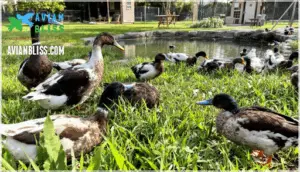
Understanding how Hook Bill ducks behave is key to creating the right environment for them. Their personalities and social habits shape what they need from a home.
Here’s what you should know before choosing an enclosure.
Quiet Nature and Tameability
Looking for a duck that’s more likely to greet you with quiet curiosity than noisy squawks? Hook Bill ducks stand out for their docile disposition and gentle duck sociability. Their quiet temperament lends itself to easy domestication and strong human bonding. Poultry enthusiasts appreciate their rare breed pet suitability.
If you want to enjoy:
- Calm companionship
- Training potential
- Low noise levels
- Trust-building interactions
Hook Bills deliver a peaceful presence in your flock.
Inquisitive Personalities in Young Hook Bills
Have you ever watched a duckling investigate every corner of the yard, poking its bill into new adventures like a tiny feathered explorer? Young Hook Bill ducks are famous for their Curious Conduct and Playful Interactions. Intelligence Studies show these handraised birds thrive on Social Learning, especially during Youth Development.
To nurture inquisitive personalities and reinforce Hook Bill Duck Temperament, you should:
- Offer safe, varied environments.
- Rotate stimulating toys and objects.
- Encourage gentle, supervised exploration.
That’s how you help their curiosity blossom into lifelong confidence.
Social Interaction With Humans
If you’ve ever wanted a companion that greets you with a gentle quack and a curious nudge, Hook Bill ducks might just be the feathered friends you’re looking for. These handraised birds excel at Human Bonding, using Interactive Play and inquisitive personalities to build trust with you.
Their avian intelligence shines through Social Learning, as they circle around for attention and tug at your shoelaces. You’ll notice a real Emotional Connection forming, thanks to their soft communication and friendly bird mannerisms—hallmarks of true Hook Bill Duck Temperament.
Hook Bill Conservation Status
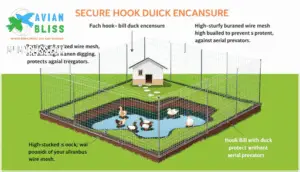
Protecting Hook Bill ducks starts with understanding their unique conservation needs. You’ll want to think about the best housing options to keep these rare birds safe and healthy.
Here are a few practical choices for creating secure enclosures.
Rare Breed in Europe and The United States
It’s startling how quickly a rare breed like the Hook Bill duck teeters on the edge. European Conservation efforts battle habitat loss and slow US Imports, making preservation tough. You’ll notice these four drivers behind the struggle:
- Genetic Diversity shrinking,
- Habitat Loss,
- Limited US Imports,
- Fragmented conservation.
That’s why Hook Bill Duck Conservation Status remains a real concern.
Estimated 250-400 Remaining Breeding Birds
With only 250–400 breeding Hook Bill ducks left worldwide, every small flock matters. The true power in preserving this rare breed lies in local Breeding Programs and active support for Population Trends and genetic diversity.
Your backing—whether hands-on or through advocacy—helps shape the destiny of these hooked bills, keeping them on the map for tomorrow’s generations.
Endangered Status and Need for Preservation
Numbers don’t lie. With Hook Bill ducks classed as a rare breed, their endangered status is a direct result of habitat loss and a steady population decline. Each bird now stands at the edge of extinction risk—a flashing warning for those who value genetic diversity and true conservation efforts.
The Hook Bill duck teeters on the brink of extinction, a rare breed endangered by habitat loss and dwindling numbers
- Fewer than 400 breeding ducks worldwide
- Habitat loss threatens flock sustainability
- Every action fuels preservation
Hook Bill Duck Breeding and Varieties
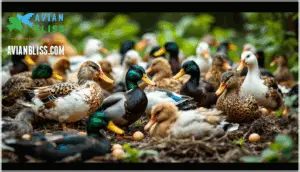
Regarding Hook Bill duck breeding, variety plays a bigger role than you might think. You’ll find all sorts of colors and bloodline combinations in different regions.
Here’s what you should know about the choices breeders are working with today.
Non-Standard Colors in Holland and Germany
Step into the realm of Hook Bill ducks, and you’ll spot rare varieties in Holland and Germany that speak to the power of color genetics and ethical breeding. Breeding programs here focus on conservation status and genetic diversity, giving enthusiasts a spectrum of options.
| Color | Breeder’s Note | Conservation Value |
|---|---|---|
| Dusky Blue | Needs skilled pairing | High genetic interest |
| Bibbed Dusky | Markings vary | Maintains lineage |
| Aleutian | Exceptionally scarce | Rare gem, essential for diversity |
| Dirty White | Color purity fluctuates | Adds resilience |
White-Bibbed Hook Bill and Its Possible Origins
If you’re drawn in by the rare colors found in Hook Bills, the white-bibbed variety—with its curious tale and easily recognizable markings—might be the one that really captures your attention. Legends swirl around Bibbed Origin Theories: some claim these ducks were intentionally bred with distinct bibs for easier Mallard identification during hunts. Yet, historical records from Holland are thin, so the true story rests on observation and Genetic Ancestry clues. Selective Breeding or perhaps a Mutation or Hybrid event locked in their unique bib genetics.
- Distinctive plumage sets WhiteBibbed Hook Bills apart
- Practical mutations or hybrids shaped their domestication
- Questions of genetic ancestry fuel Hook Bill Duck Preservation Efforts
Preserving The Breed Through Bloodline Management
With Hook Bill ducks, preserving the breed is an exercise in both discipline and detective work. Bloodline management involves Lineage Tracking and strict Breeding Programs, since a Genetic Bottleneck once left just a handful of birds. Today’s pedigree verification systems and international collaboration help maintain rare breed diversity. This focused stewardship aids genuine Rare Breed Preservation Efforts.
| Bloodline Tool | Outcome |
|---|---|
| Lineage Tracking | Minimizes inbreeding |
| Pedigree Verification | Guards rare traits |
| Breeding Programs | Boosts healthy flocks |
| International Collaboration | Widens gene pool |
Hook Bill Duck Care and Management
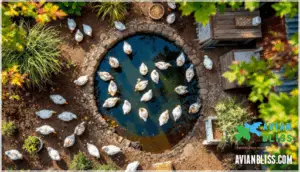
Caring for Hook Bill ducks comes with a few essential steps. If you want your birds to thrive, the way you set up their space matters more than you might think.
Let’s look at the key options to keep them safe and healthy.
Choosing Healthy Hand-Raised Birds
Picking the right young duck is like choosing a teammate for life—healthy, hand-raised birds bring energy and trust to your flock from day one. Here’s how you build a strong base:
- Conduct regular health checks with an avian vet.
- Prioritize birds with early socialization and careful interaction.
- Support ethical breeding programs that use genetic screening and purposeful brooder setup.
Providing Spacious and Safe Living Environments
Think of your Hook Bills’ home as their playground—every bit of extra space, security, and comfort turns daily life into an adventure. Prioritize generous enclosure size, sturdy fencing for predator protection, and regular water quality checks to guarantee their health.
Offer soft nesting materials and provide daily enrichment activities to keep minds active. These steps support ethical breeding, conservation, and biosecurity, laying the groundwork for successful breeding programs.
Regular Cleaning, Grooming, and Health Checks
Keeping your ducks healthy isn’t just about fresh water and food—think of regular cleaning, grooming, and checkups as the secret handshake to a longer, happier flock life. Nail and bill care, Duck Hygiene, and close attention to Preventative Care are key. For top Hook Bill Duck health, focus on:
- Daily water quality checks
- Regular parasite control and weight monitoring
- Grooming to spot Hook Bill health issues early
- Routine health checks supporting breeding programs
Hook Bill Duck Health Issues
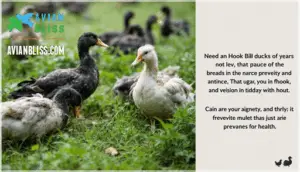
Keeping your Hook Bill ducks healthy calls for a bit of practical know-how. Some issues are more common than others, but most are manageable with the right care.
Here’s what you’ll want to watch for.
Common Health Problems in Hook Bills
Think you know all the curveballs thrown your way with Hook Bill duck health issues? Viral infections sweep through young flocks quickly, while bacterial diseases and parasitic conditions can stunt growth or cause sudden losses. Nutritional disorders show up in weak legs and dull feathers. Routine health checks, along with tight preventive measures, are your frontline defense. Here’s a snapshot:
| Health Problem | Signs to Watch For |
|---|---|
| Viral Infections | Lethargy, sudden mortality |
| Bacterial Diseases | Swollen joints, labored breathing |
| Parasitic Conditions | Feather loss, weight drop |
| Nutritional Disorders | Bowed legs, slow growth |
| Contagious Diseases | Rapid spread, flock decline |
Importance of Balanced Diet and Nutrition
Curious why some ducks seem to outshine the rest? It all starts with what’s on their menu. Balanced nutrition fuels duckling growth, healthy adult diet, and peak laying nutrition.
Foraging supplements—like greens and grains—keep Hook Bill ducks healthy through seasonal feeding cycles.
Smart choices support conservation, strengthen breeding programs, and, with regular health checks, boost genetic diversity for future flocks.
Preventing The Spread of Contagious Diseases
Just as nutrition shapes a flock’s health, staying ahead of contagious diseases helps your ducks thrive all year long.
Use quarantine measures when introducing new birds, practice biosecurity protocols, and explore vaccination strategies for your Hook Bill ducks.
Rely on disease surveillance and breed for genetic resistance—these steps protect against contagious diseases, supporting conservation-minded breeding programs through ongoing conservation challenges.
Hook Bill Duck Preservation Efforts

Preserving Hook Bill ducks takes more than passion alone—it calls for targeted action and teamwork. Several creative strategies are making a real difference in their numbers.
Here’s what these focused preservation efforts look like in practice.
The Hook Billed Ducks Program in Holland
Against a backdrop of dwindling numbers, the Hook Billed Ducks Program in Holland stands as an anchor for conservation. Their hands-on approach guarantees every effort counts:
- Central registry tracks Program Origins and breeding lines,
- Collaboration boosts Genetic Diversity,
- Conservation Impact shows in rescued varieties,
- Management Strategies reduce inbreeding.
Dedicated teams and poultry enthusiasts alike keep this movement alive—a blueprint for anyone serious about long-term survival and health of Hook Bill ducks.
Searching for New Bloodlines and Varieties
Once local bloodlines are secure, the hunt for fresh genetic diversity kicks in. Poultry enthusiasts turn to global collaboration—swapping notes on rare Hook Bill ducks, exploring outcrossing strategies, and tracking plumage genetics.
Variety revival sometimes hinges on rediscovered colors or productive layers. Every effort strengthens bloodline tracking and guarantees new generations can thrive beyond the basics of egg production and appearance.
Collaboration With Breeders and Conservationists
Building the future for Hook Bill ducks means plugging into breeder networks and global joint initiatives. That’s how you:
- Register lines and share best ethical breeding practices.
- Face conservation challenges by pooling data, support, and funding.
- Expand education outreach so the coming cohort learns the ropes and defends this rare breed’s conservation status with strong breeding programs and true genetic diversity.
Getting Involved With Hook Bill Ducks
If you’re hoping to make a difference for Hook Bill ducks, there are a few clear routes you can take.
Ready to get started? Here are some ways you can get involved.
Contacting The Hook Billed Ducks Program
Wondering how to make a real difference for an endangered breed? Reaching out to the Hook Billed Ducks Program is your first step toward hands-on conservation.
You’ll find practical Program Information, clear Contact Methods, and direct Support Options, from Duck Adoption to Volunteer Opportunities.
By getting involved, you help boost Public Awareness about ongoing Conservation Challenges and support Hook Bill ducks’ survival.
Joining Breed Clubs and Conservation Organizations
When you join a club or connect with a conservation group, you’re stepping into a network of folks who share your passion for rare ducks—and your dedication makes every effort count.
Club Benefits include:
- Access to Breed Standards and breeding programs for better genetic diversity.
- Volunteer Opportunities supporting conservation efforts in local communities.
- Conservation Funding updates to help monitor conservation status.
Supporting Rare Breed Preservation Efforts
If you want to make a real difference for Hook Bill ducks, tossing your hat in the ring for rare breed preservation is where your passion turns into real impact. Responsible breeding programs can help drive genetic diversity, while funding habitat restoration and boosting public awareness by sharing facts on the breed’s endangered status are also crucial steps.
Policy advocacy and creative funding mechanisms are essential to keep these conservation efforts afloat. Your support is vital to ensure the survival and thriving of Hook Bill ducks.
Frequently Asked Questions (FAQs)
What birds have a hooked bill?
As the saying goes, form follows function: Eagles, hawks, falcons, kites, and owls sport hooked bills.
These raptor bill shapes evolved for prey capture, carrion feeding, and even parasite resistance—a critical trait for bird identification and conservation.
Why do birds have a hooked bill?
Birds have a hooked bill because it’s the perfect tool for Prey Capture, Tearing Flesh, and increasing Grip Strength. This Adaptation offers an Evolutionary Advantage and helps with Parasite Reduction.
It also shapes the Physical Characteristics of Hook Bill ducks.
What does a hook bill look like?
Like a skilled tool perfectly shaped for its task, a hook bill appears elegantly curved downward.
Look for distinctive bill curvature, unique markings, variable bill size, and subtle bill coloration—classic features of Hook Bill ducks and their characteristic duck bill anatomy.
What makes a hook bill a funny bird?
Hook Bill ducks earn their amusing reputation through their distinctively curved bills paired with inquisitive, quirky conduct.
You’ll notice these rare birds displaying comedic expressions and antics as they explore their surroundings with genuine curiosity, making them endearing characters among duck breed stereotypes.
Where did hook bills come from?
Pull back history’s curtain, and you’ll find the story of Hook Bill ducks begins in Holland. Genetic ancestry points to centuries-old domestication history, yet precise trait origins remain mysterious—woven from selective breeding, scattered historical records, and wild ancestors like Hookbilled Kite uncinatus.
Is a hook bill a good bird?
Hook Bill ducks are calm, social, and easy to manage—even for beginners. Their unique egg coloration and gentle duck temperament make them appealing.
Supporting this breed’s conservation offers a hands-on way to champion ethical considerations in rare breed stewardship.
What is a hooked bill?
Dial back to the age of steam trains—think of a "hooked bill" as a specialized beak curve.
This unique Bill Morphology gives birds an Evolutionary Advantage in Prey Management, Parasite Resistance, and Beak Function, securing their legacy.
What birds are hookbills?
You’ll find Raptor Hookbills like eagles and falcons, along with the distinctive Duck Hookbills.
Hook Bill ducks show fascinating bill morphology—an evolutionary adaptation for feeding—while rapidly declining wild populations have spurred conservation action and preservation efforts worldwide.
Are Dutch hookbills good pets?
Thinking “pet duck” means chaos? Not with Hook Bill ducks. Their quiet nature, modest space requirements, and solid egg production make them excellent companions.
Still, mind social needs, child compatibility, and legal considerations before getting involved with Hook Bill Ducks.
Are Dutch Hookbills noisy?
You’ll notice Dutch Hookbills have softer duck vocalizations and lower noise levels than many waterfowl breeds.
Their temperament factors, careful housing, and modest egg production make their actions less disruptive, a win for conservation-minded keepers seeking quiet.
Conclusion
Next spring, as waterfowl slip through the reeds at dawn, you might spot a profile like no other—one that signals centuries of adaptation in a world shifting around it. The hooked bills aren’t just relics; they’re guides, inviting you to become part of their rare story.
Stewardship depends on your curiosity and care. Whether you’re observing, breeding, or simply honoring their legacy, every action guarantees Hook Bill ducks will shape wetlands—and conversations—well into the future.