This site is supported by our readers. We may earn a commission, at no cost to you, if you purchase through links.
 You won’t see the Hermit Thrush hopping around your backyard feeder, but walk quietly through a forest and you might spot one flipping leaves on the ground like a tiny gardener turning soil. This reddish-tailed songbird has mastered life in North America’s woodlands, where it forages with deliberate pauses and foot quivers that expose hidden insects beneath the leaf litter.
Despite skulking habits that keep it hidden from casual observers, the Hermit Thrush is surprisingly common—its population has grown by 35% since 1970. From its distinctive rust-colored tail to its haunting flute-like song that echoes through coniferous forests, this medium-sized thrush rewards patient observers with fascinating behaviors and identification challenges that separate it from its close relatives.
Table Of Contents
- Key Takeaways
- Hermit Thrush Identification and Appearance
- Habitat and Geographic Distribution
- Hermit Thrush Behavior and Diet
- Breeding, Nesting, and Life Cycle
- Conservation Status and Cultural Significance
- Frequently Asked Questions (FAQs)
- How does the hermit thrush reproduce and rear young?
- What are the seasonal adaptations of hermit thrushes?
- Are there any cultural significances of the hermit thrush?
- What legal protections exist for hermit thrushes?
- How do hermit thrushes interact with other species?
- What predators hunt Hermit Thrushes?
- How long do Hermit Thrushes live?
- Do Hermit Thrushes mate for life?
- Can Hermit Thrushes be kept as pets?
- What time of day are they most active?
- Conclusion
Key Takeaways
- The Hermit Thrush population has grown 35% since 1970 to roughly 70 million birds, though climate change threatens up to 73% of their summer breeding range by 2080 and some regional populations like Vermont’s montane thrushes have dropped over 77% since 2010.
- This thrush switches its diet dramatically between seasons, eating over 70% insects during spring and summer breeding months but shifting to 60-70% fruit and berries in fall and winter, which helps it survive across diverse habitats.
- The bird’s distinctive reddish-brown tail and unique foraging behavior—including hopping with pauses, leaf-flipping, and foot-quivering to expose hidden insects—make identification straightforward once you know what to look for on the forest floor.
- Its song uses harmonic ratios similar to human music (spanning frequencies from 1,545 to 7,925 Hz), earned it the nickname "Voice of the Wilderness," and inspired cultural works from Walt Whitman’s Lincoln elegy to Amy Beach’s piano compositions.
Hermit Thrush Identification and Appearance
Spotting a Hermit Thrush in the wild isn’t difficult once you know what to look for. This bird has a few key features that set it apart from other thrushes, making identification straightforward even for beginners.
Let’s break down the physical traits that’ll help you recognize this species with confidence.
Key Physical Characteristics
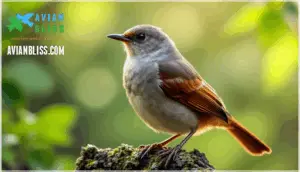
If you’re trying to pin down a hermit thrush in the field, start with body measurements and key markers. You’ll spot a medium-sized songbird, about 15–18 cm long with a wingspan near 29 cm, weighing roughly 18–37 grams. The rounded head shows a distinctive white eye ring and thin, straight bill. That reddish-brown tail stands out immediately, separating this species from similar thrushes and making hermit thrush identification straightforward once you know what plumage patterns to watch for.
They’re known to have gray-brown feathers covering their head, back, and wings.
Plumage, Coloration, and Size
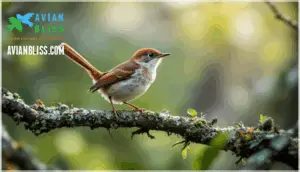
When you look closely at hermit thrush plumage, you’ll notice brown upperparts that shift into that signature reddish-brown tail. The whitish breast displays dark, smudged spots, while a thin white eye ring frames the face.
Adults undergo seasonal molting in late summer, replacing worn feathers with fresh plumage. Juvenile plumage shows heavier spotting across the back before maturing into smoother adult coloration, helping with hermit thrush identification year-round.
These birds are known to breed in the Trans-Pecos mountains.
Distinctive Reddish Tail
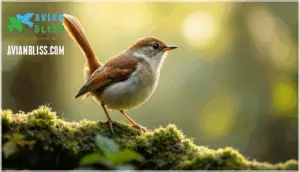
The reddish tail is your best identification cue when spotting this thrush. Higher pheomelanin concentrations create the distinctive chestnut hue that contrasts sharply with cooler brown upperparts, especially noticeable during the bird’s rhythmic tail-flick movement.
Juveniles show paler tail pigmentation until adult molt, while regional populations display slight color variations. This evolutionary role in species recognition makes tail color essential for hermit thrush identification, particularly when distinguishing it from similar thrush species.
Differences Between Sexes and Ages
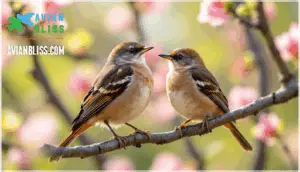
You’ll notice males and females look nearly identical, making sexing methods a real challenge. Here’s how you can determine age and sex:
- Check for brood patches or cloacal protuberances during breeding season for accurate sex determination
- Look for pale tips on wing coverts—present in juveniles, absent in adults
- Examine primary feather p10—shorter and tapered in older birds
- Observe molt patterns—juveniles show worn, spotted plumage before their first fall molt
- Measure tarsus length—males generally have slightly longer tarsi than females
Age determination relies on molt limits visible in wings, while plumage color remains consistent across both sexes.
Comparison to Similar Thrush Species
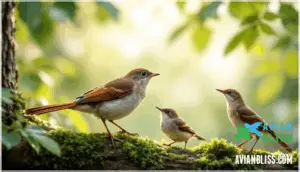
When comparing the Hermit Thrush to similar species like Swainson’s Thrush, Gray-cheeked Thrush, and Veery, you’ll want to focus on several key features. Plumage variability helps you distinguish them—the Hermit’s reddish tail contrasts with its duller back, while Swainson’s shows olive-brown tones overall.
Morphological measurements matter too, as Hermit Thrushes are smaller (12–13 cm) than Wood Thrushes. Behavioral differences include posture and migration timing, with Hermits wintering in the US unlike Gray-cheeked.
Acoustic distinctions and seasonal overlap during migration make identification challenging in May and September.
Habitat and Geographic Distribution

The Hermit Thrush doesn’t stay in one place year-round, and knowing where to find it depends on the season. This bird picks different habitats for breeding, migration, and winter, adapting to whatever environment offers the best food and shelter.
Let’s look at where you’re most likely to spot this thrush throughout the year.
Preferred Woodland and Forest Habitats
You’ll find Hermit Thrushes in coniferous and mixed forests dominated by spruce, fir, and pine across Canada and northern states. Their preferred woodland habitat includes moderate canopy cover with open understory and dense shrubs, creating ideal conditions for ground foraging.
During seasonal shifts, these birds move from high-elevation breeding forests to lower winter habitats with berry-producing vegetation, showing their ecological role as seed dispersers.
Breeding Range in North America
During the breeding season, you’ll encounter Hermit Thrushes across most of Canada and Alaska, with their breeding range extending through the Rockies to New Mexico and along the Appalachians from Newfoundland to Virginia. Breeding grounds span elevations from sea level to 2,470 meters, with population structure showing regional variations—northern states like Minnesota and Wisconsin support growing populations, while some western areas face localized declines.
Conservation needs focus on protecting boreal and montane forests, where habitat zonation determines breeding success. Range expansion continues southward into high-elevation Appalachian forests across North America.
Wintering Areas and Seasonal Movements
When winter arrives, Hermit Thrushes head south to the southern United States, Mexico, and Central America, with migration timing peaking in mid-October and return trips starting in mid-February. These migratory birds show considerable site fidelity, with some individuals returning to the same wintering grounds year after year.
- Range boundaries: Winter range extends from southern Massachusetts to southern Texas, including Guatemala and Oaxaca
- Migration timing: Fall migration peaks in mid-October, spring departure occurs February through early May
- Climate shifts: Warming trends have pushed winter ranges northward, with drying conditions affecting 67.7% of wintering grounds
You’ll find them defending small winter territories in deciduous woodlands and pine-oak forests.
Adaptability to Different Environments
You’ll be impressed by how adaptable Hermit Thrushes are across North America’s diverse landscapes. Their habitat range spans from sea level to 3,000 meters, covering boreal forests, mixed woodlands, and even suburban areas with good cover.
This flexibility in microhabitat use and climate adaptation sets them apart—they tolerate moderate forest fragmentation and human disturbance better than other forest thrushes.
Their resource dependence on berry-bearing shrubs and dense understory keeps them thriving across their range, though they prefer forest habitats with 60–80% canopy closure for best success.
Hermit Thrush Behavior and Diet
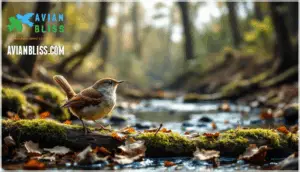
If you’re trying to understand what makes the Hermit Thrush tick, you’ll want to watch how it eats and moves through its world. The bird’s feeding habits shift dramatically with the seasons, and its foraging style is all its own.
Here’s what you need to know about its behavior and diet throughout the year.
Foraging Strategies and Feeding Habits
You’ll spot Hermit Thrush feeding behavior most often on the forest floor, where over 90% of their breeding season foraging happens. Their ground foraging technique combines short hops with patient pauses, scanning leaf litter for prey with striking precision.
Watch for these distinctive foraging behaviors and prey selection patterns:
- Hop and pause method: Quick bursts of movement followed by motionless scanning to detect insect movement beneath leaves
- Leaf flipping: Using their bills to turn over ground litter, a behavior seen in more than 80% of foraging bouts
- Foot quivering: Stirring leaves with their feet to expose hidden beetles, caterpillars, and ants
- Low shrub gleaning: Plucking insects and berries from branches below three meters, especially during migration
- Urban foraging: Visiting suburban parks with natural ground cover, comprising up to 15% of observations during travel periods
Habitat influence plays a key role in avian diet success. Dense, moist woodlands support 25% higher foraging efficiency than drier forests, thanks to greater invertebrate biomass and deeper leaf litter. During the breeding season, insect consumption dominates the Hermit Thrush diet, with caterpillars, beetles, and flies making up over 75% of invertebrate intake.
Seasonal Diet Changes: Insects and Berries
Your understanding of how the Hermit Thrush hunts for food becomes more complete when you examine seasonal changes in diet. During spring and summer breeding months, insects and arthropods make up over 70% of their intake, but this shifts dramatically to 60–70% fruit and berries in fall and winter. This dietary flexibility helps these birds maintain nutritional balance as temperatures drop and insect populations decline, showing impressive ecological implications for survival across diverse habitats.
| Season | Primary Food Source | Percentage of Diet |
|---|---|---|
| Spring/Summer (Apr–Aug) | Insects (beetles, ants, caterpillars, spiders) | 70%+ |
| Fall/Winter (Oct–Mar) | Berries (elderberries, pokeberries, serviceberries) | 60–70% |
| Late Winter/Early Spring | Mixed insects and remaining fruit | Variable by location |
| Migration Periods | Fruits for energy, insects when available | 50–50 depending on habitat |
| Year-round Preference | Insects (higher caloric efficiency) | Preferred when accessible |
Geographic variation affects this seasonal shift—birds in southeastern regions rely heavily on beautyberry, while western populations favor fruiting conifers.
Ground and Shrub Foraging Techniques
You’ll see Hermit Thrushes hopping across the ground, pausing to peer at leaf litter before striking at beetles or ants. They turn over leaves with their bills, and some use foot-quivering to flush insects from grass.
They also practice shrub-gleaning methods in low branches, hovering briefly to snatch prey.
This foraging diversity increases in mixed-species flocks during winter, when they switch between ground and shrubs as conditions change.
Migration Patterns and Timing
From late September through mid-October, you’ll notice Hermit Thrushes heading south along the Central and Mississippi Flyways, traveling mostly at night. They make stopovers lasting two to six days, refueling on fruits before continuing.
Spring migration starts in early April, when males return north to claim breeding territories. Climate change has shifted their range northward, and warmer springs now bring earlier arrivals on breeding grounds.
Breeding, Nesting, and Life Cycle
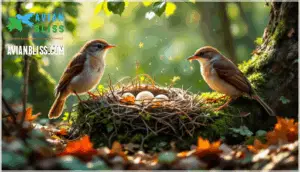
When spring arrives, male Hermit Thrushes return to their breeding grounds to stake out territory and begin the courtship process.
The breeding season involves careful nest building, egg incubation, and intensive parental care that shapes the coming cohort.
You’ll find that understanding these stages reveals how this species balances survival with reproduction across different regions.
Courtship and Territorial Behavior
When males return to breeding territories in early spring, they use song to announce ownership and attract females. Territorial behavior includes gaping, crest raising, and bill snapping—males defend 1–3 hectares against rivals.
Courtship displays feature aerial chases lasting 3–4 days, with circular flight patterns before pair bonding occurs. Female choice depends on territory quality and male displays, and pair bonds form after synchronized flights signal acceptance.
Nest Construction and Nest Site Selection
Once pair bonds form, females select nest sites and begin construction within 7–10 days, weaving grasses, leaves, lichens, and mud into cup-shaped structures measuring 10–15 cm across.
Regional preferences are evident: eastern birds nest on the ground under roots or ferns, while western populations favor small conifers 1–6 meters up for predation avoidance.
Site elevation and surrounding vegetation density help conceal nests from jays and squirrels, with construction timing aligning with late April foliage cover.
Egg Description and Incubation Period
You’ll find pale blue or greenish blue eggs in each nest, sometimes dotted with fine brown speckles, measuring roughly an inch long. The female takes care of egg incubation solo for about 12 days, rarely leaving her post in the protective nesting environment she’s chosen. Hatching success depends heavily on stable temperatures and minimal disturbance during this critical incubation period.
- Clutches generally hold 3–4 eggs, occasionally up to 6
- Egg coloration ranges from pale blue to blue-green with optional spotting
- Incubation duration averages 12 days, ranging 11–13 days total
- Only the female incubates, maintaining constant nest warmth
- Incubation starts after the final egg is laid
Parental Care and Fledgling Development
Once nestlings hatch, both parents share feeding duties, delivering high-protein insects like caterpillars and beetles dozens of times daily. The young fledge around 11–12 days old but aren’t independent yet—they’ll rely on parental care for roughly two more weeks while mastering flight and foraging.
Males also defend territory aggressively during this vulnerable period, using wing-flicking and alarm calls to protect their developing offspring from predators.
Brood Size and Number of Broods Per Year
You’ll generally see 3–4 eggs per clutch, though this varies by region—western populations lean toward 4, eastern ones slightly fewer. Breeding season spans May through August, allowing time for 1–2 broods per year in northern areas, occasionally 3 in the south.
Incubation takes 12–13 days, fledging another 10–12, meaning each brood cycle runs about 24–26 days. Fledging success varies widely, from 17% in Arizona to 37% east of the Rockies, shaped by predation, food availability, and habitat quality.
Conservation Status and Cultural Significance
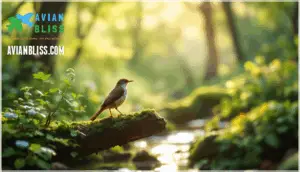
The Hermit Thrush isn’t just surviving—it’s thriving, with a healthy population of around 70 million birds across North America.
Beyond the numbers, this bird has earned a special place in our hearts and culture, thanks largely to its hauntingly beautiful song.
Let’s look at what keeps these birds secure and why they’ve captivated poets, musicians, and nature lovers for generations.
Population Trends and Threats
You’ll find that Hermit Thrush populations have grown by roughly 35% since 1970 across North America, reaching about 70 million breeding adults. However, regional declines tell a different story.
Climate change threatens up to 73% of their summer breeding range by 2080, while habitat fragmentation reduces nesting success near forest edges. Vermont’s montane populations have dropped over 77% since 2010.
Despite a "Least Concern" IUCN Red List conservation status, mortality factors like collisions and shifting ranges demand attention in conservation assessment and bird population trends monitoring.
Conservation Efforts and Habitat Protection
You can support Hermit Thrush conservation through strategic forest management and climate-focused habitat protection. Conservation efforts center on preserving mature forests with dense understories and berry-producing plants. Key initiatives include:
- Forest management maintaining mixed canopy cover above 60% with native understory
- Climate initiatives addressing northward range shifts through habitat complexity
- Community projects removing invasive species and restoring berry-bearing shrubs
- Monitoring programs tracking populations through Breeding Bird Surveys and citizen science
Public awareness campaigns reduce window collisions and promote bird-safe landscapes, strengthening wildlife conservation across North America.
The Hermit Thrush’s Iconic Song
You’ll recognize the Hermit Thrush song by its overtone-based structure, with pitches following harmonic ratios similar to human music—spanning frequencies from about 1,545 to 7,925 Hz. The bird produces these vocalizations through precise neural control rather than mechanical resonance, allowing voluntary pitch selection.
Regional variation exists: western populations sing at lower frequencies, while eastern birds produce higher-pitched songs.
This harmonic organization likely aids mate selection and has inspired over a century of cultural symbolism in poetry and music.
Importance in North American Ecosystems
Beyond its haunting song, you’ll find the Hermit Thrush plays an important role in forest ecology. Through seed dispersal, these birds move dogwood and pondberry seeds across the landscape, boosting germination rates and plant diversity.
During breeding season, their insect regulation helps control pest populations—reducing leaf litter arthropods by up to 30% in some habitats. As both predator and prey within the food web, they link multiple trophic levels while supporting ecological monitoring efforts that assess forest health and environmental impact across North American ecosystems.
Symbolic and Cultural Influence
The Hermit Thrush’s Literary Symbolism and Cultural Significance extend far beyond ecology. Walt Whitman immortalized this American Nightingale in his Lincoln elegy, while Indigenous Traditions celebrate its song as a messenger between worlds. Vermont named it their State Symbol in 1941, and composer Amy Beach captured its Musical Influence in piano works.
The Hermit Thrush has inspired poets like Walt Whitman, earned Vermont’s state bird title, and been celebrated in Indigenous traditions as a sacred messenger between worlds
- Native American legends link the bird’s vocalizations to humility and spiritual wisdom
- Its harmonic song structure actually aligns with human musical scales, earning it the title "Voice of the Wilderness"
- Spiritual Values of renewal and introspection remain central to its enduring cultural appeal
Frequently Asked Questions (FAQs)
How does the hermit thrush reproduce and rear young?
These songbirds mate between late April and August, with females building concealed cup nests from grasses, mosses, and twigs in dense understory.
You’ll find their pale blue eggs incubated for roughly 12 days, then both parents feed helpless hatchlings until fledging occurs around two weeks later.
What are the seasonal adaptations of hermit thrushes?
How do migratory birds like thrushes handle dramatic seasonal changes in behavior and diet? Hermit thrushes shift from eating insects during breeding to consuming berries in winter, change foraging locations from forest floors to shrubby thickets, and trigger migration through environmental cues like temperature and photoperiod, while building fat reserves for survival.
Are there any cultural significances of the hermit thrush?
You’ll find this songbird woven into American poetry, especially Walt Whitman’s Lincoln elegy, where its song symbolizes spiritual voice. Vermont named it their state bird in
Native legends, particularly Oneida traditions, celebrate its song as sacred Spirit music representing honesty and renewal.
What legal protections exist for hermit thrushes?
You benefit from strong federal laws in both the U.S. and Canada. The Migratory Bird Treaty Act protects hermit thrushes from hunting, capture, and habitat destruction, with violations bringing serious fines and penalties.
How do hermit thrushes interact with other species?
You’ll notice Hermit Thrush interactions span competition with Swainson’s Thrush for nesting sites, brood parasitism by cowbirds reaching 36%, seed dispersal for native plants, predation by avian predators like hawks, and diet overlaps with Yellow-rumped Warbler during berry season.
What predators hunt Hermit Thrushes?
Hawks and owls like Sharp-shinned Hawks and Barred Owls target adult Hermit Thrushes from above, while raccoons, snakes, and other mammals raid nests for eggs and nestlings, creating serious natural challenges for survival.
How long do Hermit Thrushes live?
You can expect your Hermit Thrush to live around 8 to 10 years in the wild, though some individuals reach 13 years. Survival rates vary dramatically—adult avian populations show roughly 43-49% annual survival, while fledglings face tougher odds at just 25%.
Migration impact, environmental threats, and other factors like collisions greatly affect the Hermit Thrush life cycle and overall population lifespan.
Do Hermit Thrushes mate for life?
Monogamous pairs form each breeding season, though true lifelong bonds remain uncertain. Males establish territories first, attracting females who often return to previous nesting sites.
This site fidelity suggests possible re-pairing with former mates across years, especially when environmental stress effects and reproductive success ties support stable pair bond duration throughout the avian breeding cycle.
Can Hermit Thrushes be kept as pets?
No, you can’t legally keep Hermit Thrushes as pets. Federal and state laws protect these avian species, prohibiting ownership without permits. Their complex habitat, diet, and nesting needs make captivity unethical and harmful to welfare.
What time of day are they most active?
You’ll catch Hermit Thrushes at their busiest during dawn and dusk, when their crepuscular activity peaks. Morning foraging begins around thirty minutes before sunrise, with vocal patterns intensifying through the dawn chorus.
Evening activity mirrors this pattern, extending until sunset, especially during breeding season when diet shifts seasonally between insects and berries.
Conclusion
Some birders claim the hermit thrush got its name from preferring solitude, but watch one during breeding season and you’ll see territorial disputes that contradict the "hermit" label. The truth is simpler: this bird just keeps to dense cover where most eyes won’t follow.
Your patience changes everything—stand still in coniferous forest and let the leaf litter reveal what hurried hikers miss. The hermit thrush rewards those who slow down with rust-tailed glimpses and flute songs that make woodland silence worth protecting.