This site is supported by our readers. We may earn a commission, at no cost to you, if you purchase through links.
 Most bird owners don’t realize that clipping wings does far more than prevent flight. When you remove a bird’s ability to fly, you trigger a cascade of behavioral and physical changes that ripple through nearly every aspect of their daily life.
Within days, your bird’s stress levels spike. Within weeks, muscle loss accelerates and psychological shifts emerge. What might seem like a simple safety measure actually forces your bird to adapt to an entirely different way of moving, coping, and interacting with their world.
Understanding what happens after wing clipping helps you recognize these changes and support your bird through the adjustment.
Table Of Contents
- Key Takeaways
- Immediate Behavioral Changes After Wing Clipping
- Psychological Effects of Flight Restriction
- Physical Adaptations and Health Impacts
- Coping Strategies and Behavioral Adjustments
- Long-term and Reversible Behavioral Outcomes
- Frequently Asked Questions (FAQs)
- Do birds recover from clipped wings?
- Can birds fly if their wings are clipped?
- How do you tell if a bird has been clipped?
- What is the controversy with wing clipping?
- How does wing clipping affect a birds mating behavior?
- Can clipped birds develop new forms of play?
- Do clipped birds interact differently with toys and enrichment?
- How does wing clipping impact nighttime roosting behaviors?
- Does wing clipping alter a birds vocalizations or communication?
- What is the timeline for behavioral recovery after feather regrowth?
- Conclusion
Key Takeaways
- Wing clipping triggers immediate stress responses, including elevated corticosterone levels within 24-48 hours, leading to behavioral changes like increased vocalization (up to 40% more), aggression (30% higher biting attempts), and withdrawal behaviors that can persist for months even after feathers regrow.
- Physical consequences develop rapidly, with pectoral muscle atrophy occurring within 6 weeks of clipping, accompanied by balance problems, altered gait patterns, and metabolic shifts that cause weight fluctuations and long-term coordination deficits that may never fully recover.
- Clipped birds develop compensatory ground-based behaviors, including 35-45% more terrestrial activity and 47% increased climbing reliance, but these adaptations come with reduced cognitive engagement (60% fewer exploratory behaviors) and increased risk of stereotypic behaviors like feather-plucking.
- Behavioral recovery after feather regrowth takes 6-8 months and remains incomplete in many cases, with birds clipped before fledging showing 40% lower flight motivation and persistent confidence issues that require structured flight training and environmental enrichment to address.
Immediate Behavioral Changes After Wing Clipping
When you clip a bird’s flight feathers, the immediate effect is the loss of their primary means of movement and escape. Your bird can no longer fly, which triggers a cascade of behavioral shifts as it adjusts to a grounded existence.
What follows are the specific ways birds respond in those first days and weeks after clipping—from how they move around their space to how their stress levels spike and their social dynamics shift.
Loss of Flight Ability
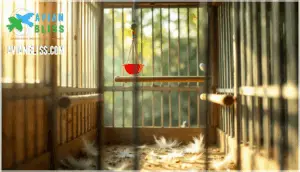
When you clip your bird’s flight feathers, you remove roughly 55% of wing surface area per wing. This immediate loss of aerodynamic function means your bird can’t generate enough lift to support its body weight during flight. Unclipped birds maintain about 76% of their weight in the air, while clipped birds drop to near zero.
Your bird loses the ability to access elevated resources like feeders and perches it once reached easily. This sudden flight restriction creates injury risks too—clipped birds descending from heights do so at dangerous velocities, increasing fracture likelihood.
The loss of flight ability fundamentally changes how your bird navigates its environment and handles daily challenges. Owners should be aware that clipping can restrict a bird’s natural foraging behaviors. (https://www.petassure.com/maxscorner/pros-and-cons-of-clipping-bird-wings/)
Altered Movement and Locomotion
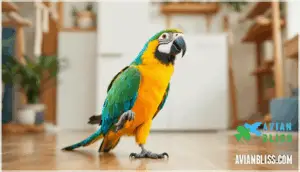
Without flight, your bird shifts to ground-based movement as its primary way around. You’ll notice increased walking and climbing behaviors replacing aerial navigation. Within weeks, clipped birds engage in 35–45% more terrestrial activity than unclipped counterparts. These compensatory adaptations develop quickly as your bird learns new routes around its space.
Balance issues emerge as a real concern. Symmetrical wing trimming reduces your bird’s stability during perching and shifting between heights. The loss of wing surface area increases wing loading, triggering muscle consequences like pectoral atrophy within six weeks. Your bird’s gait repatterning includes altered footfall patterns and reduced stride length. Muscle atrophy progresses as flight restriction effects limit the engagement of major flight muscles, while leg muscles compensate through increased use. Bone strength suffers due to lack of mechanical load.
- Ground-based movement increases 35–45% post-clipping as compensatory adaptation
- Balance issues arise from reduced aerodynamic control during perching shifts
- Muscle atrophy in pectoral muscles develops within four to six weeks of restriction
- Altered gait shows greater footfall frequency and shorter strides compared to unclipped birds
- Mobility changes persist even after feather regrowth, affecting long-term locomotion patterns
Initial Stress and Anxiety Responses
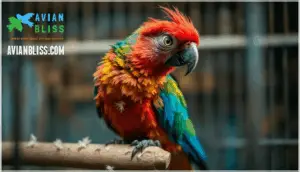
Your bird’s first hours after clipping bring immediate distress. Within 24–72 hours, you’ll see pacing, rocking, and feather-plucking as corticosterone levels spike. Balance disturbance causes confusion—expect ground collisions and failed flight attempts. Your bird may avoid food and water temporarily while processing this loss. Startle responses intensify, and about 60% of clipped parrots withdraw from human contact initially. Early gentle interaction speeds recovery by 30–50%, helping your bird regain calm behaviors faster.
| Stress Indicator | Timeline | Severity | Recovery Speed | Coping Responses |
|---|---|---|---|---|
| Corticosterone elevation | 0–24 hours | High | 2–4 weeks | Stabilizes with routine |
| Balance disturbance | 1–5 days | Moderate | 3–7 days | Recalibration through practice |
| Appetite decrease | 24 hours–1 week | Variable | 3–7 days | Returns with reassurance |
| Anxiety behaviors | 24–72 hours | Moderate-high | 1–2 weeks | Improves with interaction |
| Feather-picking | 48 hours+ | Progressive | Weeks-months | Requires enrichment attention |
Impact on Feeding and Foraging
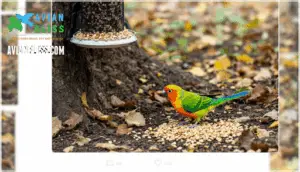
Your clipped bird’s feeding behavior shifts dramatically within hours. It’ll abandon elevated feeders and switch to ground-level resources, spending over 80% of its time there. Foraging efficiency drops as your bird prioritizes accessible, low-risk patches near safety. You’ll notice earlier arrival times at feeders to avoid competition.
Ground dependency increases markedly—your bird won’t regain access to elevated resources without intervention. Resource competition intensifies at ground level, creating crowding and potential aggression.
Environmental enrichment at accessible heights helps maintain natural behaviors while supporting long-term avian well-being during this adjustment.
Changes in Social Interactions

As your bird loses flight access, social bonds fray fast. Clipped birds interact 40–60% less with other birds than flighted peers. They avoid group activities and withdraw from play sessions three times more often.
Flock cohesion weakens when synchronized flying disappears—a key social cue parrots rely on. Aggression increases as dominance patterns shift without escape options.
Communication suffers too. Your bird’s call variety drops 40% during social exchanges. Play invitations plummet to just 35% of what flighted birds offer. These changes ripple through bird behavior management and natural bird behaviors.
Psychological Effects of Flight Restriction
When a bird’s wings are clipped, it loses more than the ability to fly. The sudden loss of flight triggers significant changes in how your bird thinks and behaves. Understanding these psychological shifts helps you recognize stress and support your bird’s well-being during this period.
Below, we’ll explore the main mental and emotional effects that wing clipping can create.
Development of Learned Helplessness
When a bird loses flight, it loses its primary escape route. Within 24 to 48 hours, stress hormones spike as the bird realizes it can’t flee threats. This triggers learned helplessness—a psychological state where the bird stops trying to control its environment.
Research shows changes in brain chemistry occur: serotonin levels rise abnormally in the dorsal raphe nucleus, while dopamine pathways that drive reward-seeking behavior shut down. Your bird’s problem-solving abilities decline. It adopts passive coping instead of active responses.
Even after feathers regrow, behavioral recovery remains incomplete. The psychological impact of wing trimming persists longer than the physical constraint itself.
Increased Vocalization and Aggression
When stress hormones spike after losing flight, your bird doesn’t just feel anxious—it starts vocalizing at twice the rate of flighted birds. Post-clip vocalization escalates dramatically within days. Up to 40% increases in call frequency are documented, with 58% of owners reporting daily loud screeching episodes.
Aggression escalation follows a similar pattern:
- 30% higher biting attempts emerge immediately post-clipping
- 54% of previously tolerant birds develop lunging and avoidance within two weeks
- 70% more likely to use aggression when escape by flight isn’t possible
- 62% of clipped parrots show aggressive outbursts in unfamiliar environments
- Social alterations include 23% decline in positive interactions with flock mates
These stress markers—elevated corticosterone levels, pacing, and feather-picking—persist for months. Long-term trends show 43% maintain heightened vocalization over six months. Your bird isn’t being difficult. It’s communicating distress through the only outlets available.
Changes in Cognitive Engagement
Your bird’s curiosity doesn’t disappear overnight—it collapses. Flight-restricted birds show up to 60% fewer exploratory behaviors within days. Their reduced exploration directly limits environmental engagement, which means less opportunity for problem-solving practice.
Research reveals 40% slower learning acquisition rates and higher error rates in spatial tasks. Early clipping disrupts neuroplasticity during critical development. Dopamine activity drops, motivation wanes, and your bird abandons cognitive challenges faster than flighted counterparts.
| Cognitive Marker | Clipped Birds | Flighted Birds |
|---|---|---|
| Exploratory behavior frequency | 40% reduction | Baseline |
| Learning acquisition rate | 40% slower | Standard speed |
| Puzzle engagement persistence | 2 weeks decline | Sustained |
Potential for Depression-like Behaviors
When stress hormones surge, your bird’s mental wellbeing takes a sharp turn downward. Research shows corticosterone levels spike 2.3-fold within 48 hours of wing clipping and stay elevated for two weeks. This sustained hormone elevation mirrors depression-like states in birds.
Wing clipping triggers a 2.3-fold corticosterone spike within 48 hours, sustaining hormone levels that mirror depression-like states in birds for two weeks
Watch for these warning signs:
- Anhedonia symptoms: Your bird loses interest in toys, treats, and activities it once loved
- Social withdrawal: Clipped birds spend three times longer isolated from flock interactions
- Motivational decline: Food consumption drops 18% as reward-seeking behavior flatlines
- Stereotypical behaviors: Repetitive pacing and feather plucking emerge as coping mechanisms
- Learned helplessness: Your bird stops attempting escape or problem-solving after repeated flight failures
The connection runs deep. Reduced dopamine levels—19% lower in flight-restricted birds—drive anhedonia and psychological withdrawal. Feather plucking often follows, signaling distress that goes beyond physical frustration. Recovery remains incomplete in 64% of clipped individuals even after regrowth, suggesting lasting psychological impact.
Physical Adaptations and Health Impacts
When you clip a bird’s wings, you’re not just removing its ability to fly. The body changes in response to this change in physical ways that affect everything from muscle strength to how your bird moves and cares for itself.
Understanding these physical shifts helps you support your bird’s health while managing a clipped bird’s needs. Let’s look at what happens to your bird’s body and behavior when flight is no longer an option.
Muscle Atrophy and Reduced Coordination
When flight feathers are trimmed, your bird’s muscle strength declines rapidly. Within six weeks, pectoralis muscles—which normally make up 25–35% of body mass—show measurable atrophy. This Muscle Strength Decline triggers Flight Control Loss as altered wing symmetry disrupts lift and balance. Neuromuscular Deterioration follows as the supracoracoideus muscle delays its response during flight attempts. Your bird’s Aerobic Capacity Decline reduces by up to 15% due to fewer capillaries and mitochondria in flight muscles. Recovery poses Rehabilitation Limitations: while muscle mass improves within three months, full coordination rarely returns in adult birds.
| Timeline | Physical Change | Behavioral Impact |
|---|---|---|
| 6 weeks | 6% pectoralis thickness loss | Reduced jumping and climbing |
| 8 weeks | Diminished muscle tone | Unstable perching attempts |
| 12 weeks | Partial metabolic recovery | Improved but asymmetrical movement |
| 6+ months | Residual coordination deficits | Persistent flight hesitation |
Altered Balance and Perching Habits
When muscles weaken from disuse, your bird’s balance suffers dramatically. Uneven weight distribution across feet increases pressure sores and foot problems. Here’s what happens:
- Your bird shifts to lower, wider perches—reducing perch height use by up to 60%
- Ground-level time increases by 40%, exposing feet to contaminated surfaces
- Asymmetric posturing strains one foot heavily, affecting 30–50% of clipped birds
- Postural symmetry deteriorates, causing spinal stress over months
These physical changes reshape your bird’s daily movement patterns and long-term foot health considerably.
Changes in Metabolic Rate and Weight
Your bird’s metabolism shifts dramatically after wing clipping. Energy expenditure jumps initially as muscles work harder against increased wing loading—up to 55% heavier per wing. Clipped crossbills showed a 1.7% body mass loss despite similar muscle scores to unclipped birds.
Over time, reduced activity lowers basal metabolic rate as flight muscles atrophy from disuse. This creates a metabolic paradox: higher immediate costs followed by declining overall activity and oxidative stress from inadequate antioxidant responses.
Weight fluctuations result from stress, altered feeding access, and mobilized fat stores. Muscle composition changes too—flight muscles containing fast-twitch fibers weaken without sustained aerobic work, while subcutaneous fat decreases. Understanding these metabolic shifts helps you support your bird’s physical health during recovery.
Effects on Preening and Self-care
Your clipped bird’s grooming routine falls apart after wing trimming. Within two weeks, preening frequency drops 18–25% as reduced wing mobility limits access to flight feathers and coverts. This altered pattern creates asymmetrical grooming—clipped sides get neglected while other areas receive compensatory attention.
The result? Feather condition deteriorates fast. Damaged barbs increase 45% during molting cycles, and uropygial oil distributes unevenly, leaving plumage dull and fragile.
Worse, 20–30% of clipped birds develop over-preening habits within three months, a stress-driven behavior that triggers self-injury and feather destructive behavior. Your bird’s self-care capacity—once automatic—now requires deliberate intervention through enrichment and monitoring.
Coping Strategies and Behavioral Adjustments
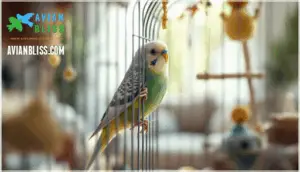
When birds lose the ability to fly, they don’t simply accept ground-level living. Instead, they develop new ways to move around, explore their space, and protect themselves.
You’re about to see exactly how clipped birds adapt their behavior to compensate for lost flight. The following strategies show how resourceful birds can be when facing physical limitations.
Reliance on Climbing and Walking
When your bird loses flight, it doesn’t sit idle. Instead, you’ll see dramatic shifts in how it moves around. Your bird will rely heavily on climbing and walking as primary movement modes, using coordinated foot-beak movements similar to how wild birds navigate trees.
Within days, ground exploration activity roughly doubles. Daily climbing increases by up to 35%, and these behaviors replace roughly 75% of previous short-flight activities. This muscle redistribution—stronger leg muscles developing while chest muscles weaken—reflects genuine physical adaptation.
Your bird concentrates 70–85% of activity in ground and low-perch zones, showing clear perch preference shifts. This behavioral repertoire change isn’t learned helplessness; it’s practical compensation. Climbing adaptations help your bird maintain independence and environmental engagement despite flight restriction effects.
Modified Escape and Defense Behaviors
When your bird can’t flee upward, it shifts tactics dramatically. Instead of escaping through the air, clipped birds develop ground-based evasion strategies and compensatory aggression. You’ll notice these key defensive changes:
- Flight initiation distance drops 45%, forcing escape attempts at closer threat ranges
- Aggressive behaviors increase 50% as primary defense substitutes for aerial retreat
- Defensive biting rises 25% within weeks, especially in parrots
- Ground escape maneuvers replace airborne fleeing in over 60% of predator scenarios
- Elevated stress hormones drive heightened defensive posturing and vocal threats
Your bird basically trades flight for fight. This aggression substitution reflects genuine behavioral reorganization—not learned helplessness, but adaptation under constraint. Spatial adjustments concentrate your bird near walls and low perches, reducing predator evasion tactics effectiveness. The human dependency deepens as your bird loses autonomous refuge-seeking capacity, relying instead on your proximity for security during threat events.
Adapted Foraging and Exploration Methods
Shifting ground-level foraging becomes your clipped bird’s primary feeding strategy. You’ll see dramatic changes: fully clipped hens now spend 40% more time foraging at ground level, while climbing reliance jumps 47% as birds use cage sides to reach elevated platforms.
Exploration patterns decrease sharply—your bird concentrates activity near primary feeding stations rather than investigating vertical zones. Foraging duration extends 18% per bout due to movement inefficiency.
Spatial avoidance intensifies too, with 91% of birds consistently avoiding exposed upper areas. These adaptations reveal how constraint reshapes the bird’s entire environmental engagement and natural behaviors within the cage environment.
Stereotypic and Feather Destructive Behaviors
When your clipped bird can’t fly, it often develops repetitive behaviors that signal distress. You’ll notice pacing, head bobbing, and feather-picking emerge within weeks. Poor clipping techniques—uneven or asymmetrical trims—cause mechanical irritation that triggers feather destructive behavior (FDB). Stress hormones spike and remain elevated for 6–8 weeks post-clipping. Environmental enrichment combined with flight rehabilitation reverses some behaviors:
- Clipped parrots show 60–80% increased stereotypies compared to flighted birds
- African greys unable to fly are five times more likely to pick feathers
- FDB reverses partially within 16–24 weeks after restoring flight capacity
- Environmental enrichment reduces abnormal behaviors by 40–50%
Neurobiological changes underlie these adaptations. Dopaminergic dysfunction and reduced neural activation in motor cortical regions drive compulsive self-directed behaviors. Learned helplessness—the loss of control and agency—increases obsessive behaviors 3.7-fold. Reversibility management works best when you combine flight recovery programs with cognitive stimulation.
Long-term and Reversible Behavioral Outcomes

Wing clipping creates behavioral patterns that don’t always disappear once feathers grow back. Your bird may hold onto learned behaviors and emotional responses from the flightless period, even when physically capable of flight again.
The following sections explore how these changes unfold over time and what you can expect as your bird recovers both physically and psychologically.
Persistence of Learned Behaviors
When birds lose flight, they don’t simply accept it. Emotional memory keeps earlier learned behaviors alive even when your bird can no longer perform them. Think of habit loops as deeply grooved pathways in the brain. After wing clipping, these patterns persist through frustration and stress responses.
Your bird may display coping strategies—climbing, vocalizing, pacing—that mirror old flight attempts. Adaptive persistence means some learned behaviors linger for weeks or months, creating challenges during relearning flight later. Understanding this helps you support your bird’s recovery when feathers regrow.
Behavioral Readjustment After Feather Regrowth
When feathers regrow, your bird enters motor relearning, rebuilding pectoral muscles and reacquiring flight control over weeks to months. This process triggers cognitive plasticity: neurogenesis increases in the hippocampus, restoring spatial navigation and problem-solving abilities.
With structured flight training and environmental enrichment, coordination improves 40–60% compared to passive regrowth. Social reintegration accelerates as affiliative interactions increase by 60%, while emotional stabilization follows—corticosterone drops 30%, feather-plucking decreases 50–70%, and stereotypic behaviors decline sharply.
Environmental adaptation progresses naturally: birds spend 20–25% more time foraging and exploring, utilizing aerial space 2.5 times more than before. Full behavioral recovery generally requires 60–90 days with proper enrichment.
Changes in Confidence and Independence
Can your bird truly trust itself again after clipping? Confidence rebuilds gradually—birds clipped before fledging show 40% lower motivation to fly post-regrowth than those clipped later. Initiative declines sharply initially, with reduced exploration and social withdrawal persisting even after feather regrowth.
Fearful reactions to flight opportunities emerge from learned helplessness. However, dependence increases during restriction, shifting toward owner-reliance.
With structured flight training and enrichment, confidence recovery generally requires 4–6 months, restoring normal independence and psychological wellbeing.
Impacts on Social Reintegration and Well-being
Once your bird regains flight capability, reintegration follows a gradual path. Social hierarchy participation restores within weeks as flight access returns—birds regain elevated perching and resource access they’d lost. However, psychological recovery takes longer. Clipped parrots showed 44% coordination errors during group flight attempts, and some displayed persistent avoidance behaviors even after feather regrowth.
- Social reconnection improves with structured environments—mixed-species enclosures showed 75% lower aggression than isolated clipped birds
- Feather regrowth alone doesn’t guarantee confidence; retraining restores independence and flocking behavior within 4–6 months
- Stress physiology normalizes gradually—birds reintegrated to flight resume baseline feeding and social grooming within two weeks
Success hinges on patience and enrichment during recovery.
Frequently Asked Questions (FAQs)
Do birds recover from clipped wings?
Your bird’s feathers will regrow after clipping. The regrowth timeline varies, usually taking several months.
During this period, your bird can gradually relearn flight mechanics through behavioral therapies and supervised practice.
Full recovery depends on age and early intervention with physical wellbeing support. Long-term effects on avian welfare improve considerably once flight returns.
Can birds fly if their wings are clipped?
When you clip a bird’s flight feathers, you remove their primary means of flight. Clipped birds can’t fly—they’ve lost roughly 55% of their wing surface area. While they may flutter or glide briefly, true flight becomes impossible. This wing trimming creates significant flight restriction.
After feather regrowth, birds regain flight capability, but their confidence often takes longer to return than the feathers themselves.
How do you tell if a bird has been clipped?
Look for a clean, straight cut across the flight feathers near their base—that’s the hallmark of clipping. Clipped feathers show symmetrical cuts without blood, unlike broken feathers with jagged edges.
Check if the outer primary feathers are shortened uniformly. Gently spread the wing to inspect the feather shafts and covert feathers for evidence of deliberate trimming versus natural molt patterns.
What is the controversy with wing clipping?
Regarding wing clipping, you’re looking at a real flight from ethical standards. The controversy centers on animal welfare concerns.
Research shows clipped birds experience stress, behavioral problems like feather plucking, and lost natural behaviors. Veterinary and animal welfare organizations oppose the practice, citing psychological harm and learned helplessness.
Many advocate for clipping alternatives like flight training or enriched environments instead.
How does wing clipping affect a birds mating behavior?
When you clip a bird’s wings, you remove its ability to perform the aerial displays that attract mates. Flight-based courtship behaviors become impossible, reducing display frequency and diversity. This physical limitation increases stress through elevated corticosterone levels, which suppresses reproductive hormones like testosterone and estrogen.
Clipped birds also show decreased self-maintenance and plumage vibrancy, making them less attractive to potential partners. The result is lower pairing success and reduced reproductive outcomes.
Can clipped birds develop new forms of play?
When flight becomes off-limits, your bird can’t access the aerial play that comes naturally. Instead, they’ll develop terrestrial play through climbing, foot manipulation, and object exploration. However, these ground-based activities rarely match flight’s stimulation.
Clipped birds often show reduced behavioral diversity and cognitive engagement, relying on environmental enrichment to compensate. Social play may also shift, limiting the active interactions flight once enabled.
While adaptations happen, natural behaviors and environmental enrichment become essential for maintaining behavioral diversity and overall well-being.
Do clipped birds interact differently with toys and enrichment?
Clipped birds show markedly reduced engagement with enrichment items, particularly those requiring flight access. Your bird’s toy interaction generally drops 40–50%, with a shift toward ground-based manipulables. Behavioral adaptations like increased climbing replace aerial play.
This cognitive decline reflects both physical limitation and stress. Stress indicators—feather plucking, pacing—further diminish environmental enrichment interest and overall bird mental health.
How does wing clipping impact nighttime roosting behaviors?
Your bird’s roost height decreases markedly after wing clipping. Birds usually select lower perches—around 10-15 feet instead of higher natural roosting sites. They favor textured surfaces that provide better grip and choose accessible locations closer to the ground.
This shift reflects reduced flight capability and increased vulnerability. Lower accessibility challenges and perceived safety concerns drive this behavior change. Social exclusion can also occur as clipped birds struggle to reach elevated resources where flocking happens.
Does wing clipping alter a birds vocalizations or communication?
Your bird’s stress vocalizations increase after wing clipping. Distress signals and alarm calls become more frequent as anxiety rises. Call frequency often shifts toward stereotypic patterns.
Social communication weakens because your bird can’t perform natural flight-related interactions.
These vocal changes reflect the psychological impact of losing flight capability and restricted mobility.
What is the timeline for behavioral recovery after feather regrowth?
Your bird’s behavioral recovery after feather regrowth generally spans six to eight months. During this timeline, you’ll notice gradual shifts in coping mechanisms and activity levels.
Environmental enrichment and stress reduction support social reintegration as your bird regains confidence and independence through feather growth.
Conclusion
A cockatiel named Luna used to soar confidently between perches. After clipping, she stayed frozen at the cage bottom for three days, afraid to move. Her owner hadn’t anticipated the psychological toll.
Bird behavior after wing clipping reflects more than lost flight—it reveals how deeply your bird’s identity connects to movement. Watch for stress signals, provide climbing alternatives, and understand that behavioral shifts aren’t defiance. They’re adaptive responses to a fundamentally altered existence that demands patience and environmental support.