This site is supported by our readers. We may earn a commission, at no cost to you, if you purchase through links.
 Picture an animal that kicks like a heavyweight boxer, sprints faster than a racehorse, and spots danger from two miles away. That’s your average Tuesday for an ostrich. These flightless giants dominate the African savanna with legs that pack enough force to kill a lion and a stride so long they cover 16 feet in a single bound.
But speed and power only scratch the surface of why ostriches are so fascinating. Their eyeballs outweigh their brains, they can survive weeks without water by metabolizing their own body fat, and males turn bright pink during mating season like oversized flamingos with anger issues.
From their bizarre parenting strategies to their surprising problem-solving abilities, ostriches challenge everything you thought you knew about bird behavior and survival.
Table Of Contents
- Key Takeaways
- Unique Physical Attributes
- Social Structure and Behavior
- Adaptations for Survival
- Intelligence and Problem-Solving
- Conservation Status and Threats
- Frequently Asked Questions (FAQs)
- How do ostriches care for their young?
- What is the lifespan of an ostrich?
- Do ostriches have any unique reproductive traits?
- How do ostriches communicate with each other?
- What is the diet of an ostrich?
- How long do ostriches live in the wild?
- What predators hunt adult ostriches most frequently?
- Can ostriches swim or cross water bodies?
- How do ostrich farms operate commercially today?
- What sounds do ostriches make when alarmed?
- Conclusion
Key Takeaways
- Ostriches combine extreme physical adaptations—70 km/h sprint speeds, 2,000-pound kick force, and eyes larger than their brains—with surprising intelligence like recognizing handlers for over 12 months and solving foraging puzzles, proving they’re way more than just fast, flightless birds.
- Their survival toolkit includes metabolic superpowers like converting body fat into water (producing 1.07 grams of water per gram of fat) and specialized kidneys that reduce water loss by 75%, letting them thrive for weeks in brutal desert conditions where most animals would die.
- Ostrich social structures reveal complex cooperative behaviors including communal nests with up to 60 eggs from multiple females, tag-team incubation shifts between males and females, and strategic egg placement where dominant hens position their eggs in prime center spots for 70% hatching success.
- Despite their remarkable adaptations, ostriches face serious modern threats—habitat loss has shrunk North African populations from 18 countries to just 4, climate change reduces egg production by 40% with just 5-degree temperature shifts, and conservation efforts like breeding programs and protected sanctuaries are now critical for their survival.
Unique Physical Attributes
When you picture an ostrich, you probably think of a tall, goofy-looking bird that can’t fly. But here’s the thing—their physical features are actually engineering marvels that help them survive in harsh African landscapes.
Let’s break down what makes these birds so uniquely built for their world.
Exceptional Height and Speed

When you think about nature’s speed demons, ostriches reign paramount among birds—towering up to 2.8 meters tall and blazing across African savannas at speeds reaching 70 kilometers per hour!
Here’s what makes their running biomechanics so astonishing:
- Record-breaking stride length: Each step covers up to 5 meters—that’s car-length territory
- Skeletal structure built for speed: Lightweight bones paired with powerful pelvic muscles create explosive muscle power
- Energy-efficient tendons: They recycle 25% of mechanical energy per stride, making them the fastest runners on two legs
- Double-suspension gallop: Both feet leave the ground simultaneously during their sprint
- Speed evolution advantage: Males weighing up to 156 kilograms still hit 45 mph, outpacing most predators
Their specialized limb design places heavy muscles near the hips while keeping lower legs light—minimizing inertia and maximizing pure, jaw-dropping speed! These birds are usually found in African savanna habitats, perfectly suited for their lifestyle.
Distinctive Legs and Feet

What makes an ostrich’s feet so mechanically remarkable? You’re looking at a didactyl foot—just two toes instead of the typical bird’s three or four. That massive third toe packs four phalanges and bears nearly all their weight during those 70 km/h sprints, while the smaller fourth toe stabilizes sideways movement.
Their leg anatomy features super-long tendons that act like elastic springs, storing and releasing energy with each stride—that’s elastic recoil in action! Ostriches are known as fastest long-distance runners, capable of impressive speeds.
This joint mobility at the metatarsophalangeal joint absorbs shock like a biological suspension system, giving ostriches a serious evolutionary advantage in running mechanics and making them nature’s quintessential two-legged speedsters.
Powerful Wings for Balance
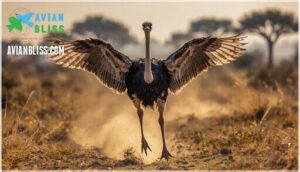
While those legs get all the glory, ostriches’ wings are secretly exceptional stabilizers! These powerful wings for balance act like air-rudders during high-speed runs, improving control by up to 15% through wing aerodynamics. Here’s how they work:
- Musculoskeletal mechanics generate torque for sharp turns
- Hindlimb coordination reduces joint stress by 12–20%
- Behavioral adaptations help them brake and pivot at 60+ km/h
These unique adaptations showcase amazing evolutionary insights—nature’s built-in gyroscopes!
Soft and Dull Feathers

You know how balancing wings help ostriches sprint? Well, their soft and dull feathers are equally genius—just in a sneakier way.
Feather structure matters here: those loose barbs without interlocking barbules create plush plumage that’s perfect for thermal regulation in scorching deserts. Feather pigmentation plays a camouflage role too—females sport dull brown-gray tones that blend into sandy landscapes, hiding them from predators. This evolutionary adaptation ditched rigid flight feathers for specialized feathers for insulation instead.
The economic importance of this unique feather evolution is huge, with premium plumes fetching up to $500 per kilogram in global markets!
Strong and Long Neck

Imagine this: an ostrich’s strong and long neck stretches up to 1.1 meters, housing 15 neck vertebrae that work like a biological crane. This anatomical marvel showcases remarkable neck flexibility—with sections bending up to 30° for ground-to-branch feeding range.
Here’s what makes ostrich physical attributes so impressive:
- Muscle function powers lightning-fast defensive strikes against predators
- Specialized cartilage between vertebrae facilitates scanning a 180° radius
- The feeding range spans 2–4 meters vertically without moving their feet
- Elastic ligaments minimize energy costs during 12+ hour foraging sessions
- Ecological implications include reduced competition through niche partitioning
You’re looking at ostrich anatomy that’s built for survival—this neck isn’t just long, it’s a multitool for eating, watching, and defending in harsh African landscapes.
Social Structure and Behavior
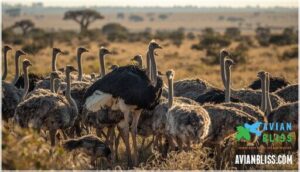
Ostriches aren’t loners—they’re social animals with surprising group dynamics. From nomadic herds to dominant males calling the shots, their social structure is anything but simple.
Let’s look at how these birds organize themselves, communicate, and work together to survive in the wild.
Nomadic Groups and Herds
You’ll find ostriches aren’t lone wanderers—they’re social creatures that form nomadic groups ranging from 5 to 50 birds, sometimes expanding to 100 during breeding season. This active group behavior creates fascinating herd mobility patterns:
- Nomadic patterns follow rainfall—herds chase seasonal vegetation across savannas and deserts, covering huge distances daily.
- Social hierarchy determines movement—the social structure includes dominant males organizing travel routes and rest stops.
- Species interactions boost survival—ostriches often team up with zebras and antelopes, creating mixed herds with better predator detection.
Group advantages are clear: collective vigilance drops from 35% for solo birds to just 14% in groups, letting everyone eat more and worry less!
Dominant Males and Female Hierarchy
Within ostrich herds, male dominance shapes everything from territory to survival. Dominant males control zones up to 15 square kilometers, defending their turf through dramatic wing-flapping displays and ritualized head-bobbing mating dances.
Female hierarchy matters just as much—the top hen strategically lays her eggs in the nest’s sweet spot, where nesting success rates soar above 70%. Meanwhile, subordinate females deposit eggs around the edges, facing 40% lower hatching odds.
In ostrich nests, dominant hens secure prime central spots with 70% hatching success while subordinate females risk 40% lower survival at the edges
This unique social structure creates fascinating social dynamics: males handle nighttime incubation duties using dark plumage for camouflage, while females take day shifts. These breeding roles boost survival through teamwork and strategic positioning!
Mating and Breeding Habits
When breeding season hits—March through September—male ostriches turn on the charm with dramatic courtship displays: vivid skin coloring, alternating wing flaps, and booming calls that echo across the savanna! These polygamous systems allow territorial males to attract harems of up to seven females for communal nesting.
You’ll witness unique mating rituals where synchronized feeding precedes copulation. During incubation, males guard nests at night while females take day shifts—though harsh reality strikes when fewer than 10% of nests survive the 35-to-45-day incubation period, and chick survival plummets to just 15% by age one.
Communication Methods
Ostriches rely on a rich vocal repertoire and visual displays to navigate their complex social structure and behavior—think of it as texting and video calling combined! Males boom loudly during courtship and territorial standoffs, producing calls that reach 97 decibels and travel over a kilometer across open terrain. Both sexes use hisses for alarm signals when predators approach, while chicks chirp persistently to stay connected with parents.
These vocalizations and body language work together during social interactions: males inflate their necks while booming, females coordinate soft grunts during nesting, and everyone watches for wing-flapping warnings that spell danger ahead!
Cooperative Incubation and Parenting
Regarding parental care, ostriches put most birds to shame with their tag-team approach! Cooperative incubation and parenting create impressive hatching success rates—up to 90% under stable conditions—thanks to smart group dynamics and predator defense strategies:
- Males incubate at night using dark plumage for camouflage while females take day shifts with their sandy-brown coloring
- Egg temperature stays perfect between 36.5°C and 37.0°C through alternating two-hour shifts that prevent cooling gaps
- Communal nests hold up to 50 eggs from multiple females, diluting predation risk while the dominant female’s center-placed eggs get prime protection
- Both parents rotate eggs regularly to prevent embryos from sticking to shell membranes, ensuring uniform development
- Protective of their hatchlings, adults coordinate vigilance and defense, creating parental bonds that boost chick survival and growth rates considerably
Adaptations for Survival

When you’re living in open savanna where danger lurks around every acacia tree, you need some serious survival tricks up your sleeve—or in this case, under your feathers. Ostriches have evolved a toolkit of adaptations that would make even the most sophisticated action hero jealous.
Let’s explore the five key adaptations that help these notable birds thrive in some of Africa’s harshest environments.
Excellent Eyesight and Vision
Ever wonder how you’d spot danger from miles away without binoculars? Ostriches master this skill with eyes nearly five centimeters wide—the largest of any land animal! Their remarkable eyesight provides razor-sharp visual acuity of about 19 cycles per degree, allowing them to scan the horizon for lurking predators. Each eye offers a monocular field of view of around 155°, while binocular vision covers 20° horizontally for close-range foraging. Retinal cell density peaks at 9,500 cells per square millimeter, and their color vision spans four cone types, detecting everything from ultraviolet to red. These optical adaptations make ostrich vision a survival superpower!
| Visual Feature | Measurement | Survival Benefit |
|---|---|---|
| Eye diameter | ~5 cm | Spot predators from 3.5 km away |
| Retinal ganglion cells | 2.27 million | Process detailed landscape images |
| Monocular field | 155° per eye | Nearly complete side surveillance |
| Peak retinal density | 9,500 cells/mm² | Sharp focus across wide terrain |
| Cone types | 4 (tetrachromatic) | Detect UV through visible spectrum |
Strong Sense of Hearing
While sharp vision helps ostriches scan the horizon, their ears tune into threats you might miss entirely. You’d be amazed by their auditory adaptations—the columella, a specialized ear bone measuring over 12 millimeters (the largest among birds!), acts like nature’s amplifier for sound conduction. This setup makes them incredibly sensitive to low frequencies between 0.3–4 kHz, perfect for predator detection across open savanna. Their hearing actually outperforms humans by up to 35 decibels in certain ranges! Here’s how these survival adaptations work:
- Columella Size: Maximizes sound transmission efficiency
- Low-Frequency Sensitivity: Detects distant rumbles and approaching danger
- Directional Hearing: Pinpoints threat locations without external ears
- Enhanced Alertness: Triggers immediate behavioral responses to environmental sounds
Powerful Legs for Kicking and Running
After tuning into their surroundings, you’ll appreciate how those powerful legs drive survival. Ostriches pack muscular legs built for two jobs: delivering devastating kicks and hitting amazing running speeds. Their muscular structure includes 36 major muscle groups that generate kicking force exceeding 2,000 pounds—enough to stop a lion cold!
Speed adaptations like long tendons create tendon elasticity, storing energy that boosts running economy by 50% compared to humans. Ostrich speed tops 45 mph, thanks to these biological springs.
| Feature | Survival Advantage |
|---|---|
| Hip Extensors | Propulsion and support during sprints |
| Ankle Extensors | High force production for kicks |
| Elastic Tendons | Energy-efficient running mechanics |
| Two-Toed Feet | Lethal striking weapons with claws |
Specialized Feathers for Insulation
Speed is just the start—those powerful legs also rely on plumage for survival. Feather airspace is essential because soft and dull feathers trap air, creating insulation layers up to 7 cm thick for thermal regulation. Climate adaptation shows when temperatures swing 40 °C daily!
Water resistance from natural oils protects the feathers during rain, maintaining steady body heat. Regular feather maintenance through dust baths keeps this system running smoothly.
Textile applications even mimic these properties, proving feather evolution delivered one of nature’s best insulators.
Ability to Convert Fat Into Water and Energy
When ostriches face the desert environment’s brutal conditions, their Ability to Convert Fat Into Water and Energy becomes a lifesaver. Through fat oxidation, they produce metabolic water—about 1.07 grams of water per gram of fat burned.
This arid adaptation is paired with impressive kidney function that reduces water loss by 75% during dehydration.
Combined with dietary sources like succulent plants, these unique adaptations allow energy conversion that keeps them thriving where others would perish!
Intelligence and Problem-Solving

You might think ostriches are just big, fast birds with tiny brains, but they’re actually pretty clever!
These feathered giants have surprising smarts when it comes to their surroundings and staying alive. Let’s look at some ways ostriches show off their intelligence and problem-solving abilities.
Complex Social Interactions
You’ll notice something striking when watching ostriches interact—they live within active groups where social hierarchy shapes every encounter. Males compete fiercely for dominance and mating rights, while females form social bonds through cooperative breeding, sharing incubation duties at communal nests.
These birds excel at individual recognition, distinguishing between familiar flock members and strangers through conflict resolution strategies. Their group dynamics constantly shift, balancing cooperation with competition as they navigate complex social structures together.
Ability to Solve Simple Problems
How smart are these giant birds regarding solving puzzles? Recent studies reveal that ostriches face some cognitive limitations—they struggled with rotary foraging tasks that emus breezed through, completing them at less than 10% success.
Their problem-solving behaviors are shaped by several factors:
- Brain size matters: their smaller brain-to-body ratio limits innovation potential
- Neophobia levels run high: they avoid new objects, delaying task attempts by 9+ minutes
- Task motivation needs a boost: they require triple the food incentive compared to relatives
Despite these challenges, their intelligence shines in foraging contexts—about 23% manipulate shrubs to access hidden seeds, showing they’ve got problem-solving skills when survival’s on the line!
Learning and Memory
Think your memory’s impressive? These towering birds can recognize individual handlers for over 12 months and remember feeding spots across territories spanning 150 km²! Their learning behavior relies heavily on Social Learning—juveniles boost foraging efficiency by 25% after watching older birds for just 10 days.
Sensory Integration supercharges their cognitive abilities: combining visual and auditory cues improves threat recognition by 18%. Environmental Influence matters too—enriched habitats boost cognitive test scores by 30-35%!
Here’s how their Memory Retention and Cognitive Flexibility stack up:
| Learning Aspect | Performance |
|---|---|
| Visual task retention | 6+ months without retraining |
| Spatial memory accuracy | 40% better with multi-sensory input |
| Social cue learning speed | 10 days for foraging mastery |
| Recognition memory duration | 12+ months for familiar individuals |
Their intelligence and problem-solving skills prove these birds are cognitive champions!
Tool Use and Manipulation
While crows master tools like pros, ostriches sit on the sidelines of avian innovation. Research in Cognitive Bird Studies shows they lack true tool use—their Motor Skill Limits and beak functionality favor pecking over precise grasping.
However, you’ll spot clever problem-solving skills during nesting:
- Repositioning eggs with their beaks for best temperature control
- Selecting specific stones and branches for Nesting Material Use across 3-meter nests
- Scratching through 10 cm of sand to uncover buried food
These behaviors reflect Evolutionary Pressures favoring strength over finesse—adaptation without artifact manipulation!
Innovative Foraging Strategies
You’ll witness striking ingenuity in ostrich foraging strategies! Ostriches cover 7.7–18.5 km daily in sparse habitats, spending about 35 minutes foraging with nearly 2,000 ground pecks. Recent studies reveal they solve rotary foraging puzzles in under 5 minutes—spinning wheels to reveal hidden food—demonstrating flexible cognition through social learning and motor repetition.
| Foraging Aspect | Behavior | Adaptation Benefit |
|---|---|---|
| Grit Consumption | Swallow stones (9% of feeding time) | Mechanical digestion aid |
| Fiber Fermentation | Hindgut microbes process 76% of energy needs | Survive on low-quality vegetation |
| Water Acquisition | Extract moisture from plants | Thrive without direct water access |
| Group Coordination | Forage in flocks (3–50 birds) | Shared vigilance, expanded range |
| Gender Patterns | Females forage 27% of time vs. males’ 12% | Efficient resource division |
This creative approach to ostrich diet and habitat showcases survival brilliance in arid environments!
Conservation Status and Threats

Despite their impressive survival skills, ostriches aren’t immune to modern threats. From disappearing habitats to changing climates, these notable birds face challenges that test their resilience in ways predators never could.
Let’s look at what’s putting pressure on ostrich populations and what’s being done to protect them.
Habitat Loss and Fragmentation
Over the last century, habitat loss and fragmentation have shrunk the North African ostrich’s range from 18 countries down to just 4. You’re looking at settlements, roads, and farms carving up wild spaces—cutting ostrich populations off from food, water, and each other. Here’s what’s driving this crisis:
- Agricultural expansion pushing ostriches into smaller, isolated patches
- Infrastructure development slicing through migration routes and nesting areas
- Livestock competition reducing available forage in shared landscapes
- Settlement encroachment forcing birds into fragmented, human-dominated zones
Population decline follows fast—densities in disturbed areas like West Kilimanjaro drop to 0.03 ostriches per km². Land use changes have left tens of thousands confined to farms instead of roaming free.
Recovery trends look promising, though: community conservancies in Kenya now provide habitat connectivity, and specialized breeding facilities support ostrich conservation through reintroduction programs. Conservation efforts are giving these birds a fighting chance against habitat degradation and fragmentation impacts.
Human-Wildlife Conflict
Beyond habitat fragmentation, human-wildlife conflict puts ostriches in direct competition with people. In Africa, 72% of communities report rising tensions as agricultural expansion and livestock operations push into ostrich territory. Habitat encroachment forces these birds onto farms, sparking property damage and ostrich attacks when cornered.
Mitigation methods like strategic fencing and community-led conservation strategies reduce clashes by 30% in test areas. Conservation efforts now focus on restoring grasslands and stakeholder education—giving ostriches space to roam while protecting rural livelihoods from wildlife impacts.
Poaching and Egg Collecting
Poaching hotspots across East Africa reveal a troubling reality for ostrich conservation. Illegal trade in feathers, meat, and ostrich eggs fuels population decline, especially after South Africa’s 2011 bird flu export ban slashed legal farming by 50%. Economic drivers push communities toward black markets where poachers pluck birds at night or raid nests for egg collecting—each egg weighs 1.5 kg and equals 24 chicken eggs! Conservation measures like community patrols and alternative income programs are fighting back:
- Feather plucking operations injuring birds for luxury markets
- Egg harvesting destroying breeding nests across Kenya
- Bush-meat trafficking near refugee camps like Dadaab
- Snare traps killing ostriches at watering holes
Climate Change and Drought
Climate change poses significant challenges for ostriches, creating a perfect storm of threats. When temperatures deviate just 5 degrees from the ideal 20°C, female ostriches lay 40% fewer eggs, a phenomenon wildlife biologists term temperature sensitivity. Droughts exacerbate these issues, with Kenya’s Amboseli region experiencing a population density decline of over 13 ostriches per area following the 2009 drought. During dry spells, ostriches congregate near water sources, temporarily setting aside their territorial instincts for survival. Their specialized kidneys, adept at water conservation, concentrate urine like biological recyclers, yet extreme heat still slashes breeding success by 44%.
Here’s the climate reality:
| Climate Threat | Impact on Ostriches | Population Response |
|---|---|---|
| Temperature fluctuations | 40% fewer eggs laid | Genetic resilience varies |
| Severe drought events | -13.44 density decline | Behavioral responses shift |
| Extreme heat (45°C) | 44% reproduction drop | Concentrate near water |
| Cold snaps (-5°C) | Sperm production falls | Genetic trade-offs emerge |
| Changing precipitation | Breeding disruption | Ancient adaptation tested |
Habitat loss further compounds these pressures. Twenty years of monitoring 1,300 South African ostriches revealed a troubling pattern: genes that enhance heat tolerance simultaneously weaken cold defenses. This genetic resilience gamble underscores the complexities of ostrich conservation today.
Conservation Efforts and Protection Programs
Around the globe, conservation efforts are racing to pull ostriches back from the brink. Programs like Niger’s breeding centers and Saudi Arabia’s reintroduction projects are turning the tide, combining habitat restoration with disease prevention protocols. Since 2007, the Sahara Conservation Fund has coordinated breeding programs across Chad and Niger, while funding initiatives from international zoos keep these efforts alive. Local involvement strengthens every project—Nigerien professionals now manage sites that once stood empty, proving conservation works best when communities lead the charge.
Key strategies saving ostriches today:
- Translocation magic: Chad received 63 ostrich chicks between 2020-2021, vaccinated against diseases and monitored with modern telemetry
- Artificial incubation breakthroughs: Morocco’s controlled breeding achieved 93% early survival rates, creating insurance populations against habitat loss
- Protected sanctuaries: Gadabeji Biosphere Reserve and similar zones provide safe havens where ostriches can breed without threats from poaching or human conflict
Frequently Asked Questions (FAQs)
How do ostriches care for their young?
Both parents take turns incubating eggs for about 42 days—males at night, females during the day.
After precocial chicks hatch, parents provide intense protection for two months, teaching foraging skills and shielding them from predators like hyenas and lions.
Parental vigilance extends up to a year, with cooperative defense strategies greatly boosting survival rates in communal groups.
What is the lifespan of an ostrich?
Wild longevity factors like predation impact and environmental effects keep ostriches surviving 30-40 years naturally, while captive lifespan advantages—protected food, zero predators, vet care—push maximum ostrich age past 50, with rare individuals hitting 70!
Do ostriches have any unique reproductive traits?
Yes, ostriches have some wild reproductive traits! Males are polygamous, mating with 3 to 5 females in their territory. Females lay up to 13 eggs each in communal nests—sometimes holding 60 eggs total! These are the largest eggs of any living bird, weighing around 3 pounds.
Both parents share incubation duties for about 42 days, with males sitting at night and females during the day. This biparental incubation and cooperative care boost chick survival in harsh environments!
How do ostriches communicate with each other?
Ostriches rely on booming calls—deep, lion-like sounds that carry several kilometers—to warn others of danger. These alarm signals work within 100 milliseconds!
Visual cues like neck stretching, hissing, and wing displays also communicate threats, territory, and attraction across their social structure.
What is the diet of an ostrich?
Ever wonder what fuels a bird that can outrun a lion? Your ostrich’s wild diet is a fascinating mix—about 60-70% plant-based meals like leaves, grasses, seeds, roots, and flowers, plus occasional insects and small vertebrates, making it a true omnivorous diet champion adaptable to harsh environments!
How long do ostriches live in the wild?
In the wild, these amazing birds generally make it to around 30 to 40 years. However, predation impact and habitat degradation can shorten their lifespan.
Climate effects and conservation success also play key roles in their survival.
What predators hunt adult ostriches most frequently?
You might think massive birds like ostriches have few natural enemies, but that’s not quite the case.
Lions lead the pack in predator defense battles, using teamwork for ambush tactics. Cheetah tactics rely on pure speed, while hyena opportunism and wild dog packs employ persistence. Leopard attacks target vulnerable adults less frequently.
Can ostriches swim or cross water bodies?
While flightless birds like ostriches can paddle with their legs to stay afloat briefly, they’re not built for swimming. Their habitat limitations and water aversion mean they stick to shallow wading—aquatic locomotion isn’t their thing, and ostrich buoyancy adaptations for survival favor speed on land.
How do ostrich farms operate commercially today?
Ostrich farms operate commercially today by raising birds for meat production, leather markets, feather trade, and egg sales.
Global distribution spans South Africa to China, where ostrich farming practices balance profitability with ethical treatment of ostriches despite ongoing debates about ostrich exploitation.
What sounds do ostriches make when alarmed?
When alarmed, ostriches produce booming calls, hissing, snorting, and guttural sounds, with alarm call loudness reaching 70 decibels.
Their syrinx sound production creates rapid notes that coordinate flock response coordination, triggering alarm calls that travel kilometers across open terrain.
Conclusion
They can sprint past predators. They can kick with bone-crushing force. They can thrive in scorching heat where water’s scarce. Ostriches master survival through a toolkit most animals only dream of having.
Now you know why ostriches are so fascinating—they’ve turned physical extremes, social complexity, and environmental adaptation into an art form. These flightless giants don’t just survive the savanna; they’ve rewritten the rulebook on what birds can do when evolution pushes them beyond the sky.
- https://www.ebsco.com/research-starters/zoology/ostriches-and-related-birds
- https://www.ifaw.org/animals/ostriches
- https://nationalzoo.si.edu/animals/ostrich
- https://animaldiversity.org/accounts/Struthio_camelus/
- https://agriculture.vic.gov.au/biosecurity/pest-animals/exotic-pest-animal-species/birds/ostrich